With your partner: Develop your own definition of “culture” Create a visual to go along with your definition What is “culture”? Music
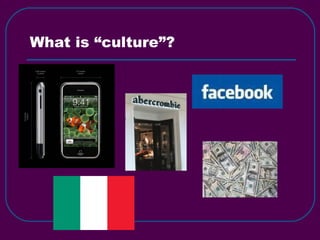
What is “culture”?
CULTURE A people’s total way of life Everything an individual has  learned  and will pass on to future generations Influences personality and behavior
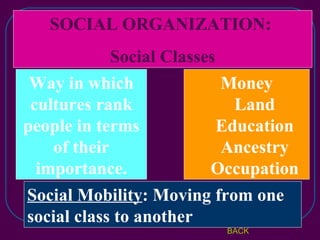
SOCIAL ORGANIZATION:  Social Classes Way in which cultures rank people in terms of their importance. Social Mobility : Moving from one social class to another Money Land Education Ancestry Occupation BACK
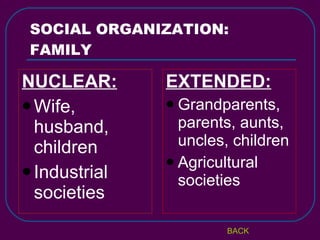
SOCIAL ORGANIZATION: FAMILY NUCLEAR: Wife, husband, children Industrial societies EXTENDED: Grandparents, parents, aunts, uncles, children Agricultural societies BACK
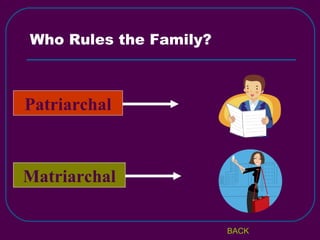
Who Rules the Family? Matriarchal Patriarchal BACK
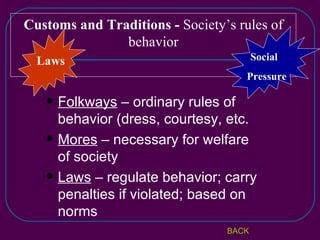
Customs and Traditions -  Society’s rules of behavior Laws Social  Pressure BACK Folkways  – ordinary rules of behavior (dress, courtesy, etc. Mores  – necessary for welfare of society Laws  – regulate behavior; carry penalties if violated; based on norms
Language Positive: The cornerstone of culture Means of communication IDENTITY Negative: Creates a great deal of tension as countries attempt to develop a unified culture BACK
Arts & Literature Teach about a particular culture Used to pass along values Strengthen IDENTITY BACK
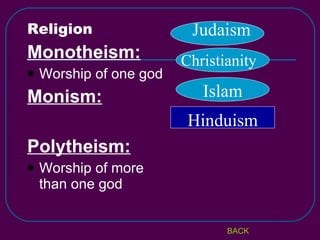
Religion Monotheism: Worship of one god Monism: Polytheism: Worship of more than one god Christianity Hinduism Judaism Islam BACK
Governments Person/People who hold power in a society Provide for the common need: Keep order Protect society from outside threats Society’s laws and political institutions
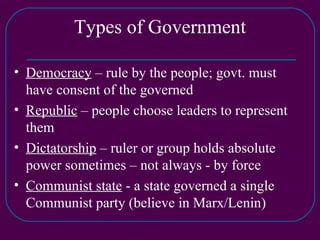
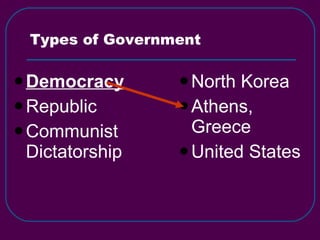
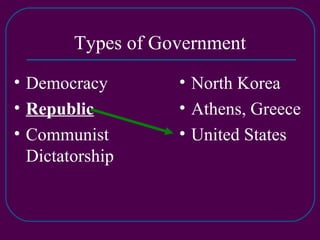
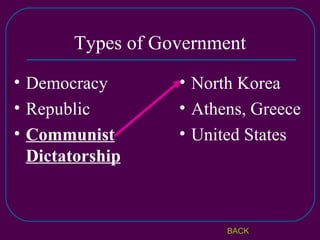
Types of Government Democracy  – rule by the people; govt. must have consent of the governed Republic  – people choose leaders to represent them Dictatorship  – ruler or group holds absolute power sometimes – not always - by force Communist state  - a state governed a single Communist party (believe in Marx/Lenin)
Types of Government Democracy Republic Communist Dictatorship North Korea Athens, Greece United States
Types of Government Democracy Republic Communist Dictatorship North Korea Athens, Greece United States BACK
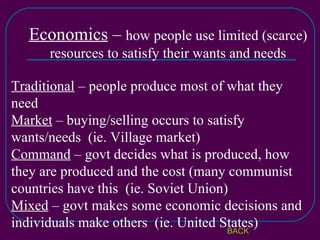
Economics  –  how people use limited (scarce) resources to satisfy their wants and needs Traditional  – people produce most of what they need Market  – buying/selling occurs to satisfy wants/needs  (ie. Village market) Command  – govt decides what is produced, how they are produced and the cost (many communist countries have this  (ie. Soviet Union) Mixed  – govt makes some economic decisions and individuals make others  (ie. United States) BACK
UNDERSTANDING OTHER CULTURES Why is it so difficult?
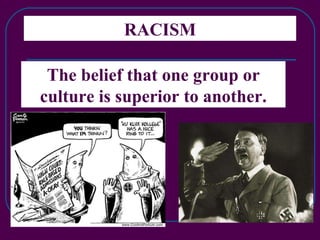
RACISM The belief that one group or culture is superior to another.
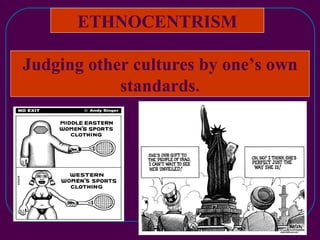
ETHNOCENTRISM Judging other cultures by one’s own standards.
What does society need? Appreciation of  CULTURAL DIVERSITY
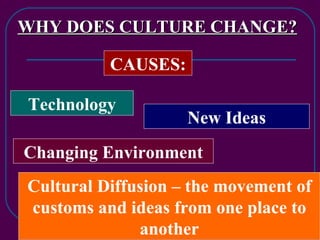
WHY DOES CULTURE CHANGE? CAUSES: Technology Changing Environment New Ideas Cultural Diffusion – the movement of customs and ideas from one place to another
“ How can anyone govern a nation that has two hundred and forty-six different kinds of cheese?" — Charles de Gaulle (1890-1970), French general, president. Quoted in: Newsweek (New York, 1 Oct. 1962)
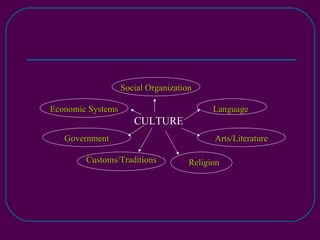
Social Organization CULTURE Economic Systems Government Customs/Traditions Religion Language Arts/Literature

What is Culture

  • 1.
    With your partner:Develop your own definition of “culture” Create a visual to go along with your definition What is “culture”? Music
  • 2.
  • 3.
    CULTURE A people’stotal way of life Everything an individual has learned and will pass on to future generations Influences personality and behavior
  • 4.
    SOCIAL ORGANIZATION: Social Classes Way in which cultures rank people in terms of their importance. Social Mobility : Moving from one social class to another Money Land Education Ancestry Occupation BACK
  • 5.
    SOCIAL ORGANIZATION: FAMILYNUCLEAR: Wife, husband, children Industrial societies EXTENDED: Grandparents, parents, aunts, uncles, children Agricultural societies BACK
  • 6.
    Who Rules theFamily? Matriarchal Patriarchal BACK
  • 7.
    Customs and Traditions- Society’s rules of behavior Laws Social Pressure BACK Folkways – ordinary rules of behavior (dress, courtesy, etc. Mores – necessary for welfare of society Laws – regulate behavior; carry penalties if violated; based on norms
  • 8.
    Language Positive: Thecornerstone of culture Means of communication IDENTITY Negative: Creates a great deal of tension as countries attempt to develop a unified culture BACK
  • 9.
    Arts & LiteratureTeach about a particular culture Used to pass along values Strengthen IDENTITY BACK
  • 10.
    Religion Monotheism: Worshipof one god Monism: Polytheism: Worship of more than one god Christianity Hinduism Judaism Islam BACK
  • 11.
    Governments Person/People whohold power in a society Provide for the common need: Keep order Protect society from outside threats Society’s laws and political institutions
  • 12.
    Types of GovernmentDemocracy – rule by the people; govt. must have consent of the governed Republic – people choose leaders to represent them Dictatorship – ruler or group holds absolute power sometimes – not always - by force Communist state - a state governed a single Communist party (believe in Marx/Lenin)
  • 13.
    Types of GovernmentDemocracy Republic Communist Dictatorship North Korea Athens, Greece United States
  • 14.
    Types of GovernmentDemocracy Republic Communist Dictatorship North Korea Athens, Greece United States
  • 15.
    Types of GovernmentDemocracy Republic Communist Dictatorship North Korea Athens, Greece United States BACK
  • 16.
    Economics – how people use limited (scarce) resources to satisfy their wants and needs Traditional – people produce most of what they need Market – buying/selling occurs to satisfy wants/needs (ie. Village market) Command – govt decides what is produced, how they are produced and the cost (many communist countries have this (ie. Soviet Union) Mixed – govt makes some economic decisions and individuals make others (ie. United States) BACK
  • 17.
    UNDERSTANDING OTHER CULTURESWhy is it so difficult?
  • 18.
    RACISM The beliefthat one group or culture is superior to another.
  • 19.
    ETHNOCENTRISM Judging othercultures by one’s own standards.
  • 20.
    What does societyneed? Appreciation of CULTURAL DIVERSITY
  • 21.
    WHY DOES CULTURECHANGE? CAUSES: Technology Changing Environment New Ideas Cultural Diffusion – the movement of customs and ideas from one place to another
  • 22.
    “ How cananyone govern a nation that has two hundred and forty-six different kinds of cheese?" — Charles de Gaulle (1890-1970), French general, president. Quoted in: Newsweek (New York, 1 Oct. 1962)
  • 23.
    Social Organization CULTUREEconomic Systems Government Customs/Traditions Religion Language Arts/Literature