What is Climate Change?
Section I
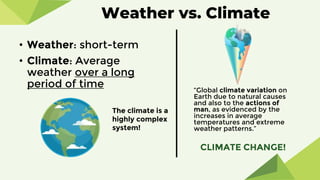
• Weather: short-term
• Climate: Average
weather over a long
period of time “Global climate variation on
Earth due to natural causes
and also to the actions of
man, as evidenced by the
increases in average
temperatures and extreme
weather patterns.”
The climate is a
highly complex
system!
CLIMATE CHANGE!
Weather vs. Climate
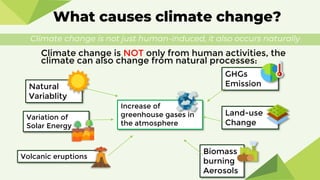
Increase of
greenhouse gases in
the atmosphere
Volcanic eruptions
Variation of
Solar Energy
Natural
Variablity
Climate change is NOT only from human activities, the
climate can also change from natural processes:
Climate change is not just human-induced, it also occurs naturally
What causes climate change?
GHGs
Emission
Land-use
Change
Biomass
burning
Aerosols
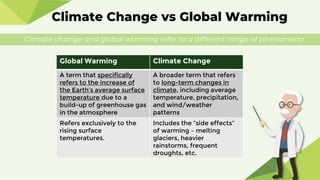
Climate change and global warming refer to a different range of phenomena
Climate Change vs Global Warming
Global Warming Climate Change
A term that specifically
refers to the increase of
the Earth’s average surface
temperature due to a
build-up of greenhouse gas
in the atmosphere
A broader term that refers
to long-term changes in
climate, including average
temperature, precipitation,
and wind/weather
patterns
Refers exclusively to the
rising surface
temperatures.
Includes the “side effects”
of warming – melting
glaciers, heavier
rainstorms, frequent
droughts, etc.
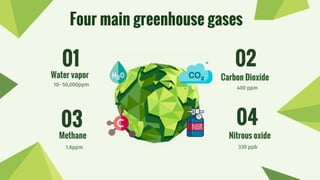
Four main greenhouse gases
01
Water vapor
10- 50,000ppm
02
Carbon Dioxide
400 ppm
03
Methane
1.8ppm
04
Nitrous oxide
330 ppb
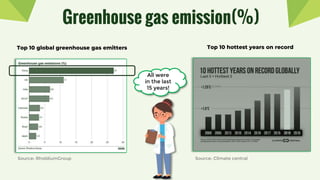
Greenhouse gas emission(%)
All were
in the last
15 years!
Top 10 global greenhouse gas emitters Top 10 hottest years on record
Source: RholdiumGroup Source: Climate central
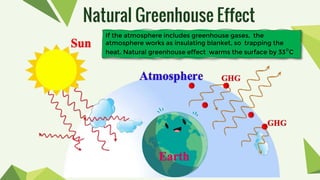
Natural Greenhouse Effect
If the atmosphere includes greenhouse gases, the
atmosphere works as insulating blanket, so trapping the
heat. Natural greenhouse effect warms the surface by 33°C
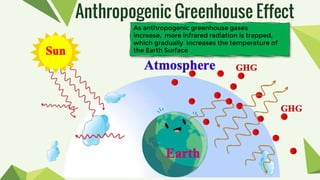
As anthropogenic greenhouse gases
increase, more infrared radiation is trapped,
which gradually increases the temperature of
the Earth Surface
Anthropogenic Greenhouse Effect
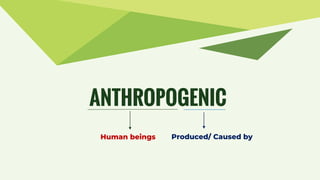
ANTHROPOGENIC
Human beings Produced/ Caused by
Climate in global mean temperature
Source: [WG1AR5/Figure
SPM.1]
Anthropogenic Impact
With Anthropogenic GHGs Without Anthropogenic GHGs
Source: [WG1AR5/Figure TS.9]
 There is significant anthropogenic warming over the past 50 years
 It is “extremely likely” that human influence has been the dominant cause
of observed warming since the mid 20th century.
Assessment of Risks from Extreme
Events
Source: [WG2AR5/Figure SPM.1]
Where is the hottest location in the world?
Spatial distribution of the maximum temperature climatology
Does the region characterized by the highest maximum temperature coincide with
the region where the people suffer from the worst heat stress Source: [WG2AR5/Figure SPM.1]
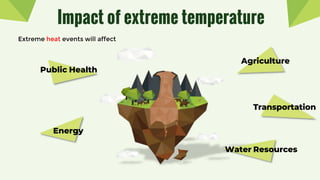
Impact of extreme temperature
Extreme heat events will affect
Agriculture
Public Health
Energy
Transportation
Water Resources
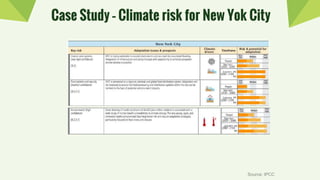
Case Study – Climate risk for New Yok City
Source: IPCC
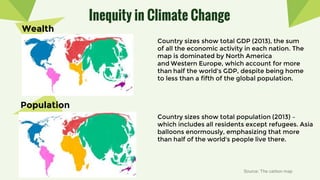
Inequity in Climate Change
Population
Country sizes show total population (2013) –
which includes all residents except refugees. Asia
balloons enormously, emphasizing that more
than half of the world's people live there.
Country sizes show total GDP (2013), the sum
of all the economic activity in each nation. The
map is dominated by North America
and Western Europe, which account for more
than half the world's GDP, despite being home
to less than a fifth of the global population.
Wealth
Source: The carbon map
Inequity in Climate Change
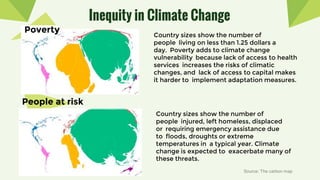
People at risk
Poverty
Country sizes show the number of
people injured, left homeless, displaced
or requiring emergency assistance due
to floods, droughts or extreme
temperatures in a typical year. Climate
change is expected to exacerbate many of
these threats.
Country sizes show the number of
people living on less than 1.25 dollars a
day. Poverty adds to climate change
vulnerability because lack of access to health
services increases the risks of climatic
changes, and lack of access to capital makes
it harder to implement adaptation measures.
Source: The carbon map

What is climate change

  • 1.
    What is ClimateChange? Section I
  • 2.
    • Weather: short-term •Climate: Average weather over a long period of time “Global climate variation on Earth due to natural causes and also to the actions of man, as evidenced by the increases in average temperatures and extreme weather patterns.” The climate is a highly complex system! CLIMATE CHANGE! Weather vs. Climate
  • 3.
    Increase of greenhouse gasesin the atmosphere Volcanic eruptions Variation of Solar Energy Natural Variablity Climate change is NOT only from human activities, the climate can also change from natural processes: Climate change is not just human-induced, it also occurs naturally What causes climate change? GHGs Emission Land-use Change Biomass burning Aerosols
  • 4.
    Climate change andglobal warming refer to a different range of phenomena Climate Change vs Global Warming Global Warming Climate Change A term that specifically refers to the increase of the Earth’s average surface temperature due to a build-up of greenhouse gas in the atmosphere A broader term that refers to long-term changes in climate, including average temperature, precipitation, and wind/weather patterns Refers exclusively to the rising surface temperatures. Includes the “side effects” of warming – melting glaciers, heavier rainstorms, frequent droughts, etc.
  • 5.
    Four main greenhousegases 01 Water vapor 10- 50,000ppm 02 Carbon Dioxide 400 ppm 03 Methane 1.8ppm 04 Nitrous oxide 330 ppb
  • 6.
    Greenhouse gas emission(%) Allwere in the last 15 years! Top 10 global greenhouse gas emitters Top 10 hottest years on record Source: RholdiumGroup Source: Climate central
  • 7.
    Natural Greenhouse Effect Ifthe atmosphere includes greenhouse gases, the atmosphere works as insulating blanket, so trapping the heat. Natural greenhouse effect warms the surface by 33°C
  • 8.
    As anthropogenic greenhousegases increase, more infrared radiation is trapped, which gradually increases the temperature of the Earth Surface Anthropogenic Greenhouse Effect
  • 9.
  • 10.
    Climate in globalmean temperature Source: [WG1AR5/Figure SPM.1]
  • 11.
    Anthropogenic Impact With AnthropogenicGHGs Without Anthropogenic GHGs Source: [WG1AR5/Figure TS.9]  There is significant anthropogenic warming over the past 50 years  It is “extremely likely” that human influence has been the dominant cause of observed warming since the mid 20th century.
  • 12.
    Assessment of Risksfrom Extreme Events Source: [WG2AR5/Figure SPM.1]
  • 13.
    Where is thehottest location in the world? Spatial distribution of the maximum temperature climatology Does the region characterized by the highest maximum temperature coincide with the region where the people suffer from the worst heat stress Source: [WG2AR5/Figure SPM.1]
  • 14.
    Impact of extremetemperature Extreme heat events will affect Agriculture Public Health Energy Transportation Water Resources
  • 15.
    Case Study –Climate risk for New Yok City Source: IPCC
  • 16.
    Inequity in ClimateChange Population Country sizes show total population (2013) – which includes all residents except refugees. Asia balloons enormously, emphasizing that more than half of the world's people live there. Country sizes show total GDP (2013), the sum of all the economic activity in each nation. The map is dominated by North America and Western Europe, which account for more than half the world's GDP, despite being home to less than a fifth of the global population. Wealth Source: The carbon map
  • 17.
    Inequity in ClimateChange People at risk Poverty Country sizes show the number of people injured, left homeless, displaced or requiring emergency assistance due to floods, droughts or extreme temperatures in a typical year. Climate change is expected to exacerbate many of these threats. Country sizes show the number of people living on less than 1.25 dollars a day. Poverty adds to climate change vulnerability because lack of access to health services increases the risks of climatic changes, and lack of access to capital makes it harder to implement adaptation measures. Source: The carbon map

Editor's Notes

  • #11 https://www.ipcc.ch/site/assets/uploads/2018/02/WG1AR5_SPM_FINAL.pdf 
  • #12 https://www.ipcc.ch/site/assets/uploads/2018/02/WG1AR5_SPM_FINAL.pdf  
  • #13 https://www.ipcc.ch/site/assets/uploads/2018/02/WG1AR5_SPM_FINAL.pdf   
  • #14 https://www.ipcc.ch/site/assets/uploads/2018/02/WG1AR5_SPM_FINAL.pdf   
  • #17 https://www.carbonmap.org/#intro
  • #18 https://www.carbonmap.org/#intro