Course Overview
1.What is Permaculture?
2.The Ethics of Permaculture
3.The 12 Principles of Permaculture
4.Permaculture Zones
5.Soil and Land Preparation
6.Making Compost: 18 Day Hot Method
7.Mulch
8.Companion Planting
What is Permaculture?
Perma-culture is a term coined by university
Professor Bill Mollison and his student, David
Holmgren, to describe a system of design that they
put together from observing the ways of nature, as
well as the intelligent community-centred, subsistence
and food growing ways of indigenous people around
the world.
The term was taken from the words ‘Permanens’ and
‘Agriculture’ and/or ‘culture’ – meaning: a
persistent design system that creates permanent
food systems, and therefore permanent society
and community structures for the existence of
humans in harmony with nature.
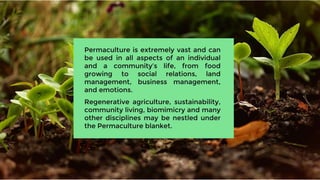
Permaculture is extremely vast and can be used in all
aspects of an individual and a community’s life, from
food growing to social relations, land management,
business management, and emotions.
Regenerative agriculture, sustainability, community
living, biomimicry and many other disciplines may be
nestled under the Permaculture blanket.
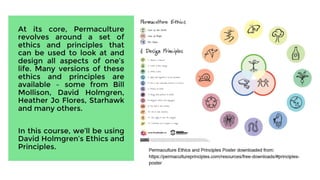
At its core, Permaculture revolves
around a set of ethics and principles
that can be used to look at and design
all aspects of one’s life. Many versions
of these ethics and principles are
available – some from Bill Mollison,
David Holmgren, Heather Jo Flores,
Starhawk and many others.
In this course, we’ll be using David
Holmgren’s Ethics and Principles.
Permaculture Ethics and Principles Poster downloaded from:
https://permacultureprinciples.com/resources/free-downloads/#principles-
poster

What is permaculture

  • 2.
    Course Overview 1.What isPermaculture? 2.The Ethics of Permaculture 3.The 12 Principles of Permaculture 4.Permaculture Zones 5.Soil and Land Preparation 6.Making Compost: 18 Day Hot Method 7.Mulch 8.Companion Planting
  • 3.
    What is Permaculture? Perma-cultureis a term coined by university Professor Bill Mollison and his student, David Holmgren, to describe a system of design that they put together from observing the ways of nature, as well as the intelligent community-centred, subsistence and food growing ways of indigenous people around the world. The term was taken from the words ‘Permanens’ and ‘Agriculture’ and/or ‘culture’ – meaning: a persistent design system that creates permanent food systems, and therefore permanent society and community structures for the existence of humans in harmony with nature.
  • 4.
    Permaculture is extremelyvast and can be used in all aspects of an individual and a community’s life, from food growing to social relations, land management, business management, and emotions. Regenerative agriculture, sustainability, community living, biomimicry and many other disciplines may be nestled under the Permaculture blanket.
  • 5.
    At its core,Permaculture revolves around a set of ethics and principles that can be used to look at and design all aspects of one’s life. Many versions of these ethics and principles are available – some from Bill Mollison, David Holmgren, Heather Jo Flores, Starhawk and many others. In this course, we’ll be using David Holmgren’s Ethics and Principles. Permaculture Ethics and Principles Poster downloaded from: https://permacultureprinciples.com/resources/free-downloads/#principles- poster