GOBAL WARMING
INTRODUCTION
Global warming is the long-term heating of Earth’s climate system observed since the
pre-industrial period (between 1850 and 1900) due to human activities, primarily fossil
fuel burning, which increases heat-trapping greenhouse gas levels in Earth’s atmosphere.
The term is frequently used interchangeably with the term climate change, though the
latter refers to both human- and naturally produced warming and the effects it has on
our planet. It is most commonly measured as the average increase in Earth’s global
surface temperature. Since the pre-industrial period, human activities are estimated to
have increased Earth’s global average temperature by about 1 degree Celsius (1.8
degrees Fahrenheit), a number that is currently increasing by 0.2 degrees Celsius (0.36
degrees Fahrenheit) per decade. It is unequivocal that human influence has warmed the
atmosphere, ocean, and land.
What is Climate Change?
Climate change is a long-term change in the average weather patterns that have come to define Earth’s local,
regional and global climates. These changes have a broad range of observed effects that are synonymous with the
term.Changes observed in Earth’s climate since the early 20th century are primarily driven by human activities,
particularly fossil fuel burning, which increases heat-trapping greenhouse gas levels in Earth’s atmosphere, raising
Earth’s average surface temperature. These human-produced temperature increases are commonly referred to as
global warming. Natural processes can also contribute to climate change, including internal variability (e.g., cyclical
ocean patterns like El Niño, La Niña and the Pacific Decadal Oscillation) and external forcings (e.g., volcanic activity,
changes in the Sun’s energy output, variations in Earth’s orbit).Scientists use observations from the ground, air and
space, along with theoretical models, to monitor and study past, present and future climate change. Climate data
records provide evidence of climate change key indicators, such as global land and ocean temperature increases;
rising sea levels; ice loss at Earth’s poles and in mountain glaciers; frequency and severity changes in extreme
weather such as hurricanes, heatwaves, wildfires, droughts, floods and precipitation; and cloud and vegetation
cover changes, to name but a few.
GLOBAL WARMING VERSUS CLIMATE CHANGE
Global Warming
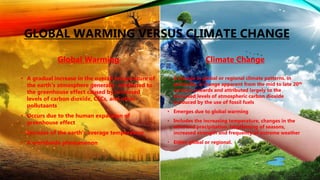
• A gradual increase in the overall temperature of
the earth’s atmosphere generally attributed to
the greenhouse effect caused by increased
levels of carbon dioxide, CFCs, and other
pollutaants
• Occurs due to the human expansion of
greenhouse effect
• Increase of the earth’s average temperature
• A worldwide phenomenon
Climate Change
• A change in global or regional climate patterns, in
particular, a change apparent from the mid to late 20th
century onwards and attributed largely to the
increased levels of atmospheric carbon dioxide
produced by the use of fossil fuels
• Emerges due to global warming
• Includes the increasing temperature, changes in the
wind and precipitation, lengthening of seasons,
increased strength and frequency of extreme weather
• Either global or regional.
CONCLUSION
Global warming could not be solve easily if people are
not very well practice in lowering carbon emission, law
and regulation’s implementation and effective forests and
agriculture management. The solutions for this issue will
be more effective when individuals change their lifestyles.
Individuals can contributes to reduce the changes in the
global climate through changing their habits. We must
try our best to solve the problem and strive as much as
possible to reinstate our earth for sake of future
generation.

Gobal warming ppt

  • 1.
  • 2.
    INTRODUCTION Global warming isthe long-term heating of Earth’s climate system observed since the pre-industrial period (between 1850 and 1900) due to human activities, primarily fossil fuel burning, which increases heat-trapping greenhouse gas levels in Earth’s atmosphere. The term is frequently used interchangeably with the term climate change, though the latter refers to both human- and naturally produced warming and the effects it has on our planet. It is most commonly measured as the average increase in Earth’s global surface temperature. Since the pre-industrial period, human activities are estimated to have increased Earth’s global average temperature by about 1 degree Celsius (1.8 degrees Fahrenheit), a number that is currently increasing by 0.2 degrees Celsius (0.36 degrees Fahrenheit) per decade. It is unequivocal that human influence has warmed the atmosphere, ocean, and land.
  • 3.
    What is ClimateChange? Climate change is a long-term change in the average weather patterns that have come to define Earth’s local, regional and global climates. These changes have a broad range of observed effects that are synonymous with the term.Changes observed in Earth’s climate since the early 20th century are primarily driven by human activities, particularly fossil fuel burning, which increases heat-trapping greenhouse gas levels in Earth’s atmosphere, raising Earth’s average surface temperature. These human-produced temperature increases are commonly referred to as global warming. Natural processes can also contribute to climate change, including internal variability (e.g., cyclical ocean patterns like El Niño, La Niña and the Pacific Decadal Oscillation) and external forcings (e.g., volcanic activity, changes in the Sun’s energy output, variations in Earth’s orbit).Scientists use observations from the ground, air and space, along with theoretical models, to monitor and study past, present and future climate change. Climate data records provide evidence of climate change key indicators, such as global land and ocean temperature increases; rising sea levels; ice loss at Earth’s poles and in mountain glaciers; frequency and severity changes in extreme weather such as hurricanes, heatwaves, wildfires, droughts, floods and precipitation; and cloud and vegetation cover changes, to name but a few.
  • 4.
    GLOBAL WARMING VERSUSCLIMATE CHANGE Global Warming • A gradual increase in the overall temperature of the earth’s atmosphere generally attributed to the greenhouse effect caused by increased levels of carbon dioxide, CFCs, and other pollutaants • Occurs due to the human expansion of greenhouse effect • Increase of the earth’s average temperature • A worldwide phenomenon Climate Change • A change in global or regional climate patterns, in particular, a change apparent from the mid to late 20th century onwards and attributed largely to the increased levels of atmospheric carbon dioxide produced by the use of fossil fuels • Emerges due to global warming • Includes the increasing temperature, changes in the wind and precipitation, lengthening of seasons, increased strength and frequency of extreme weather • Either global or regional.
  • 5.
    CONCLUSION Global warming couldnot be solve easily if people are not very well practice in lowering carbon emission, law and regulation’s implementation and effective forests and agriculture management. The solutions for this issue will be more effective when individuals change their lifestyles. Individuals can contributes to reduce the changes in the global climate through changing their habits. We must try our best to solve the problem and strive as much as possible to reinstate our earth for sake of future generation.