Helia Salamat
Parsian
Ostomy
What is an Ostomy?
A stoma (or ostomy, these 2 words mean the
same thing) is a surgically created opening on
the abdomen which allows stool or urine to exit
the body. There are 3 main types of stoma –
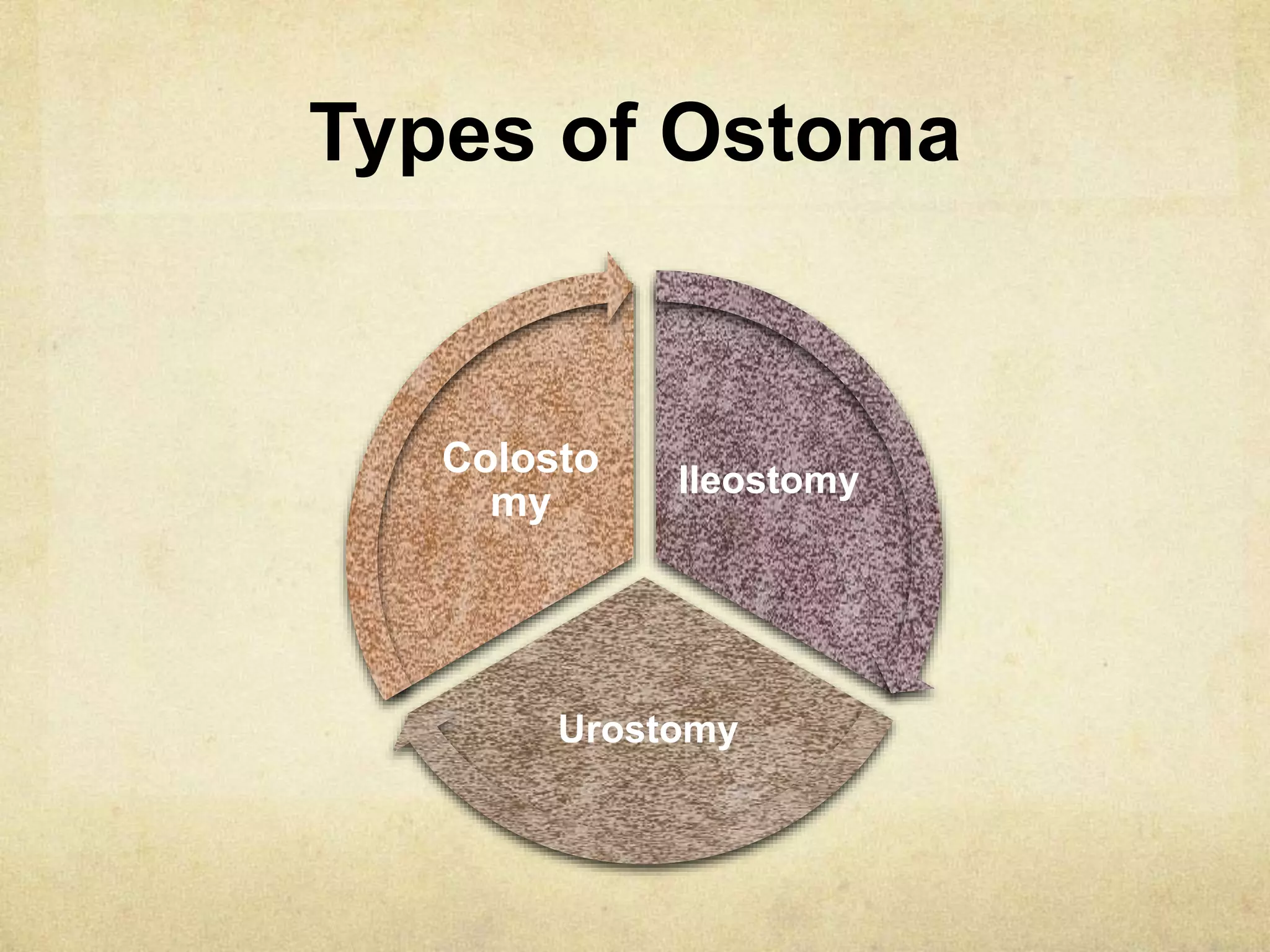
colostomy, ileostomy and urostomy
Generally, your stoma will be pink and moist (like
the inside of your mouth) and a little swollen after
your operation. This will reduce over a period of
between six to eight weeks. There are no nerves
in your stoma so there will not be any sensation
when you touch it. Everyone’s stoma is different
in shape and size.
Types of Ostoma
Ileostomy
Urostomy
Colosto
my
Colostomy
Colostomy is the term used to
describe an opening from the
large intestine (colon). The
surgeon will bring a part of
the colon from inside your
body, through the abdomen to
the outside and stitch it down
to secure it. Normally this will
be on the left side of your
abdomen.
Ileostomy
Ileostomy is the term used to
describe an opening from the
small intestine, specifically
the ileum. The surgeon will
bring a part of the small
bowel from inside your body
to the surface where it will be
stitched down to secure it.
Normally this will be on the
right hand side of your
abdomen.
Urostomy
A urostomy is made by taking a
piece of your small intestine and
attaching it to your ureters to
create a channel for urine to
pass through. One end of the
tube is brought out through the
abdomen to create a urostomy.
Depending on your operation
sometimes the bladder is
removed, but this will be
discussed with you prior to your
operation. Urostomies are
normally on the right hand side
of your abdomen and will have a
little spout to allow the urine to
exit the body.
Types of pouching
systems
Pouching systems may include a one-piece or
two-piece system. Both kinds include a skin
barrier/wafer ("faceplate" in older terminology)
and a collection pouch. The pouch (one-piece or
two-piece) attaches to the abdomen by the skin
barrier and is fitted over and around the stoma to
collect the diverted output, either stool or urine.
The barrier/wafer is designed to protect the skin
from the stoma output and to be as neutral to the
skin as possible.
In a one-piece
pouching system,
the skin barrier is
attached to the pouch
— so that it is in “one-
piece”. When changing
a one-piece pouching
system, the pouch and
skin barrier are
removed together
since they are
connected.
In a two-piece
pouching system,
the skin barrier is
separate from the
pouch — so they are in
“two-pieces”. The two-
piece pouching system
allows you to change
your pouch while the
skin barrier stays in
place on your body.
Colostomy and
Ileostomy Pouches
Can be either open-
ended, requiring a closing
device (traditionally a
clamp or tail clip); or
closed and sealed at the
bottom. Open-ended
pouches are called
drainable and are left
attached to the body
while emptying. Closed
end pouches are most
commonly used by
colostomates who can
irrigate or by patients who
have regular elimination
patterns. Closed end
Urinary Pouching
Systems
Urostomates can use
either one or two piece
systems. However,
these systems also
contain a special valve
or spout which adapts
to either a leg bag or to
a night drain tube
connecting to a special
drainable bag or bottle.
Irrigation Systems
Irrigation is a method where water is introduced
via the stoma to promote bowel movement,
which will allow waste material to leave the body.
The aim is to have no stoma output between
irrigations. Most people irrigate every other day.
Irrigation is only indicated for left colostomates

What is an Ostomy

  • 1.
  • 2.
    What is anOstomy? A stoma (or ostomy, these 2 words mean the same thing) is a surgically created opening on the abdomen which allows stool or urine to exit the body. There are 3 main types of stoma – colostomy, ileostomy and urostomy Generally, your stoma will be pink and moist (like the inside of your mouth) and a little swollen after your operation. This will reduce over a period of between six to eight weeks. There are no nerves in your stoma so there will not be any sensation when you touch it. Everyone’s stoma is different in shape and size.
  • 3.
  • 4.
    Colostomy Colostomy is theterm used to describe an opening from the large intestine (colon). The surgeon will bring a part of the colon from inside your body, through the abdomen to the outside and stitch it down to secure it. Normally this will be on the left side of your abdomen.
  • 5.
    Ileostomy Ileostomy is theterm used to describe an opening from the small intestine, specifically the ileum. The surgeon will bring a part of the small bowel from inside your body to the surface where it will be stitched down to secure it. Normally this will be on the right hand side of your abdomen.
  • 6.
    Urostomy A urostomy ismade by taking a piece of your small intestine and attaching it to your ureters to create a channel for urine to pass through. One end of the tube is brought out through the abdomen to create a urostomy. Depending on your operation sometimes the bladder is removed, but this will be discussed with you prior to your operation. Urostomies are normally on the right hand side of your abdomen and will have a little spout to allow the urine to exit the body.
  • 7.
    Types of pouching systems Pouchingsystems may include a one-piece or two-piece system. Both kinds include a skin barrier/wafer ("faceplate" in older terminology) and a collection pouch. The pouch (one-piece or two-piece) attaches to the abdomen by the skin barrier and is fitted over and around the stoma to collect the diverted output, either stool or urine. The barrier/wafer is designed to protect the skin from the stoma output and to be as neutral to the skin as possible.
  • 8.
    In a one-piece pouchingsystem, the skin barrier is attached to the pouch — so that it is in “one- piece”. When changing a one-piece pouching system, the pouch and skin barrier are removed together since they are connected. In a two-piece pouching system, the skin barrier is separate from the pouch — so they are in “two-pieces”. The two- piece pouching system allows you to change your pouch while the skin barrier stays in place on your body.
  • 9.
    Colostomy and Ileostomy Pouches Canbe either open- ended, requiring a closing device (traditionally a clamp or tail clip); or closed and sealed at the bottom. Open-ended pouches are called drainable and are left attached to the body while emptying. Closed end pouches are most commonly used by colostomates who can irrigate or by patients who have regular elimination patterns. Closed end Urinary Pouching Systems Urostomates can use either one or two piece systems. However, these systems also contain a special valve or spout which adapts to either a leg bag or to a night drain tube connecting to a special drainable bag or bottle.
  • 11.
    Irrigation Systems Irrigation isa method where water is introduced via the stoma to promote bowel movement, which will allow waste material to leave the body. The aim is to have no stoma output between irrigations. Most people irrigate every other day. Irrigation is only indicated for left colostomates