Coordinating
Climate-Resilient
Development
Introduction: High-Level Political
Support for NAP Processes
Hayley Price-Kelly, NAP Global Network
Secretariat
Sept. 21, 2016 | Targeted Topics Forum
Phnom Penh, Cambodia
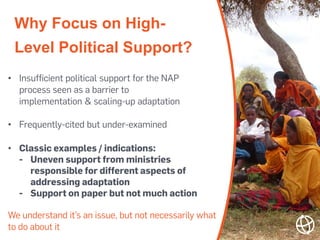
Why Focus on High-
Level Political Support?
• Insufficient political support for the NAP
process seen as a barrier to
implementation & scaling-up adaptation
• Frequently-cited but under-examined
• Classic examples / indications:
- Uneven support from ministries
responsible for different aspects of
addressing adaptation
- Support on paper but not much action
We understand it’s an issue, but not necessarily what
to do about it
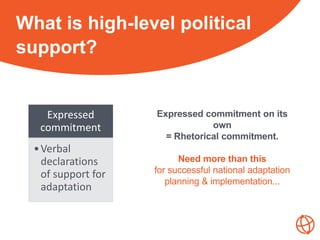
What is high-level political
support?
Expressed
commitment
•Verbal
declarations
of support for
adaptation
Expressed commitment on its
own
= Rhetorical commitment.
Need more than this
for successful national adaptation
planning & implementation...
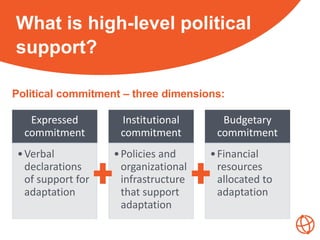
What is high-level political
support?
Expressed
commitment
•Verbal
declarations
of support for
adaptation
Institutional
commitment
•Policies and
organizational
infrastructure
that support
adaptation
Budgetary
commitment
•Financial
resources
allocated to
adaptation
Political commitment – three dimensions:
What does
political
support look
like?
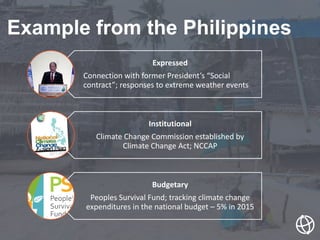
Example from the Philippines
Expressed
Connection with former President’s “Social
contract”; responses to extreme weather events
Institutional
Climate Change Commission established by
Climate Change Act; NCCAP
Budgetary
Peoples Survival Fund; tracking climate change
expenditures in the national budget – 5% in 2015
What shapes
political
priority?
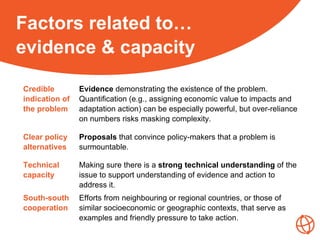
Factors related to…
evidence & capacity
Credible
indication of
the problem
Evidence demonstrating the existence of the problem.
Quantification (e.g., assigning economic value to impacts and
adaptation action) can be especially powerful, but over-reliance
on numbers risks masking complexity.
Clear policy
alternatives
Proposals that convince policy-makers that a problem is
surmountable.
Technical
capacity
Making sure there is a strong technical understanding of the
issue to support understanding of evidence and action to
address it.
South-south
cooperation
Efforts from neighbouring or regional countries, or those of
similar socioeconomic or geographic contexts, that serve as
examples and friendly pressure to take action.
…communication
& profile
Clarity Describing the adaptation issue, and the NAP process in
particular, in simple, non-technical terms. Intermediaries
can play a key role in enhancing clarity.
Civil society &
media
mobilization
Network of actors committed to raising the profile and
advocating for adaptation; building common messages
and a shared vision for responding.
Political
champions
Respected, capable individuals willing to promote and
advance issues.
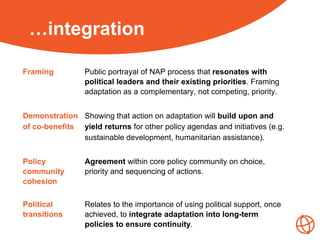
…integration
Framing Public portrayal of NAP process that resonates with
political leaders and their existing priorities. Framing
adaptation as a complementary, not competing, priority.
Demonstration
of co-benefits
Showing that action on adaptation will build upon and
yield returns for other policy agendas and initiatives (e.g.
sustainable development, humanitarian assistance).
Policy
community
cohesion
Agreement within core policy community on choice,
priority and sequencing of actions.
Political
transitions
Relates to the importance of using political support, once
achieved, to integrate adaptation into long-term
policies to ensure continuity.
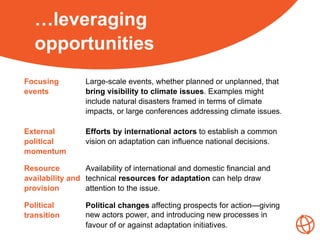
…leveraging
opportunities
Focusing
events
Large-scale events, whether planned or unplanned, that
bring visibility to climate issues. Examples might
include natural disasters framed in terms of climate
impacts, or large conferences addressing climate issues.
External
political
momentum
Efforts by international actors to establish a common
vision on adaptation can influence national decisions.
Resource
availability and
provision
Availability of international and domestic financial and
technical resources for adaptation can help draw
attention to the issue.
Political
transition
Political changes affecting prospects for action—giving
new actors power, and introducing new processes in
favour of or against adaptation initiatives.
Example from
the US context
Carousel group
discussions:
Challenges,
opportunities,
drivers
Carousel Discussion
Drivers What were the specific factors (policies, people, events,
etc.) that helped to give the adaptation planning
agenda a higher political profile in your country’s
experience?
Challenges What challenges have you faced in securing political
support? Try to give a specific example.
Opportunities Where you have been successful in securing support,
what opportunities has it created for you? Try to give a
specific example.
Discussion Groups
Drivers
[Hayley]
Mexico (Colombia, South Africa)
Challenges
[John F.]
Madagascar (Cambodia, Benin)
Opportunities
[Nikola]
Samoa (Thailand, Tanzania)
www.napglobalnetwork.org
info@napglobalnetwork.org
Twitter: @NAP_Network
Financial support provided by Secretariat hosted by

Introduction: High-Level Political Support for NAP Processes

  • 1.
    Coordinating Climate-Resilient Development Introduction: High-Level Political Supportfor NAP Processes Hayley Price-Kelly, NAP Global Network Secretariat Sept. 21, 2016 | Targeted Topics Forum Phnom Penh, Cambodia
  • 2.
    Why Focus onHigh- Level Political Support? • Insufficient political support for the NAP process seen as a barrier to implementation & scaling-up adaptation • Frequently-cited but under-examined • Classic examples / indications: - Uneven support from ministries responsible for different aspects of addressing adaptation - Support on paper but not much action We understand it’s an issue, but not necessarily what to do about it
  • 3.
    What is high-levelpolitical support? Expressed commitment •Verbal declarations of support for adaptation Expressed commitment on its own = Rhetorical commitment. Need more than this for successful national adaptation planning & implementation...
  • 4.
    What is high-levelpolitical support? Expressed commitment •Verbal declarations of support for adaptation Institutional commitment •Policies and organizational infrastructure that support adaptation Budgetary commitment •Financial resources allocated to adaptation Political commitment – three dimensions:
  • 5.
  • 6.
    Example from thePhilippines Expressed Connection with former President’s “Social contract”; responses to extreme weather events Institutional Climate Change Commission established by Climate Change Act; NCCAP Budgetary Peoples Survival Fund; tracking climate change expenditures in the national budget – 5% in 2015
  • 7.
  • 8.
    Factors related to… evidence& capacity Credible indication of the problem Evidence demonstrating the existence of the problem. Quantification (e.g., assigning economic value to impacts and adaptation action) can be especially powerful, but over-reliance on numbers risks masking complexity. Clear policy alternatives Proposals that convince policy-makers that a problem is surmountable. Technical capacity Making sure there is a strong technical understanding of the issue to support understanding of evidence and action to address it. South-south cooperation Efforts from neighbouring or regional countries, or those of similar socioeconomic or geographic contexts, that serve as examples and friendly pressure to take action.
  • 9.
    …communication & profile Clarity Describingthe adaptation issue, and the NAP process in particular, in simple, non-technical terms. Intermediaries can play a key role in enhancing clarity. Civil society & media mobilization Network of actors committed to raising the profile and advocating for adaptation; building common messages and a shared vision for responding. Political champions Respected, capable individuals willing to promote and advance issues.
  • 10.
    …integration Framing Public portrayalof NAP process that resonates with political leaders and their existing priorities. Framing adaptation as a complementary, not competing, priority. Demonstration of co-benefits Showing that action on adaptation will build upon and yield returns for other policy agendas and initiatives (e.g. sustainable development, humanitarian assistance). Policy community cohesion Agreement within core policy community on choice, priority and sequencing of actions. Political transitions Relates to the importance of using political support, once achieved, to integrate adaptation into long-term policies to ensure continuity.
  • 11.
    …leveraging opportunities Focusing events Large-scale events, whetherplanned or unplanned, that bring visibility to climate issues. Examples might include natural disasters framed in terms of climate impacts, or large conferences addressing climate issues. External political momentum Efforts by international actors to establish a common vision on adaptation can influence national decisions. Resource availability and provision Availability of international and domestic financial and technical resources for adaptation can help draw attention to the issue. Political transition Political changes affecting prospects for action—giving new actors power, and introducing new processes in favour of or against adaptation initiatives.
  • 12.
  • 13.
  • 14.
    Carousel Discussion Drivers Whatwere the specific factors (policies, people, events, etc.) that helped to give the adaptation planning agenda a higher political profile in your country’s experience? Challenges What challenges have you faced in securing political support? Try to give a specific example. Opportunities Where you have been successful in securing support, what opportunities has it created for you? Try to give a specific example.
  • 15.
    Discussion Groups Drivers [Hayley] Mexico (Colombia,South Africa) Challenges [John F.] Madagascar (Cambodia, Benin) Opportunities [Nikola] Samoa (Thailand, Tanzania)
  • 16.