Multilateral
Environmental
Agreements
(MEAs)
What are MEAs?
MEAs or Multilateral Environmental Agreements are
agreements between states which may take the form of “soft-
law”, setting out non legally-binding principles which parties
are obligated to consider when taking actions to address a
particular environmental issue, or “hard-law” which specify
legally-binding actions to be undertaken toward an
environmental objective.
2 1/4/2023 Add a footer
Other terms of MEAs are the following:
Many global environmental issues don’t stop at the border:
• they are caused by sources thousands of kilometers away;
• they can have a regional or even a global impact.
MEAs are international legal instruments that:
• have a goal of environmental protection (sustainable development);
• take measures to remedy, mitigate or otherwise deal with global and/or regional
environmental concerns;
• are concluded between a large number of states or international organizations as Parties;
• can be embodied in a single instrument or more related instruments;
• are governed by international law;
• are concluded in written form.
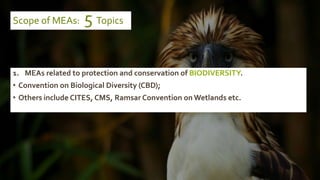
Scope of MEAs: 5 Topics
1. MEAs related to protection and conservation of BIODIVERSITY.
• Convention on Biological Diversity (CBD);
• Others include CITES, CMS, Ramsar Convention on Wetlands etc.
2. MEAs focusing on protecting LAND from “negative
altering”.
• UN Convention to Combat Desertification (UNCCD);
• 3 Rio Conventions linked to climate change and biodiversity.
3. MEAs relevant to the REGIONAL SEAS & MARINE
ENVIRONMENT.
• 17 Regional Seas Conventions;
• Global Program of Action for the protection of the marine
environment from land-based
activities (GPA).
4. MEAs aimed at protection of the ATMOSPHERE from
pollutants.
7 1/4/2023 Add a footer
• Montreal Protocol on substances that deplete the ozone layer;
• UNFCCC (UN Framework Convention on Climate Change) and the
linked Kyoto Protocol.
5. MEAs dealing with hazardous WASTES & CHEMICAL
pollution.
8 1/4/2023 Add a footer
• Basel Convention on the control of transboundary movement of
hazardous wastes and their
disposal;
• Rotterdam Convention on the prior informed consent for certain
hazardous chemicals and
pesticides in international trade;
• Stockholm Convention on Persistent Organic Pollutants (POPs).
MEAs are international instruments states enter into,
addressing particular environmental issues.They play
a vital role in the development of overall environmental
frameworks from the global, regional, national to sub-
national levels of governance and cooperation

Multilateral-Environmental-Agreements-MEAs.pptx

  • 1.
  • 2.
    What are MEAs? MEAsor Multilateral Environmental Agreements are agreements between states which may take the form of “soft- law”, setting out non legally-binding principles which parties are obligated to consider when taking actions to address a particular environmental issue, or “hard-law” which specify legally-binding actions to be undertaken toward an environmental objective. 2 1/4/2023 Add a footer
  • 3.
    Other terms ofMEAs are the following: Many global environmental issues don’t stop at the border: • they are caused by sources thousands of kilometers away; • they can have a regional or even a global impact. MEAs are international legal instruments that: • have a goal of environmental protection (sustainable development); • take measures to remedy, mitigate or otherwise deal with global and/or regional environmental concerns; • are concluded between a large number of states or international organizations as Parties; • can be embodied in a single instrument or more related instruments; • are governed by international law; • are concluded in written form.
  • 4.
    Scope of MEAs:5 Topics 1. MEAs related to protection and conservation of BIODIVERSITY. • Convention on Biological Diversity (CBD); • Others include CITES, CMS, Ramsar Convention on Wetlands etc.
  • 5.
    2. MEAs focusingon protecting LAND from “negative altering”. • UN Convention to Combat Desertification (UNCCD); • 3 Rio Conventions linked to climate change and biodiversity.
  • 6.
    3. MEAs relevantto the REGIONAL SEAS & MARINE ENVIRONMENT. • 17 Regional Seas Conventions; • Global Program of Action for the protection of the marine environment from land-based activities (GPA).
  • 7.
    4. MEAs aimedat protection of the ATMOSPHERE from pollutants. 7 1/4/2023 Add a footer • Montreal Protocol on substances that deplete the ozone layer; • UNFCCC (UN Framework Convention on Climate Change) and the linked Kyoto Protocol.
  • 8.
    5. MEAs dealingwith hazardous WASTES & CHEMICAL pollution. 8 1/4/2023 Add a footer • Basel Convention on the control of transboundary movement of hazardous wastes and their disposal; • Rotterdam Convention on the prior informed consent for certain hazardous chemicals and pesticides in international trade; • Stockholm Convention on Persistent Organic Pollutants (POPs).
  • 9.
    MEAs are internationalinstruments states enter into, addressing particular environmental issues.They play a vital role in the development of overall environmental frameworks from the global, regional, national to sub- national levels of governance and cooperation