People, Development and
Environment
Dr.N. Anandakumar
Assistant Professor-Contractual Faculty
Department of Education
The Gandhigram Rural Institute-DTBU, Gandhigram.
2.
Instructional Objectives
• Developmentand environment
• Human environment interaction
• Environmental issues
• Impacts of pollutants on human health
• Natural and energy resources
• Natural hazards and disasters
• Environmental Protection Laws & Actions
3.
1. Development andenvironment
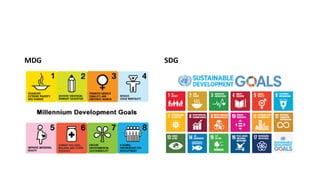
• The Millennium Development Goals (MDGs) and Sustainable
Development Goals (SDGs) are both UN-led initiatives focused on
global development, but the SDGs build upon and expand the scope
of the MDGs.
• The MDGs, established in 2000, focused on eight key areas like
poverty, education, and health, aiming to be achieved by 2015. The
SDGs, adopted in 2015, are a more comprehensive set of 17 goals and
169 targets that address a broader range of issues, including
environmental sustainability, social equity, and economic
development, with a 2030 deadline.
2. Human environmentinteraction
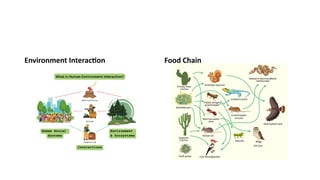
• Human-environment interaction refers to the complex and reciprocal
relationship between humans and their natural surroundings.
• It encompasses how humans depend on, adapt to, and modify the
environment, and how these actions, in turn, impact the
environment.
• This interaction is a two-way process where human activities both
shape and are shaped by the environment.
3. Environmental issues
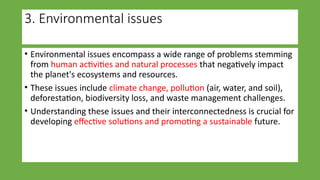
•Environmental issues encompass a wide range of problems stemming
from human activities and natural processes that negatively impact
the planet's ecosystems and resources.
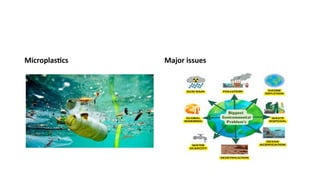
• These issues include climate change, pollution (air, water, and soil),
deforestation, biodiversity loss, and waste management challenges.
• Understanding these issues and their interconnectedness is crucial for
developing effective solutions and promoting a sustainable future.
4. Impacts ofpollutants on human health
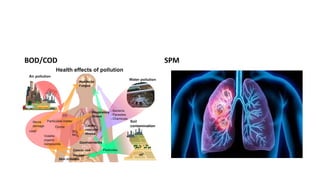
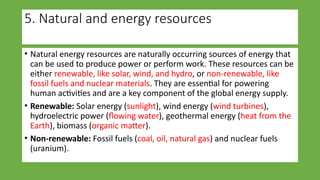
• Pollutants can have a wide range of negative impacts on human
health, both in the short-term and long-term, and can affect various
systems in the body.
• Short-term effects can include respiratory irritation, eye and skin
irritation, coughing, headaches, and nausea. Long-term exposure can
lead to more serious conditions such as respiratory diseases (asthma,
COPD), cardiovascular problems (heart disease, stroke), neurological
damage, and even cancer. Vulnerable populations, like children, the
elderly, and those with pre-existing conditions, are particularly
susceptible.
5. Natural andenergy resources
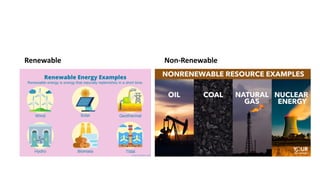
• Natural energy resources are naturally occurring sources of energy that
can be used to produce power or perform work. These resources can be
either renewable, like solar, wind, and hydro, or non-renewable, like
fossil fuels and nuclear materials. They are essential for powering
human activities and are a key component of the global energy supply.
• Renewable: Solar energy (sunlight), wind energy (wind turbines),
hydroelectric power (flowing water), geothermal energy (heat from the
Earth), biomass (organic matter).
• Non-renewable: Fossil fuels (coal, oil, natural gas) and nuclear fuels
(uranium).
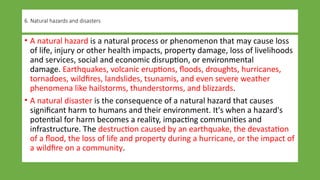
6. Natural hazardsand disasters
• A natural hazard is a natural process or phenomenon that may cause loss
of life, injury or other health impacts, property damage, loss of livelihoods
and services, social and economic disruption, or environmental
damage. Earthquakes, volcanic eruptions, floods, droughts, hurricanes,
tornadoes, wildfires, landslides, tsunamis, and even severe weather
phenomena like hailstorms, thunderstorms, and blizzards.
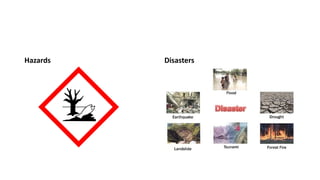
• A natural disaster is the consequence of a natural hazard that causes
significant harm to humans and their environment. It's when a hazard's
potential for harm becomes a reality, impacting communities and
infrastructure. The destruction caused by an earthquake, the devastation
of a flood, the loss of life and property during a hurricane, or the impact of
a wildfire on a community.
7. Environmental ProtectionLaws & Actions
• The Environment (Protection) Act, 1986 is a landmark legislation in India
enacted to protect and improve the environment. It empowers the
Central Government to take measures to prevent, control, and abate
environmental pollution.
• The National Action Plan on Climate Change (NAPCC) is a
comprehensive framework launched by the Indian government in 2008
to address climate change and promote sustainable development.
• The Montreal Protocol is a global agreement designed to protect the
Earth's ozone layer by phasing out the production and consumption of
ozone-depleting substances (ODS).
• The "RioSummit," also known as the "Earth Summit" or the "United
Nations Conference on Environment and Development (UNCED),"
was held in Rio de Janeiro, Brazil, from June 3-14, 1992. It was a major
international conference that focused on addressing urgent
environmental and development issues. The summit brought together
representatives from 178 countries, including over 100 heads of
state.
• The Convention on Biological Diversity (CBD) is an international treaty
signed at the 1992 Earth Summit in Rio de Janeiro. Its main objectives
are the conservation of biological diversity, the sustainable use of its
components, and the fair and equitable sharing of benefits from the
utilization of genetic resources. The CBD aims to translate the
principles of sustainable development into practical action.
18.
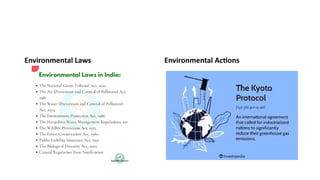
• The KyotoProtocol is an international treaty that extends the United
Nations Framework Convention on Climate Change (UNFCCC). It
commits industrialized countries to reduce greenhouse gas emissions,
aiming to stabilize atmospheric concentrations of these
gases. Adopted in Kyoto, Japan in 1997, it entered into force in 2005
and has been ratified by 192 parties according to the United Nations.
• The Paris Agreement is a legally binding international treaty on
climate change, adopted in 2015 at the COP21 climate conference in
Paris. Its main goal is to limit global warming to well below 2 degrees
Celsius, preferably to 1.5 degrees Celsius, compared to pre-industrial
levels. The agreement also focuses on adaptation to the impacts of
climate change and providing financial support to developing
countries for climate action.
19.
• The InternationalSolar Alliance (ISA) is a treaty-based,
intergovernmental organization established in 2015 by India and
France to promote solar energy. Its main goal is to mobilize over $1
trillion in investments by 2030 to accelerate the deployment of solar
energy technologies globally. The ISA is headquartered in Gurugram,
India.