
West Marine:
Driving Growth through Shipshape
    Supply Chain Management
       Case Study Solution


            Presented By:
                      Arun Kabra 11BM60046
          Chandra Veer S Dulawat 11BM60030
                    Partha Pratim 11BM60041
                 Sumit Pal Singh 11BM60048
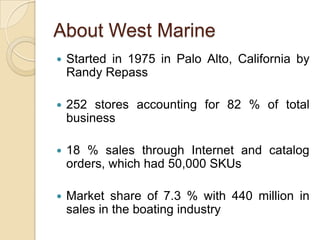
About West Marine
   Started in 1975 in Palo Alto, California by
    Randy Repass

   252 stores accounting for 82 % of total
    business

   18 % sales through Internet and catalog
    orders, which had 50,000 SKUs

   Market share of 7.3 % with 440 million in
    sales in the boating industry
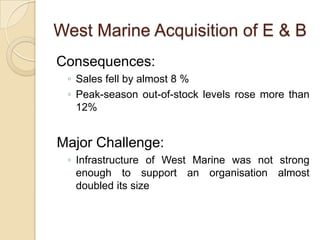
West Marine Acquisition of E & B
Consequences:
 ◦ Sales fell by almost 8 %
 ◦ Peak-season out-of-stock levels rose more than
   12%


Major Challenge:
 ◦ Infrastructure of West Marine was not strong
   enough to support an organisation almost
   doubled its size
West Marine Acquisition of E & B
Continued
   Focus Points for Change:
    ◦ Leadership – The Captain selects his
      Crew
      Key players changed by veterans in the
       industry in case business in failing
      More experienced people in the management
       team

    ◦ Strategy – New Navigation Rules
      Each executive was given the general mandate
       to turn around his respective function
      outlined a series of specific financial goals
       (company wide performance indicators)
West Marine Acquisition of E & B
Continued
 ◦ People and Culture – All Aboard
   Cultural change drive on the idea of providing
    “better than expected customer service”.
   Significant effort was put in redefining roles, the
    silos mentality was totally abandoned and new
    transparent communication was established.


 ◦ Systems and Processes – Regain an
   Even Keel
   New management team started attacking every
    process by reviewing every process     and
    reinventing all of the systems.
About CPFR
   Collaborative     Planning     Forecasting      and
    Replenishment

   Development of a single, shared forecast
    supporting joint plans of trading partners in supply
    chain and driving their replenishment activities.

   Included systematic identification of exceptions,
    clear performance measures and monetizing of
    risks.
CPFR at West Marine
The key drivers to customer sales forecasts were

   Base annual forecasts
   Seasonal selling curves or “profiles”
   Ranking or service levels for items
   Promotional changes
   Assortment changes

In their business model, sales from non-stocking
locations were also a significant driver.
Store-DC link
   West Marine elected to develop a custom
    integration solution to link its store and DC level
    replenishment       platforms.      West    Marine
    implemented a successful, robust linkage between
    the point-of-sale and DC systems that maximized
    automation and mass-maintenance procedures,
    thereby creating new user interfaces that enhanced
    the user’s view of how products performed across
    the network.

   West Marine implemented JDA’s Intellectual
    seasonal profiling package to address the
    challenge of accomplishing accurate profiling.
West Marine – Trading
Partners
   Electronic data interchange (EDI) standardized
    electronic transfer of structured information
    between trading partners to increase productivity,
    reduce human error, and drive down costs.

   West Marine worked with NMMA to establish this
    as the EDI standard in the marine industry with the
    hope of more rapidly stimulating its adoption.

   West Marine also launched a significant data
    clean-up effort, by evaluating one SKU at a time.
With these improvements, West Marine created
accurate 52-week forecasts of supplier orders of all
of its products with a minimum of manual
intervention. Historical sales data was used to
generate the baseline forecast, which was made
richer by taking into account:

   Seasonal (geographic based) profiles,

   Product rank (based on anticipated sales volume
    and gross margin), and

   Scheduled promotions (fliers, special displays in
    the stores, and other promotional activities).

   These forecasts were updates every 24-hours.
Internal Improvements
   To support this new forecasting and replenishment
    approach, West Marine agreed to implement a
    category management approach that would drive
    employees in the merchandising and planning and
    replenishment departments to perform as an
    integrated unit.
   They divided West Marine’s products into 24 distinct
    product clusters, and assigned a category
    manager and an assistant category manager
    from the merchandising group to each one.
   A merchandise planner and a replenishment
    analyst were assigned from the planning and
    replenishment department.
   These four individuals were collocated in a team
    “pod” and were charged with working together.
ROLES
   Category Manager and Assistant: responsible for
    choosing the items that the company would stock,
    assigning a channel(s) to each product, negotiating
    vendor agreements, determining price, margin, and
    volume goals, developing promotion strategies,
    and managing the on-going vendor relationships.

   Merchandise Planner: acted as “supply chain
    captain”, cutting purchase orders, monitoring
    shipments and fill rates, resolving problems, and
    coordinating all aspects of supply chain from the
    vendor to the DC.
   Replenishment Analyst: worked closely with the
    merchandise planner, but focused on those
    aspects of the supply chain related to getting the
    product form the DC to the stores. S/he entered
    and monitored the forecasts, interfaced with the
    stores to ensure that they got what products they
    needed and managed special requests from the
    stores.

   The new category teams also worked closely with
    assortment planning, visual merchandising and
    marketing. The assortment planning group helped
    ensure that each unique store had the right mix of
    products to maximize sales and profitability in the
    market.
CPFR: Pilot at West Marine
Collaboration with 150 vendors including 350 EDI
partners.

   In-stock rates at stores: 96%
   Forecast Accuracy: 85%
   On-time shipping: 30%

Improved Forecast for shipping and receiving
activities at DC resulting in marriage of
replenishment and physical logistics at DC.
Recommendations for Takeover
of BoatU.S.
Branding and Integration Strategy:

   A vendor and SKU Rationalization Effort would be
    needed, when the company is going for merging
    the two into a single brand West Marine.

   But if it wants to go with Dual-Branding Strategy
    and decides to maintain the BoatU.S. brand, the
    company has to develop a more diverse product
    base and more unique assortments than ever
    before.

   It also needs to take care of the integration of the
    replenishment activities because these are mostly
    manual processes in case of BoatU.S.
Recommendations for Takeover
of BoatU.S. Continued
   Overall complexity involved in the supply chain
    integration of both companies is high since both
    offered 50,000 SKUs via stores, internet and
    catalogs.

   This is one of the most critical factor as West
    Marine cannot afford to have a repeat of the Supply
    Chain breakdown, as happened in the case of
    previous acquisition of E&B Marine.

   Thus, the experience gained from the CPFR needs
    to be used and applied for the successful
    integration of two companies.
THANK YOU

West marine case

  • 1.
    West Marine: Driving Growththrough Shipshape Supply Chain Management Case Study Solution Presented By: Arun Kabra 11BM60046 Chandra Veer S Dulawat 11BM60030 Partha Pratim 11BM60041 Sumit Pal Singh 11BM60048
  • 2.
    About West Marine  Started in 1975 in Palo Alto, California by Randy Repass  252 stores accounting for 82 % of total business  18 % sales through Internet and catalog orders, which had 50,000 SKUs  Market share of 7.3 % with 440 million in sales in the boating industry
  • 3.
    West Marine Acquisitionof E & B Consequences: ◦ Sales fell by almost 8 % ◦ Peak-season out-of-stock levels rose more than 12% Major Challenge: ◦ Infrastructure of West Marine was not strong enough to support an organisation almost doubled its size
  • 4.
    West Marine Acquisitionof E & B Continued  Focus Points for Change: ◦ Leadership – The Captain selects his Crew  Key players changed by veterans in the industry in case business in failing  More experienced people in the management team ◦ Strategy – New Navigation Rules  Each executive was given the general mandate to turn around his respective function  outlined a series of specific financial goals (company wide performance indicators)
  • 5.
    West Marine Acquisitionof E & B Continued ◦ People and Culture – All Aboard  Cultural change drive on the idea of providing “better than expected customer service”.  Significant effort was put in redefining roles, the silos mentality was totally abandoned and new transparent communication was established. ◦ Systems and Processes – Regain an Even Keel  New management team started attacking every process by reviewing every process and reinventing all of the systems.
  • 6.
    About CPFR  Collaborative Planning Forecasting and Replenishment  Development of a single, shared forecast supporting joint plans of trading partners in supply chain and driving their replenishment activities.  Included systematic identification of exceptions, clear performance measures and monetizing of risks.
  • 7.
    CPFR at WestMarine The key drivers to customer sales forecasts were  Base annual forecasts  Seasonal selling curves or “profiles”  Ranking or service levels for items  Promotional changes  Assortment changes In their business model, sales from non-stocking locations were also a significant driver.
  • 8.
    Store-DC link  West Marine elected to develop a custom integration solution to link its store and DC level replenishment platforms. West Marine implemented a successful, robust linkage between the point-of-sale and DC systems that maximized automation and mass-maintenance procedures, thereby creating new user interfaces that enhanced the user’s view of how products performed across the network.  West Marine implemented JDA’s Intellectual seasonal profiling package to address the challenge of accomplishing accurate profiling.
  • 9.
    West Marine –Trading Partners  Electronic data interchange (EDI) standardized electronic transfer of structured information between trading partners to increase productivity, reduce human error, and drive down costs.  West Marine worked with NMMA to establish this as the EDI standard in the marine industry with the hope of more rapidly stimulating its adoption.  West Marine also launched a significant data clean-up effort, by evaluating one SKU at a time.
  • 10.
    With these improvements,West Marine created accurate 52-week forecasts of supplier orders of all of its products with a minimum of manual intervention. Historical sales data was used to generate the baseline forecast, which was made richer by taking into account:  Seasonal (geographic based) profiles,  Product rank (based on anticipated sales volume and gross margin), and  Scheduled promotions (fliers, special displays in the stores, and other promotional activities).  These forecasts were updates every 24-hours.
  • 11.
    Internal Improvements  To support this new forecasting and replenishment approach, West Marine agreed to implement a category management approach that would drive employees in the merchandising and planning and replenishment departments to perform as an integrated unit.  They divided West Marine’s products into 24 distinct product clusters, and assigned a category manager and an assistant category manager from the merchandising group to each one.  A merchandise planner and a replenishment analyst were assigned from the planning and replenishment department.  These four individuals were collocated in a team “pod” and were charged with working together.
  • 12.
    ROLES  Category Manager and Assistant: responsible for choosing the items that the company would stock, assigning a channel(s) to each product, negotiating vendor agreements, determining price, margin, and volume goals, developing promotion strategies, and managing the on-going vendor relationships.  Merchandise Planner: acted as “supply chain captain”, cutting purchase orders, monitoring shipments and fill rates, resolving problems, and coordinating all aspects of supply chain from the vendor to the DC.
  • 13.
    Replenishment Analyst: worked closely with the merchandise planner, but focused on those aspects of the supply chain related to getting the product form the DC to the stores. S/he entered and monitored the forecasts, interfaced with the stores to ensure that they got what products they needed and managed special requests from the stores.  The new category teams also worked closely with assortment planning, visual merchandising and marketing. The assortment planning group helped ensure that each unique store had the right mix of products to maximize sales and profitability in the market.
  • 14.
    CPFR: Pilot atWest Marine Collaboration with 150 vendors including 350 EDI partners.  In-stock rates at stores: 96%  Forecast Accuracy: 85%  On-time shipping: 30% Improved Forecast for shipping and receiving activities at DC resulting in marriage of replenishment and physical logistics at DC.
  • 15.
    Recommendations for Takeover ofBoatU.S. Branding and Integration Strategy:  A vendor and SKU Rationalization Effort would be needed, when the company is going for merging the two into a single brand West Marine.  But if it wants to go with Dual-Branding Strategy and decides to maintain the BoatU.S. brand, the company has to develop a more diverse product base and more unique assortments than ever before.  It also needs to take care of the integration of the replenishment activities because these are mostly manual processes in case of BoatU.S.
  • 16.
    Recommendations for Takeover ofBoatU.S. Continued  Overall complexity involved in the supply chain integration of both companies is high since both offered 50,000 SKUs via stores, internet and catalogs.  This is one of the most critical factor as West Marine cannot afford to have a repeat of the Supply Chain breakdown, as happened in the case of previous acquisition of E&B Marine.  Thus, the experience gained from the CPFR needs to be used and applied for the successful integration of two companies.
  • 17.