Walmart SCM
Zhi Lin - Hossain Nazarat - Ulukman Mamytov
Kyoto University, IPROMAC GSM
Supply Chain Management
professor: GAUTAM RAY
“Supply chain management is moving the right items to the
right customer at the right time by the most efficient means,
no one does that better than Walmart.”
Army Col. Vernon L. Beatty, commanded the Defense Distribution Depot in Kuwait,
spent a year with Wal-Mart as part of the military’s Training With Industry program
Some Walmart facts
• Average profit - $1.8 million every hour
• 35 million people - every day, as much as the
population of Canada
• Worth $150 billion
• Top selling item in 2012 - the Banana
• 90% of Americans live within 15 minutes
About Walmart
1. The first Walmart in Rogers, Ark in 1962
2. One of the world's most valuable companies by
market value and is also the largest grocery
retailer in the U.S. In 2016.
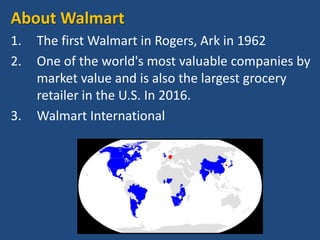
3. Walmart International
Introduction
Walmart’s supply chain management
1) early years - removing a few of the chain’s links
2) 1980s - working directly with manufacturers to cut
costs
3) Vendor Managed Inventory (VMI) - manufacturers
became responsible for managing their products in
Walmart’s warehouses.
Walmart was able to expect close to 100% order
fulfilment on merchandise.
Inventory & transportation
The goals – to provide customers with the goods
they wanted whenever and wherever they
wanted them.
Significant system
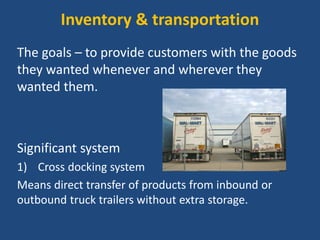
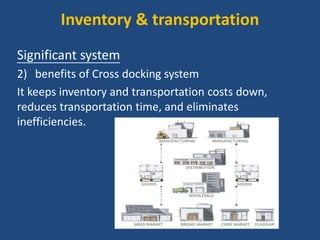
1) Cross docking system
Means direct transfer of products from inbound or
outbound truck trailers without extra storage.
Inventory & transportation
Significant system
2) benefits of Cross docking system
It keeps inventory and transportation costs down,
reduces transportation time, and eliminates
inefficiencies.
Inventory & transportation
Applied technology
1) Universal Product Code bar codes
store level information was immediately collected and
analyzed, and the company then devised Retail Link, a
mammoth Bentonville database.
2) Radio frequency identification tags (RFID)
use numerical codes that can be scanned from a
distance to track pallets of merchandise moving along
the supply chain.
According to researchers at the University of Arkansas,
there was a 16% reduction in out-of-stocks since Wal-
Mart introduced RFID technology into its supply chain.
Inventory & transportation
Applied technology
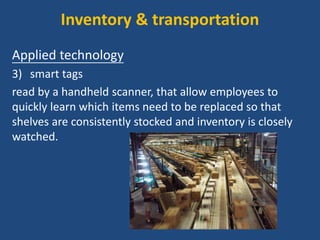
3) smart tags
read by a handheld scanner, that allow employees to
quickly learn which items need to be replaced so that
shelves are consistently stocked and inventory is closely
watched.
The role of IT in Walmart’s
Supply Chain Management
EDI based Supply Chain System
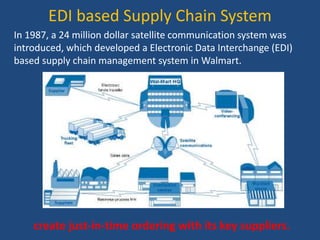
In 1987, a 24 million dollar satellite communication system was
introduced, which developed a Electronic Data Interchange (EDI)
based supply chain management system in Walmart.
create just-in-time ordering with its key suppliers.
Inventory Management through IT system
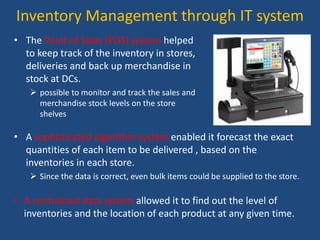
• The Point of Sales (POS) system helped
to keep track of the inventory in stores,
deliveries and back up merchandise in
stock at DCs.
 possible to monitor and track the sales and
merchandise stock levels on the store
shelves
• A sophisticated algorithm system enabled it forecast the exact
quantities of each item to be delivered , based on the
inventories in each store.
 Since the data is correct, even bulk items could be supplied to the store.
• A centralized data system allowed it to find out the level of
inventories and the location of each product at any given time.
Retail Link System
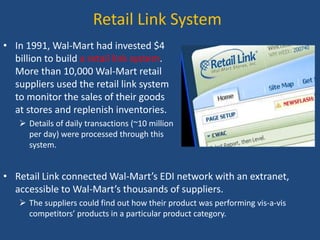
• In 1991, Wal-Mart had invested $4
billion to build a retail link system.
More than 10,000 Wal-Mart retail
suppliers used the retail link system
to monitor the sales of their goods
at stores and replenish inventories.
 Details of daily transactions (~10 million
per day) were processed through this
system.
• Retail Link connected Wal-Mart’s EDI network with an extranet,
accessible to Wal-Mart’s thousands of suppliers.
 The suppliers could find out how their product was performing vis-a-vis
competitors’ products in a particular product category.
Inventory Management through UPC
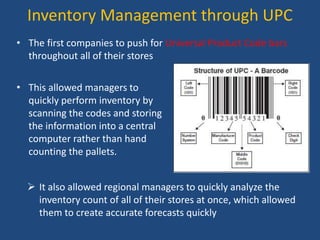
• The first companies to push for Universal Product Code bars
throughout all of their stores
• This allowed managers to
quickly perform inventory by
scanning the codes and storing
the information into a central
computer rather than hand
counting the pallets.
 It also allowed regional managers to quickly analyze the
inventory count of all of their stores at once, which allowed
them to create accurate forecasts quickly
Inventory Management through RFID
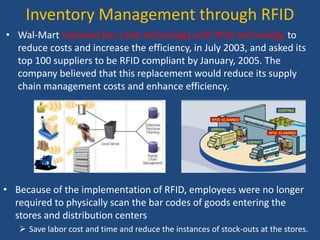
• Wal-Mart replaced bar-code technology with RFID technology to
reduce costs and increase the efficiency, in July 2003, and asked its
top 100 suppliers to be RFID compliant by January, 2005. The
company believed that this replacement would reduce its supply
chain management costs and enhance efficiency.
• Because of the implementation of RFID, employees were no longer
required to physically scan the bar codes of goods entering the
stores and distribution centers
 Save labor cost and time and reduce the instances of stock-outs at the stores.
Advantages of implementing IT in
Supply Chain System
• Around 2% of all lost sales are due to the simple fact
a store has run out of an item, but 41% of lost sales
are due to inventory problems
• Gain $287 million per year by avoiding 10% lost sales
• Improved performance of stores by 63%
• Out-of-stock items are replenished 3 times faster
than before
• The out-of-stock items that have to be manually
filled has been cut by 10 percent.
The role of facilities in Walmart’s
Supply Chain Management
Walmart’s store
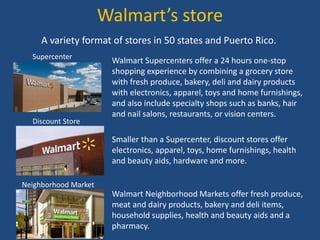
A variety format of stores in 50 states and Puerto Rico.
Walmart Supercenters offer a 24 hours one-stop
shopping experience by combining a grocery store
with fresh produce, bakery, deli and dairy products
with electronics, apparel, toys and home furnishings,
and also include specialty shops such as banks, hair
and nail salons, restaurants, or vision centers.
Smaller than a Supercenter, discount stores offer
electronics, apparel, toys, home furnishings, health
and beauty aids, hardware and more.
Walmart Neighborhood Markets offer fresh produce,
meat and dairy products, bakery and deli items,
household supplies, health and beauty aids and a
pharmacy.
Supercenter
Discount Store
Neighborhood Market
Distribution Center
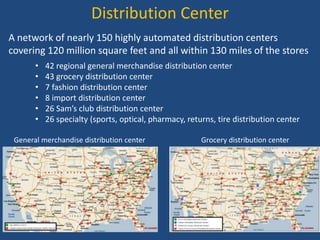
A network of nearly 150 highly automated distribution centers
covering 120 million square feet and all within 130 miles of the stores
• 42 regional general merchandise distribution center
• 43 grocery distribution center
• 7 fashion distribution center
• 8 import distribution center
• 26 Sam’s club distribution center
• 26 specialty (sports, optical, pharmacy, returns, tire distribution center
General merchandise distribution center Grocery distribution center
Advantages of centralized DCs
• Over 80,000 items were stocked in Wal-Mart’s distribution centers
located at different geographical locations, which directly supplied
85 percent of the inventory, as compared to 50-65 percent for its
competitors.
 to provide replenishments within 2 days against at least 5 days for
competitors
 shipping costs worked out to be roughly 3 percent as against 5 percent
for competitors.
• Wal-Mart’s sophisticated hub-and-spoke distribution network uses
warehouses to service stores less than a day's truck drive away
remove middlemen, quickly replenish shelves and reduce costs
• At its distribution centers, scanning technology tracks merchandise
as it flows at 6 miles per hour on 12 miles of conveyor belts onto
trucks
Some items spend less than 45 minutes in warehouses
Sourcing in Walmart’s
Supply Chain Management
Sourcing
• Till 2010, relied on intermediaries for bulk of its global
sourcing activities, instead of buying it directly from the
offshore suppliers. Walmart bought hardly 20% of goods
directly from the suppliers. Also the mode of operation was
highly decentralized across all the 15 countries where it has its
stores.
• In 2010 declared the sourcing strategy to buy 80% of the
goods from the manufacturers directly from counterparts in
Bangladesh, China and other countries.
• Planned to make the global sourcing process more
centralized. By eliminating the middlemen in the transaction
and consolidating global procurement functions, avoiding the
5-15% markup introduced by them. This helped reduce the
cost leading to billions of dollars of savings
Sourcing
For this strategy
• Centralized the process by setting up four global
merchandising centers for general goods and clothing.
• Started purchasing fruits and vegetables on a global scale and
eliminated the import companies and the agents.
• Acquired Asda, the grocery chain in UK which had expertise in
direct sourcing, so Walmart leveraged this expertise across
the globe.
This strategy of direct sourcing not only helped Walmart reduce
the cost, but also helped in other supply chain activities by
improving the efficiency throughout the process. They could now
better manage and consolidate the incoming shipments and also
gained a better visibility through the entire product lifecycle.
Some of the sourcing strategies:
Strategic Vendor Partnerships
• Selection of suppliers, who could meet the demand and at the same time
offer the best price for the goods.
• Long-term strategic relationships with high volume purchases in exchange
for lowest possible prices.
• Communication and relationship networks with suppliers to improve the
material flow. Collaboration - the key to success.
Cross Docking
• Centered around a key inventory tactic called Cross docking.
• Transfers products directly from inbound trucks to outbound trucks.
• This saves the storage costs. Suppliers deliver products to Walmart’s
distribution centers, where those are cross docked and then delivered to
the Walmart stores.
• This process of cross docking lowers the inventory transportation costs
and eliminates inefficiencies. This results in savings for the company which
are then passed on to the customers in the form of competitive prices.
Pricing in Walmart’s
Supply Chain Management
Pricing Strategy
• Everyday low prices (EDLP) - prices on items at relatively low
compared to the everyday market price (maintaining customer
trust in pricing and customer loyalty)
• Additionally to their traditional Bricks-and-Mortar, Clicks and
bricks model - allows the customer to order products either
online or physically in one of their stores, also allowing them to
either pick-up their order directly at a local branch of the store
or get it delivered to their home
• “Price match guarantee“ it has challenged other competitors to
reduce their pricing (PMG: if a consumer brings in some sort of proof
that a competitor is offering the same product at a lower price, the business
will allow the consumer to purchase that product from them at that lower
price)
Why lowest prices?
• Huge sales volume, scope of operation and wide customer
base - selling almost everything, and being almost everywhere.
Multiple-store format that extends its market reach, and it sells
goods through four types of stores: discount stores, Walmart
Supercenters, Sam's Club warehouses (which sell bulk items), and
neighborhood markets.
90% of Americans live within 15 miles of a Walmart store. High
penetration in customers' lives and increase the probability of a
purchase.
Why lowest prices?
• SCM based on maximizing efficiency and reducing outlays
WalMart was a pioneer in getting detailed product information
electronically attached to products so that such information could
be relayed to its database and could inform its inventory
management system.
The goal - to master the art of knowing
• what it needed,
• how much was needed, and
• when it needed it.
Why lowest prices?
• Minimization of overhead and operational costs
Walmart saves money on everything, including the labor costs.
• Meager wages,
• Low-benefit healthcare plans,
• Executives fly coach and share hotel rooms with colleagues.
• Hourly workers put in overtime without pay.
• Each Walmart associate does the job of 1.5 to 1.75 employees
of a rival.
• Saving on heating and cooling of the buildings.
Why lowest prices?
• Leveraging of Its bargaining power to force suppliers to lower
prices (Porter’s five forces)
The Walmart Effect - as the biggest buyer Walmart is constantly
pushing its suppliers to cut prices.
Case: Lakewood Engineering & Manufacturing Company
In the early 1990s the cost of a 20-inch fan was $20. After Walmart pushed for
the lowering of the price, Lakewood automated its production process, which
resulted in the layoff of workers. It also put pressure on its own suppliers to
slash the prices of parts, and it opened a factory in China where workers earned
25 cents an hour. By 2003, the price of a fan in Walmart had dropped to $10.
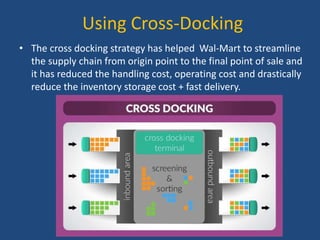
Using Cross-Docking
• The cross docking strategy has helped Wal-Mart to streamline
the supply chain from origin point to the final point of sale and
it has reduced the handling cost, operating cost and drastically
reduce the inventory storage cost + fast delivery.
Thank you!
Zhi Lin - Hossain Nazarat - Ulukman Mamytov
Kyoto University, IPROMAC GSM
Supply Chain Management
professor: GAUTAM RAY

Walmart's SCM

  • 1.
    Walmart SCM Zhi Lin- Hossain Nazarat - Ulukman Mamytov Kyoto University, IPROMAC GSM Supply Chain Management professor: GAUTAM RAY
  • 2.
    “Supply chain managementis moving the right items to the right customer at the right time by the most efficient means, no one does that better than Walmart.” Army Col. Vernon L. Beatty, commanded the Defense Distribution Depot in Kuwait, spent a year with Wal-Mart as part of the military’s Training With Industry program
  • 3.
    Some Walmart facts •Average profit - $1.8 million every hour • 35 million people - every day, as much as the population of Canada • Worth $150 billion • Top selling item in 2012 - the Banana • 90% of Americans live within 15 minutes
  • 4.
    About Walmart 1. Thefirst Walmart in Rogers, Ark in 1962 2. One of the world's most valuable companies by market value and is also the largest grocery retailer in the U.S. In 2016. 3. Walmart International
  • 5.
    Introduction Walmart’s supply chainmanagement 1) early years - removing a few of the chain’s links 2) 1980s - working directly with manufacturers to cut costs 3) Vendor Managed Inventory (VMI) - manufacturers became responsible for managing their products in Walmart’s warehouses. Walmart was able to expect close to 100% order fulfilment on merchandise.
  • 6.
    Inventory & transportation Thegoals – to provide customers with the goods they wanted whenever and wherever they wanted them. Significant system 1) Cross docking system Means direct transfer of products from inbound or outbound truck trailers without extra storage.
  • 7.
    Inventory & transportation Significantsystem 2) benefits of Cross docking system It keeps inventory and transportation costs down, reduces transportation time, and eliminates inefficiencies.
  • 8.
    Inventory & transportation Appliedtechnology 1) Universal Product Code bar codes store level information was immediately collected and analyzed, and the company then devised Retail Link, a mammoth Bentonville database. 2) Radio frequency identification tags (RFID) use numerical codes that can be scanned from a distance to track pallets of merchandise moving along the supply chain. According to researchers at the University of Arkansas, there was a 16% reduction in out-of-stocks since Wal- Mart introduced RFID technology into its supply chain.
  • 9.
    Inventory & transportation Appliedtechnology 3) smart tags read by a handheld scanner, that allow employees to quickly learn which items need to be replaced so that shelves are consistently stocked and inventory is closely watched.
  • 10.
    The role ofIT in Walmart’s Supply Chain Management
  • 11.
    EDI based SupplyChain System In 1987, a 24 million dollar satellite communication system was introduced, which developed a Electronic Data Interchange (EDI) based supply chain management system in Walmart. create just-in-time ordering with its key suppliers.
  • 12.
    Inventory Management throughIT system • The Point of Sales (POS) system helped to keep track of the inventory in stores, deliveries and back up merchandise in stock at DCs.  possible to monitor and track the sales and merchandise stock levels on the store shelves • A sophisticated algorithm system enabled it forecast the exact quantities of each item to be delivered , based on the inventories in each store.  Since the data is correct, even bulk items could be supplied to the store. • A centralized data system allowed it to find out the level of inventories and the location of each product at any given time.
  • 13.
    Retail Link System •In 1991, Wal-Mart had invested $4 billion to build a retail link system. More than 10,000 Wal-Mart retail suppliers used the retail link system to monitor the sales of their goods at stores and replenish inventories.  Details of daily transactions (~10 million per day) were processed through this system. • Retail Link connected Wal-Mart’s EDI network with an extranet, accessible to Wal-Mart’s thousands of suppliers.  The suppliers could find out how their product was performing vis-a-vis competitors’ products in a particular product category.
  • 14.
    Inventory Management throughUPC • The first companies to push for Universal Product Code bars throughout all of their stores • This allowed managers to quickly perform inventory by scanning the codes and storing the information into a central computer rather than hand counting the pallets.  It also allowed regional managers to quickly analyze the inventory count of all of their stores at once, which allowed them to create accurate forecasts quickly
  • 15.
    Inventory Management throughRFID • Wal-Mart replaced bar-code technology with RFID technology to reduce costs and increase the efficiency, in July 2003, and asked its top 100 suppliers to be RFID compliant by January, 2005. The company believed that this replacement would reduce its supply chain management costs and enhance efficiency. • Because of the implementation of RFID, employees were no longer required to physically scan the bar codes of goods entering the stores and distribution centers  Save labor cost and time and reduce the instances of stock-outs at the stores.
  • 16.
    Advantages of implementingIT in Supply Chain System • Around 2% of all lost sales are due to the simple fact a store has run out of an item, but 41% of lost sales are due to inventory problems • Gain $287 million per year by avoiding 10% lost sales • Improved performance of stores by 63% • Out-of-stock items are replenished 3 times faster than before • The out-of-stock items that have to be manually filled has been cut by 10 percent.
  • 17.
    The role offacilities in Walmart’s Supply Chain Management
  • 18.
    Walmart’s store A varietyformat of stores in 50 states and Puerto Rico. Walmart Supercenters offer a 24 hours one-stop shopping experience by combining a grocery store with fresh produce, bakery, deli and dairy products with electronics, apparel, toys and home furnishings, and also include specialty shops such as banks, hair and nail salons, restaurants, or vision centers. Smaller than a Supercenter, discount stores offer electronics, apparel, toys, home furnishings, health and beauty aids, hardware and more. Walmart Neighborhood Markets offer fresh produce, meat and dairy products, bakery and deli items, household supplies, health and beauty aids and a pharmacy. Supercenter Discount Store Neighborhood Market
  • 19.
    Distribution Center A networkof nearly 150 highly automated distribution centers covering 120 million square feet and all within 130 miles of the stores • 42 regional general merchandise distribution center • 43 grocery distribution center • 7 fashion distribution center • 8 import distribution center • 26 Sam’s club distribution center • 26 specialty (sports, optical, pharmacy, returns, tire distribution center General merchandise distribution center Grocery distribution center
  • 20.
    Advantages of centralizedDCs • Over 80,000 items were stocked in Wal-Mart’s distribution centers located at different geographical locations, which directly supplied 85 percent of the inventory, as compared to 50-65 percent for its competitors.  to provide replenishments within 2 days against at least 5 days for competitors  shipping costs worked out to be roughly 3 percent as against 5 percent for competitors. • Wal-Mart’s sophisticated hub-and-spoke distribution network uses warehouses to service stores less than a day's truck drive away remove middlemen, quickly replenish shelves and reduce costs • At its distribution centers, scanning technology tracks merchandise as it flows at 6 miles per hour on 12 miles of conveyor belts onto trucks Some items spend less than 45 minutes in warehouses
  • 21.
  • 22.
    Sourcing • Till 2010,relied on intermediaries for bulk of its global sourcing activities, instead of buying it directly from the offshore suppliers. Walmart bought hardly 20% of goods directly from the suppliers. Also the mode of operation was highly decentralized across all the 15 countries where it has its stores. • In 2010 declared the sourcing strategy to buy 80% of the goods from the manufacturers directly from counterparts in Bangladesh, China and other countries. • Planned to make the global sourcing process more centralized. By eliminating the middlemen in the transaction and consolidating global procurement functions, avoiding the 5-15% markup introduced by them. This helped reduce the cost leading to billions of dollars of savings
  • 23.
    Sourcing For this strategy •Centralized the process by setting up four global merchandising centers for general goods and clothing. • Started purchasing fruits and vegetables on a global scale and eliminated the import companies and the agents. • Acquired Asda, the grocery chain in UK which had expertise in direct sourcing, so Walmart leveraged this expertise across the globe. This strategy of direct sourcing not only helped Walmart reduce the cost, but also helped in other supply chain activities by improving the efficiency throughout the process. They could now better manage and consolidate the incoming shipments and also gained a better visibility through the entire product lifecycle.
  • 24.
    Some of thesourcing strategies: Strategic Vendor Partnerships • Selection of suppliers, who could meet the demand and at the same time offer the best price for the goods. • Long-term strategic relationships with high volume purchases in exchange for lowest possible prices. • Communication and relationship networks with suppliers to improve the material flow. Collaboration - the key to success. Cross Docking • Centered around a key inventory tactic called Cross docking. • Transfers products directly from inbound trucks to outbound trucks. • This saves the storage costs. Suppliers deliver products to Walmart’s distribution centers, where those are cross docked and then delivered to the Walmart stores. • This process of cross docking lowers the inventory transportation costs and eliminates inefficiencies. This results in savings for the company which are then passed on to the customers in the form of competitive prices.
  • 25.
  • 26.
    Pricing Strategy • Everydaylow prices (EDLP) - prices on items at relatively low compared to the everyday market price (maintaining customer trust in pricing and customer loyalty) • Additionally to their traditional Bricks-and-Mortar, Clicks and bricks model - allows the customer to order products either online or physically in one of their stores, also allowing them to either pick-up their order directly at a local branch of the store or get it delivered to their home • “Price match guarantee“ it has challenged other competitors to reduce their pricing (PMG: if a consumer brings in some sort of proof that a competitor is offering the same product at a lower price, the business will allow the consumer to purchase that product from them at that lower price)
  • 27.
    Why lowest prices? •Huge sales volume, scope of operation and wide customer base - selling almost everything, and being almost everywhere. Multiple-store format that extends its market reach, and it sells goods through four types of stores: discount stores, Walmart Supercenters, Sam's Club warehouses (which sell bulk items), and neighborhood markets. 90% of Americans live within 15 miles of a Walmart store. High penetration in customers' lives and increase the probability of a purchase.
  • 28.
    Why lowest prices? •SCM based on maximizing efficiency and reducing outlays WalMart was a pioneer in getting detailed product information electronically attached to products so that such information could be relayed to its database and could inform its inventory management system. The goal - to master the art of knowing • what it needed, • how much was needed, and • when it needed it.
  • 29.
    Why lowest prices? •Minimization of overhead and operational costs Walmart saves money on everything, including the labor costs. • Meager wages, • Low-benefit healthcare plans, • Executives fly coach and share hotel rooms with colleagues. • Hourly workers put in overtime without pay. • Each Walmart associate does the job of 1.5 to 1.75 employees of a rival. • Saving on heating and cooling of the buildings.
  • 30.
    Why lowest prices? •Leveraging of Its bargaining power to force suppliers to lower prices (Porter’s five forces) The Walmart Effect - as the biggest buyer Walmart is constantly pushing its suppliers to cut prices. Case: Lakewood Engineering & Manufacturing Company In the early 1990s the cost of a 20-inch fan was $20. After Walmart pushed for the lowering of the price, Lakewood automated its production process, which resulted in the layoff of workers. It also put pressure on its own suppliers to slash the prices of parts, and it opened a factory in China where workers earned 25 cents an hour. By 2003, the price of a fan in Walmart had dropped to $10.
  • 31.
    Using Cross-Docking • Thecross docking strategy has helped Wal-Mart to streamline the supply chain from origin point to the final point of sale and it has reduced the handling cost, operating cost and drastically reduce the inventory storage cost + fast delivery.
  • 32.
    Thank you! Zhi Lin- Hossain Nazarat - Ulukman Mamytov Kyoto University, IPROMAC GSM Supply Chain Management professor: GAUTAM RAY

Editor's Notes

  • #12 Wal-Mart introduced its 24 million dollar satellite communication system in 1987, it was ruled the worlds largest private satellite communication network. This network allows the instantaneous transfer of data between headquarters, distribution centers, suppliers and stores. Moreover, this vast networking system allows for management to communicate effectively with all employees, or even better, to hold meetings with the managers from each store to get direct feedback as quickly as possible. Wal-Mart implemented this new technological resource to create just-in-time ordering with many of its key suppliers. Essentially, what this means is that when the stock of certain products hit a reordering point, an automated response is sent out instantaneously via satellite to the supplier of that product, purchasing more units, automatically shipping the units to its stores, and paying for the new units electronically all in the blink of an eye. Networking with suppliers through IT System It entered into collaboration with P&G for maintaing the inventory in its stores and built an automates re ordering system. The It system at walmart stores identified an item which was low in stock and sent a signal to P&G. The system then sent a re-supply order to the P&G factory through a satellite communication system. P&G then delivered the item either to walmart DC or directly to the stores
  • #13 Magi Wand a hand held computer which was linked to in-store terminals through a communication network. These helped them to keep track of the inventory in stores, deliveries and back up merchandise in stock at DCs. The order management and replenishment of goods were entirely executed with the help of computers through the Point of Sales (POS) system. Through this system, it was possible to monitor and track the sales and merchandise stock levels on the store shelves. Walmart also made use of the sophisticated algorithm system which enabled it to forecast the exact quantities of each item to be delivered , based on the inventories in each store. Since the data is correct, even bulk items could be supplied to the store. Walmart also used a centralized data system, which allowed it to find out the level of inventories and the location of each product at any given time.
  • #15 The first companies to push for Universal Product Code bars throughout all of their stores This allowed managers to quickly perform inventory by scanning the codes and storing the information into a central computer rather than hand counting the pallets. It also allowed regional managers to quickly analyze the inventory count of all of their stores at once, which allowed them to create accurate forecasts quickly
  • #16 Wal-Mart replaced bar-code technology with RFID technology to reduce costs and increase the efficiency, in July 2003, and asked its top 100 suppliers to be RFID compliant by January, 2005. Wal-Mart planned to replace bar-code technology with RFID technology. The company believed that this replacement would reduce its supply chain management costs and enhance efficiency. Because of the implementation of RFID, employees were no longer required to physically scan the bar codes of goods entering the stores and distribution centers, saving labor cost and time. Wal-Mart expected that RFID would reduce the instances of stock-outs at the stores.
  • #19 Walmart has stores in 50 states and Puerto Rico offering low prices on the broadest assortment of products through a variety of formats including the Supercenter, Discount Store and Neighborhood Market.  Walmart began building Supercenters in 1988 and are around 182,000 square feet employing about 300 associates. Walmart Supercenters offer a one-stop shopping experience by combining a grocery store with fresh produce, bakery, deli and dairy products with electronics, apparel, toys and home furnishings. Most Supercenters are open 24 hours, and may also include specialty shops such as banks, hair and nail salons, restaurants, or vision centers. Since Sam Walton opened his first discount store in Rogers, Ark., in 1962, we've built hundreds across the U.S. Smaller than a Supercenter, discount stores employ about 200 associates and offer electronics, apparel, toys, home furnishings, health and beauty aids, hardware and more in about 106,000 square feet of open, brightly lit space. Walmart Neighborhood Markets were designed in 1998 as a smaller-footprint option for communities in need of a pharmacy, affordable groceries and merchandise. Each one is approximately 38,000 square feet and employs up to 95 associates. Walmart Neighborhood Markets offer fresh produce, meat and dairy products, bakery and deli items, household supplies, health and beauty aids and a pharmacy.
  • #20 Wal-Mart’s corporate website calls “logistics” and “distribution” the heart of its operation, one that keeps millions of products moving to customers every day of the year. Wal-Mart’s highly-automated distribution centers, which operate 24 hours a day and are served by Wal-Mart’s truck fleet, are the foundation of its growth strategy and supply network.  In the United States alone, the company has more than 40 regional distribution centers for import flow and more than 140 distribution centers for domestic flow (Logistics, 2011).  When entering a new geographic arena, the company first determines if the area will be able to contain enough stores to support a distribution center.  Each distribution center supports between 75 to 100 retail stores within a 250-mile area.  Once a center is built, stores are gradually built around it to saturate the area and the distribution network is realigned to maximize efficiencies through a process termed “reoptimization” (Troy, 2003).  The result is a “trickle-down” effect:  trucks do not have to travel as far to retail stores to make deliveries, shorter distances reduce transportation costs and lead time, and shorter lead time means holding less safety inventory.  If shortages do occur, replenishment can be made more quickly because stores receive daily deliveries from distribution centers. The company’s hub-and-spoke distribution network utilizes a system of manufacturer storage with customer pickup.  No inventory is stored at Wal-Mart’s distribution centers.  Wal-Mart’s fleet of 6,500 dedicated trucks and over 50,000 trailers (SC Digest’s editorial staff, 2011) are used to pick up goods directly from manufacturers’ warehouses, thus eliminating intermediaries and increasing responsiveness.  The use of trucks raises transportation costs but is justified in terms of reduced inventory.   Merchandise brought in by truck to distribution centers is sorted for delivery to stores within 24 to 48 hours.  However, certain goods, such as automotive and drug products, are delivered directly to stores by suppliers.  Wal-Mart, a pioneer in the logistics technique of cross-docking, also has store-specific orders packed and shipped directly to the store by the manufacturer. 
  • #21 Over 80,000 items were stocked in Wal-Mart’s distribution centers located at different geographical locations , its own warehouses directly supplied 85 percent of the inventory, as compared to 50-65 percent for its competitors. According to rough estimates, Wal-Mart was able to provide replenishments within two days (on average) against at least five days for competitors. Shipping costs for Wal-Mart worked out to be roughly 3 percent as against 5 percent for competitors. Each distribution center was divided into different sections on the basis of the quantity of goods received. The inventory turnover rate was very high, about once every two weeks for most items. In some cases, suppliers delivered goods such as automotive and drug products directly to the stores. About 85% of the goods which were available at the stores passed through the distribution centers. Wal-Mart pioneered a sophisticated hub-and-spoke distribution network which uses warehouses to service stores less than a day's truck drive away so it could remove middlemen, quickly replenish shelves and reduce costs. At its distribution centers, scanning technology tracks merchandise as it flows at 6 miles per hour on 12 miles of conveyor belts onto trucks. Some items spend less than 45 minutes in warehouses.