Group 4


Chandra Veer Singh Dulawat (11BM60030)
              Mouli Ghatak (11BM60031)
                Arun Kabra (11BM60046)
INDIAN RETAIL INDUSTRY

 One of the top five retail markets in the world.
 Market size is estimated to be US$ 450 billion.
 Projected as Prominent service industry            with   a
  substantial contribution to the GDP (about 15%).
 Comprises of unorganized (90%) and organized (10%)
  sector.
 Generates employment for about 40 million Indians
  (approximately 3.3% of Indian population).
WHY RETAIL!

 Retail salespeople are likely to encounter situations
    that could be ethically troublesome.
   The pressure of the job may place salespeople in
    uncomfortable situations that may be addressed using
    questionable behaviour.
   The ethical behaviour of the retail salespeople is
    likely to be affected by their awareness of the
    company policies.
   The needs and problems of the various stakeholders
    are likely to be incompatible.
WHAT DREW OUR ATTENTION!
 The Retail Business in India is currently at the point of
  inflection.
 The Indian government has now allowed 51% FDI in
    multi-brand retail.
   Global players like Walmart, Carrefour which have
    been plagued with multiple cases of ethical violations,
    would enter the Indian retail space.
   Existing ethical issues in the retail sector have not
    been resolved yet. The existing ethical issues might
    get aggravated with the entry of these new players.
   These new entrants have enough muscle power to
    influence the concerned authorities and the various
    stakeholders.
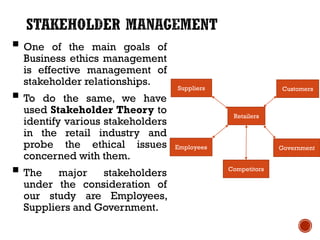
 One   of the main goals of
  Business ethics management
  is effective management of
  stakeholder relationships.
                                  Suppliers                 Customers
 To  do the same, we have
  used Stakeholder Theory to                   Retailers
  identify various stakeholders
  in the retail industry and
  probe the ethical issues        Employees                 Government
  concerned with them.
 The    major   stakeholders                 Competitors

  under the consideration of
  our study are Employees,
  Suppliers and Government.
EMPLOYEE RELATED ISSUES
 Global retailers are known for unfair workload or poor
  working conditions: working off the clock, being denied
  overtime pay etc.
 They hire most of the on-floor employees on a part-time
  basis and provide them low wages in comparison to the
  industry standards, without the regular benefits like
  insurance, health cover applicable for full time employees.
 All the employees are entitled to the rights of appropriate
  and safe working conditions along with benefits.
 Employers should act as agents to do all the above which is
  ethically right thing to do. Here as employers fail to fulfill
  their duties, it would result in a moral lapse thus violating
  the Deontology Theory of ethics.
EMPLOYEE RELATED ISSUES (CNTD.)

Suggestions:


 It is the duty of the employer to protect the rights of
  the employees and provide them with appropriate
  benefits for both part time and full time employees.
 Occupational Health and Safety measures disclosure
  should be made mandatory for organizations.
SUPPLIER RELATED ISSUES
• A big retailer has enough muscle power to determine the
    supplier prices and if the need be to lower the same to
    increase their own share of the pie.
•   Pressure of large companies on retailers: e.g. ITC allegedly
    forces its retailers to put their cigarette packets face-wise
    while that of competitors edge-wise [cigarette companies
    are not allowed to advertise their product].
•   Under stocking products of certain suppliers by retailers,
    giving unequal opportunity to certain suppliers.
•   The Utilitarian Theory states that the action should be
    morally right if it results in the greatest amount of good for
    the greatest number of people.
•   In this case, the focal firm would gain the maximum utility
    at the cost of other stakeholders like farmers, SMEs and
    standalone suppliers.
SUPPLIER RELATED ISSUES (CNTD.)

Suggestions:


 Developing   a regulatory framework to avoid
  monopolistic practices (like fear of predatory
  behaviour and abuse of dominance) under the
  supervision of CCI or an independent regulatory
  body in association with Retailers Association of India
  (RAI).
OTHER STAKEHOLDERS: GOVERNMENT

 Recently there was news regarding Walmart lobbying
  heavily in US for entry in India.
 With lobbying they are trying to influence the Indian
  Government by application of pressure from the US
  Government.
 This pressure might help them in influencing the
  formulation of regulations or preferential treatment.
 This issue gets even more serious in the light of
  corruption practices prevalent in India.
Ethical issues after walmarts entry in Indai

Ethical issues after walmarts entry in Indai

  • 1.
    Group 4 Chandra VeerSingh Dulawat (11BM60030) Mouli Ghatak (11BM60031) Arun Kabra (11BM60046)
  • 2.
    INDIAN RETAIL INDUSTRY One of the top five retail markets in the world.  Market size is estimated to be US$ 450 billion.  Projected as Prominent service industry with a substantial contribution to the GDP (about 15%).  Comprises of unorganized (90%) and organized (10%) sector.  Generates employment for about 40 million Indians (approximately 3.3% of Indian population).
  • 3.
    WHY RETAIL!  Retailsalespeople are likely to encounter situations that could be ethically troublesome.  The pressure of the job may place salespeople in uncomfortable situations that may be addressed using questionable behaviour.  The ethical behaviour of the retail salespeople is likely to be affected by their awareness of the company policies.  The needs and problems of the various stakeholders are likely to be incompatible.
  • 4.
    WHAT DREW OURATTENTION!  The Retail Business in India is currently at the point of inflection.  The Indian government has now allowed 51% FDI in multi-brand retail.  Global players like Walmart, Carrefour which have been plagued with multiple cases of ethical violations, would enter the Indian retail space.  Existing ethical issues in the retail sector have not been resolved yet. The existing ethical issues might get aggravated with the entry of these new players.  These new entrants have enough muscle power to influence the concerned authorities and the various stakeholders.
  • 5.
     One of the main goals of Business ethics management is effective management of stakeholder relationships. Suppliers Customers  To do the same, we have used Stakeholder Theory to Retailers identify various stakeholders in the retail industry and probe the ethical issues Employees Government concerned with them.  The major stakeholders Competitors under the consideration of our study are Employees, Suppliers and Government.
  • 6.
    EMPLOYEE RELATED ISSUES Global retailers are known for unfair workload or poor working conditions: working off the clock, being denied overtime pay etc.  They hire most of the on-floor employees on a part-time basis and provide them low wages in comparison to the industry standards, without the regular benefits like insurance, health cover applicable for full time employees.  All the employees are entitled to the rights of appropriate and safe working conditions along with benefits.  Employers should act as agents to do all the above which is ethically right thing to do. Here as employers fail to fulfill their duties, it would result in a moral lapse thus violating the Deontology Theory of ethics.
  • 7.
    EMPLOYEE RELATED ISSUES(CNTD.) Suggestions:  It is the duty of the employer to protect the rights of the employees and provide them with appropriate benefits for both part time and full time employees.  Occupational Health and Safety measures disclosure should be made mandatory for organizations.
  • 8.
    SUPPLIER RELATED ISSUES •A big retailer has enough muscle power to determine the supplier prices and if the need be to lower the same to increase their own share of the pie. • Pressure of large companies on retailers: e.g. ITC allegedly forces its retailers to put their cigarette packets face-wise while that of competitors edge-wise [cigarette companies are not allowed to advertise their product]. • Under stocking products of certain suppliers by retailers, giving unequal opportunity to certain suppliers. • The Utilitarian Theory states that the action should be morally right if it results in the greatest amount of good for the greatest number of people. • In this case, the focal firm would gain the maximum utility at the cost of other stakeholders like farmers, SMEs and standalone suppliers.
  • 9.
    SUPPLIER RELATED ISSUES(CNTD.) Suggestions:  Developing a regulatory framework to avoid monopolistic practices (like fear of predatory behaviour and abuse of dominance) under the supervision of CCI or an independent regulatory body in association with Retailers Association of India (RAI).
  • 10.
    OTHER STAKEHOLDERS: GOVERNMENT Recently there was news regarding Walmart lobbying heavily in US for entry in India.  With lobbying they are trying to influence the Indian Government by application of pressure from the US Government.  This pressure might help them in influencing the formulation of regulations or preferential treatment.  This issue gets even more serious in the light of corruption practices prevalent in India.