WAL-MART: SUPPLY CHAIN
MANAGEMENT
K.VARUN
123511
BACKGROUND
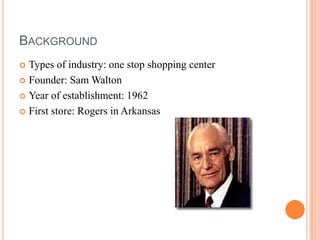
 Types of industry: one stop shopping center
 Founder: Sam Walton
 Year of establishment: 1962
 First store: Rogers in Arkansas
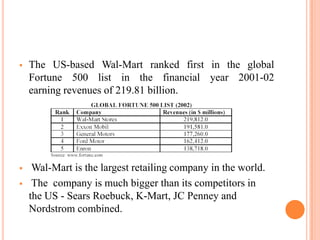
 The US-based Wal-Mart ranked first in the global
Fortune 500 list in the financial year 2001-02
earning revenues of 219.81 billion.
 Wal-Mart is the largest retailing company in the world.
 The company is much bigger than its competitors in
the US - Sears Roebuck, K-Mart, JC Penney and
Nordstrom combined.
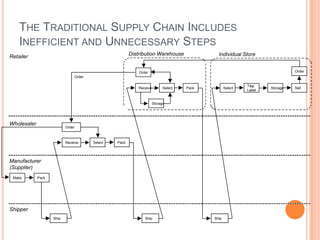
THE TRADITIONAL SUPPLY CHAIN INCLUDES
INEFFICIENT AND UNNECESSARY STEPS
Select
Tag/
Label
Ship
Pack
Ship
Select PackReceive
Ship
Manufacturer
(Supplier)
Retailer
Shipper
Wholesaler
Receive PackSelect Storage
Storage
Sell
Order
Individual StoreDistribution Warehouse
Order
Order
Order
Make
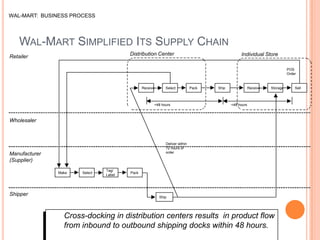
WAL-MART SIMPLIFIED ITS SUPPLY CHAIN
Ship Receive
Select
Ship
Manufacturer
(Supplier)
Retailer
Shipper
Wholesaler
Receive PackSelect Storage Sell
Individual StoreDistribution Center
Tag/
Label
PackMake
WAL-MART: BUSINESS PROCESS
Cross-docking in distribution centers results in product flow
from inbound to outbound shipping docks within 48 hours.
Deliver within
72 hours of
order
POS
Order
<48 hours<48 hours
6
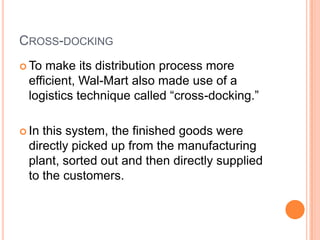
CROSS-DOCKING
 To make its distribution process more
efficient, Wal-Mart also made use of a
logistics technique called “cross-docking.”
 In this system, the finished goods were
directly picked up from the manufacturing
plant, sorted out and then directly supplied
to the customers.
7
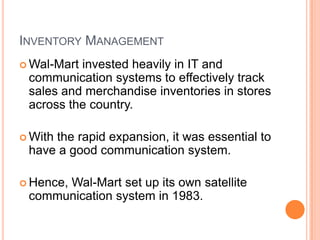
INVENTORY MANAGEMENT
 Wal-Mart invested heavily in IT and
communication systems to effectively track
sales and merchandise inventories in stores
across the country.
 With the rapid expansion, it was essential to
have a good communication system.
 Hence, Wal-Mart set up its own satellite
communication system in 1983.
8
INVENTORY MANAGEMENT…
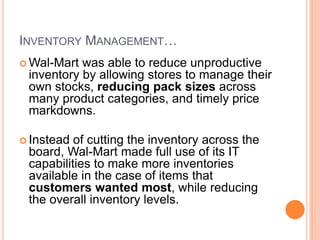
 Wal-Mart was able to reduce unproductive
inventory by allowing stores to manage their
own stocks, reducing pack sizes across
many product categories, and timely price
markdowns.
 Instead of cutting the inventory across the
board, Wal-Mart made full use of its IT
capabilities to make more inventories
available in the case of items that
customers wanted most, while reducing
the overall inventory levels.
9
INVENTORY MANAGEMENT…
 Employees at the stores had the “Magic
Wand,” a hand-held computer which was
linked to in-store terminals through a radio
frequency network.
 These helped them to keep track of the
inventory in stores, deliveries, and backup
merchandise in stock at the distribution
centers.
10
INVENTORY MANAGEMENT…
 The order management and store
replenishment of goods are entirely
executed with the help of computers
through the Point-of-Sales (POS) system.
 Through this system, it was possible to
monitor and track the sales and
merchandise stock levels on the store
shelves.
11
INVENTORY MANAGEMENT…
(QUICK REPLENISHMENT)
 Since the floor area of any Wal-Mart store
varied between 40,000 to 200,000 square
feet, movement of goods within the store
was an important part of logistics
operations.
 Wal-Mart made significant investments in IT
to quickly locate and replenish goods at the
stores.
12
INVENTORY MANAGEMENT…
(RETAIL LINK SYSTEM)
 In 1991, Wal-Mart had invested
approximately $4 billion to build a retail link
system.
 More than 10,000 Wal-Mart retail suppliers
used the retail link system to monitor the
sales of their goods at stores and replenish
inventories.
 Details of daily transactions (~10 million per
day) were processed through this system.
13
INVENTORY MANAGEMENT…
(RETAIL LINK SYSTEM)
 Retail Link connected Wal-Mart’s EDI network with
an extranet, accessible to Wal-Mart’s thousands of
suppliers.
 The suppliers could find out how their product was
performing vis-a-vis competitors’ products in a
particular product category.
WAL-MART INVESTS HEAVILY IN INFORMATION TECHNOLOGY
(CONT.)
 Various Quick-Response (QR) systems (retail-link) to allow direct store-to-
supplier ordering: “continuous replenishment”
Wal-Mart
Supplier
POS Data
Store
Vendor-managed QR
Supplier Store
Wal-Mart-managed
QR
Order
Wal-Mart
Supplier Store
Warehouse Just-in-Time
System
Distribution
Center
Distribution
Center
WAL-MART: BUSINESS PROCESS
POS Data
15
RFID TECHNOLOGY
(RADIO FREQUENCY IDENTIFICATION)
 In efforts to implement new technologies to
reduce costs and increase the efficiency, in July
2003, Wal-Mart asked its top 100 suppliers to be
RFID compliant by January, 2005.
 Wal-Mart planned to replace bar-code
technology with RFID technology.
 The company believed that this replacement
would reduce its supply chain management costs
and enhance efficiency.
16
RFID TECHNOLOGY
(RADIO FREQUENCY IDENTIFICATION)
 Because of the implementation of RFID,
employees were no longer required to
physically scan the bar codes of goods
entering the stores and distribution centers,
saving labor cost and time.
 Wal-Mart expected that RFID would reduce
the instances of stock-outs at the stores.
17
RFID TECHNOLOGY
(RADIO FREQUENCY IDENTIFICATION)
 Although Wal-Mart was optimistic about the
benefits of RFID, analysts felt that it would
impose a heavy burden on its suppliers.
 To make themselves RFID compliant, the
suppliers needed to incur an estimated $20
Million.
 Of this, an estimated %50 would be spent
on integrating the system and making
modifications in the supply chain software.
THE BENEFITS REAPED
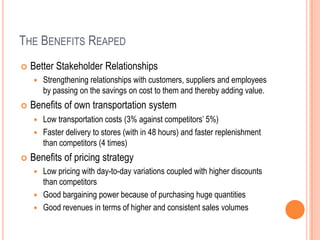
 Better Stakeholder Relationships
 Strengthening relationships with customers, suppliers and employees
by passing on the savings on cost to them and thereby adding value.
 Benefits of own transportation system
 Low transportation costs (3% against competitors’ 5%)
 Faster delivery to stores (with in 48 hours) and faster replenishment
than competitors (4 times)
 Benefits of pricing strategy
 Low pricing with day-to-day variations coupled with higher discounts
than competitors
 Good bargaining power because of purchasing huge quantities
 Good revenues in terms of higher and consistent sales volumes
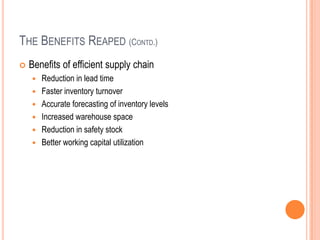
THE BENEFITS REAPED (CONTD.)
 Benefits of efficient supply chain
 Reduction in lead time
 Faster inventory turnover
 Accurate forecasting of inventory levels
 Increased warehouse space
 Reduction in safety stock
 Better working capital utilization
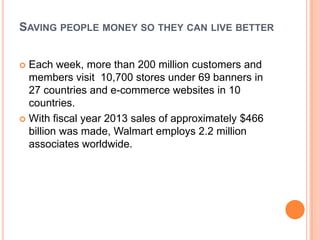
SAVING PEOPLE MONEY SO THEY CAN LIVE BETTER
 Each week, more than 200 million customers and
members visit 10,700 stores under 69 banners in
27 countries and e-commerce websites in 10
countries.
 With fiscal year 2013 sales of approximately $466
billion was made, Walmart employs 2.2 million
associates worldwide.

Wal mart

  • 1.
  • 2.
    BACKGROUND  Types ofindustry: one stop shopping center  Founder: Sam Walton  Year of establishment: 1962  First store: Rogers in Arkansas
  • 3.
     The US-basedWal-Mart ranked first in the global Fortune 500 list in the financial year 2001-02 earning revenues of 219.81 billion.  Wal-Mart is the largest retailing company in the world.  The company is much bigger than its competitors in the US - Sears Roebuck, K-Mart, JC Penney and Nordstrom combined.
  • 4.
    THE TRADITIONAL SUPPLYCHAIN INCLUDES INEFFICIENT AND UNNECESSARY STEPS Select Tag/ Label Ship Pack Ship Select PackReceive Ship Manufacturer (Supplier) Retailer Shipper Wholesaler Receive PackSelect Storage Storage Sell Order Individual StoreDistribution Warehouse Order Order Order Make
  • 5.
    WAL-MART SIMPLIFIED ITSSUPPLY CHAIN Ship Receive Select Ship Manufacturer (Supplier) Retailer Shipper Wholesaler Receive PackSelect Storage Sell Individual StoreDistribution Center Tag/ Label PackMake WAL-MART: BUSINESS PROCESS Cross-docking in distribution centers results in product flow from inbound to outbound shipping docks within 48 hours. Deliver within 72 hours of order POS Order <48 hours<48 hours
  • 6.
    6 CROSS-DOCKING  To makeits distribution process more efficient, Wal-Mart also made use of a logistics technique called “cross-docking.”  In this system, the finished goods were directly picked up from the manufacturing plant, sorted out and then directly supplied to the customers.
  • 7.
    7 INVENTORY MANAGEMENT  Wal-Martinvested heavily in IT and communication systems to effectively track sales and merchandise inventories in stores across the country.  With the rapid expansion, it was essential to have a good communication system.  Hence, Wal-Mart set up its own satellite communication system in 1983.
  • 8.
    8 INVENTORY MANAGEMENT…  Wal-Martwas able to reduce unproductive inventory by allowing stores to manage their own stocks, reducing pack sizes across many product categories, and timely price markdowns.  Instead of cutting the inventory across the board, Wal-Mart made full use of its IT capabilities to make more inventories available in the case of items that customers wanted most, while reducing the overall inventory levels.
  • 9.
    9 INVENTORY MANAGEMENT…  Employeesat the stores had the “Magic Wand,” a hand-held computer which was linked to in-store terminals through a radio frequency network.  These helped them to keep track of the inventory in stores, deliveries, and backup merchandise in stock at the distribution centers.
  • 10.
    10 INVENTORY MANAGEMENT…  Theorder management and store replenishment of goods are entirely executed with the help of computers through the Point-of-Sales (POS) system.  Through this system, it was possible to monitor and track the sales and merchandise stock levels on the store shelves.
  • 11.
    11 INVENTORY MANAGEMENT… (QUICK REPLENISHMENT) Since the floor area of any Wal-Mart store varied between 40,000 to 200,000 square feet, movement of goods within the store was an important part of logistics operations.  Wal-Mart made significant investments in IT to quickly locate and replenish goods at the stores.
  • 12.
    12 INVENTORY MANAGEMENT… (RETAIL LINKSYSTEM)  In 1991, Wal-Mart had invested approximately $4 billion to build a retail link system.  More than 10,000 Wal-Mart retail suppliers used the retail link system to monitor the sales of their goods at stores and replenish inventories.  Details of daily transactions (~10 million per day) were processed through this system.
  • 13.
    13 INVENTORY MANAGEMENT… (RETAIL LINKSYSTEM)  Retail Link connected Wal-Mart’s EDI network with an extranet, accessible to Wal-Mart’s thousands of suppliers.  The suppliers could find out how their product was performing vis-a-vis competitors’ products in a particular product category.
  • 14.
    WAL-MART INVESTS HEAVILYIN INFORMATION TECHNOLOGY (CONT.)  Various Quick-Response (QR) systems (retail-link) to allow direct store-to- supplier ordering: “continuous replenishment” Wal-Mart Supplier POS Data Store Vendor-managed QR Supplier Store Wal-Mart-managed QR Order Wal-Mart Supplier Store Warehouse Just-in-Time System Distribution Center Distribution Center WAL-MART: BUSINESS PROCESS POS Data
  • 15.
    15 RFID TECHNOLOGY (RADIO FREQUENCYIDENTIFICATION)  In efforts to implement new technologies to reduce costs and increase the efficiency, in July 2003, Wal-Mart asked its top 100 suppliers to be RFID compliant by January, 2005.  Wal-Mart planned to replace bar-code technology with RFID technology.  The company believed that this replacement would reduce its supply chain management costs and enhance efficiency.
  • 16.
    16 RFID TECHNOLOGY (RADIO FREQUENCYIDENTIFICATION)  Because of the implementation of RFID, employees were no longer required to physically scan the bar codes of goods entering the stores and distribution centers, saving labor cost and time.  Wal-Mart expected that RFID would reduce the instances of stock-outs at the stores.
  • 17.
    17 RFID TECHNOLOGY (RADIO FREQUENCYIDENTIFICATION)  Although Wal-Mart was optimistic about the benefits of RFID, analysts felt that it would impose a heavy burden on its suppliers.  To make themselves RFID compliant, the suppliers needed to incur an estimated $20 Million.  Of this, an estimated %50 would be spent on integrating the system and making modifications in the supply chain software.
  • 18.
    THE BENEFITS REAPED Better Stakeholder Relationships  Strengthening relationships with customers, suppliers and employees by passing on the savings on cost to them and thereby adding value.  Benefits of own transportation system  Low transportation costs (3% against competitors’ 5%)  Faster delivery to stores (with in 48 hours) and faster replenishment than competitors (4 times)  Benefits of pricing strategy  Low pricing with day-to-day variations coupled with higher discounts than competitors  Good bargaining power because of purchasing huge quantities  Good revenues in terms of higher and consistent sales volumes
  • 19.
    THE BENEFITS REAPED(CONTD.)  Benefits of efficient supply chain  Reduction in lead time  Faster inventory turnover  Accurate forecasting of inventory levels  Increased warehouse space  Reduction in safety stock  Better working capital utilization
  • 20.
    SAVING PEOPLE MONEYSO THEY CAN LIVE BETTER  Each week, more than 200 million customers and members visit 10,700 stores under 69 banners in 27 countries and e-commerce websites in 10 countries.  With fiscal year 2013 sales of approximately $466 billion was made, Walmart employs 2.2 million associates worldwide.