Hewlett Packard Company
Deskjet Printer Supply Chain
Prepared by :
Ali Yudhi
Azhar Harris
Irawati Cipto
Dame Reiny Manalu
About HP
Hewlett Packard Company was founded
in 1939 by William Hewlett and David
Packard.
Headquarters in Palo Alto, California.
In 1990, HP had over 50 operations
worldwide, with revenues of $13.2 billion
and net income $739 million.
DeskJet Printer
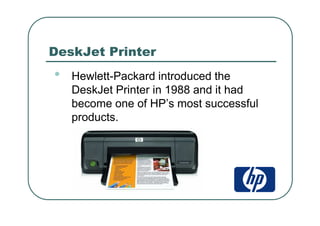
• Hewlett-Packard introduced the
DeskJet Printer in 1988 and it had
become one of HP’s most successful
products.
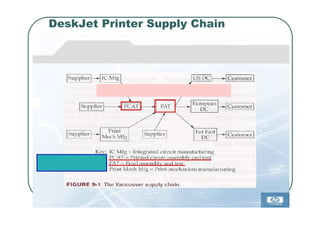
DeskJet Printer Supply Chain
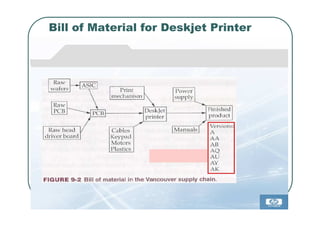
Bill of Material for Deskjet Printer
Manufacturing process
Printed Circuit Assembly and Test (PCAT)
* ASIC’s (Application Spesific Integrated
Circuits).
* ROM (Read Only Memory)
FAT (Final Assembly and Test)
The total factory cycle time through the PCAT
and FAT stages was about a week.
Manufacturing of the deskjet printer operated
in a pull mode.
The distribution process
Products from FAT sorted into three
groups destined : US DC, Europe DC,
and Asia DC.
The transportation time from Vancouver
to the US DC in California => 1 day.
Long shipment time about 4-5 weeks to
ship the printers to Europe and Asia =>
due to ocean transit and the time to clear
customs and duties at port of entry.
Distribution process
Line item fill rate (LIFR) calculated as the
total number of customer order line items
filled on time divided by the total number
of customer line items attempted.
Order fill rate (OFR) based on orders
completed, where an order contains
multiple line items.
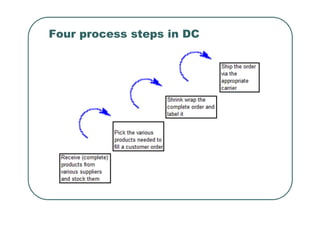
Four process steps in DC
Design Options for a distribution
network
Manufacturer Storage with Direct Shipping
•Manufacturer Storage with Direct Shipping and In-Transit Merge
•Distributor Storage with Carrier Delivery
•Distributor Storage with Last Mile Delivery
•Manufacturer or Distributor Storage with Consumer Pickup
•Retail Storage with Consumer Pickup
•Selecting a Distribution Network Design
Problem Identification
Uncertainty about how to set the correct inventory
level.
Different localization options make inventory difficult to
manage.
Long lead times due to transport using shipsand this in
turn adds difficulty to the forecasting process.
Shipment by ocean not by air takes four to five weeks
to ship the printers to Europe and Asia, the long lead
time means cannot faster reaction time to unexpected
changes in product mix.
High demand fluctuations in European markets leading
to higher levels of safety stocks.
Uncertainty in many local markets makes forecasting
difficult.
Uncertainty
Uncertainties in manufacturing process
The uncertainties in manufacturing process included
the delivery variability of incoming materials, process
yields and downtimes at the plant. The uncertainties
may increase the lead time and cause the shortage
of inventory at Distribution Center. Also,
manufacturing process don’t take into account in the
product design process, so the process not efficient
enough.
Uncertainty
Demand Uncertainties
Demand uncertainties could lead to inventory buildup or
back order at the Distribution Centers, especially at
European and Asian Distribution Centers. It is because
the transportation time from Vancouver to there requires
four to five weeks. Thus, the European and Asian
Distribution Centers’ ability to respond to fluctuations in
the demand for the different versions of the product is
limited. In order to assure high availability to customers,
high levels of safety stocks were set up. Therefore, it will
increase the inventory holding cost.
Recommendations
Improve forecasting system
Reduce lead time :
* Shipment by air freight
* Make a new plant between Asia and Europe to reduce
leadtime from FAT into DC.
ERP system implemented in DC to support
manufacturing.
Empowering e-Commerce
Using multiple facility location
Conclusion
Optimum inventory level can be obtained
by estimate the forecast more
accurately.
Safety stock is important for each DC to
ensure the availability stock in each DC
depends on the leadtime to each DC.
Hewlett packard company Hewlett Packard Company Deskjet Printer Supply Chain

Hewlett packard company Hewlett Packard Company Deskjet Printer Supply Chain

  • 1.
    Hewlett Packard Company DeskjetPrinter Supply Chain Prepared by : Ali Yudhi Azhar Harris Irawati Cipto Dame Reiny Manalu
  • 2.
    About HP Hewlett PackardCompany was founded in 1939 by William Hewlett and David Packard. Headquarters in Palo Alto, California. In 1990, HP had over 50 operations worldwide, with revenues of $13.2 billion and net income $739 million.
  • 3.
    DeskJet Printer • Hewlett-Packardintroduced the DeskJet Printer in 1988 and it had become one of HP’s most successful products.
  • 4.
  • 5.
    Bill of Materialfor Deskjet Printer
  • 6.
    Manufacturing process Printed CircuitAssembly and Test (PCAT) * ASIC’s (Application Spesific Integrated Circuits). * ROM (Read Only Memory) FAT (Final Assembly and Test) The total factory cycle time through the PCAT and FAT stages was about a week. Manufacturing of the deskjet printer operated in a pull mode.
  • 7.
    The distribution process Productsfrom FAT sorted into three groups destined : US DC, Europe DC, and Asia DC. The transportation time from Vancouver to the US DC in California => 1 day. Long shipment time about 4-5 weeks to ship the printers to Europe and Asia => due to ocean transit and the time to clear customs and duties at port of entry.
  • 8.
    Distribution process Line itemfill rate (LIFR) calculated as the total number of customer order line items filled on time divided by the total number of customer line items attempted. Order fill rate (OFR) based on orders completed, where an order contains multiple line items.
  • 9.
  • 10.
    Design Options fora distribution network Manufacturer Storage with Direct Shipping •Manufacturer Storage with Direct Shipping and In-Transit Merge •Distributor Storage with Carrier Delivery •Distributor Storage with Last Mile Delivery •Manufacturer or Distributor Storage with Consumer Pickup •Retail Storage with Consumer Pickup •Selecting a Distribution Network Design
  • 11.
    Problem Identification Uncertainty abouthow to set the correct inventory level. Different localization options make inventory difficult to manage. Long lead times due to transport using shipsand this in turn adds difficulty to the forecasting process. Shipment by ocean not by air takes four to five weeks to ship the printers to Europe and Asia, the long lead time means cannot faster reaction time to unexpected changes in product mix. High demand fluctuations in European markets leading to higher levels of safety stocks. Uncertainty in many local markets makes forecasting difficult.
  • 12.
    Uncertainty Uncertainties in manufacturingprocess The uncertainties in manufacturing process included the delivery variability of incoming materials, process yields and downtimes at the plant. The uncertainties may increase the lead time and cause the shortage of inventory at Distribution Center. Also, manufacturing process don’t take into account in the product design process, so the process not efficient enough.
  • 13.
    Uncertainty Demand Uncertainties Demand uncertaintiescould lead to inventory buildup or back order at the Distribution Centers, especially at European and Asian Distribution Centers. It is because the transportation time from Vancouver to there requires four to five weeks. Thus, the European and Asian Distribution Centers’ ability to respond to fluctuations in the demand for the different versions of the product is limited. In order to assure high availability to customers, high levels of safety stocks were set up. Therefore, it will increase the inventory holding cost.
  • 14.
    Recommendations Improve forecasting system Reducelead time : * Shipment by air freight * Make a new plant between Asia and Europe to reduce leadtime from FAT into DC. ERP system implemented in DC to support manufacturing. Empowering e-Commerce Using multiple facility location
  • 15.
    Conclusion Optimum inventory levelcan be obtained by estimate the forecast more accurately. Safety stock is important for each DC to ensure the availability stock in each DC depends on the leadtime to each DC.