
West Marine: Driving Growth
Through Shipshape Supply Chain
         Management
                          CASE ANALYSIS


             Presented By:
             Ashish Mehta (11BM60079)
             Manish Gupta (11BM60100)
             Harpreet Kaur (11BM60111)
             Harsh Kr. Srivastava (11BM60122)
Challenges

 Boat US has same number of stores as E&B Marine
 Integration of business difficult because of growing catalog and
    wholesale business
   Boat US port supply division is less mature
   Customer base not clearly defined for Boat US
   Boat US home staff is not being acquired so limited info and
    assistance from legacy system
   Only 10k common SKU
   750 suppliers with only 100 common.
   Both use EDI but 30% of transactions of Boat US are integrated
   Boat US does not have CPFR
   Pricing is different because of different suppliers
   Product assortments are less well defined for Boat US
Current Options

 Supplier integration through CPFR
 Internal as well as external integration is needed to
  succeed.
 Two strategies are possible
    Dual branding strategy
    Merger of two brands
CPFR

 Single Shared forecast for all trading partners
 Point-of-sale data used for forecasting.
 Minimization of Bullwhip effect
 Joint & mutual replenishment activities
 Clear performance measures set.
 Risks are monetized to show clear financial
  consequences.
 Incentives to drive the collaborative effort.
 Gains by its application in the E&B case.
Strengths

 CPFR experience from previous merger has to be
  leveraged in Boat US merger
 Bar code and RFID is available
 Boat US warehouse management systems
  comparable with West Marine but not directly
  compatible
 Hardware is same as West Marine but software is
  different
The Right Replenishment System

 Data such as seasonal forecasts, promotion stock levels, and future
  assortment changes are automatically calculated so that the retailer
  gets a reliable projection of its future orders and so that suppliers can
  continually deliver accurate, on-time orders to the DCs
 The resulting order forecast is in the form of machine-readable data
  that can be entered into a supplier’s materials requirement planning
  (MRP) or enterprise resource planning (ERP) system to represent a
  key customer’s demand.
 The store system uses actual customer-purchase data to forecast
  future customer purchases and what the store needs to order to
  support retail-service levels and in-stock levels. But the warehouse
  system has no data about store-level overstocks or understocks, and
  promotional needs must be forecasted in both platforms.
The Right Replenishment System

Cont…

 Reports to its collaborative supplier teams
     weekly automated e-mail containing our current purchase forecast by
      item and week for a year
      a weekly automated e-mail containing key in-stock and late-shipping
      information, covering the metrics achieved and the items that failed to
      meet goals
      a monthly automated e-mail giving audit-level detail and performance
      measurement on each supplier’s shipping record based on the supplier’s
      advanced ship notices.
Multiple Routes to Supplier Buy-In

 Prior to the CPFR program, the only contact a supplier might
  have with West Marine was usually with a customer-service
  clerk. Today, all collaborative suppliers join monthly and
  quarterly meetings
 Encourage the “point people” on both sides to be powerful
  collaboration champions in their respective organizations
 West Marine adopted cross-functional management and
  accountability and they adopt team approaches to conducting
  supply chain activities. They also start to harmonize conflicting
  “silo” goals and metrics throughout their operations.
Multiple Routes to Supplier Buy-In
Cont…
 An engagement usually begins with a quarterly meeting.
 The quarterly meetings are held at West Marine’s offices or at the
  supplier’s location; they usually entail a half day devoted to supply
  chain collaboration and a half day devoted to sales and marketing
  planning.
 The supply chain portion includes a session on West Marine’s
  bottom-up forecasting process and a wide-ranging discussion of
  initiatives and opportunities. The initiatives are detailed by West
  Marine’s supply chain captains, who must manage the solution
  process and timeline.
 Since senior executives are present, each side is expected to commit to
  resources and timelines for the improvements identified. They don’t
  advocate a formal collaboration agreement, but they do expect a
  flexible commitment to their mutual success from both sides.
Multiple Routes to Supplier Buy-In

Cont…
 As with the quarterly meetings, the “routine” or monthly meetings
  have defined formats and expectations. The format is usually a
  conference call attended at least by the two partners—West Marine’s
  supply chain captain and suppliers.
 The meeting is usually kept short to make it efficient and effective and
  to encourage other key participants to attend, since they can expect
  the meeting will be concise, businesslike, and productive.
 The agenda is three-part:
   Review results ;

   Report on and manage current initiatives by assigning clear
     owners, accountabilities, and deliverable dates; and
   Resolve any supply chain constraints identified through review of
     the order forecast.
Internal Collaboration

 Category managers and their assistants operated primarily as sole
    practitioners.
   Merchandise planners and replenishment analysts often dealt with
    supply chain management as a downstream effort. Communication
    between the co-located teams was often pretty poor.
   Merchandising associates owned sales and margin.
   Replenishment associates were responsible for inventory and
    service levels. Yet many of the specific responsibilities were ill-
    defined and inconsistent.
   For instance, since initial product forecasts and store assortment
    decisions were the purview of category management, some of the
    most important determinants of inventory performance were not
    the job of the inventory management group.
   Internal collaboration is all the more important because Boat US
    Employees are not being merged.
10 performance-improvement steps to
 reflect “full strength” approach to CPFR
1. Seek long-term, holistic solutions, not quick or myopic fixes.
2. Reconcile conflicting goals and metrics.
3. Pursue inclusive problem-solving; do not depend upon
  “experts” who don’t have accountability for the business.
4. Instill collaborative processes that encourage idea creation,
  shared problem solving, and high adoption rates across
  organizational boundaries.
5. Use a disciplined and iterative set of methodologies such as
  CPFR, SCOR, or Six Sigma to help teams define issues, root
  causes, and solutions.
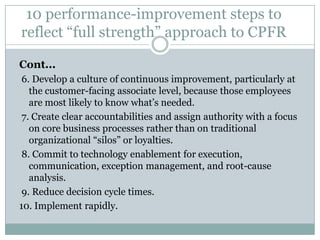
10 performance-improvement steps to
reflect “full strength” approach to CPFR

Cont...
 6. Develop a culture of continuous improvement, particularly at
   the customer-facing associate level, because those employees
   are most likely to know what’s needed.
 7. Create clear accountabilities and assign authority with a focus
   on core business processes rather than on traditional
   organizational “silos” or loyalties.
 8. Commit to technology enablement for execution,
   communication, exception management, and root-cause
   analysis.
 9. Reduce decision cycle times.
10. Implement rapidly.
Thank You

West marine case study final

  • 1.
    West Marine: DrivingGrowth Through Shipshape Supply Chain Management CASE ANALYSIS Presented By: Ashish Mehta (11BM60079) Manish Gupta (11BM60100) Harpreet Kaur (11BM60111) Harsh Kr. Srivastava (11BM60122)
  • 2.
    Challenges  Boat UShas same number of stores as E&B Marine  Integration of business difficult because of growing catalog and wholesale business  Boat US port supply division is less mature  Customer base not clearly defined for Boat US  Boat US home staff is not being acquired so limited info and assistance from legacy system  Only 10k common SKU  750 suppliers with only 100 common.  Both use EDI but 30% of transactions of Boat US are integrated  Boat US does not have CPFR  Pricing is different because of different suppliers  Product assortments are less well defined for Boat US
  • 3.
    Current Options  Supplierintegration through CPFR  Internal as well as external integration is needed to succeed.  Two strategies are possible  Dual branding strategy  Merger of two brands
  • 4.
    CPFR  Single Sharedforecast for all trading partners  Point-of-sale data used for forecasting.  Minimization of Bullwhip effect  Joint & mutual replenishment activities  Clear performance measures set.  Risks are monetized to show clear financial consequences.  Incentives to drive the collaborative effort.  Gains by its application in the E&B case.
  • 5.
    Strengths  CPFR experiencefrom previous merger has to be leveraged in Boat US merger  Bar code and RFID is available  Boat US warehouse management systems comparable with West Marine but not directly compatible  Hardware is same as West Marine but software is different
  • 6.
    The Right ReplenishmentSystem  Data such as seasonal forecasts, promotion stock levels, and future assortment changes are automatically calculated so that the retailer gets a reliable projection of its future orders and so that suppliers can continually deliver accurate, on-time orders to the DCs  The resulting order forecast is in the form of machine-readable data that can be entered into a supplier’s materials requirement planning (MRP) or enterprise resource planning (ERP) system to represent a key customer’s demand.  The store system uses actual customer-purchase data to forecast future customer purchases and what the store needs to order to support retail-service levels and in-stock levels. But the warehouse system has no data about store-level overstocks or understocks, and promotional needs must be forecasted in both platforms.
  • 7.
    The Right ReplenishmentSystem Cont…  Reports to its collaborative supplier teams  weekly automated e-mail containing our current purchase forecast by item and week for a year  a weekly automated e-mail containing key in-stock and late-shipping information, covering the metrics achieved and the items that failed to meet goals  a monthly automated e-mail giving audit-level detail and performance measurement on each supplier’s shipping record based on the supplier’s advanced ship notices.
  • 8.
    Multiple Routes toSupplier Buy-In  Prior to the CPFR program, the only contact a supplier might have with West Marine was usually with a customer-service clerk. Today, all collaborative suppliers join monthly and quarterly meetings  Encourage the “point people” on both sides to be powerful collaboration champions in their respective organizations  West Marine adopted cross-functional management and accountability and they adopt team approaches to conducting supply chain activities. They also start to harmonize conflicting “silo” goals and metrics throughout their operations.
  • 9.
    Multiple Routes toSupplier Buy-In Cont…  An engagement usually begins with a quarterly meeting.  The quarterly meetings are held at West Marine’s offices or at the supplier’s location; they usually entail a half day devoted to supply chain collaboration and a half day devoted to sales and marketing planning.  The supply chain portion includes a session on West Marine’s bottom-up forecasting process and a wide-ranging discussion of initiatives and opportunities. The initiatives are detailed by West Marine’s supply chain captains, who must manage the solution process and timeline.  Since senior executives are present, each side is expected to commit to resources and timelines for the improvements identified. They don’t advocate a formal collaboration agreement, but they do expect a flexible commitment to their mutual success from both sides.
  • 10.
    Multiple Routes toSupplier Buy-In Cont…  As with the quarterly meetings, the “routine” or monthly meetings have defined formats and expectations. The format is usually a conference call attended at least by the two partners—West Marine’s supply chain captain and suppliers.  The meeting is usually kept short to make it efficient and effective and to encourage other key participants to attend, since they can expect the meeting will be concise, businesslike, and productive.  The agenda is three-part:  Review results ;  Report on and manage current initiatives by assigning clear owners, accountabilities, and deliverable dates; and  Resolve any supply chain constraints identified through review of the order forecast.
  • 11.
    Internal Collaboration  Categorymanagers and their assistants operated primarily as sole practitioners.  Merchandise planners and replenishment analysts often dealt with supply chain management as a downstream effort. Communication between the co-located teams was often pretty poor.  Merchandising associates owned sales and margin.  Replenishment associates were responsible for inventory and service levels. Yet many of the specific responsibilities were ill- defined and inconsistent.  For instance, since initial product forecasts and store assortment decisions were the purview of category management, some of the most important determinants of inventory performance were not the job of the inventory management group.  Internal collaboration is all the more important because Boat US Employees are not being merged.
  • 12.
    10 performance-improvement stepsto reflect “full strength” approach to CPFR 1. Seek long-term, holistic solutions, not quick or myopic fixes. 2. Reconcile conflicting goals and metrics. 3. Pursue inclusive problem-solving; do not depend upon “experts” who don’t have accountability for the business. 4. Instill collaborative processes that encourage idea creation, shared problem solving, and high adoption rates across organizational boundaries. 5. Use a disciplined and iterative set of methodologies such as CPFR, SCOR, or Six Sigma to help teams define issues, root causes, and solutions.
  • 13.
    10 performance-improvement stepsto reflect “full strength” approach to CPFR Cont... 6. Develop a culture of continuous improvement, particularly at the customer-facing associate level, because those employees are most likely to know what’s needed. 7. Create clear accountabilities and assign authority with a focus on core business processes rather than on traditional organizational “silos” or loyalties. 8. Commit to technology enablement for execution, communication, exception management, and root-cause analysis. 9. Reduce decision cycle times. 10. Implement rapidly.
  • 14.