UG Sem-III
Chemistry
Paper: CC-5
Inorganic Chemistry
Chapter -6
Co-ordination compounds
Lecture-1
by
Dr. Chandrani Sarkar
Department of Chemistry
Mahila College, Chaibasa
(A constituent college of Kolhan University)
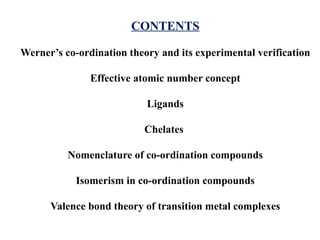
CONTENTS
Werner’s co-ordination theory and its experimental verification
Effective atomic number concept
Ligands
Chelates
Nomenclature of co-ordination compounds
Isomerism in co-ordination compounds
Valence bond theory of transition metal complexes
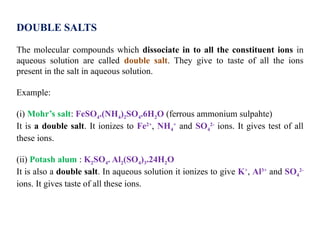
DOUBLE SALTS
The molecular compounds which dissociate in to all the constituent ions in
aqueous solution are called double salt. They give to taste of all the ions
present in the salt in aqueous solution.
Example:
(i) Mohr’s salt: FeSO4.(NH4)2SO4.6H2O (ferrous ammonium sulpahte)
It is a double salt. It ionizes to Fe2+
, NH4
+
and SO4
2-
ions. It gives test of all
these ions.
(ii) Potash alum : K2SO4. Al2(SO4)3.24H2O
It is also a double salt. In aqueous solution it ionizes to give K+
, Al3+
and SO4
2-
ions. It gives taste of all these ions.
CO-ORDINATION COMPOUNDS: Co-ordination compounds are
molecular compounds which do not dissociate in to all the constituent ions in
aqueous solution. They consist-
(i) Simple cation + complex anion
Example : K3[Fe(CN)6] 3K+
+ [Fe(CN)6]3-
simple cation complex anion
(ii) Complex cation + simple anion
[Cu(NH3)4]SO4 [Cu(NH3)4]2+
+ SO4
2-
complex cation simple anion
(iii) Complex cation + complex anion
[Pt(NH3)4][Cu(CN)4] [Pt(NH3)4]2+
+ [Cu(CN)4]2-
complex cation complex anion
(iv) Complex neutral molecules
Ni(CO)4, Fe(CO)5
COMPLEX ION: A complex ion consists -
(i) Co-ordination sphere shown by [ ].
(ii) Central metal ion (M)
(iii) Oxidation state (OS) of central metal ion
(iv) Ligands (L)
(v) Co-ordination number (CN) of metal ion
Example: [Cu(NH3)4]2+
Metal ion: Cu2+
; OS of Cu: +2
Ligands: NH3; CN of Cu(II) =4
In complex ion-
(i) The central metal ion is Lewis acid and can accept pair of electrons.
(ii) Ligands are Lewis base and can donate pair of electrons.
(iii) Co-ordinate bonds are formed between ligands and metal ion
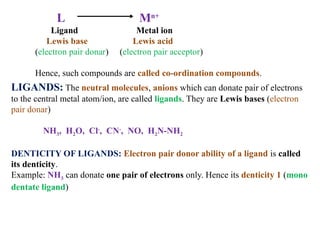
LIGANDS: The neutral molecules, anions which can donate pair of electrons
to the central metal atom/ion, are called ligands. They are Lewis bases (electron
pair donar)
NH3, H2O, Cl-
, CN-
, NO, H2N-NH2
DENTICITY OF LIGANDS: Electron pair donor ability of a ligand is called
its denticity.
Example: NH3 can donate one pair of electrons only. Hence its denticity 1 (mono
dentate ligand)
L Mn+
Ligand Metal ion
Lewis base Lewis acid
(electron pair donar) (electron pair acceptor)
Hence, such compounds are called co-ordination compounds.
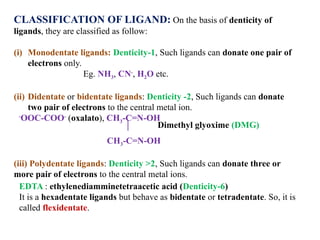
CLASSIFICATION OF LIGAND: On the basis of denticity of
ligands, they are classified as follow:
(i) Monodentate ligands: Denticity-1, Such ligands can donate one pair of
electrons only.
Eg. NH3, CN-
, H2O etc.
(ii) Didentate or bidentate ligands: Denticity -2, Such ligands can donate
two pair of electrons to the central metal ion.
-
OOC-COO-
(oxalato), CH3-C=N-OH
CH3-C=N-OH
(iii) Polydentate ligands: Denticity >2, Such ligands can donate three or
more pair of electrons to the central metal ions.
EDTA : ethylenediamminetetraacetic acid (Denticity-6)
It is a hexadentate ligands but behave as bidentate or tetradentate. So, it is
called flexidentate.
Dimethyl glyoxime (DMG)
CHELATING LIGANDS: Bidentate and poly dentate ligands form ring
compounds with the central metal ion. Such ligands are called chelating ligands
and the complex is called chelate.
Example: en (ethylenediammine), EDTA (ethylenediamminetetraacetic acid)
CHELATES: The ring or cyclic structure formed when a bidentate or
polydentate ligand is attached by two or more donor atom to the same central
metal ion, is called a chelate.
Such ligands which bind the metal atom through two or more donor atoms are
called chelating ligands.
Example : [Cu(en)2]2+
[en (ethylene diammine) is a bidentate ligand]
CH2 H2N NH2 CH2 CH2 H2N NH2 CH2
+ Cu2+
+ Cu
CH2 H2N NH2 CH2 CH2 H2N NH2 CH2
Bis(ethylenediammine)copper(II) ion
2+ 2+
IMPORTANCE OF CHELATES :
Chelates are more stable than non-chelates.
The stability of complexes also depend upon the following factors-
1. Number of chelate rings: A chelate in which more number of rings are
formed is more stable i.e. larger the number of chelate rings in the
complexes, greater is its stability.
Example: stability is in the order:
[Ni(en)3]2+
> [Ni(en)2(H2O)2]2+
> [Ni(en)(H2O)4]2+
> [Ni(H2O)6]2+
3 rings 2 rings 1 ring no ring
2. Size of the chelate rings: Metal chelates with five membered rings have been
found to be more stable.
Example: [Cu(en)2]2+
has two five membered rings.
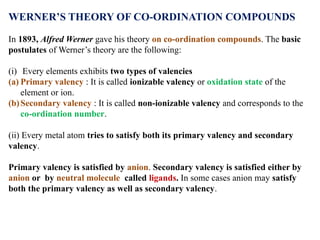
WERNER’S THEORY OF CO-ORDINATION COMPOUNDS
In 1893, Alfred Werner gave his theory on co-ordination compounds. The basic
postulates of Werner’s theory are the following:
(i) Every elements exhibits two types of valencies
(a) Primary valency : It is called ionizable valency or oxidation state of the
element or ion.
(b)Secondary valency : It is called non-ionizable valency and corresponds to the
co-ordination number.
(ii) Every metal atom tries to satisfy both its primary valency and secondary
valency.
Primary valency is satisfied by anion. Secondary valency is satisfied either by
anion or by neutral molecule called ligands. In some cases anion may satisfy
both the primary valency as well as secondary valency.
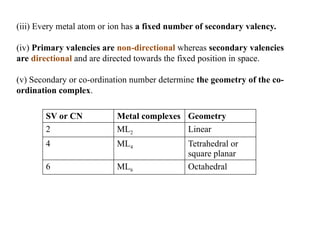
SV or CN Metal complexes Geometry
2 ML2 Linear
4 ML4 Tetrahedral or
square planar
6 ML6 Octahedral
(iii) Every metal atom or ion has a fixed number of secondary valency.
(iv) Primary valencies are non-directional whereas secondary valencies
are directional and are directed towards the fixed position in space.
(v) Secondary or co-ordination number determine the geometry of the co-
ordination complex.
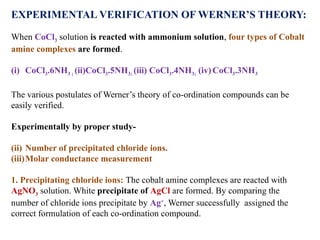
EXPERIMENTAL VERIFICATION OF WERNER’S THEORY:
When CoCl3 solution is reacted with ammonium solution, four types of Cobalt
amine complexes are formed.
(i) CoCl3.6NH3 ; (ii)CoCl3.5NH3; (iii) CoCl3.4NH3; (iv)CoCl3.3NH3
The various postulates of Werner’s theory of co-ordination compounds can be
easily verified.
Experimentally by proper study-
(ii) Number of precipitated chloride ions.
(iii)Molar conductance measurement
1. Precipitating chloride ions: The cobalt amine complexes are reacted with
AgNO3 solution. White precipitate of AgCl are formed. By comparing the
number of chloride ions precipitate by Ag+
, Werner successfully assigned the
correct formulation of each co-ordination compound.
CoCl3.6NH3 3 mols of AgCl ppt
CoCl3.5NH3 2 mols of AgCl ppt
CoCl3.4NH3 1 mol of AgCl ppt
CoCl3.3NH3 No ppt
Therefore, the number of ionizable chlorides ions are 3Cl-
, 2Cl-
, Cl-
and zero,
respectively. Hence, the formula of complexes will be-
(i) [Co(NH3)6]Cl3 (ii) [Co(NH3)5Cl]Cl2
(iii) [Co(NH3)4Cl2]Cl (iv) [Co(NH3)3Cl3]
Cobalt amines Molar conductance
(Ω-1
cm2
mol-1
)
No. of ions/
charge
Structural
formula
CoCl3.6NH3 395 4 (+3, -3) [Co(NH3)6]Cl3
CoCl3.5NH3 265 3 (+2, -2) [Co(NH3)5Cl]Cl2
CoCl3.4NH3 108 2(+1, -1) [Co(NH3)4Cl2]Cl
CoCl3.3NH3 0 0 [Co(NH3)3Cl3]
In all the four amines PV of Co = +3 satisfied by 3Cl-
ions
SV of Co =6
Structure = octahedral
(ii) Molar conductance measurement: This method gives number of ions and
charge on ions. The experimental value and result are as follow-
LIMITATIONS OF WENER’S THEORY:
This theory doesn’t explain-
(i) Stability of complexes
(ii) Magnetic properties, colour and electronic spectra of complexes
(iii)Nature of ligands and the types of orbitals involved in the bonding.

1st lecture on Co-ordination compounds.pptx

  • 1.
    UG Sem-III Chemistry Paper: CC-5 InorganicChemistry Chapter -6 Co-ordination compounds Lecture-1 by Dr. Chandrani Sarkar Department of Chemistry Mahila College, Chaibasa (A constituent college of Kolhan University)
  • 2.
    CONTENTS Werner’s co-ordination theoryand its experimental verification Effective atomic number concept Ligands Chelates Nomenclature of co-ordination compounds Isomerism in co-ordination compounds Valence bond theory of transition metal complexes
  • 3.
    DOUBLE SALTS The molecularcompounds which dissociate in to all the constituent ions in aqueous solution are called double salt. They give to taste of all the ions present in the salt in aqueous solution. Example: (i) Mohr’s salt: FeSO4.(NH4)2SO4.6H2O (ferrous ammonium sulpahte) It is a double salt. It ionizes to Fe2+ , NH4 + and SO4 2- ions. It gives test of all these ions. (ii) Potash alum : K2SO4. Al2(SO4)3.24H2O It is also a double salt. In aqueous solution it ionizes to give K+ , Al3+ and SO4 2- ions. It gives taste of all these ions.
  • 4.
    CO-ORDINATION COMPOUNDS: Co-ordinationcompounds are molecular compounds which do not dissociate in to all the constituent ions in aqueous solution. They consist- (i) Simple cation + complex anion Example : K3[Fe(CN)6] 3K+ + [Fe(CN)6]3- simple cation complex anion (ii) Complex cation + simple anion [Cu(NH3)4]SO4 [Cu(NH3)4]2+ + SO4 2- complex cation simple anion (iii) Complex cation + complex anion [Pt(NH3)4][Cu(CN)4] [Pt(NH3)4]2+ + [Cu(CN)4]2- complex cation complex anion (iv) Complex neutral molecules Ni(CO)4, Fe(CO)5
  • 5.
    COMPLEX ION: Acomplex ion consists - (i) Co-ordination sphere shown by [ ]. (ii) Central metal ion (M) (iii) Oxidation state (OS) of central metal ion (iv) Ligands (L) (v) Co-ordination number (CN) of metal ion Example: [Cu(NH3)4]2+ Metal ion: Cu2+ ; OS of Cu: +2 Ligands: NH3; CN of Cu(II) =4 In complex ion- (i) The central metal ion is Lewis acid and can accept pair of electrons. (ii) Ligands are Lewis base and can donate pair of electrons. (iii) Co-ordinate bonds are formed between ligands and metal ion
  • 6.
    LIGANDS: The neutralmolecules, anions which can donate pair of electrons to the central metal atom/ion, are called ligands. They are Lewis bases (electron pair donar) NH3, H2O, Cl- , CN- , NO, H2N-NH2 DENTICITY OF LIGANDS: Electron pair donor ability of a ligand is called its denticity. Example: NH3 can donate one pair of electrons only. Hence its denticity 1 (mono dentate ligand) L Mn+ Ligand Metal ion Lewis base Lewis acid (electron pair donar) (electron pair acceptor) Hence, such compounds are called co-ordination compounds.
  • 7.
    CLASSIFICATION OF LIGAND:On the basis of denticity of ligands, they are classified as follow: (i) Monodentate ligands: Denticity-1, Such ligands can donate one pair of electrons only. Eg. NH3, CN- , H2O etc. (ii) Didentate or bidentate ligands: Denticity -2, Such ligands can donate two pair of electrons to the central metal ion. - OOC-COO- (oxalato), CH3-C=N-OH CH3-C=N-OH (iii) Polydentate ligands: Denticity >2, Such ligands can donate three or more pair of electrons to the central metal ions. EDTA : ethylenediamminetetraacetic acid (Denticity-6) It is a hexadentate ligands but behave as bidentate or tetradentate. So, it is called flexidentate. Dimethyl glyoxime (DMG)
  • 8.
    CHELATING LIGANDS: Bidentateand poly dentate ligands form ring compounds with the central metal ion. Such ligands are called chelating ligands and the complex is called chelate. Example: en (ethylenediammine), EDTA (ethylenediamminetetraacetic acid) CHELATES: The ring or cyclic structure formed when a bidentate or polydentate ligand is attached by two or more donor atom to the same central metal ion, is called a chelate. Such ligands which bind the metal atom through two or more donor atoms are called chelating ligands. Example : [Cu(en)2]2+ [en (ethylene diammine) is a bidentate ligand] CH2 H2N NH2 CH2 CH2 H2N NH2 CH2 + Cu2+ + Cu CH2 H2N NH2 CH2 CH2 H2N NH2 CH2 Bis(ethylenediammine)copper(II) ion 2+ 2+
  • 9.
    IMPORTANCE OF CHELATES: Chelates are more stable than non-chelates. The stability of complexes also depend upon the following factors- 1. Number of chelate rings: A chelate in which more number of rings are formed is more stable i.e. larger the number of chelate rings in the complexes, greater is its stability. Example: stability is in the order: [Ni(en)3]2+ > [Ni(en)2(H2O)2]2+ > [Ni(en)(H2O)4]2+ > [Ni(H2O)6]2+ 3 rings 2 rings 1 ring no ring 2. Size of the chelate rings: Metal chelates with five membered rings have been found to be more stable. Example: [Cu(en)2]2+ has two five membered rings.
  • 10.
    WERNER’S THEORY OFCO-ORDINATION COMPOUNDS In 1893, Alfred Werner gave his theory on co-ordination compounds. The basic postulates of Werner’s theory are the following: (i) Every elements exhibits two types of valencies (a) Primary valency : It is called ionizable valency or oxidation state of the element or ion. (b)Secondary valency : It is called non-ionizable valency and corresponds to the co-ordination number. (ii) Every metal atom tries to satisfy both its primary valency and secondary valency. Primary valency is satisfied by anion. Secondary valency is satisfied either by anion or by neutral molecule called ligands. In some cases anion may satisfy both the primary valency as well as secondary valency.
  • 11.
    SV or CNMetal complexes Geometry 2 ML2 Linear 4 ML4 Tetrahedral or square planar 6 ML6 Octahedral (iii) Every metal atom or ion has a fixed number of secondary valency. (iv) Primary valencies are non-directional whereas secondary valencies are directional and are directed towards the fixed position in space. (v) Secondary or co-ordination number determine the geometry of the co- ordination complex.
  • 12.
    EXPERIMENTAL VERIFICATION OFWERNER’S THEORY: When CoCl3 solution is reacted with ammonium solution, four types of Cobalt amine complexes are formed. (i) CoCl3.6NH3 ; (ii)CoCl3.5NH3; (iii) CoCl3.4NH3; (iv)CoCl3.3NH3 The various postulates of Werner’s theory of co-ordination compounds can be easily verified. Experimentally by proper study- (ii) Number of precipitated chloride ions. (iii)Molar conductance measurement 1. Precipitating chloride ions: The cobalt amine complexes are reacted with AgNO3 solution. White precipitate of AgCl are formed. By comparing the number of chloride ions precipitate by Ag+ , Werner successfully assigned the correct formulation of each co-ordination compound.
  • 13.
    CoCl3.6NH3 3 molsof AgCl ppt CoCl3.5NH3 2 mols of AgCl ppt CoCl3.4NH3 1 mol of AgCl ppt CoCl3.3NH3 No ppt Therefore, the number of ionizable chlorides ions are 3Cl- , 2Cl- , Cl- and zero, respectively. Hence, the formula of complexes will be- (i) [Co(NH3)6]Cl3 (ii) [Co(NH3)5Cl]Cl2 (iii) [Co(NH3)4Cl2]Cl (iv) [Co(NH3)3Cl3]
  • 14.
    Cobalt amines Molarconductance (Ω-1 cm2 mol-1 ) No. of ions/ charge Structural formula CoCl3.6NH3 395 4 (+3, -3) [Co(NH3)6]Cl3 CoCl3.5NH3 265 3 (+2, -2) [Co(NH3)5Cl]Cl2 CoCl3.4NH3 108 2(+1, -1) [Co(NH3)4Cl2]Cl CoCl3.3NH3 0 0 [Co(NH3)3Cl3] In all the four amines PV of Co = +3 satisfied by 3Cl- ions SV of Co =6 Structure = octahedral (ii) Molar conductance measurement: This method gives number of ions and charge on ions. The experimental value and result are as follow- LIMITATIONS OF WENER’S THEORY: This theory doesn’t explain- (i) Stability of complexes (ii) Magnetic properties, colour and electronic spectra of complexes (iii)Nature of ligands and the types of orbitals involved in the bonding.