Coordination /complexation
Lecture two
PhD. Pharmaceutical chemistry
M.Sc. Pharmaceutical chemistry
B.Sc. pharmacy
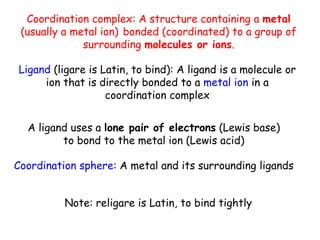
Coordination complex: A structure containing a metal
(usually a metal ion) bonded (coordinated) to a group of
surrounding molecules or ions.
Ligand (ligare is Latin, to bind): A ligand is a molecule or
ion that is directly bonded to a metal ion in a
coordination complex
Coordination sphere: A metal and its surrounding ligands
Note: religare is Latin, to bind tightly
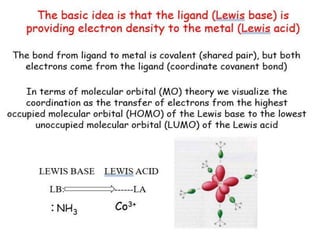
A ligand uses a lone pair of electrons (Lewis base)
to bond to the metal ion (Lewis acid)
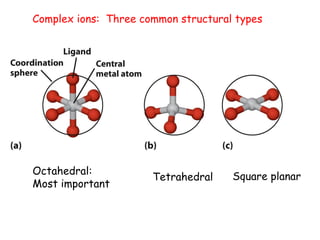
Complex ions: Three common structural types
Octahedral:
Most important
Tetrahedral Square planar
4
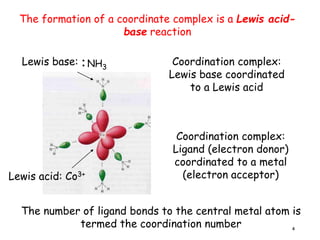
Lewis acid: Co3+
Lewis base: NH3
Coordination complex:
Lewis base coordinated
to a Lewis acid
Coordination complex:
Ligand (electron donor)
coordinated to a metal
(electron acceptor)
The formation of a coordinate complex is a Lewis acid-
base reaction
The number of ligand bonds to the central metal atom is
termed the coordination number
5
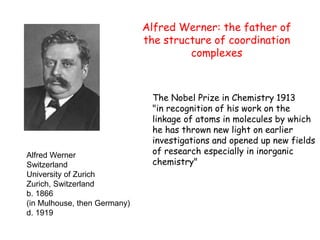
Alfred Werner
Switzerland
University of Zurich
Zurich, Switzerland
b. 1866
(in Mulhouse, then Germany)
d. 1919
The Nobel Prize in Chemistry 1913
"in recognition of his work on the
linkage of atoms in molecules by which
he has thrown new light on earlier
investigations and opened up new fields
of research especially in inorganic
chemistry"
Alfred Werner: the father of
the structure of coordination
complexes
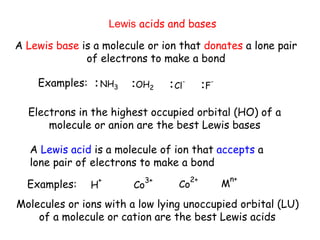
Lewis acids and bases
A Lewis base is a molecule or ion that donates a lone pair
of electrons to make a bond
A Lewis acid is a molecule of ion that accepts a
lone pair of electrons to make a bond
Examples: NH3 OH2 Cl
-
F
-
Examples: H
+
Co
3+
Co
2+
M
n+
Electrons in the highest occupied orbital (HO) of a
molecule or anion are the best Lewis bases
Molecules or ions with a low lying unoccupied orbital (LU)
of a molecule or cation are the best Lewis acids
Conventions in writing the structure of coordination
compounds:
Brackets [] are used to indicate all of the
composition of the coordinate complex
The symbol for the central atom metal of the
complex is first within the brackets
Species outside of the [] are not coordinated to the
metal but are require to maintain a charge balance
A coordination compounds is a neutral species
consisting of a coordinate complex and uncoordinated
ions required to maintain the charge balance
Ligand substitution reactions
For some complex ions, the coordinated ligands may
be substituted for other ligands
Complexes that undergo very rapid substitution of
one ligand for another are termed labile
Complexes that undergo very slow substitution of
one ligand for another are termed inert
[Ni(H2O)6]2+ + 6 NH3 → [Ni(NH3)6]2+ + 6 H2O (aqueous)
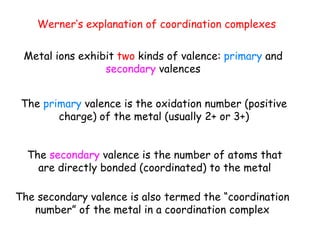
Werner’s explanation of coordination complexes
Metal ions exhibit two kinds of valence: primary and
secondary valences
The primary valence is the oxidation number (positive
charge) of the metal (usually 2+ or 3+)
The secondary valence is the number of atoms that
are directly bonded (coordinated) to the metal
The secondary valence is also termed the “coordination
number” of the metal in a coordination complex
Example of a coordination complex: [Co(NH3)6]Cl3
[Co(NH3)6]3+
What is the atomic
composition of the
complex?
What is the net charge
of the complex?
[Co(NH3)6]
How do we know the charge
is 3+ on the metal?
3+ is required to balance
the three Cl- ions
The primary valence of [Co(NH3)6]Cl3 is 3 (charge on Co)
The secondary valence of [Co(NH3)6]Cl3 is 6 (ligands)
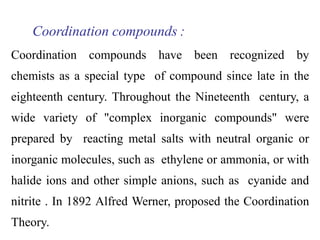
Coordination compounds :
Coordination compounds have been recognized by
chemists as a special type of compound since late in the
eighteenth century. Throughout the Nineteenth century, a
wide variety of "complex inorganic compounds" were
prepared by reacting metal salts with neutral organic or
inorganic molecules, such as ethylene or ammonia, or with
halide ions and other simple anions, such as cyanide and
nitrite . In 1892 Alfred Werner, proposed the Coordination
Theory.
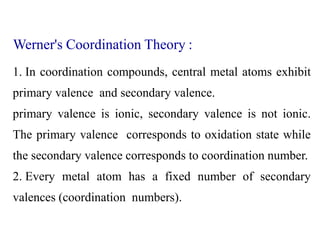
Werner's Coordination Theory :
1. In coordination compounds, central metal atoms exhibit
primary valence and secondary valence.
primary valence is ionic, secondary valence is not ionic.
The primary valence corresponds to oxidation state while
the secondary valence corresponds to coordination number.
2. Every metal atom has a fixed number of secondary
valences (coordination numbers).
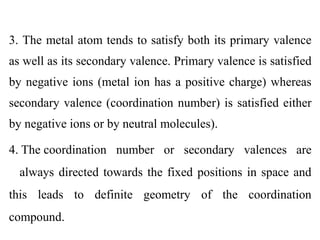
3. The metal atom tends to satisfy both its primary valence
as well as its secondary valence. Primary valence is satisfied
by negative ions (metal ion has a positive charge) whereas
secondary valence (coordination number) is satisfied either
by negative ions or by neutral molecules).
4. The coordination number or secondary valences are
always directed towards the fixed positions in space and
this leads to definite geometry of the coordination
compound.
A coordination compound is one in which a central atom or
ion is joined to one or more ligands through what is called a
coordinate covalent bond in which both of the bonding
electrons are supplied by the ligand.
In such a complex the central atom acts as an electron-pair
acceptor (Lewis acid) and the ligand as an electron-pair
donor (Lewis base).
The central atom and the ligands coordinated to what
constitute the coordination sphere.
Thus the salt [Co(NH3)5Cl]Cl2 is composed of the
complex ion [Co(NH3)5Cl]2+ and two Cl– ions;
components within the square brackets are inside the
coordination sphere, whereas the two chloride ions are
situated outside the coordination sphere. These latter two
ions could be replaced by other ions such as NO3
-.
The central atoms of coordination complexes are most
often cations (positive ions), but may in some cases be
neutral atoms, as in nickel carbonyl Ni(CO)4.
Ligands composed of ions such as F– or small molecules
such as H2O or CN– possess more than one set of lone pair
electrons, but only one of these pairs can coordinate with a
central ion. Such ligands are said to be monodentate (-one
tooth).
Larger ligands may contain more than one atom capable of
coordinating with a single central ion, and are described as
polydentate.
Thus ethylenediamine is a bidentate ligand.
Polydentate ligands whose geometry enables them to
occupy more than one coordinating position of a central
ion act as chelating agents and tend to form extremely
stable complexes known as chelates.
Coordination sphere: The central atom/ion and the ligands
attached to it are enclosed in square bracket and is
collectively termed as the coordination sphere.
For example: in the complex K4[Fe(CN)6], [Fe(CN)6]4- is
the coordination sphere.
Counter ions: The ions present outside the coordination
sphere are called counter ions.
For example: in the complex K4[Fe(CN)6], K+4 is the
counter ion.
A complex is a structure composed of a central metal atom
or ion, generally a cation, surrounded by a number of
negatively charged ions or neutral molecules possessing
lone pairs. A complex may also be called a coordination
compound or metal complex.
The ions or molecules surrounding the metal are called
ligands.
A ligand that is bound to a metal ion is said to be coordinated
with the ion.
The process of binding to the metal ion with more than one
coordination site per ligand is called chelation.
Compounds that bind avidly to form complexes are thus
called chelating agents (for example, EDTA).
Simple ligands like water or chlorine form only one link
with the central atom and are said to be monodentate.
Some ligands are capable of forming multiple links to
the same metal atom, and are described as bidentate,
tridentate etc.
EDTA is hexadentate, which accounts for the great
stability of many of its complexes.
Donor atom: An atom of the ligand attached directly to the
metal is called the donor atom.
For example: in the complex K4[Fe(CN)6 ] carbon is a
donor atom.
Coordination number: The coordination number (CN) of a
metal ion in a complex can be defined as the number of
ligand donor atoms to which the metal is directly bonded.
For example: in the complex K4[Fe(CN)6], the coordination
number of Fe is 6.
Naming Coordination Compounds
The coordination compounds are named in the following
way:
A.To name a coordination compound, no matter whether
the complex ion is the cation or the anion, always name the
cation before the anion.
B. In naming the complex ion:
1. Name the ligands first, in alphabetical order, then the
metal atom or ion.
Note: The metal atom or ion is written before the ligands in
the chemical formula.
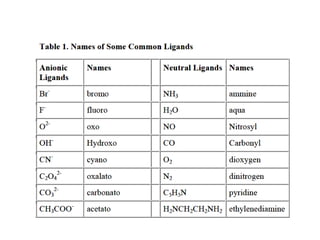
2. The names of some common ligands are listed in Table 1
For anionic ligands end in "-o"; for anions that end in "-
ide“ (e.g. chloride), "-ate" (e.g. sulfate, nitrate), and "-
ite" (e.g. nirite), change the endings as follows: -ide -o; -
ate -ato; -ite –ito.
For neutral ligands, the common name of the molecule
is used e.g. H2NCH2CH2NH2 (ethylenediamine).
Important exceptions: water is called aqua, ammonia is
called ammine, carbon monoxide is called carbonyl, and
the N2 and O2 are called dinitrogen‘ and dioxygen .
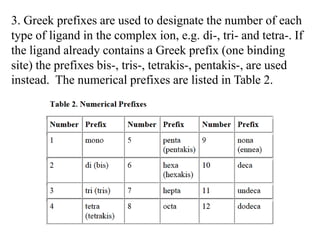
3. Greek prefixes are used to designate the number of each
type of ligand in the complex ion, e.g. di-, tri- and tetra-. If
the ligand already contains a Greek prefix (one binding
site) the prefixes bis-, tris-, tetrakis-, pentakis-, are used
instead. The numerical prefixes are listed in Table 2.
4. After naming the ligands, name the central metal. If the
complex ion is a cation, the metal is named same as the
element.
For example, Co in a complex cation is call cobalt and Pt
is called platinum.. If the complex ion is an anion, the
name of the metal ends with the suffix –ate.. For example,
Co in a complex anion is called cobaltate and Pt is called
platinate.
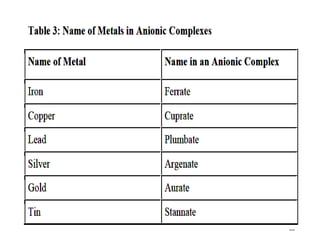
For some metals, the Latin names are used in the complex
anions e.g. Fe is called ferrate (not ironate).
28
C. To name a neutral complex molecule, follow the rules of
naming a complex cation.
Remember: Name the (possibly complex) cation before the
(possibly complex) anion.
5. Following the name of the metal, the oxidation state of
the metal in the complex is given as a Roman numeral in
parentheses.
[Co(NH3)6]3+
Hexammine cobalt(III)
K3[Fe(CN)6]
potassium hexacyano ferrate(III)
[Co(NH3)4Cl2]Cl
Tetrammine dichlorocobalt(I) chloride
[FeNO(NH3)5]Cl3
Pentammine nitrosyl iron(III) chloride
[Cr(CO)6]
hexacarbonylchromium(0)
K[V(CO)6]
potassium hexacarbonyl vanadate(I)
1. Do ligands act like Lewis acids or Lewis bases? Why?
2. Do ligands form ionic bonds with the central metal
atom?
3. What are chelating agents?
4. What is a monodentate ligand? example
5. Describe polydentate ligands and provide an example.
6. What are hexadentate ligands?
7. Name this complex [Cu(NH3)4]SO4.
8. Name this complex [Co(en)3](NO3)2.
Q /For the complex K3[Cr(C2O4)3]·3H2O
1)What is the central metal ion?
2)What is its oxidation state?
3)What is its electronic configuration?
4)What is its coordination number?
5)What is the IUPAC name of the complex?
Q/name the following complexes :
[Mn(NO)3CO] , NH4[Cr(NH3)2(NCS)4] ,
[Cu(en)2(H2O)2]SO4

Lec.2.pdf

  • 1.
    Coordination /complexation Lecture two PhD.Pharmaceutical chemistry M.Sc. Pharmaceutical chemistry B.Sc. pharmacy
  • 2.
    Coordination complex: Astructure containing a metal (usually a metal ion) bonded (coordinated) to a group of surrounding molecules or ions. Ligand (ligare is Latin, to bind): A ligand is a molecule or ion that is directly bonded to a metal ion in a coordination complex Coordination sphere: A metal and its surrounding ligands Note: religare is Latin, to bind tightly A ligand uses a lone pair of electrons (Lewis base) to bond to the metal ion (Lewis acid)
  • 3.
    Complex ions: Threecommon structural types Octahedral: Most important Tetrahedral Square planar
  • 4.
    4 Lewis acid: Co3+ Lewisbase: NH3 Coordination complex: Lewis base coordinated to a Lewis acid Coordination complex: Ligand (electron donor) coordinated to a metal (electron acceptor) The formation of a coordinate complex is a Lewis acid- base reaction The number of ligand bonds to the central metal atom is termed the coordination number
  • 5.
  • 6.
    Alfred Werner Switzerland University ofZurich Zurich, Switzerland b. 1866 (in Mulhouse, then Germany) d. 1919 The Nobel Prize in Chemistry 1913 "in recognition of his work on the linkage of atoms in molecules by which he has thrown new light on earlier investigations and opened up new fields of research especially in inorganic chemistry" Alfred Werner: the father of the structure of coordination complexes
  • 7.
    Lewis acids andbases A Lewis base is a molecule or ion that donates a lone pair of electrons to make a bond A Lewis acid is a molecule of ion that accepts a lone pair of electrons to make a bond Examples: NH3 OH2 Cl - F - Examples: H + Co 3+ Co 2+ M n+ Electrons in the highest occupied orbital (HO) of a molecule or anion are the best Lewis bases Molecules or ions with a low lying unoccupied orbital (LU) of a molecule or cation are the best Lewis acids
  • 8.
    Conventions in writingthe structure of coordination compounds: Brackets [] are used to indicate all of the composition of the coordinate complex The symbol for the central atom metal of the complex is first within the brackets Species outside of the [] are not coordinated to the metal but are require to maintain a charge balance A coordination compounds is a neutral species consisting of a coordinate complex and uncoordinated ions required to maintain the charge balance
  • 9.
    Ligand substitution reactions Forsome complex ions, the coordinated ligands may be substituted for other ligands Complexes that undergo very rapid substitution of one ligand for another are termed labile Complexes that undergo very slow substitution of one ligand for another are termed inert [Ni(H2O)6]2+ + 6 NH3 → [Ni(NH3)6]2+ + 6 H2O (aqueous)
  • 10.
    Werner’s explanation ofcoordination complexes Metal ions exhibit two kinds of valence: primary and secondary valences The primary valence is the oxidation number (positive charge) of the metal (usually 2+ or 3+) The secondary valence is the number of atoms that are directly bonded (coordinated) to the metal The secondary valence is also termed the “coordination number” of the metal in a coordination complex
  • 11.
    Example of acoordination complex: [Co(NH3)6]Cl3 [Co(NH3)6]3+ What is the atomic composition of the complex? What is the net charge of the complex? [Co(NH3)6] How do we know the charge is 3+ on the metal? 3+ is required to balance the three Cl- ions The primary valence of [Co(NH3)6]Cl3 is 3 (charge on Co) The secondary valence of [Co(NH3)6]Cl3 is 6 (ligands)
  • 12.
    Coordination compounds : Coordinationcompounds have been recognized by chemists as a special type of compound since late in the eighteenth century. Throughout the Nineteenth century, a wide variety of "complex inorganic compounds" were prepared by reacting metal salts with neutral organic or inorganic molecules, such as ethylene or ammonia, or with halide ions and other simple anions, such as cyanide and nitrite . In 1892 Alfred Werner, proposed the Coordination Theory.
  • 13.
    Werner's Coordination Theory: 1. In coordination compounds, central metal atoms exhibit primary valence and secondary valence. primary valence is ionic, secondary valence is not ionic. The primary valence corresponds to oxidation state while the secondary valence corresponds to coordination number. 2. Every metal atom has a fixed number of secondary valences (coordination numbers).
  • 14.
    3. The metalatom tends to satisfy both its primary valence as well as its secondary valence. Primary valence is satisfied by negative ions (metal ion has a positive charge) whereas secondary valence (coordination number) is satisfied either by negative ions or by neutral molecules). 4. The coordination number or secondary valences are always directed towards the fixed positions in space and this leads to definite geometry of the coordination compound.
  • 15.
    A coordination compoundis one in which a central atom or ion is joined to one or more ligands through what is called a coordinate covalent bond in which both of the bonding electrons are supplied by the ligand. In such a complex the central atom acts as an electron-pair acceptor (Lewis acid) and the ligand as an electron-pair donor (Lewis base). The central atom and the ligands coordinated to what constitute the coordination sphere.
  • 16.
    Thus the salt[Co(NH3)5Cl]Cl2 is composed of the complex ion [Co(NH3)5Cl]2+ and two Cl– ions; components within the square brackets are inside the coordination sphere, whereas the two chloride ions are situated outside the coordination sphere. These latter two ions could be replaced by other ions such as NO3 -.
  • 17.
    The central atomsof coordination complexes are most often cations (positive ions), but may in some cases be neutral atoms, as in nickel carbonyl Ni(CO)4. Ligands composed of ions such as F– or small molecules such as H2O or CN– possess more than one set of lone pair electrons, but only one of these pairs can coordinate with a central ion. Such ligands are said to be monodentate (-one tooth). Larger ligands may contain more than one atom capable of coordinating with a single central ion, and are described as polydentate.
  • 18.
    Thus ethylenediamine isa bidentate ligand. Polydentate ligands whose geometry enables them to occupy more than one coordinating position of a central ion act as chelating agents and tend to form extremely stable complexes known as chelates. Coordination sphere: The central atom/ion and the ligands attached to it are enclosed in square bracket and is collectively termed as the coordination sphere. For example: in the complex K4[Fe(CN)6], [Fe(CN)6]4- is the coordination sphere.
  • 19.
    Counter ions: Theions present outside the coordination sphere are called counter ions. For example: in the complex K4[Fe(CN)6], K+4 is the counter ion. A complex is a structure composed of a central metal atom or ion, generally a cation, surrounded by a number of negatively charged ions or neutral molecules possessing lone pairs. A complex may also be called a coordination compound or metal complex.
  • 20.
    The ions ormolecules surrounding the metal are called ligands. A ligand that is bound to a metal ion is said to be coordinated with the ion. The process of binding to the metal ion with more than one coordination site per ligand is called chelation. Compounds that bind avidly to form complexes are thus called chelating agents (for example, EDTA).
  • 21.
    Simple ligands likewater or chlorine form only one link with the central atom and are said to be monodentate. Some ligands are capable of forming multiple links to the same metal atom, and are described as bidentate, tridentate etc. EDTA is hexadentate, which accounts for the great stability of many of its complexes.
  • 22.
    Donor atom: Anatom of the ligand attached directly to the metal is called the donor atom. For example: in the complex K4[Fe(CN)6 ] carbon is a donor atom. Coordination number: The coordination number (CN) of a metal ion in a complex can be defined as the number of ligand donor atoms to which the metal is directly bonded. For example: in the complex K4[Fe(CN)6], the coordination number of Fe is 6.
  • 23.
    Naming Coordination Compounds Thecoordination compounds are named in the following way: A.To name a coordination compound, no matter whether the complex ion is the cation or the anion, always name the cation before the anion. B. In naming the complex ion: 1. Name the ligands first, in alphabetical order, then the metal atom or ion. Note: The metal atom or ion is written before the ligands in the chemical formula.
  • 24.
    2. The namesof some common ligands are listed in Table 1 For anionic ligands end in "-o"; for anions that end in "- ide“ (e.g. chloride), "-ate" (e.g. sulfate, nitrate), and "- ite" (e.g. nirite), change the endings as follows: -ide -o; - ate -ato; -ite –ito. For neutral ligands, the common name of the molecule is used e.g. H2NCH2CH2NH2 (ethylenediamine). Important exceptions: water is called aqua, ammonia is called ammine, carbon monoxide is called carbonyl, and the N2 and O2 are called dinitrogen‘ and dioxygen .
  • 26.
    3. Greek prefixesare used to designate the number of each type of ligand in the complex ion, e.g. di-, tri- and tetra-. If the ligand already contains a Greek prefix (one binding site) the prefixes bis-, tris-, tetrakis-, pentakis-, are used instead. The numerical prefixes are listed in Table 2.
  • 27.
    4. After namingthe ligands, name the central metal. If the complex ion is a cation, the metal is named same as the element. For example, Co in a complex cation is call cobalt and Pt is called platinum.. If the complex ion is an anion, the name of the metal ends with the suffix –ate.. For example, Co in a complex anion is called cobaltate and Pt is called platinate. For some metals, the Latin names are used in the complex anions e.g. Fe is called ferrate (not ironate).
  • 28.
  • 29.
    C. To namea neutral complex molecule, follow the rules of naming a complex cation. Remember: Name the (possibly complex) cation before the (possibly complex) anion. 5. Following the name of the metal, the oxidation state of the metal in the complex is given as a Roman numeral in parentheses.
  • 30.
    [Co(NH3)6]3+ Hexammine cobalt(III) K3[Fe(CN)6] potassium hexacyanoferrate(III) [Co(NH3)4Cl2]Cl Tetrammine dichlorocobalt(I) chloride [FeNO(NH3)5]Cl3 Pentammine nitrosyl iron(III) chloride [Cr(CO)6] hexacarbonylchromium(0) K[V(CO)6] potassium hexacarbonyl vanadate(I)
  • 31.
    1. Do ligandsact like Lewis acids or Lewis bases? Why? 2. Do ligands form ionic bonds with the central metal atom? 3. What are chelating agents? 4. What is a monodentate ligand? example 5. Describe polydentate ligands and provide an example. 6. What are hexadentate ligands? 7. Name this complex [Cu(NH3)4]SO4. 8. Name this complex [Co(en)3](NO3)2.
  • 32.
    Q /For thecomplex K3[Cr(C2O4)3]·3H2O 1)What is the central metal ion? 2)What is its oxidation state? 3)What is its electronic configuration? 4)What is its coordination number? 5)What is the IUPAC name of the complex? Q/name the following complexes : [Mn(NO)3CO] , NH4[Cr(NH3)2(NCS)4] , [Cu(en)2(H2O)2]SO4