WELCOME TO THE STUDENTS
7th Semester (Mining)
Bogura Polytechnic Institute, Bogura.
Md. Majedur Rahman
B. Sc (Hon’s), M. Sc in Geology & Mining, RU
Instructor (Tech)
Mining and Mine Survey Technology
Bogura Polytechnic Institute, BOGURA.
Presented By
Prepared by Md. Majedur Rahman, E-mail: majedu1r_ru6871@yahoo.com
August 3, 2022 1
Petroleum Well Design & Completion
Course Code No. 69372
Prepared by Md. Majedur Rahman, E-mail:
majedu1r_ru6871@yahoo.com
August 3, 2022 2
Chapter-10
Understand the well completion and testing
10.1 Describe well completion methods.
10.2 State well head equipment.
10.3 Define well testing.
10.4 Describe Drill Stem Test (DST)
10.5 Describe well testing operations.
10.6 Describe high pressure and high temperature testing.
10.7 Mention benefits and limitations of well stimulation.
Prepared by Md. Majedur Rahman, E-mail:
majedu1r_ru6871@yahoo.com
August 3, 2022 3
Informal definition:
The high time of the well when engineer and personnel comes to
decide whether to install the production casing in order to initiate the
production at the surface or it should be abandoned .
Technical Definition:
Well completion means to prepare the well for production by installing
the necessary equipments into the well in order to allow the safe and
controlled flow of HCS at the surface.
August 3, 2022
Prepared by Md. Majedur Rahman, E-mail:
majedu1r_ru6871@yahoo.com
4
10.1 Describe well completion methods.
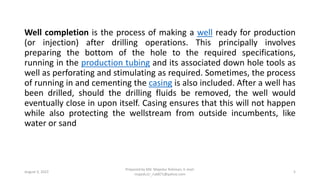
Well completion is the process of making a well ready for production
(or injection) after drilling operations. This principally involves
preparing the bottom of the hole to the required specifications,
running in the production tubing and its associated down hole tools as
well as perforating and stimulating as required. Sometimes, the process
of running in and cementing the casing is also included. After a well has
been drilled, should the drilling fluids be removed, the well would
eventually close in upon itself. Casing ensures that this will not happen
while also protecting the wellstream from outside incumbents, like
water or sand
Prepared by Md. Majedur Rahman, E-mail:
majedu1r_ru6871@yahoo.com
August 3, 2022 5
General Procedure
To understand the concept of
well completion the following
equipment's must be studied
clearly:
1. Casing
2. Tubing
3. X-Mass tree
August 3, 2022
Prepared by Md. Majedur Rahman, E-mail:
majedu1r_ru6871@yahoo.com
6
1. Casing
August 3, 2022
Prepared by Md. Majedur Rahman, E-mail:
majedu1r_ru6871@yahoo.com
7
2. Tubing
August 3, 2022
Prepared by Md. Majedur Rahman, E-mail:
majedu1r_ru6871@yahoo.com
8
3. X-Mass tree
August 3, 2022
Prepared by Md. Majedur Rahman, E-mail:
majedu1r_ru6871@yahoo.com
9
Open hole well completion
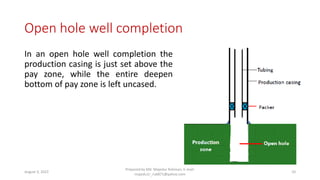
In an open hole well completion the
production casing is just set above the
pay zone, while the entire deepen
bottom of pay zone is left uncased.
August 3, 2022
Prepared by Md. Majedur Rahman, E-mail:
majedu1r_ru6871@yahoo.com
10
Open hole well completion Advantage
• Maximum exposure of pay zone
• Less pressure drawdown during flow
• No formation damage occurs due to cementing and perforation.
• Less formation damage
August 3, 2022
Prepared by Md. Majedur Rahman, E-mail:
majedu1r_ru6871@yahoo.com
11
Open hole well completion Disadvantage
• Inability to plug off water or gas zones
• Inability to stimulate the separate zones within the productive zones
August 3, 2022
Prepared by Md. Majedur Rahman, E-mail:
majedu1r_ru6871@yahoo.com
12
Close hole well completion
• For the most common type of well completion today involves the
cased hole completion, in which the production casing and liner
are cemented and perforated subsequently.
• Select the sections of the pay zone we wish to produce
• Stimulate the separate pay zone from the well
• Multiple completion zones
August 3, 2022
Prepared by Md. Majedur Rahman, E-mail:
majedu1r_ru6871@yahoo.com
13
Liner Completion
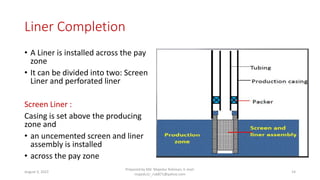
• A Liner is installed across the pay
zone
• It can be divided into two: Screen
Liner and perforated liner
Screen Liner :
Casing is set above the producing
zone and
• an uncemented screen and liner
assembly is installed
• across the pay zone
August 3, 2022
Prepared by Md. Majedur Rahman, E-mail:
majedu1r_ru6871@yahoo.com
14
Perforated Liner Completion
Casing is set above the
producing zone and a liner
assembly is installed across
the pay zone and
cemented in place. The
liner is then perforated
selectively for production.
August 3, 2022
Prepared by Md. Majedur Rahman, E-mail:
majedu1r_ru6871@yahoo.com
15
Perforated Casing Completion
Production casing is
cemented through the
producing zone and pay
section is selectively
perforated.
August 3, 2022
Prepared by Md. Majedur Rahman, E-mail:
majedu1r_ru6871@yahoo.com
16
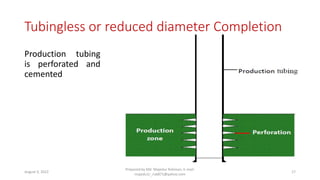
Tubingless or reduced diameter Completion
Production tubing
is perforated and
cemented
August 3, 2022
Prepared by Md. Majedur Rahman, E-mail:
majedu1r_ru6871@yahoo.com
17
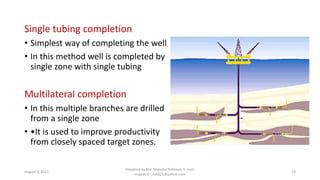
Single tubing completion
• Simplest way of completing the well
• In this method well is completed by
single zone with single tubing
Multilateral completion
• In this multiple branches are drilled
from a single zone
• •It is used to improve productivity
from closely spaced target zones.
August 3, 2022
Prepared by Md. Majedur Rahman, E-mail:
majedu1r_ru6871@yahoo.com
18
Type of Flow
• Casing flow: large flow rate no tubing is required, used in middle east.
• Tubing and Annulus flow: large flow rate flow segregation.
• Tubing flow: Used widely in Malaysia due to safety, may use one more
tubing strings.
August 3, 2022
Prepared by Md. Majedur Rahman, E-mail:
majedu1r_ru6871@yahoo.com
19
10.2 State well head equipment.
Wellhead equipment is used to connect the tubing and casing to an oil or gas pipeline. The
casing is a permanently-installed pipe for lining the well hole to provide pressure containment
and prevent collapse. The wellhead is a flanged device that attaches to the casing.
Components of Wellhead Equipment
• Wellhead equipment includes components such as casing heads, casing spools, tubing head
spools, tees, and crosses. The casing head is part of the connection between the casing and
the wellhead itself. Typically, multiple pieces of wellhead equipment are integrated into a
wellhead assembly called a "Christmas tree". This wellhead assembly allows tubes to be
placed into the well while valves and chokes are used to control the flow of oil and/or gas at
the surface.
• Wellheads and wellhead equipment may be located on offshore platforms, in sub-sea
locations, or onshore. Wellheads are cemented in place and, typically, kept in place; however,
with exploration wells, wellhead equipment may be recovered for subsequent re-use.
Wellhead equipment is designed to support the casing and tubing strings, which may also be
suspended from the Christmas tree.
August 3, 2022
Prepared by Md. Majedur Rahman, E-mail:
majedu1r_ru6871@yahoo.com
20
The primary components of a
wellhead system are:
• casing head
• casing spools
• casing hangers
• choke manifold
• packoffs (isolation) seals
• test plugs
• mudline suspension systems
• tubing heads
• tubing hangers
• tubing head adapter
August 3, 2022
Prepared by Md. Majedur Rahman, E-mail:
majedu1r_ru6871@yahoo.com
21
Functions of Wellhead
A wellhead serves numerous functions, some of which are:
• Provide a means of casing suspension. (Casing is the permanently installed
pipe used to line the well hole for pressure containment and collapse
prevention during the drilling phase).
• Provides a means of tubing suspension. (Tubing is removable pipe installed
in the well through which well fluids pass).
• Provides a means of pressure sealing and isolation between casing at
surface when many casing strings are used.
• Provides pressure monitoring and pumping access to annuli between the
different casing/tubing strings.
• Provides a means of attaching a blowout preventer during drilling.
• Provides a means of attaching a Christmas tree for production operations.
• Provides a reliable means of well access.
• Provides a means of attaching a well pump,
August 3, 2022
Prepared by Md. Majedur Rahman, E-mail:
majedu1r_ru6871@yahoo.com
22
10.3 Define well testing.
• In the petroleum industry, a well test is the execution of a set of
planned data acquisition activities. The acquired data is analyzed to
broaden the knowledge and increase the understanding of the
hydrocarbon properties therein and characteristics of the
underground reservoir where the hydrocarbons are trapped.
• A Well test is simply a period of time during which the production of
the well is measured, either at the well head with portable well test
equipment, or in a production facility.
August 3, 2022
Prepared by Md. Majedur Rahman, E-mail:
majedu1r_ru6871@yahoo.com
23
August 3, 2022
Prepared by Md. Majedur Rahman, E-mail:
majedu1r_ru6871@yahoo.com
24
Overview of Well Test
Most well tests consist of changing the rate, and observing the change in pressure
caused by this change in rate. To perform a well test successfully one must be able
to measure the time, the rate, the pressure, and control the rate. Well tests, if
properly designed, can be used to estimate the following parameters:
• Flow conductance
• Skin factor
• Non-Darcy coefficient (multirate tests)
• Storativity
• Fractured reservoir parameters
• Fractured well parameters
• Drainage area
• Distance to faults
• Drainage shape
August 3, 2022
Prepared by Md. Majedur Rahman, E-mail:
majedu1r_ru6871@yahoo.com
25
Purpose of Well Testing
Exploration wells
• Fluid sampling (Primary reason)
• Measuring the initial pressure
• Estimating a minimum reservoir volume
• Evaluating the well permeability and skin effect
• Identifying heterogeneities and boundaries.
Producing wells
• Verifying permeability and skin effect
• Identifying fluid behavior
• Estimating the average reservoir pressure
• Confirming heterogeneities and boundaries
• Assessing hydraulic connectivity.
August 3, 2022
Prepared by Md. Majedur Rahman, E-mail:
majedu1r_ru6871@yahoo.com
26
10.4 Describe Drill Stem Test (DST)
A drill stem test (DST) is a procedure for isolating and testing the pressure,
permeability and productive capacity of a geological formation during the
drilling of a well.
Originally, the objective of a drill stem test was to take a representative fluid
sample which, in the very early days of the oil industry, was obtained by
either bailing or swabbing. Following the introduction of a packer and a
downhole valve, the next step was the possibility of recording accurate
bottomhole reservoir pressures and temperatures. With the development of
downhole tools, which operated on annulus pressure and a downhole shut-
in valve with surface read-out, drill stem testing has become a generally
accepted safe method to meet the original objectives; to obtain a fluid
sample and reservoir data.
August 3, 2022
Prepared by Md. Majedur Rahman, E-mail:
majedu1r_ru6871@yahoo.com
27
In a drill stem test, information on the following parameters can be
obtained:
• Reservoir fluid type and properties
• Production rates and potential production problems
• Initial reservoir pressure
• Effective permeabilities
• Type of flow system
A drill stem test is the temporary completion of a well to gather
reservoir data. The three fundamental components are a retrievable
mechanically set packer, a downhole valve assembly (DST tools)
and drill pipe/tubing to surface.
August 3, 2022
Prepared by Md. Majedur Rahman, E-mail:
majedu1r_ru6871@yahoo.com
28
August 3, 2022
Prepared by Md. Majedur Rahman, E-mail:
majedu1r_ru6871@yahoo.com
29
A drill stem test is the temporary
completion of a well to gather
reservoir data. The three
fundamental components are a
retrievable mechanically set
packer, a downhole valve
assembly (DST tools) and drill
pipe/tubing to surface.
10.5 Describe well testing operations.
Well testing procedures are carried out on all newly drilled wells to
determine the characteristics of the well and the formations it passes
through. Most often the main goal of the well tests is to determine the
productivity potential of a new well. Well testing involves an array of
measurements and multiple types of downhole instruments for gathering
information on the well characteristics.
Well tests are conducted to quantify well characteristics, production
potential, and reservoir properties. Well tests are essential for exploration
and production drilling, well maintenance, and geothermal field
management. The tests ultimately help in optimal and sustainable utilization
of the geothermal resource.
August 3, 2022
Prepared by Md. Majedur Rahman, E-mail:
majedu1r_ru6871@yahoo.com
30
August 3, 2022
Prepared by Md. Majedur Rahman, E-mail:
majedu1r_ru6871@yahoo.com
31
•Borehole Seismic Techniques
•Single-Well And Cross-Well Seismic Imaging
•Vertical Seismic Profiling
•Formation Testing Techniques
•Well Log Techniques
•Acoustic Logs
•Cement Bond Log
•Cross-Dipole Acoustic Log
•Caliper Log
•Chemical Logging
•Density Log
•Gamma Log
•Image Logs
•Mud Logging
•Neutron Log
•Pressure Temperature Log
•Single-Well and Cross-Well Resistivity
•Spontaneous Potential Well Log
•Well Testing Techniques
•Downhole Fluid Sampling
•Earth Tidal Analysis
•Flow Test
•Injectivity Test
•Static Temperature Survey
•Stress Test
•Tracer Testing
•Vertical Flowmeter Test
Well Testing Techniques
10.6 Describe high pressure and high temperature
testing.
High pressure/high temperature (HP/HT) wells are those where the
undisturbed bottom hole temp at prospective reservoir depth or total depth
is greater than 300°F or 150°C, and either the maximum anticipated pore
pressure of any porous formation to be drilled through exceeds a hydrostatic
gradient of 0.8 psi/ft, or a well requiring pressure control equipment with a
rated working pressure in excess of 10000 psi. Drilling wells with these
characteristics pose special challenges.
A test to measure static filtration behavior of water mud or oil mud at
elevated temperature, up to about 380°F [193°C] maximum (450°F [227°C]
maximum if a special cell is used), usually according to the specifications
of API. Although the test can simulate downhole temperature conditions, it
does not simulate downhole pressure. Total pressure in a cell should not
exceed 700 psi [4900 kPa], and the differential pressure across the filter
medium is specified as 500 psi [3500 kPa]. Because these cells are half the
size of the ambient filtration area, HPHT filtrate volumes after 30 minutes are
doubled.
August 3, 2022
Prepared by Md. Majedur Rahman, E-mail:
majedu1r_ru6871@yahoo.com
32
Drilling fluid considerations
Where possible, high temperature wells are drilled with oil-based fluids
(OBFs) or synthetic-based fluids (SBFs), because of the thermal
limitations of most water-based fluids (WBFs). Such limitations of WBFs
include:
• Temperature-induced gelation
• High risk of CO2 contamination from the formation being drilled
and/or from the degradation of organic mud additives
• Increased solids sensitivity that is related to high temperatures
August 3, 2022
Prepared by Md. Majedur Rahman, E-mail:
majedu1r_ru6871@yahoo.com
33
HPHT or High Pressure, High Temperature is defined as
those Wells with a bottom hole temperature greater than 150°C
(300°F) and requiring pressure control equipment with a rated
working pressure of above 69 MPa (10,000psi) (S.P.E E&P Glossary,
HPHT, 2013).
August 3, 2022
Prepared by Md. Majedur Rahman, E-mail:
majedu1r_ru6871@yahoo.com
34
An HP/HT viscometer typically is used to monitor the temperature stability of
the drilling fluid, and to evaluate its rheological properties at up to 500°F and
20,000 psia. This test is especially useful for determining whether high-
temperature flocculation occurs in water-based muds. The test results can be
presented graphically by plotting the change in viscosity with respect to
temperature over the heating and cooling cycle, which establishes a baseline
for recognizing indicators of temperature instability.
There are a number of ways to minimize problems with temperature
gelation, including:
• Eliminating lignite and lignite derivatives from the WBF formulation
• Lowering the bentonite concentration
• Supplementing the high-temperature water-based system with synthetic
polymers and copolymers
August 3, 2022
Prepared by Md. Majedur Rahman, E-mail:
majedu1r_ru6871@yahoo.com
35
10.7 Mention benefits and limitations of well
stimulation.
Well stimulation is a well intervention performed on an oil or gas
well to increase production by improving the flow
of hydrocarbons from the reservoir into the well bore. It may be done
using a well stimulator structure or using off shore ships / drilling
vessels, also known as "Well stimulation vessels"
August 3, 2022
Prepared by Md. Majedur Rahman, E-mail:
majedu1r_ru6871@yahoo.com
36
August 3, 2022
Prepared by Md. Majedur Rahman, E-mail:
majedu1r_ru6871@yahoo.com
37
Any Questions
Prepared by Md. Majedur Rahman, E-mail:
majedu1r_ru6871@yahoo.com
August 3, 2022 38
THANKS TO ALL
Prepared by Md. Majedur Rahman, E-mail:
majedu1r_ru6871@yahoo.com
August 3, 2022 39

Well completion and testing.pptx

  • 1.
    WELCOME TO THESTUDENTS 7th Semester (Mining) Bogura Polytechnic Institute, Bogura. Md. Majedur Rahman B. Sc (Hon’s), M. Sc in Geology & Mining, RU Instructor (Tech) Mining and Mine Survey Technology Bogura Polytechnic Institute, BOGURA. Presented By Prepared by Md. Majedur Rahman, E-mail: majedu1r_ru6871@yahoo.com August 3, 2022 1
  • 2.
    Petroleum Well Design& Completion Course Code No. 69372 Prepared by Md. Majedur Rahman, E-mail: majedu1r_ru6871@yahoo.com August 3, 2022 2
  • 3.
    Chapter-10 Understand the wellcompletion and testing 10.1 Describe well completion methods. 10.2 State well head equipment. 10.3 Define well testing. 10.4 Describe Drill Stem Test (DST) 10.5 Describe well testing operations. 10.6 Describe high pressure and high temperature testing. 10.7 Mention benefits and limitations of well stimulation. Prepared by Md. Majedur Rahman, E-mail: majedu1r_ru6871@yahoo.com August 3, 2022 3
  • 4.
    Informal definition: The hightime of the well when engineer and personnel comes to decide whether to install the production casing in order to initiate the production at the surface or it should be abandoned . Technical Definition: Well completion means to prepare the well for production by installing the necessary equipments into the well in order to allow the safe and controlled flow of HCS at the surface. August 3, 2022 Prepared by Md. Majedur Rahman, E-mail: majedu1r_ru6871@yahoo.com 4 10.1 Describe well completion methods.
  • 5.
    Well completion isthe process of making a well ready for production (or injection) after drilling operations. This principally involves preparing the bottom of the hole to the required specifications, running in the production tubing and its associated down hole tools as well as perforating and stimulating as required. Sometimes, the process of running in and cementing the casing is also included. After a well has been drilled, should the drilling fluids be removed, the well would eventually close in upon itself. Casing ensures that this will not happen while also protecting the wellstream from outside incumbents, like water or sand Prepared by Md. Majedur Rahman, E-mail: majedu1r_ru6871@yahoo.com August 3, 2022 5
  • 6.
    General Procedure To understandthe concept of well completion the following equipment's must be studied clearly: 1. Casing 2. Tubing 3. X-Mass tree August 3, 2022 Prepared by Md. Majedur Rahman, E-mail: majedu1r_ru6871@yahoo.com 6
  • 7.
    1. Casing August 3,2022 Prepared by Md. Majedur Rahman, E-mail: majedu1r_ru6871@yahoo.com 7
  • 8.
    2. Tubing August 3,2022 Prepared by Md. Majedur Rahman, E-mail: majedu1r_ru6871@yahoo.com 8
  • 9.
    3. X-Mass tree August3, 2022 Prepared by Md. Majedur Rahman, E-mail: majedu1r_ru6871@yahoo.com 9
  • 10.
    Open hole wellcompletion In an open hole well completion the production casing is just set above the pay zone, while the entire deepen bottom of pay zone is left uncased. August 3, 2022 Prepared by Md. Majedur Rahman, E-mail: majedu1r_ru6871@yahoo.com 10
  • 11.
    Open hole wellcompletion Advantage • Maximum exposure of pay zone • Less pressure drawdown during flow • No formation damage occurs due to cementing and perforation. • Less formation damage August 3, 2022 Prepared by Md. Majedur Rahman, E-mail: majedu1r_ru6871@yahoo.com 11
  • 12.
    Open hole wellcompletion Disadvantage • Inability to plug off water or gas zones • Inability to stimulate the separate zones within the productive zones August 3, 2022 Prepared by Md. Majedur Rahman, E-mail: majedu1r_ru6871@yahoo.com 12
  • 13.
    Close hole wellcompletion • For the most common type of well completion today involves the cased hole completion, in which the production casing and liner are cemented and perforated subsequently. • Select the sections of the pay zone we wish to produce • Stimulate the separate pay zone from the well • Multiple completion zones August 3, 2022 Prepared by Md. Majedur Rahman, E-mail: majedu1r_ru6871@yahoo.com 13
  • 14.
    Liner Completion • ALiner is installed across the pay zone • It can be divided into two: Screen Liner and perforated liner Screen Liner : Casing is set above the producing zone and • an uncemented screen and liner assembly is installed • across the pay zone August 3, 2022 Prepared by Md. Majedur Rahman, E-mail: majedu1r_ru6871@yahoo.com 14
  • 15.
    Perforated Liner Completion Casingis set above the producing zone and a liner assembly is installed across the pay zone and cemented in place. The liner is then perforated selectively for production. August 3, 2022 Prepared by Md. Majedur Rahman, E-mail: majedu1r_ru6871@yahoo.com 15
  • 16.
    Perforated Casing Completion Productioncasing is cemented through the producing zone and pay section is selectively perforated. August 3, 2022 Prepared by Md. Majedur Rahman, E-mail: majedu1r_ru6871@yahoo.com 16
  • 17.
    Tubingless or reduceddiameter Completion Production tubing is perforated and cemented August 3, 2022 Prepared by Md. Majedur Rahman, E-mail: majedu1r_ru6871@yahoo.com 17
  • 18.
    Single tubing completion •Simplest way of completing the well • In this method well is completed by single zone with single tubing Multilateral completion • In this multiple branches are drilled from a single zone • •It is used to improve productivity from closely spaced target zones. August 3, 2022 Prepared by Md. Majedur Rahman, E-mail: majedu1r_ru6871@yahoo.com 18
  • 19.
    Type of Flow •Casing flow: large flow rate no tubing is required, used in middle east. • Tubing and Annulus flow: large flow rate flow segregation. • Tubing flow: Used widely in Malaysia due to safety, may use one more tubing strings. August 3, 2022 Prepared by Md. Majedur Rahman, E-mail: majedu1r_ru6871@yahoo.com 19
  • 20.
    10.2 State wellhead equipment. Wellhead equipment is used to connect the tubing and casing to an oil or gas pipeline. The casing is a permanently-installed pipe for lining the well hole to provide pressure containment and prevent collapse. The wellhead is a flanged device that attaches to the casing. Components of Wellhead Equipment • Wellhead equipment includes components such as casing heads, casing spools, tubing head spools, tees, and crosses. The casing head is part of the connection between the casing and the wellhead itself. Typically, multiple pieces of wellhead equipment are integrated into a wellhead assembly called a "Christmas tree". This wellhead assembly allows tubes to be placed into the well while valves and chokes are used to control the flow of oil and/or gas at the surface. • Wellheads and wellhead equipment may be located on offshore platforms, in sub-sea locations, or onshore. Wellheads are cemented in place and, typically, kept in place; however, with exploration wells, wellhead equipment may be recovered for subsequent re-use. Wellhead equipment is designed to support the casing and tubing strings, which may also be suspended from the Christmas tree. August 3, 2022 Prepared by Md. Majedur Rahman, E-mail: majedu1r_ru6871@yahoo.com 20
  • 21.
    The primary componentsof a wellhead system are: • casing head • casing spools • casing hangers • choke manifold • packoffs (isolation) seals • test plugs • mudline suspension systems • tubing heads • tubing hangers • tubing head adapter August 3, 2022 Prepared by Md. Majedur Rahman, E-mail: majedu1r_ru6871@yahoo.com 21
  • 22.
    Functions of Wellhead Awellhead serves numerous functions, some of which are: • Provide a means of casing suspension. (Casing is the permanently installed pipe used to line the well hole for pressure containment and collapse prevention during the drilling phase). • Provides a means of tubing suspension. (Tubing is removable pipe installed in the well through which well fluids pass). • Provides a means of pressure sealing and isolation between casing at surface when many casing strings are used. • Provides pressure monitoring and pumping access to annuli between the different casing/tubing strings. • Provides a means of attaching a blowout preventer during drilling. • Provides a means of attaching a Christmas tree for production operations. • Provides a reliable means of well access. • Provides a means of attaching a well pump, August 3, 2022 Prepared by Md. Majedur Rahman, E-mail: majedu1r_ru6871@yahoo.com 22
  • 23.
    10.3 Define welltesting. • In the petroleum industry, a well test is the execution of a set of planned data acquisition activities. The acquired data is analyzed to broaden the knowledge and increase the understanding of the hydrocarbon properties therein and characteristics of the underground reservoir where the hydrocarbons are trapped. • A Well test is simply a period of time during which the production of the well is measured, either at the well head with portable well test equipment, or in a production facility. August 3, 2022 Prepared by Md. Majedur Rahman, E-mail: majedu1r_ru6871@yahoo.com 23
  • 24.
    August 3, 2022 Preparedby Md. Majedur Rahman, E-mail: majedu1r_ru6871@yahoo.com 24
  • 25.
    Overview of WellTest Most well tests consist of changing the rate, and observing the change in pressure caused by this change in rate. To perform a well test successfully one must be able to measure the time, the rate, the pressure, and control the rate. Well tests, if properly designed, can be used to estimate the following parameters: • Flow conductance • Skin factor • Non-Darcy coefficient (multirate tests) • Storativity • Fractured reservoir parameters • Fractured well parameters • Drainage area • Distance to faults • Drainage shape August 3, 2022 Prepared by Md. Majedur Rahman, E-mail: majedu1r_ru6871@yahoo.com 25
  • 26.
    Purpose of WellTesting Exploration wells • Fluid sampling (Primary reason) • Measuring the initial pressure • Estimating a minimum reservoir volume • Evaluating the well permeability and skin effect • Identifying heterogeneities and boundaries. Producing wells • Verifying permeability and skin effect • Identifying fluid behavior • Estimating the average reservoir pressure • Confirming heterogeneities and boundaries • Assessing hydraulic connectivity. August 3, 2022 Prepared by Md. Majedur Rahman, E-mail: majedu1r_ru6871@yahoo.com 26
  • 27.
    10.4 Describe DrillStem Test (DST) A drill stem test (DST) is a procedure for isolating and testing the pressure, permeability and productive capacity of a geological formation during the drilling of a well. Originally, the objective of a drill stem test was to take a representative fluid sample which, in the very early days of the oil industry, was obtained by either bailing or swabbing. Following the introduction of a packer and a downhole valve, the next step was the possibility of recording accurate bottomhole reservoir pressures and temperatures. With the development of downhole tools, which operated on annulus pressure and a downhole shut- in valve with surface read-out, drill stem testing has become a generally accepted safe method to meet the original objectives; to obtain a fluid sample and reservoir data. August 3, 2022 Prepared by Md. Majedur Rahman, E-mail: majedu1r_ru6871@yahoo.com 27
  • 28.
    In a drillstem test, information on the following parameters can be obtained: • Reservoir fluid type and properties • Production rates and potential production problems • Initial reservoir pressure • Effective permeabilities • Type of flow system A drill stem test is the temporary completion of a well to gather reservoir data. The three fundamental components are a retrievable mechanically set packer, a downhole valve assembly (DST tools) and drill pipe/tubing to surface. August 3, 2022 Prepared by Md. Majedur Rahman, E-mail: majedu1r_ru6871@yahoo.com 28
  • 29.
    August 3, 2022 Preparedby Md. Majedur Rahman, E-mail: majedu1r_ru6871@yahoo.com 29 A drill stem test is the temporary completion of a well to gather reservoir data. The three fundamental components are a retrievable mechanically set packer, a downhole valve assembly (DST tools) and drill pipe/tubing to surface.
  • 30.
    10.5 Describe welltesting operations. Well testing procedures are carried out on all newly drilled wells to determine the characteristics of the well and the formations it passes through. Most often the main goal of the well tests is to determine the productivity potential of a new well. Well testing involves an array of measurements and multiple types of downhole instruments for gathering information on the well characteristics. Well tests are conducted to quantify well characteristics, production potential, and reservoir properties. Well tests are essential for exploration and production drilling, well maintenance, and geothermal field management. The tests ultimately help in optimal and sustainable utilization of the geothermal resource. August 3, 2022 Prepared by Md. Majedur Rahman, E-mail: majedu1r_ru6871@yahoo.com 30
  • 31.
    August 3, 2022 Preparedby Md. Majedur Rahman, E-mail: majedu1r_ru6871@yahoo.com 31 •Borehole Seismic Techniques •Single-Well And Cross-Well Seismic Imaging •Vertical Seismic Profiling •Formation Testing Techniques •Well Log Techniques •Acoustic Logs •Cement Bond Log •Cross-Dipole Acoustic Log •Caliper Log •Chemical Logging •Density Log •Gamma Log •Image Logs •Mud Logging •Neutron Log •Pressure Temperature Log •Single-Well and Cross-Well Resistivity •Spontaneous Potential Well Log •Well Testing Techniques •Downhole Fluid Sampling •Earth Tidal Analysis •Flow Test •Injectivity Test •Static Temperature Survey •Stress Test •Tracer Testing •Vertical Flowmeter Test Well Testing Techniques
  • 32.
    10.6 Describe highpressure and high temperature testing. High pressure/high temperature (HP/HT) wells are those where the undisturbed bottom hole temp at prospective reservoir depth or total depth is greater than 300°F or 150°C, and either the maximum anticipated pore pressure of any porous formation to be drilled through exceeds a hydrostatic gradient of 0.8 psi/ft, or a well requiring pressure control equipment with a rated working pressure in excess of 10000 psi. Drilling wells with these characteristics pose special challenges. A test to measure static filtration behavior of water mud or oil mud at elevated temperature, up to about 380°F [193°C] maximum (450°F [227°C] maximum if a special cell is used), usually according to the specifications of API. Although the test can simulate downhole temperature conditions, it does not simulate downhole pressure. Total pressure in a cell should not exceed 700 psi [4900 kPa], and the differential pressure across the filter medium is specified as 500 psi [3500 kPa]. Because these cells are half the size of the ambient filtration area, HPHT filtrate volumes after 30 minutes are doubled. August 3, 2022 Prepared by Md. Majedur Rahman, E-mail: majedu1r_ru6871@yahoo.com 32
  • 33.
    Drilling fluid considerations Wherepossible, high temperature wells are drilled with oil-based fluids (OBFs) or synthetic-based fluids (SBFs), because of the thermal limitations of most water-based fluids (WBFs). Such limitations of WBFs include: • Temperature-induced gelation • High risk of CO2 contamination from the formation being drilled and/or from the degradation of organic mud additives • Increased solids sensitivity that is related to high temperatures August 3, 2022 Prepared by Md. Majedur Rahman, E-mail: majedu1r_ru6871@yahoo.com 33
  • 34.
    HPHT or HighPressure, High Temperature is defined as those Wells with a bottom hole temperature greater than 150°C (300°F) and requiring pressure control equipment with a rated working pressure of above 69 MPa (10,000psi) (S.P.E E&P Glossary, HPHT, 2013). August 3, 2022 Prepared by Md. Majedur Rahman, E-mail: majedu1r_ru6871@yahoo.com 34
  • 35.
    An HP/HT viscometertypically is used to monitor the temperature stability of the drilling fluid, and to evaluate its rheological properties at up to 500°F and 20,000 psia. This test is especially useful for determining whether high- temperature flocculation occurs in water-based muds. The test results can be presented graphically by plotting the change in viscosity with respect to temperature over the heating and cooling cycle, which establishes a baseline for recognizing indicators of temperature instability. There are a number of ways to minimize problems with temperature gelation, including: • Eliminating lignite and lignite derivatives from the WBF formulation • Lowering the bentonite concentration • Supplementing the high-temperature water-based system with synthetic polymers and copolymers August 3, 2022 Prepared by Md. Majedur Rahman, E-mail: majedu1r_ru6871@yahoo.com 35
  • 36.
    10.7 Mention benefitsand limitations of well stimulation. Well stimulation is a well intervention performed on an oil or gas well to increase production by improving the flow of hydrocarbons from the reservoir into the well bore. It may be done using a well stimulator structure or using off shore ships / drilling vessels, also known as "Well stimulation vessels" August 3, 2022 Prepared by Md. Majedur Rahman, E-mail: majedu1r_ru6871@yahoo.com 36
  • 37.
    August 3, 2022 Preparedby Md. Majedur Rahman, E-mail: majedu1r_ru6871@yahoo.com 37
  • 38.
    Any Questions Prepared byMd. Majedur Rahman, E-mail: majedu1r_ru6871@yahoo.com August 3, 2022 38
  • 39.
    THANKS TO ALL Preparedby Md. Majedur Rahman, E-mail: majedu1r_ru6871@yahoo.com August 3, 2022 39