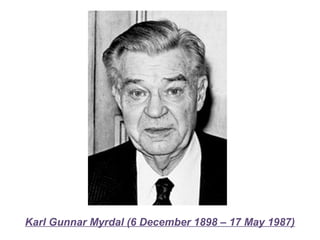
Karl Gunnar Myrdal (6 December 1898 – 17 May 1987)
Karl Gunnar Myrdal was born in Gustafs, Sweden.
Born on December 6, 1898.
He graduated from the Law School of Stockholm
University in 1923 and began practicing law while
furthering his studies at the university.
Myrdal received his doctorate degree in economics
in 1927 and was appointed as a docent in political
economy.
In 1938, the Carnegie Corporation of New York
commissioned him to conduct a study on the
American Negro predicament. The material which he
gathered and interpreted was published in 1944 as
the landmark book "An American Dilemma: The
Negro Problem and Modern Democracy".

Professor Mrydal has received more than thirty
awards in his lifetime. He received the Nobel Prize in
1974 for his ‘pioneering work in the theory of money
and economic fluctuations and penetrating analysis of
the interdependence of economic, social and
institutional phenomena’.
The classical economists are of the view that the
expansion of international trade can be taken as an
important source of economic development as it has
equalizing effect. But some of the recent economists
have argued that international trade cannot
encourage growth specially in underdeveloped
countries.

Prof. Gunnar Myrdal maintains that economic
development results in a circular causation process
leading to rapid development of developed countries
while the weaker countries tend to remain behind
and poor.
Circular cumulative causation is a multi-causal
approach where the core variables and their linkages
are delineated.
The idea behind it is that a change in one form of
an institution will lead to successive changes in other
institutions.
 These changes are circular in that they continue in
a cycle, many times in a negative way, in which there
is no end, and cumulative in that they persist
in each round.
Prof. Myrdal is well-known for some of his theses, the
main of which are :-
The theory of backwash effect of international
trade,
The cumulative causation theory of economic
development, and
The institutional reforms theory of development.


In the first two theories the causes of vicious circle of
backwardness have been analyzed while in third we
find some explicit suggestions for the development
of less developed countries.
Myrdal believes that international and inter-
regional economic relations in practice involve
unequal exchanges in the sense that the weak is
always exploited by the strong.
He describes the backwash effects of migration,
capital movement and trade in the backward regions.
The main cause of backwardness and regional
disparities has been the strong backwash effect and
the weak spread effects.
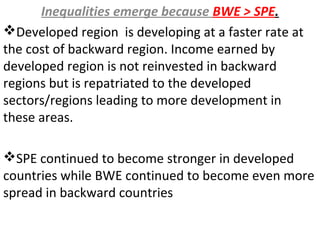
Inequalities emerge because BWE > SPE.
Developed region is developing at a faster rate at
the cost of backward region. Income earned by
developed region is not reinvested in backward
regions but is repatriated to the developed
sectors/regions leading to more development in
these areas.

SPE continued to become stronger in developed
countries while BWE continued to become even more
spread in backward countries
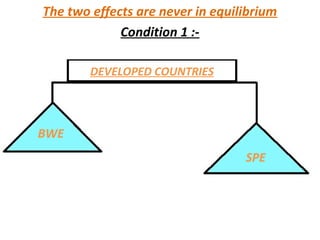
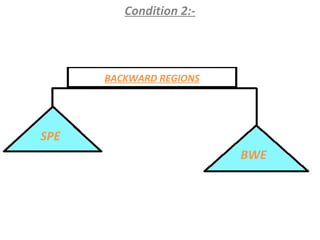
The two effects are never in equilibrium
             Condition 1 :-

        DEVELOPED COUNTRIES


BWE
                                  SPE
Condition 2:-


      BACKWARD REGIONS


SPE
                         BWE
There were some SPE from nodal regions to the
hinterland. The hinterland supplies raw material,
labour, etc. to the centres of development and in turn
receive consumer goods and services. However, these
SPE never helped in self-expansion process in rural
areas.
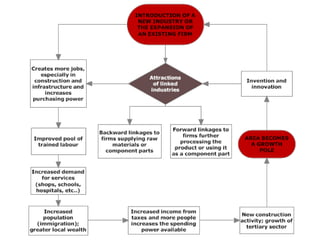
The cumulative causation action has been built
upon SPE and BWE.

The theory emphasizes that “poverty is further
perpetuated by poverty” (BWE>SPE) and “affluence
is further promoted by affluence” (SPE>BWE).

In backward regions problem creates more
problems, in developed regions auto solutions solve
all problems.
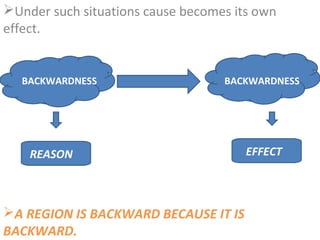
Under such situations cause becomes its own
effect.


  BACKWARDNESS                     BACKWARDNESS


    REASON                             EFFECT


A REGION IS BACKWARD BECAUSE IT IS
BACKWARD.
Myrdal contention is that :- the free play of market
forces and operation of profit motive in the capitalist
system normally tends to increase inequalities
between regions rather than decrease.

When BWE dominates; Divergence will develop;
periphery will remain weak, only center will develop
and dualism in growth is promoted.

 When SPE dominates; Convergence will develop;
periphery will develop, there will be economic
integration between center and periphery.
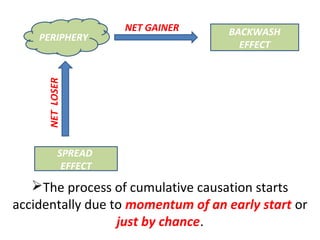
NET GAINER    BACKWASH
    PERIPHERY
                                     EFFECT
     NET LOSER


           SPREAD
            EFFECT
   The process of cumulative causation starts
accidentally due to momentum of an early start or
                  just by chance.
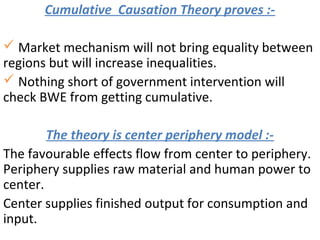
Cumulative Causation Theory proves :-

 Market mechanism will not bring equality between
regions but will increase inequalities.
 Nothing short of government intervention will
check BWE from getting cumulative.

        The theory is center periphery model :-
The favourable effects flow from center to periphery.
Periphery supplies raw material and human power to
center.
Center supplies finished output for consumption and
input.
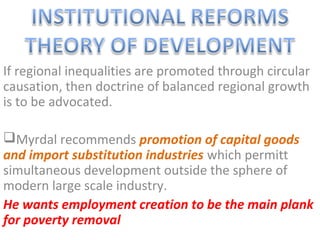
If regional inequalities are promoted through circular
causation, then doctrine of balanced regional growth
is to be advocated.

Myrdal recommends promotion of capital goods
and import substitution industries which permitt
simultaneous development outside the sphere of
modern large scale industry.
He wants employment creation to be the main plank
for poverty removal
If center and core are in semi-colonial relationship
with the periphery, then such development
programmes which provide for more
complimentarity, integration and linkages are called
for.
All efforts are to be geared towards ending socio-
economic dualism in development in less developed
countries.

Myrdal wants far reaching institutional reforms
that should bring the benefits of planning to the
masses.
He recommended strategy of balanced regional
development i.e. “Doing everything, everywhere”.

He suggested government intervention in market
mechanism as free-play will result in inequalities and
disparities.
This model combines national and international
forces which tend to keep backward countries in the
morass of cumulative process where poverty
becomes its own cause.
Though not a communist he proved that the so
called competitive markets instead of solving the
problem of backward region it would accentuate
them.
Myrdal these have made important contributions to
the theories of convergence and divergence,
agglomeration and locational economies and the
theory of vicious circle.
He was in support of balanced growth and wanted it
to be initiated, directed and sustained by
government. He was a strong supporter of the theory
of SPONSORED GROWTH.

The analysis part of Myrdal’s writings if found to be
much more satisfactory than the recommendatory
part.

The theory has been criticized regarding “accidental
factors” as the only factors which start the growth
process.
There are setbacks in developing regions and there
can be development in vicious circle region.

The agglomerating factors (same factors which
Myrdal emphasized on) can also bring decreasing
returns when diseconomies overcome the economies.

It can also be argued that even market mechanism
can reduce inequalities and disparities between two
regions.
Gunnar myrdal presentation

Gunnar myrdal presentation

  • 2.
    Karl Gunnar Myrdal(6 December 1898 – 17 May 1987)
  • 3.
    Karl Gunnar Myrdalwas born in Gustafs, Sweden. Born on December 6, 1898. He graduated from the Law School of Stockholm University in 1923 and began practicing law while furthering his studies at the university. Myrdal received his doctorate degree in economics in 1927 and was appointed as a docent in political economy.
  • 4.
    In 1938, theCarnegie Corporation of New York commissioned him to conduct a study on the American Negro predicament. The material which he gathered and interpreted was published in 1944 as the landmark book "An American Dilemma: The Negro Problem and Modern Democracy". Professor Mrydal has received more than thirty awards in his lifetime. He received the Nobel Prize in 1974 for his ‘pioneering work in the theory of money and economic fluctuations and penetrating analysis of the interdependence of economic, social and institutional phenomena’.
  • 5.
    The classical economistsare of the view that the expansion of international trade can be taken as an important source of economic development as it has equalizing effect. But some of the recent economists have argued that international trade cannot encourage growth specially in underdeveloped countries. Prof. Gunnar Myrdal maintains that economic development results in a circular causation process leading to rapid development of developed countries while the weaker countries tend to remain behind and poor.
  • 6.
    Circular cumulative causationis a multi-causal approach where the core variables and their linkages are delineated. The idea behind it is that a change in one form of an institution will lead to successive changes in other institutions.  These changes are circular in that they continue in a cycle, many times in a negative way, in which there is no end, and cumulative in that they persist in each round.
  • 7.
    Prof. Myrdal iswell-known for some of his theses, the main of which are :- The theory of backwash effect of international trade, The cumulative causation theory of economic development, and The institutional reforms theory of development. In the first two theories the causes of vicious circle of backwardness have been analyzed while in third we find some explicit suggestions for the development of less developed countries.
  • 8.
    Myrdal believes thatinternational and inter- regional economic relations in practice involve unequal exchanges in the sense that the weak is always exploited by the strong. He describes the backwash effects of migration, capital movement and trade in the backward regions. The main cause of backwardness and regional disparities has been the strong backwash effect and the weak spread effects.
  • 9.
    Inequalities emerge becauseBWE > SPE. Developed region is developing at a faster rate at the cost of backward region. Income earned by developed region is not reinvested in backward regions but is repatriated to the developed sectors/regions leading to more development in these areas. SPE continued to become stronger in developed countries while BWE continued to become even more spread in backward countries
  • 10.
    The two effectsare never in equilibrium Condition 1 :- DEVELOPED COUNTRIES BWE SPE
  • 11.
    Condition 2:- BACKWARD REGIONS SPE BWE
  • 12.
    There were someSPE from nodal regions to the hinterland. The hinterland supplies raw material, labour, etc. to the centres of development and in turn receive consumer goods and services. However, these SPE never helped in self-expansion process in rural areas.
  • 13.
    The cumulative causationaction has been built upon SPE and BWE. The theory emphasizes that “poverty is further perpetuated by poverty” (BWE>SPE) and “affluence is further promoted by affluence” (SPE>BWE). In backward regions problem creates more problems, in developed regions auto solutions solve all problems.
  • 14.
    Under such situationscause becomes its own effect. BACKWARDNESS BACKWARDNESS REASON EFFECT A REGION IS BACKWARD BECAUSE IT IS BACKWARD.
  • 15.
    Myrdal contention isthat :- the free play of market forces and operation of profit motive in the capitalist system normally tends to increase inequalities between regions rather than decrease. When BWE dominates; Divergence will develop; periphery will remain weak, only center will develop and dualism in growth is promoted.  When SPE dominates; Convergence will develop; periphery will develop, there will be economic integration between center and periphery.
  • 17.
    NET GAINER BACKWASH PERIPHERY EFFECT NET LOSER SPREAD EFFECT The process of cumulative causation starts accidentally due to momentum of an early start or just by chance.
  • 18.
    Cumulative Causation Theoryproves :-  Market mechanism will not bring equality between regions but will increase inequalities.  Nothing short of government intervention will check BWE from getting cumulative. The theory is center periphery model :- The favourable effects flow from center to periphery. Periphery supplies raw material and human power to center. Center supplies finished output for consumption and input.
  • 19.
    If regional inequalitiesare promoted through circular causation, then doctrine of balanced regional growth is to be advocated. Myrdal recommends promotion of capital goods and import substitution industries which permitt simultaneous development outside the sphere of modern large scale industry. He wants employment creation to be the main plank for poverty removal
  • 20.
    If center andcore are in semi-colonial relationship with the periphery, then such development programmes which provide for more complimentarity, integration and linkages are called for. All efforts are to be geared towards ending socio- economic dualism in development in less developed countries. Myrdal wants far reaching institutional reforms that should bring the benefits of planning to the masses.
  • 21.
    He recommended strategyof balanced regional development i.e. “Doing everything, everywhere”. He suggested government intervention in market mechanism as free-play will result in inequalities and disparities.
  • 22.
    This model combinesnational and international forces which tend to keep backward countries in the morass of cumulative process where poverty becomes its own cause. Though not a communist he proved that the so called competitive markets instead of solving the problem of backward region it would accentuate them. Myrdal these have made important contributions to the theories of convergence and divergence, agglomeration and locational economies and the theory of vicious circle.
  • 23.
    He was insupport of balanced growth and wanted it to be initiated, directed and sustained by government. He was a strong supporter of the theory of SPONSORED GROWTH. The analysis part of Myrdal’s writings if found to be much more satisfactory than the recommendatory part. The theory has been criticized regarding “accidental factors” as the only factors which start the growth process.
  • 24.
    There are setbacksin developing regions and there can be development in vicious circle region. The agglomerating factors (same factors which Myrdal emphasized on) can also bring decreasing returns when diseconomies overcome the economies. It can also be argued that even market mechanism can reduce inequalities and disparities between two regions.