The Weimar
 Republic
 Germany 1919-1933
1. Explain impact of Great Depression.

2. Identify locations in Eastern Europe and
   Central Asia.
Today’s Objectives


1. Explain impact of Great Depression.

2. Identify locations in Eastern Europe and
   Central Asia.
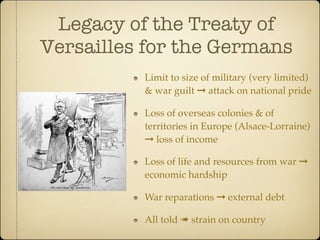
Legacy of the Treaty of
Versailles for the Germans
          Limit to size of military (very limited)
          & war guilt ➞ attack on national pride

          Loss of overseas colonies & of
          territories in Europe (Alsace-Lorraine)
          ➞ loss of income

          Loss of life and resources from war ➞
          economic hardship

          War reparations ➞ external debt

          All told ➠ strain on country
Weimar Government
Formed at the end of the war to bring a peaceful conclusion
to the war ➞ Kaiser out

Signed the Treaty of Versailles, under protest (but no choice)

SPD - Socialist Democratic party that was fiercely anti-
Communist in power, though considered a moderate party

Attempted to gather coalition of leaders to govern

Radical socialists/communists on the left; radical
conservatives in the National Socialist German Worker’s
Party (Nazi) on the right
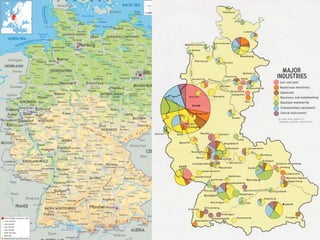
War Reparations

1921 - Government charged with £6.6 billion

Couldn’t make payments within the first two
years

70,000 French and Belgian troops march into
the Ruhr Valley and occupy ➞ take control to
take money for reparations
Economic Impact
By the end of 1923 - the impact
to the German economy
would be catastrophic

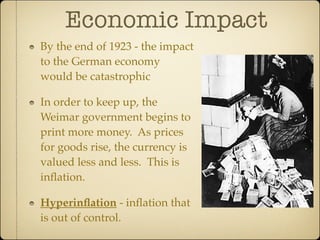
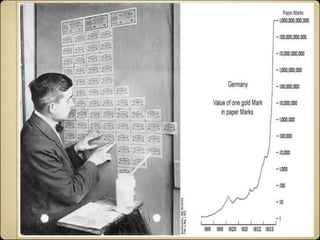
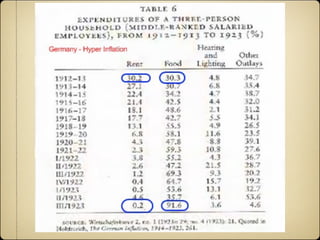
In order to keep up, the
Weimar government begins to
print more money. As prices
for goods rise, the currency is
valued less and less. This is
inflation.

Hyperinflation - inflation that
is out of control.
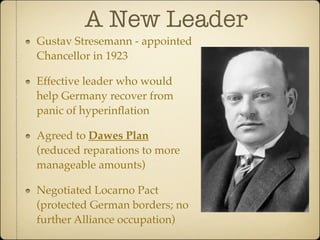
A New Leader
Gustav Stresemann - appointed
Chancellor in 1923

Effective leader who would
help Germany recover from
panic of hyperinflation

Agreed to Dawes Plan
(reduced reparations to more
manageable amounts)

Negotiated Locarno Pact
(protected German borders; no
further Alliance occupation)
Weimar on Path of
   Recovery?
Many indications show that German
production was increasing and was on path to
some recovery

In October, 1929, though, Stresemann dies from
stroke. Timing couldn’t have been worse

Shortly after his death - world is rocked by
another event
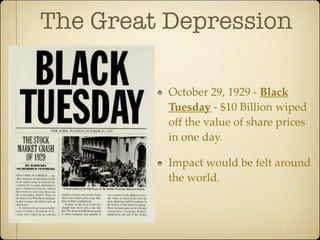
The Great Depression

          October 29, 1929 - Black
          Tuesday - $10 Billion wiped
          off the value of share prices
          in one day.

          Impact would be felt around
          the world.
Vocabulary

Ruhr Valley
Hyperinflation
Dawes Plan
Black Tuesday

Weimar Germany

  • 1.
    The Weimar Republic Germany 1919-1933
  • 2.
    1. Explain impactof Great Depression. 2. Identify locations in Eastern Europe and Central Asia.
  • 3.
    Today’s Objectives 1. Explainimpact of Great Depression. 2. Identify locations in Eastern Europe and Central Asia.
  • 4.
    Legacy of theTreaty of Versailles for the Germans Limit to size of military (very limited) & war guilt ➞ attack on national pride Loss of overseas colonies & of territories in Europe (Alsace-Lorraine) ➞ loss of income Loss of life and resources from war ➞ economic hardship War reparations ➞ external debt All told ➠ strain on country
  • 5.
    Weimar Government Formed atthe end of the war to bring a peaceful conclusion to the war ➞ Kaiser out Signed the Treaty of Versailles, under protest (but no choice) SPD - Socialist Democratic party that was fiercely anti- Communist in power, though considered a moderate party Attempted to gather coalition of leaders to govern Radical socialists/communists on the left; radical conservatives in the National Socialist German Worker’s Party (Nazi) on the right
  • 6.
    War Reparations 1921 -Government charged with £6.6 billion Couldn’t make payments within the first two years 70,000 French and Belgian troops march into the Ruhr Valley and occupy ➞ take control to take money for reparations
  • 8.
    Economic Impact By theend of 1923 - the impact to the German economy would be catastrophic In order to keep up, the Weimar government begins to print more money. As prices for goods rise, the currency is valued less and less. This is inflation. Hyperinflation - inflation that is out of control.
  • 11.
    A New Leader GustavStresemann - appointed Chancellor in 1923 Effective leader who would help Germany recover from panic of hyperinflation Agreed to Dawes Plan (reduced reparations to more manageable amounts) Negotiated Locarno Pact (protected German borders; no further Alliance occupation)
  • 12.
    Weimar on Pathof Recovery? Many indications show that German production was increasing and was on path to some recovery In October, 1929, though, Stresemann dies from stroke. Timing couldn’t have been worse Shortly after his death - world is rocked by another event
  • 13.
    The Great Depression October 29, 1929 - Black Tuesday - $10 Billion wiped off the value of share prices in one day. Impact would be felt around the world.
  • 14.

Editor's Notes

  • #2 \n
  • #3 \n
  • #4 \n
  • #5 \n
  • #6 \n
  • #7 \n
  • #8 \n
  • #9 \n
  • #10 \n
  • #11  American politician, Charles G. Dawes, developed this plan to stabilize German economy in 1924\n The Ruhr area was to be evacuated by Allied occupation troops.\n Reparation payments would begin at “one billion marks the first year, increasing to two and a half billion marks annually after five years" (Merrill 93)\n The Reichsbank would be reorganized under Allied supervision.\n The sources for the reparation money would include transportation, excise, and custom taxes.\n Plan largely centered on American money being pumped into the country.\n
  • #12 \n
  • #13 \n
  • #14 \n