The Republic of Weimar
Samuel Perrino Martínez. ISU. Republic of Weimar (1919 - 1929)
There is some basic information you
should know about this period
 What kind of system?
 Periods
 1st period:
 Problems
- Why was the RoW so unpopular?
- Attempts to overthrow the RoW
 Who was against Weimar?
 1923: The turning point: Ruhr crisis and hyperinflation
Samuel Perrino Martínez. ISU. Republic of Weimar (1919 - 1929)
What kind of system?
 Parliamentary democracy: The most democratic system in the world !
- Right to vote over the age of 20
- Proportional system
- President + Parliament + Chancellor (Division of powers)
 Constitution. Main points:
- Art. 2: Proportional sytem
- Art. 48: Emergency cases
Samuel Perrino Martínez. ISU. Republic of Weimar (1919 - 1929)
Problems
 You have to understand why the Weimar Republic was so unpopular in Germany in
the 1920s
 Try to distinguish between the general problems (i.e bad economic situation) and
the facts in order to have a clear idea.
Samuel Perrino Martínez. ISU. Republic of Weimar (1919 - 1929)
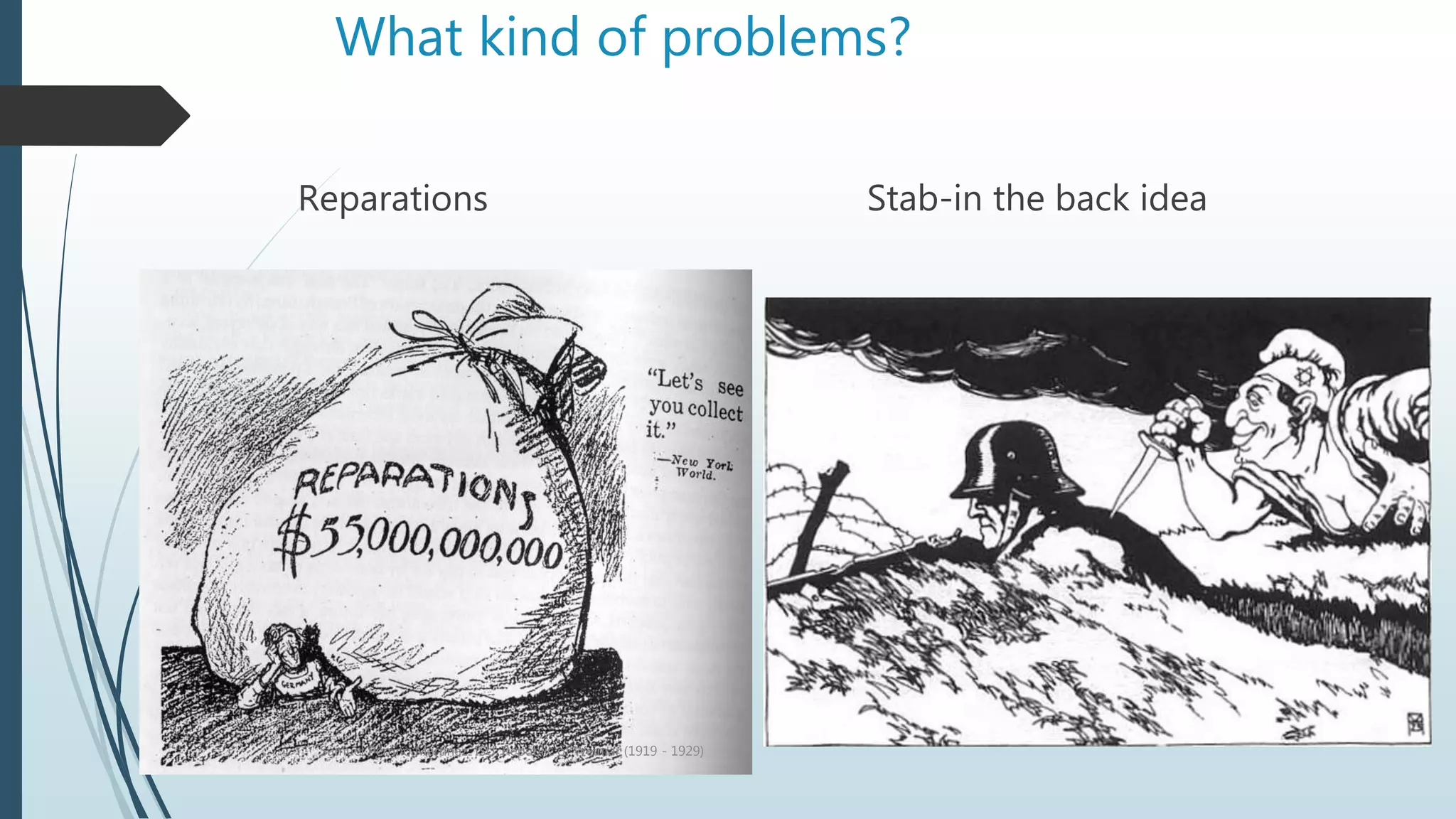
What kind of problems?
Reparations Stab-in the back idea
Samuel Perrino Martínez. ISU. Republic of Weimar (1919 - 1929)
What kind of problems?
Economic crisis Distribution of wealth
Samuel Perrino Martínez. ISU. Republic of Weimar (1919 - 1929)
Why was Germany in such a bad situation?
 Treaty of Versailles terms:
- Germany lost 10% of land
- 12 % of population
- 48 % of the iron industry (in favor of …)
- African colonies (Togoland and Cameroon)
- Germany had to accept the blame for the war
- The army was reduced to 100,000 men (no possibility of defense)
- Why was the Treaty considered negative for Germany?
Samuel Perrino Martínez. ISU. Republic of Weimar (1919 - 1929)
Treaty of Versailles. German reaction
 Diktat: Germany had no option to negotiate the
conditions. They even did not participate in the
discussions.
 How did Germans feel about this?
--- We are not obliged to follow these rules if we
have the chance
Can you argue something against this argument?
Samuel Perrino Martínez. ISU. Republic of Weimar (1919 - 1929)
Diktat
Samuel Perrino Martínez. ISU. Republic of Weimar (1919 - 1929)
Treaty of Versailles.
 Loss of territory:
- Germany lost 10% of the territory
- It,s important because many German
population was living in this territories.
They had two options:
- Stay as a minorities
- Move to Germany
- It,s not just a question of prestige, it,s
also a “personal” question.
Samuel Perrino Martínez. ISU. Republic of Weimar (1919 - 1929)
Treaty of Versailles.
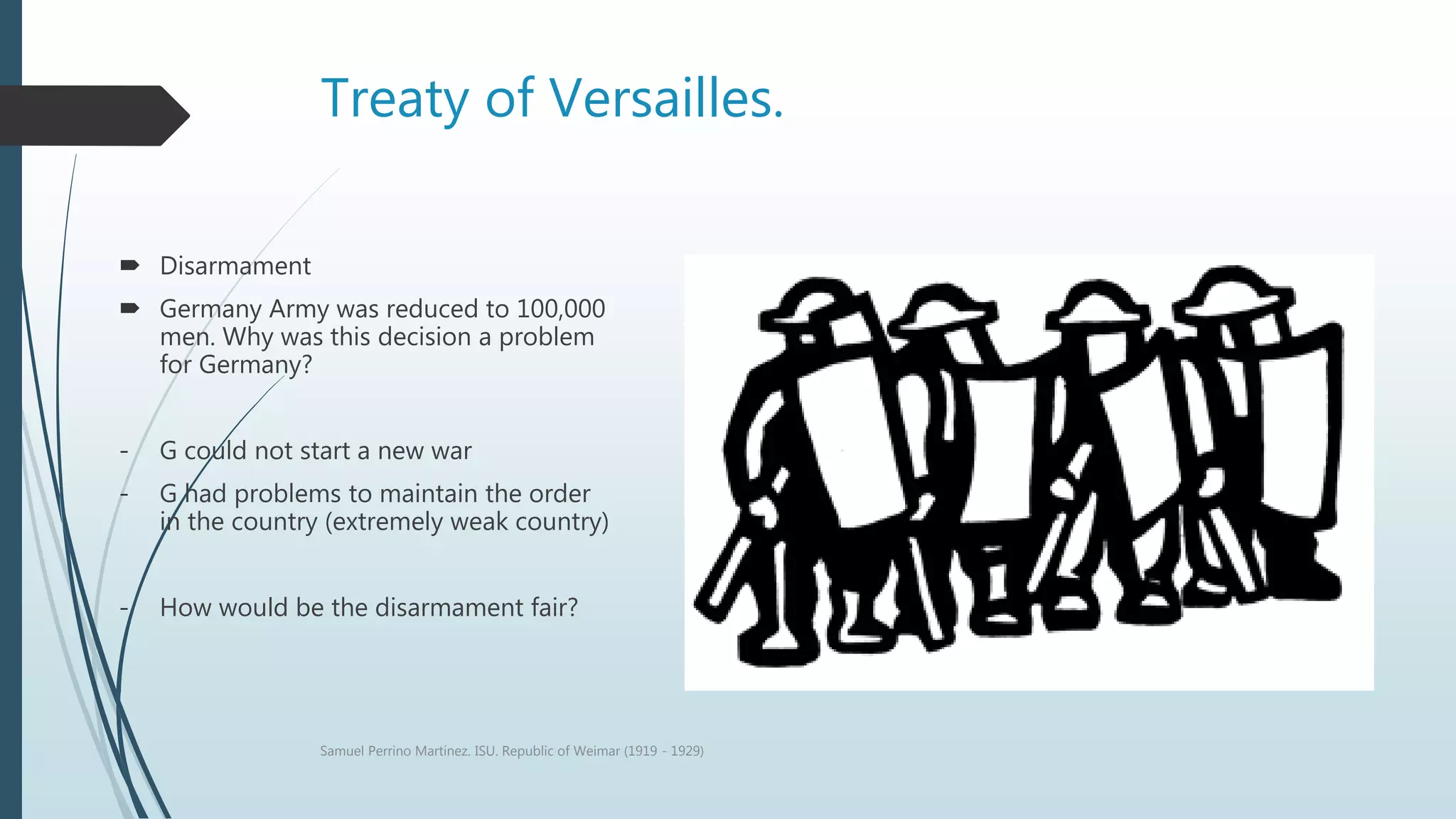
 Disarmament
 Germany Army was reduced to 100,000
men. Why was this decision a problem
for Germany?
- G could not start a new war
- G had problems to maintain the order
in the country (extremely weak country)
- How would be the disarmament fair?
Samuel Perrino Martínez. ISU. Republic of Weimar (1919 - 1929)
Treaty of Versailles
 War guilt (Art. 234 Treaty of Versailles)
The Allied and Associated Governments affirm and Germany
accepts the responsibility of Germany and her allies for causing
all loss and damage to which the Allied and Associated
Governments and their nationals have been subjected as a
consequence of the war imposed on them by the aggression of
Germany and her allies
Germans felt this was very unfair.
Also, blame meaned in real terms ….
MONEY
Samuel Perrino Martínez. ISU. Republic of Weimar (1919 - 1929)
Were the Germans right?
 Partially YES
 It is true the conditions of the Treaty
were hard for Germany
 Partially NO
 France wanted to divide Germany
into small states, even higher
reparations and the complete
elimination of the German Army (It
could be worse)
Samuel Perrino Martínez. ISU. Republic of Weimar (1919 - 1929)
So… many people were conspiring against
the democracy
 At that moment, there were different opinions in Germany:
 Those in favor of democracy (Majority of population)
 Those against the democracy (Extremists: Ultranationalist and Communist, they hated each other)
-- Common features:
-- They believed in violence as the best way to obtain the power
-- They were against democracy (they preferred authoritarian regimes)
Samuel Perrino Martínez. ISU. Republic of Weimar (1919 - 1929)
In favor of democracy
 The main party was the Social-Democrat Party (left-wing party), ruled by Ebert
 There were also right-wing parties (DDP) and central parties (Zentrum, Catholic Party)
 They had different ideas, but they accepted democracy as the best system of government
 They represented 80% of German population
Samuel Perrino Martínez. ISU. Republic of Weimar (1919 - 1929)
Those against democracy
 Left-wing extremist:
 They tried to establish a communist
rule in Germany
 1917: Russian revolution… so why not
Germany?
 Who --- Working class (they had bad
conditions of life, so they did not
care about liberties, they just want an
equal share of the wealth)
Samuel Perrino Martínez. ISU. Republic of Weimar (1919 - 1929)
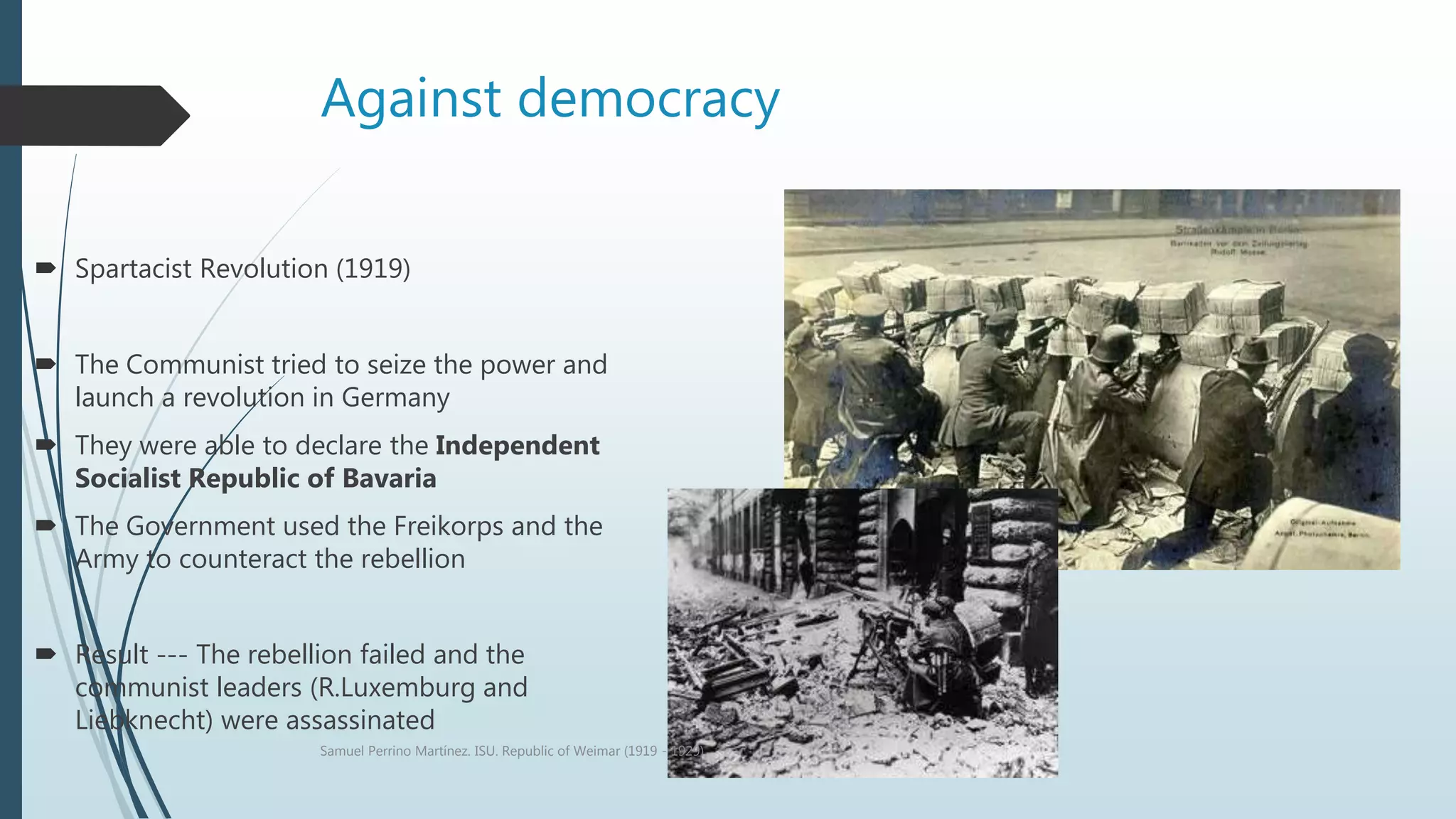
Against democracy
 Spartacist Revolution (1919)
 The Communist tried to seize the power and
launch a revolution in Germany
 They were able to declare the Independent
Socialist Republic of Bavaria
 The Government used the Freikorps and the
Army to counteract the rebellion
 Result --- The rebellion failed and the
communist leaders (R.Luxemburg and
Liebknecht) were assassinated
Samuel Perrino Martínez. ISU. Republic of Weimar (1919 - 1929)
Those against democracy
 Right-wing Nationalist:
 They thought the Treaty was a complete
humiliation for Germany
 They wanted an authoritarian and strong regime
(similar to the previous situation before the war)
 Who --- Mainly composed by ex-soldiers who
did not accept the end of the war. They were
organized in the Freikorps.
Samuel Perrino Martínez. ISU. Republic of Weimar (1919 - 1929)
Right-wing extremist. The Kapp Putsch
 1920
 Kapp was a general and he tried to
take over the power with 5,000
Freikorps
 The government asked for the aid of
the workers and they reacted with a
general strike
 Kapp left the country and the
rebellion failed
Samuel Perrino Martínez. ISU. Republic of Weimar (1919 - 1929)
1923. A key year
 The situation was quite unstable the first years of the Republic of Weimar, but 1923
will be a special year for several crisis:
- The Ruhr Crisis
- The Munich Putsch
- Hyperinflation
Samuel Perrino Martínez. ISU. Republic of Weimar (1919 - 1929)
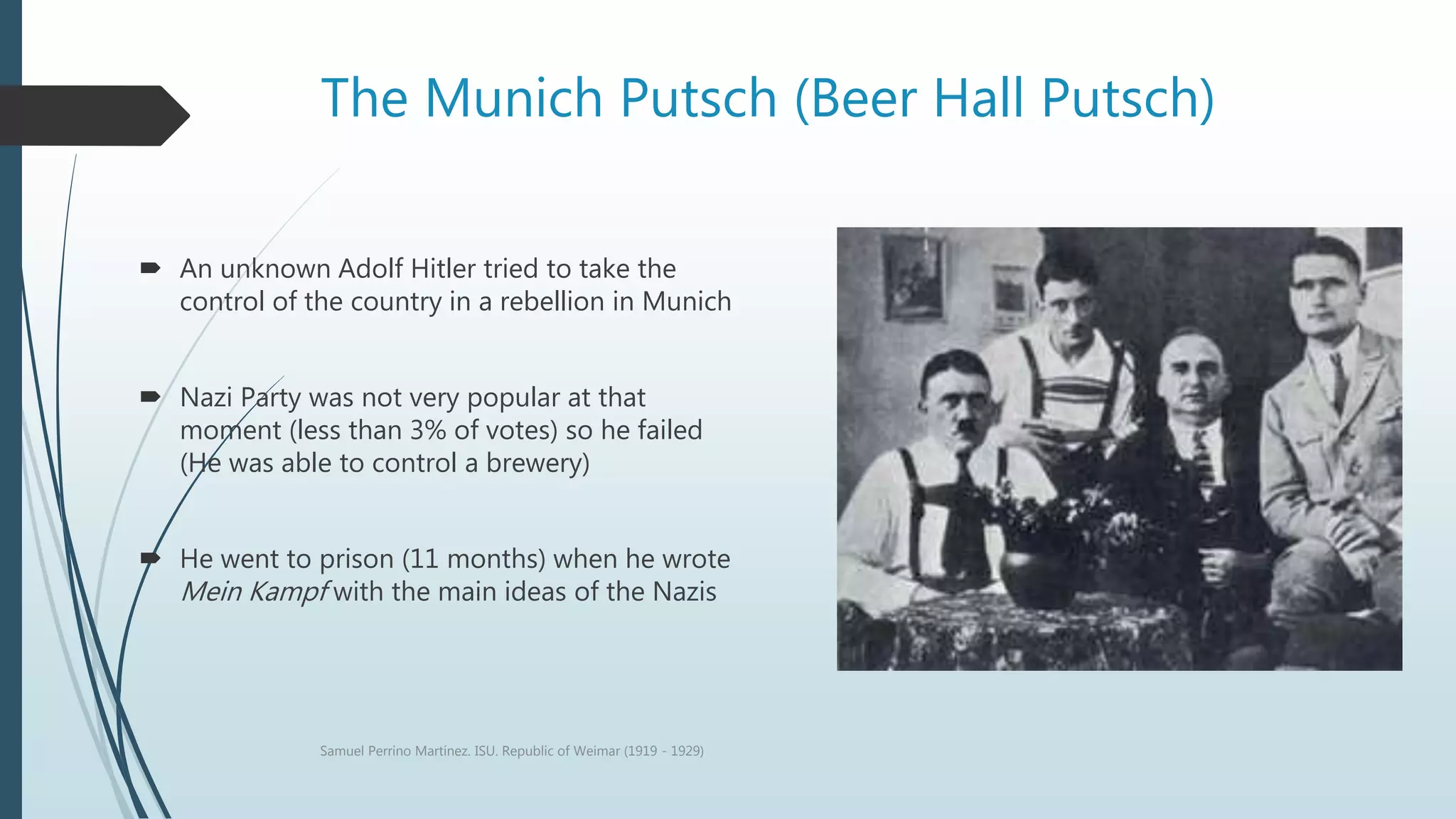
The Munich Putsch (Beer Hall Putsch)
 An unknown Adolf Hitler tried to take the
control of the country in a rebellion in Munich
 Nazi Party was not very popular at that
moment (less than 3% of votes) so he failed
(He was able to control a brewery)
 He went to prison (11 months) when he wrote
Mein Kampf with the main ideas of the Nazis
Samuel Perrino Martínez. ISU. Republic of Weimar (1919 - 1929)
Ruhr crisis
 Previous situation
 German solution
 Hyperinflation
Samuel Perrino Martínez. ISU. Republic of Weimar (1919 - 1929)
Previous situation
 The reparations commission had
determined that Germany should pay
132 billion gold marks in 42 years
to the Allied powers
Samuel Perrino Martínez. ISU. Republic of Weimar (1919 - 1929)
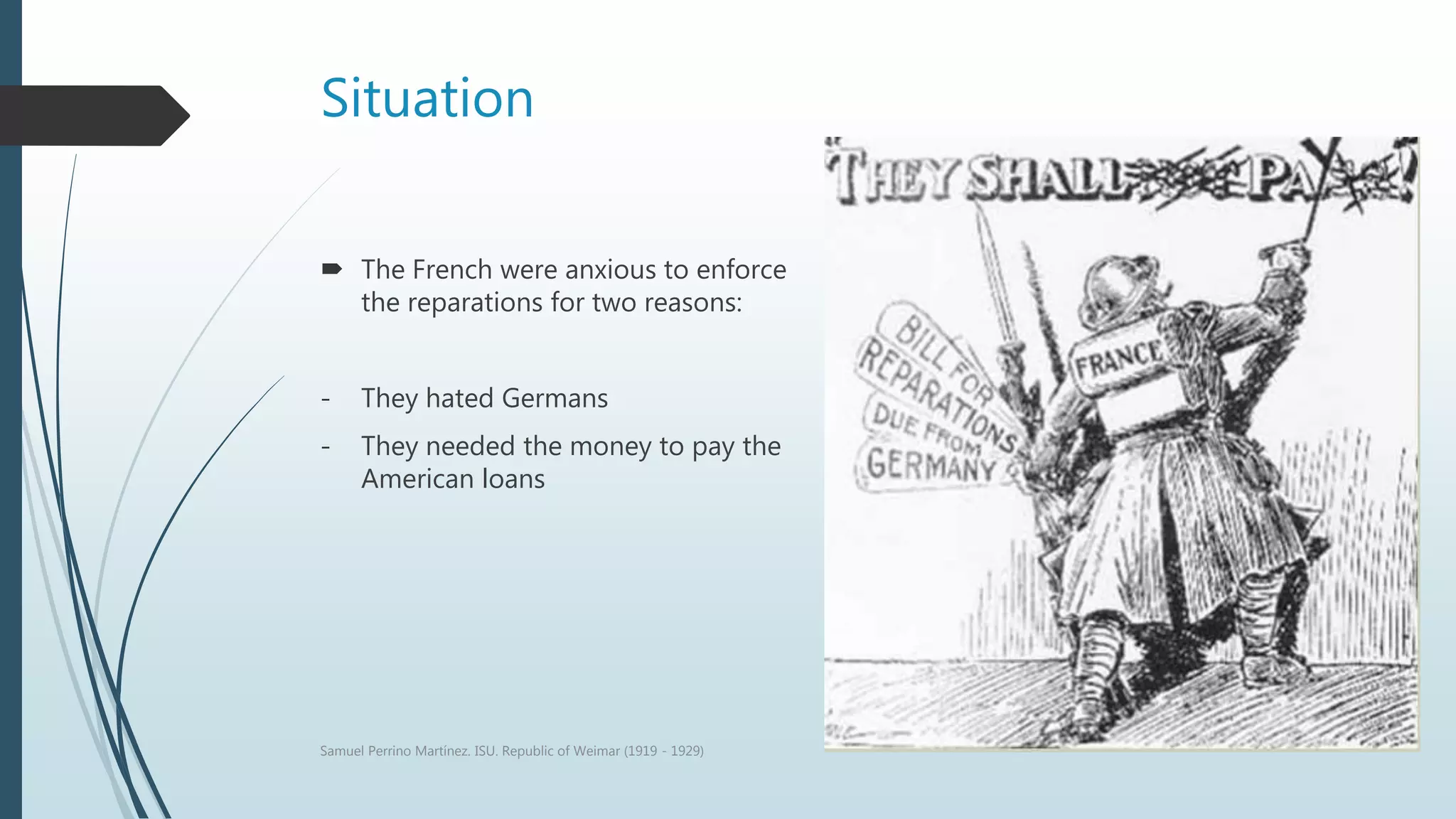
Situation
 The French were anxious to enforce
the reparations for two reasons:
- They hated Germans
- They needed the money to pay the
American loans
Samuel Perrino Martínez. ISU. Republic of Weimar (1919 - 1929)
Ruhr crisis
 Germans had problems to pay the demanded
amount of money, so the French decided to take a
hard line approach to Germany: the best way to
make Germany pay was …
 MAKING USE OF THE FORCE ---- French and
Belgium troops invaded the Ruhr (the industrial area
of Germany) to “receive” the payment
 What would you do if you were a German worker?
Samuel Perrino Martínez. ISU. Republic of Weimar (1919 - 1929)
Ruhr crisis
 As Germany had almost no army
(Treaty of Versailles) France took the
outputs of the factories and mines of
the Ruhr, and shipping them to its
territory.
Samuel Perrino Martínez. ISU. Republic of Weimar (1919 - 1929)
Ruhr crisis
 What was the German reaction?
 German workers refused to
cooperate
 Sabotage (Flooding of mines,
burning factories, destruction of
railroads, etc.)
 French fought against that. They had
the complete control of this area!
Samuel Perrino Martínez. ISU. Republic of Weimar (1919 - 1929)
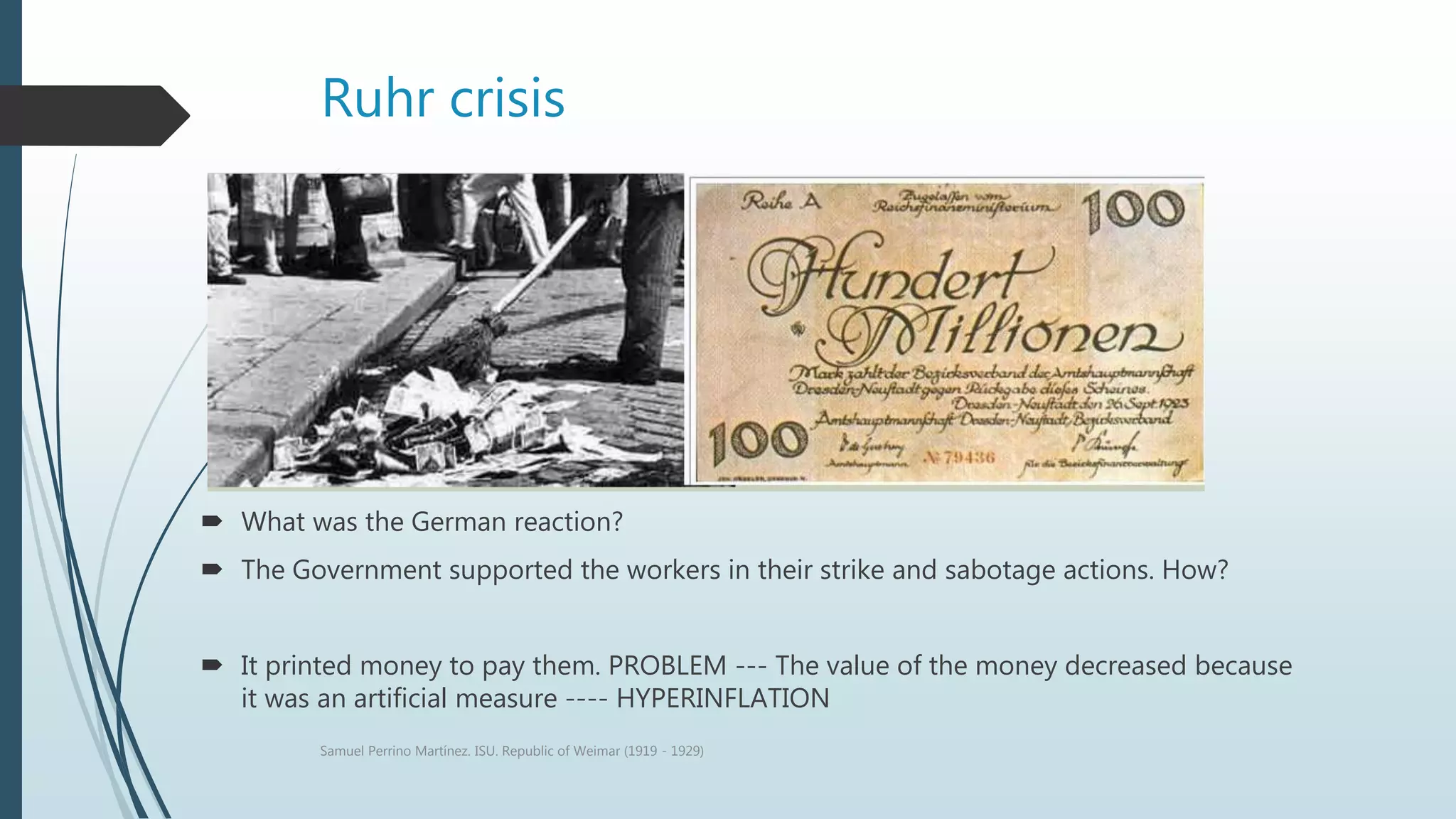
Ruhr crisis
 What was the German reaction?
 The Government supported the workers in their strike and sabotage actions. How?
 It printed money to pay them. PROBLEM --- The value of the money decreased because
it was an artificial measure ---- HYPERINFLATION
Samuel Perrino Martínez. ISU. Republic of Weimar (1919 - 1929)
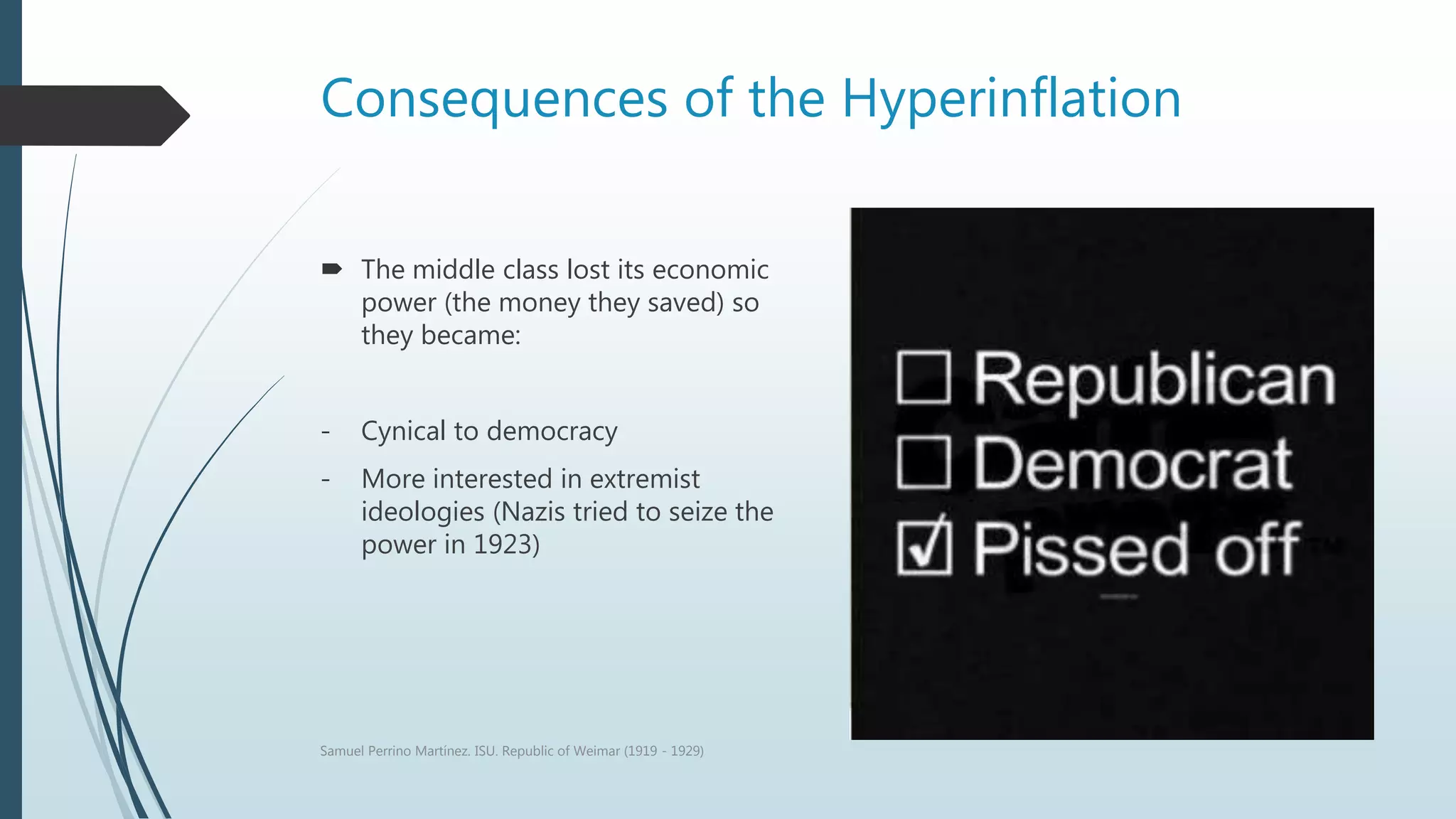
Consequences of the Hyperinflation
 The middle class lost its economic
power (the money they saved) so
they became:
- Cynical to democracy
- More interested in extremist
ideologies (Nazis tried to seize the
power in 1923)
Samuel Perrino Martínez. ISU. Republic of Weimar (1919 - 1929)
So, the Weimar Republic was in a serious
trouble
 Hyperinflation and bad economic situation
 Challenged by the Left and Right extremist
 Without a clear answer to the problems of the country
 So… in this difficult situation, a new president (Stresseman) took the power after the first
years of Ebert.
 Would he be able to change the situation?
 YES, the Golden Years (1923 – 1929)
Samuel Perrino Martínez. ISU. Republic of Weimar (1919 - 1929)
The Golden Years (1923 – 1929)
 After an initial crisis, the Weimar Republic was able to overcome most of the
problems in the period from 1923 to 1929 (the Golden Years)
 The key figure of this period was Gustave Stresseman (the Minister of Foreign
Affairs)
 Germany got important achievements in:
- The economy
- Culture
- Politics
Samuel Perrino Martínez. ISU. Republic of Weimar (1919 - 1929)
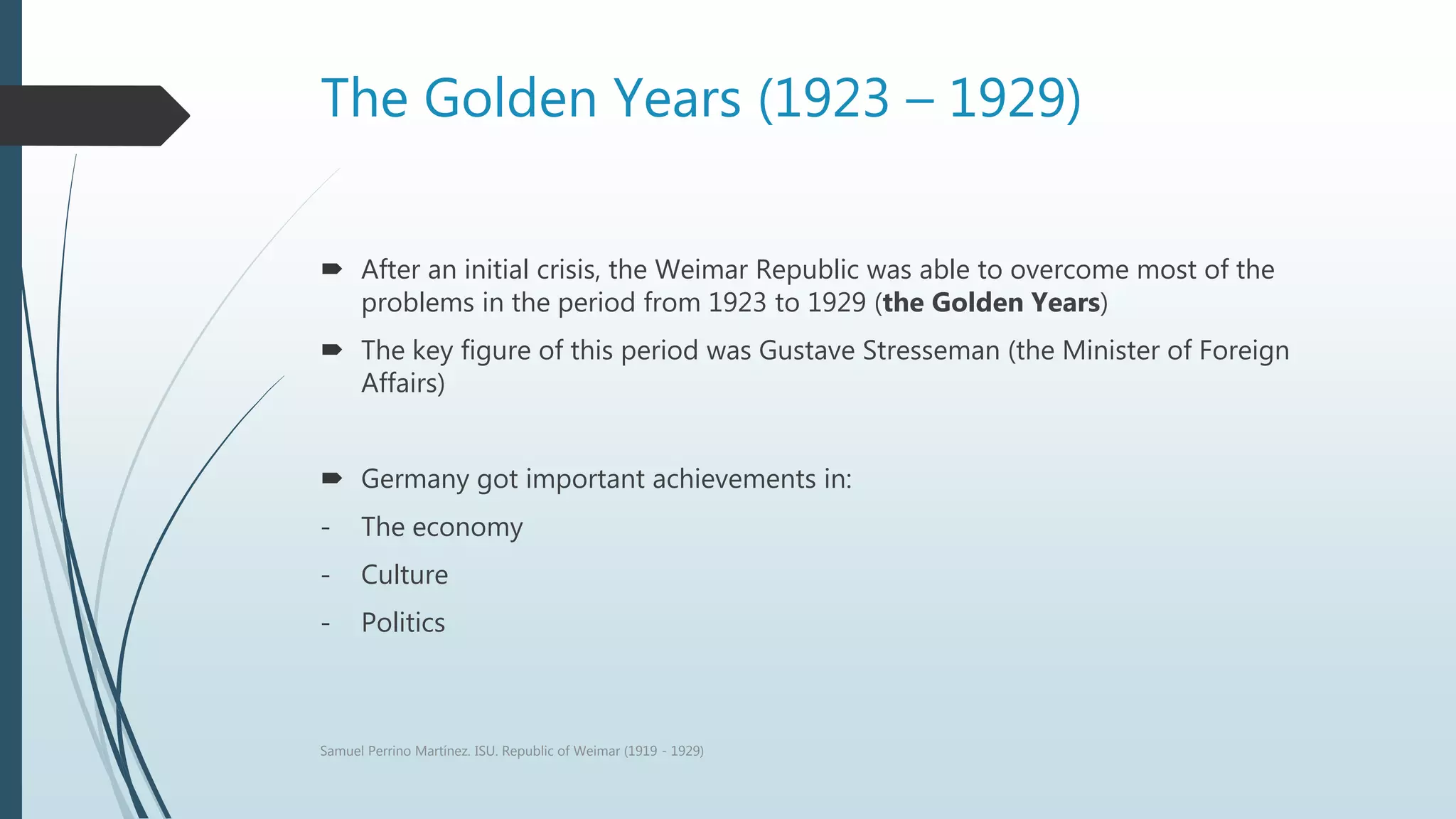
Economy
 He found a solution to solve the problem of Hyperinflation
 First, he created a new currency
 If Germany was in bad situation, the world would be in a bad
situation (because of the reparations) so …
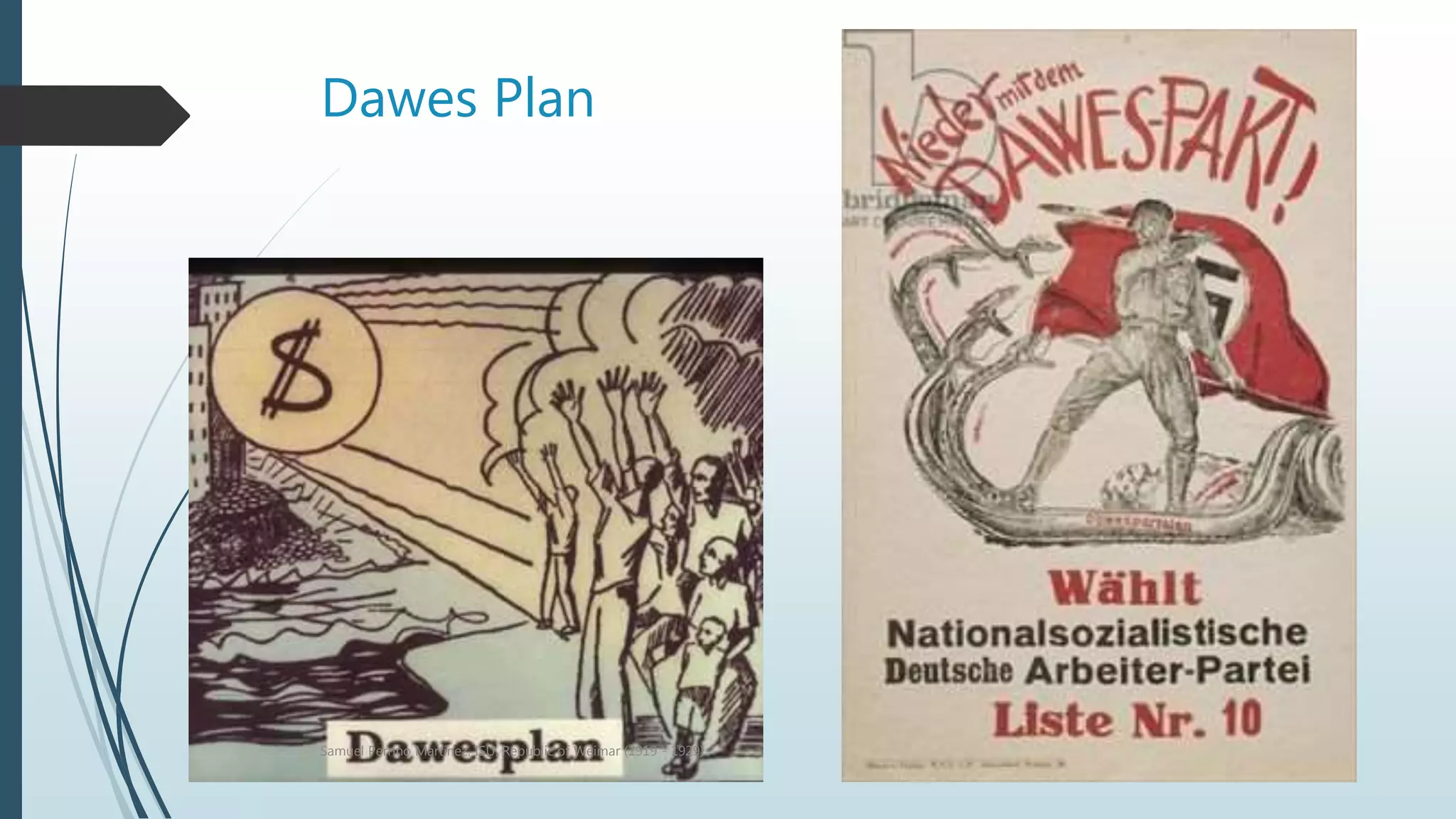
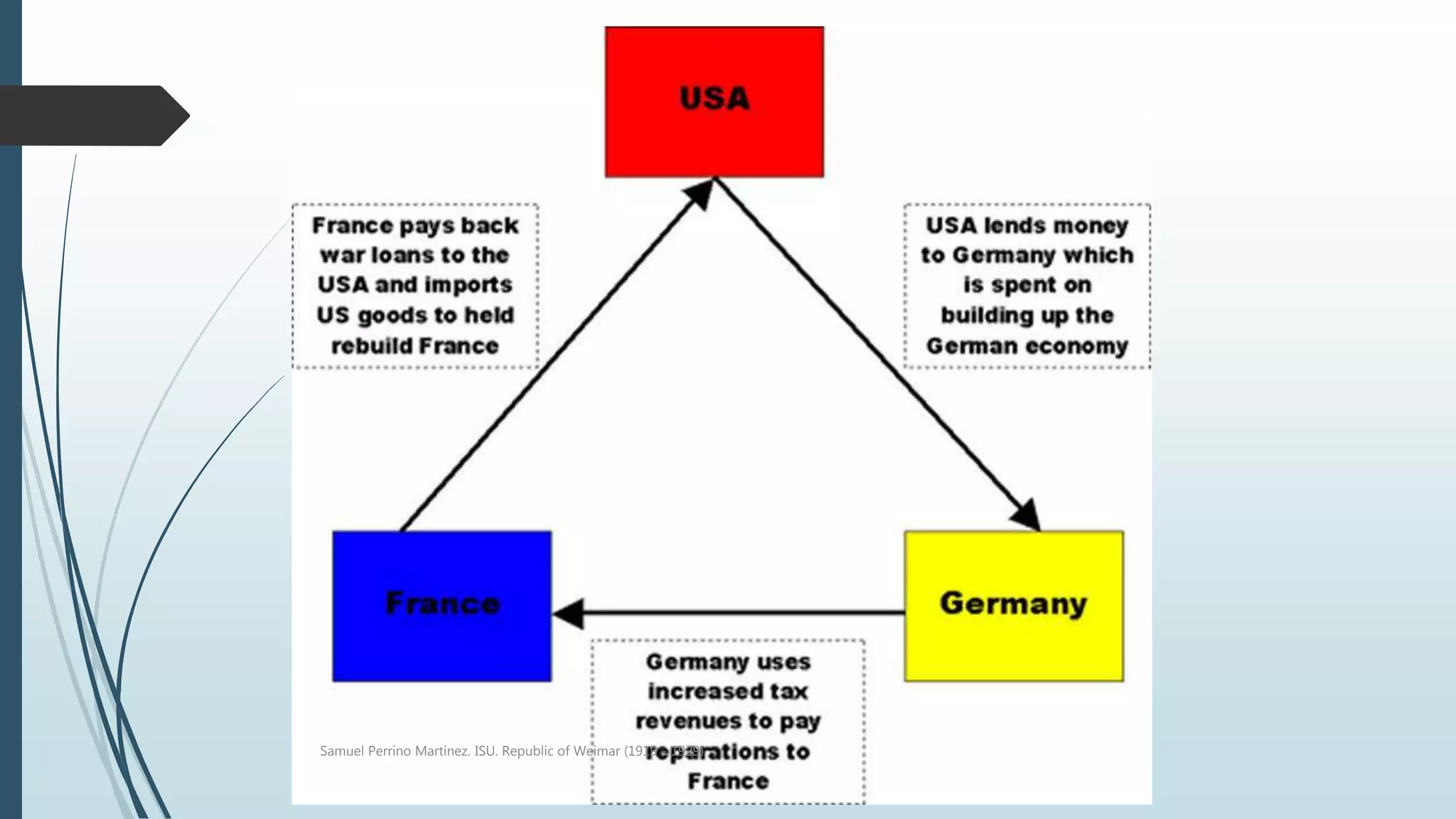
 Dawes Plan:
- Reparations payments were spread over a longer period
- The USA gave loans to Germany
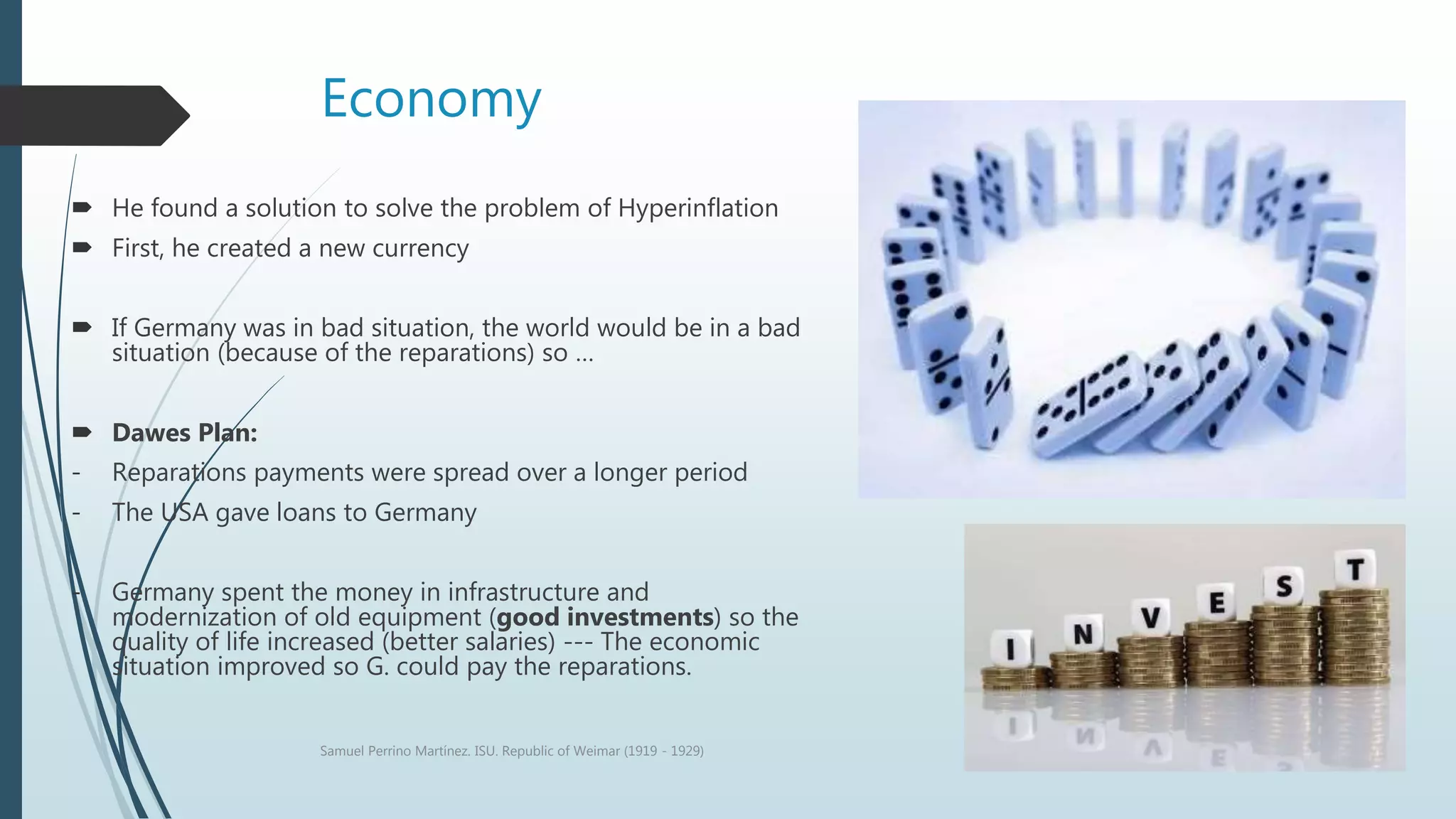
- Germany spent the money in infrastructure and
modernization of old equipment (good investments) so the
quality of life increased (better salaries) --- The economic
situation improved so G. could pay the reparations.
Samuel Perrino Martínez. ISU. Republic of Weimar (1919 - 1929)
Dawes Plan
Samuel Perrino Martínez. ISU. Republic of Weimar (1919 - 1929)
… but
 The German economy was
completely dependent on American
loans, so …
 The unemployment began to raise at
the end of the Golden Years (social
unrest)
 Peasants and small business were not
especially benefited by Weimar
policies
Samuel Perrino Martínez. ISU. Republic of Weimar (1919 - 1929)
Culture
 During the Kaiser´s time --- Dictatorship and
censorship
 Weimar Republic brought the freedom of
speech --- Cultural Renaissance
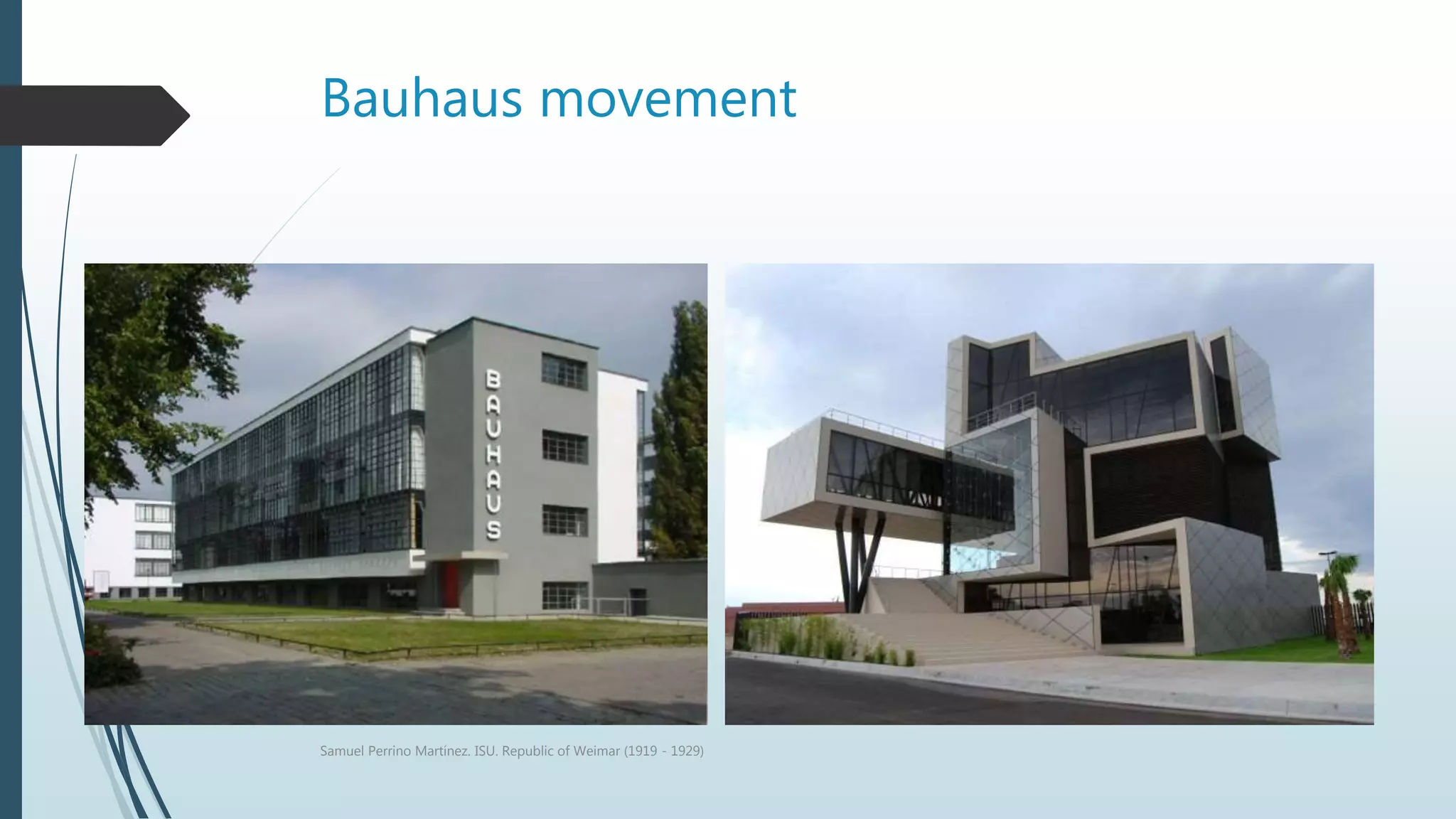
 George Grosz and Bauhaus design
 The cinema industry was the most important
in Europe (F.Lang and M.Dietrich)
Samuel Perrino Martínez. ISU. Republic of Weimar (1919 - 1929)
George Grosz
Samuel Perrino Martínez. ISU. Republic of Weimar (1919 - 1929)
Bauhaus movement
Samuel Perrino Martínez. ISU. Republic of Weimar (1919 - 1929)
Fritz Lang. Metropolis
The first science fiction movie!!Samuel Perrino Martínez. ISU. Republic of Weimar (1919 - 1929)
But …
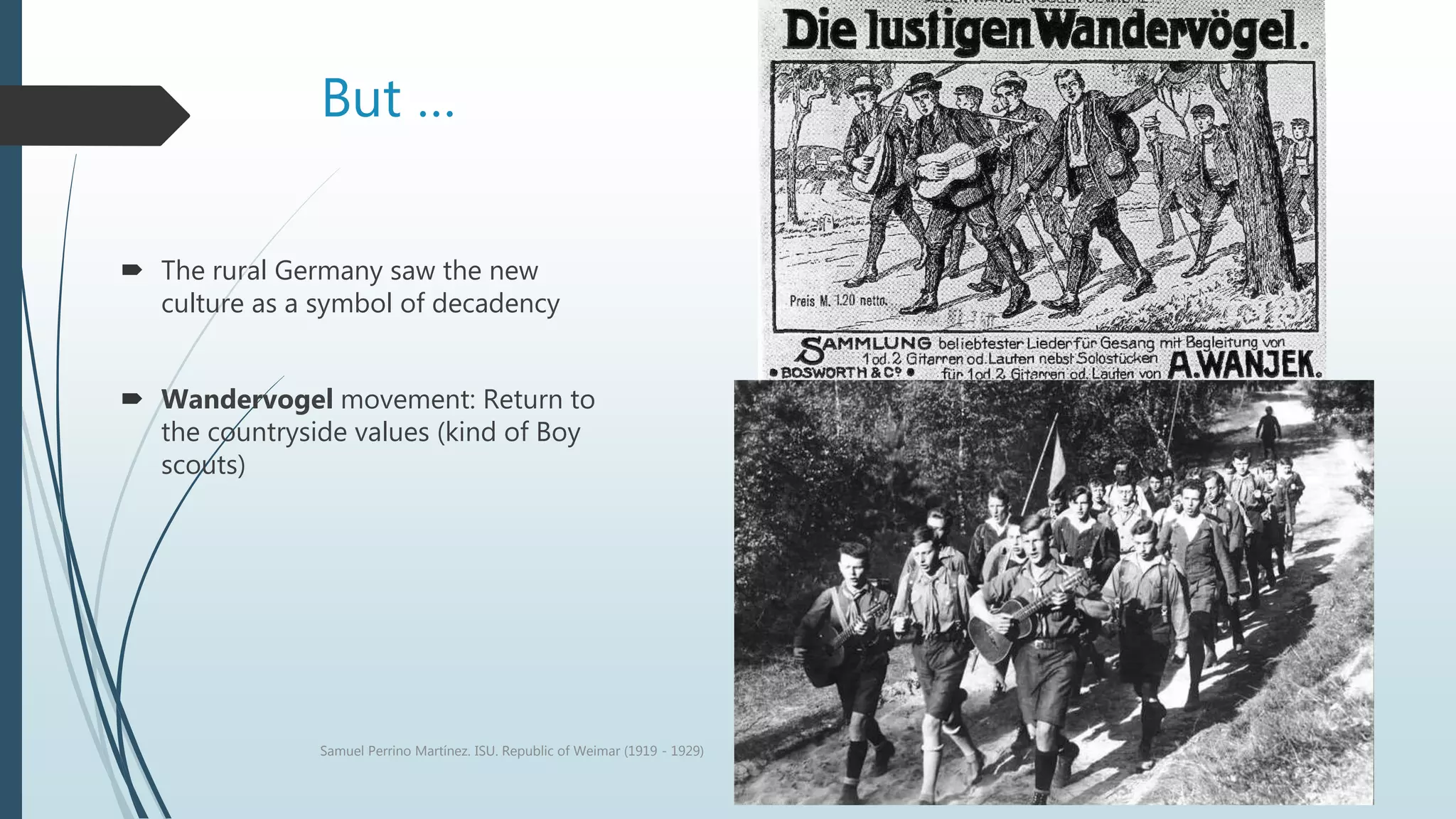
 The rural Germany saw the new
culture as a symbol of decadency
 Wandervogel movement: Return to
the countryside values (kind of Boy
scouts)
Samuel Perrino Martínez. ISU. Republic of Weimar (1919 - 1929)
Politics
 The extremist (left and right wing)
were weaker during this period
(Nazis got 5% of the vote, and
Communist did not go further than
15% of the vote)
 A GrossKoalition was formed with all
democratic parties, so the
government was strong
Samuel Perrino Martínez. ISU. Republic of Weimar (1919 - 1929)
… but
 Extremist parties were not banned,
even if they were against democracy
---- They could establish an
organization for the future
 People started to accept extremist
parties as part of the system
Samuel Perrino Martínez. ISU. Republic of Weimar (1919 - 1929)
Foreign policy
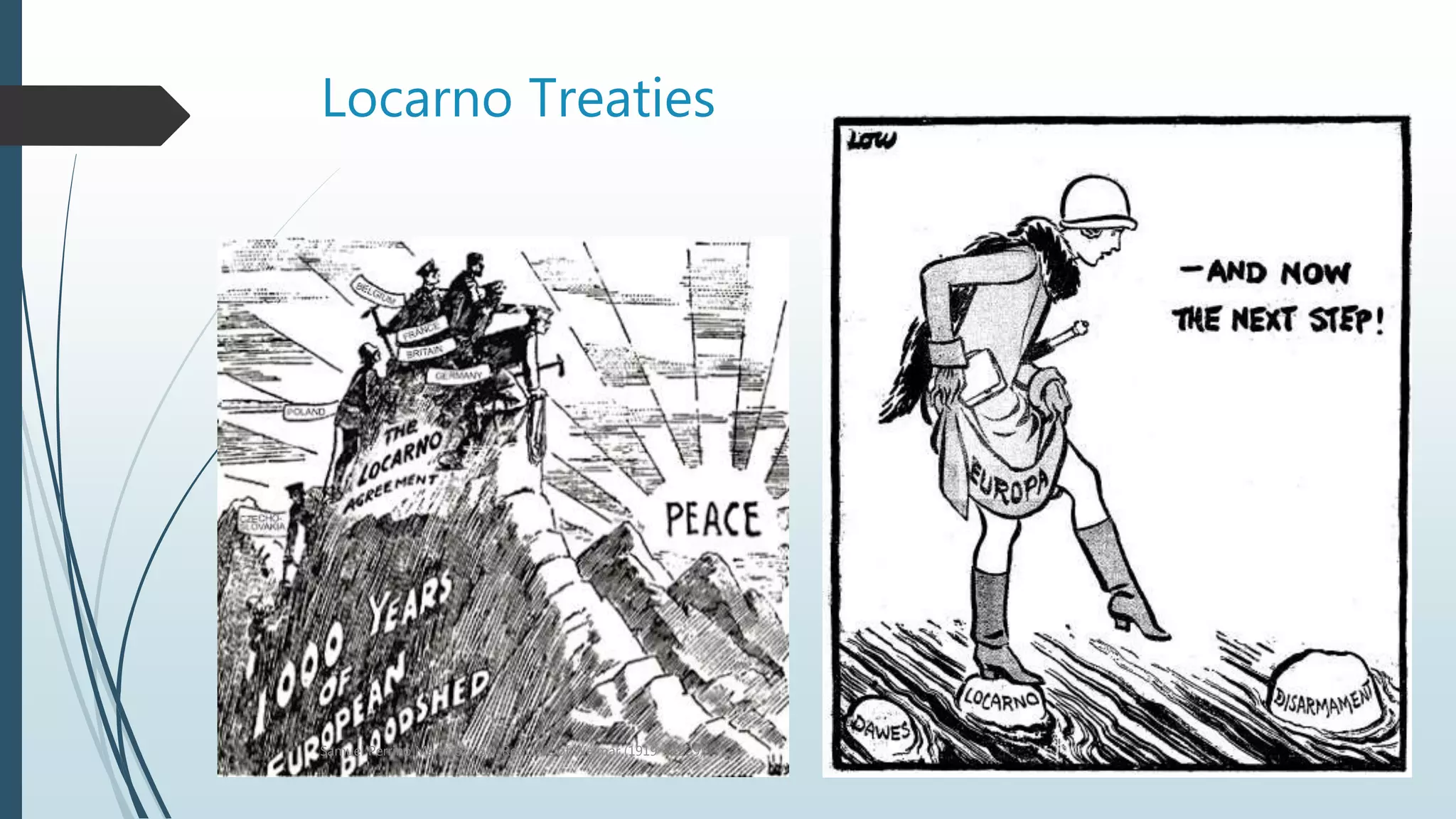
 Stressman reached the Locarno Treaties
(1925) where:
- Germany recognized the Western borders after
the war
- The Eastern borders were not defined (Why was
this a problem for the future?)
- Germany was accepted in the League of Nations
- Young Plan (1929): Less reparations for
Germany and the foreign troops left Germany
Samuel Perrino Martínez. ISU. Republic of Weimar (1919 - 1929)
Locarno Treaties
Samuel Perrino Martínez. ISU. Republic of Weimar (1919 - 1929)
But…
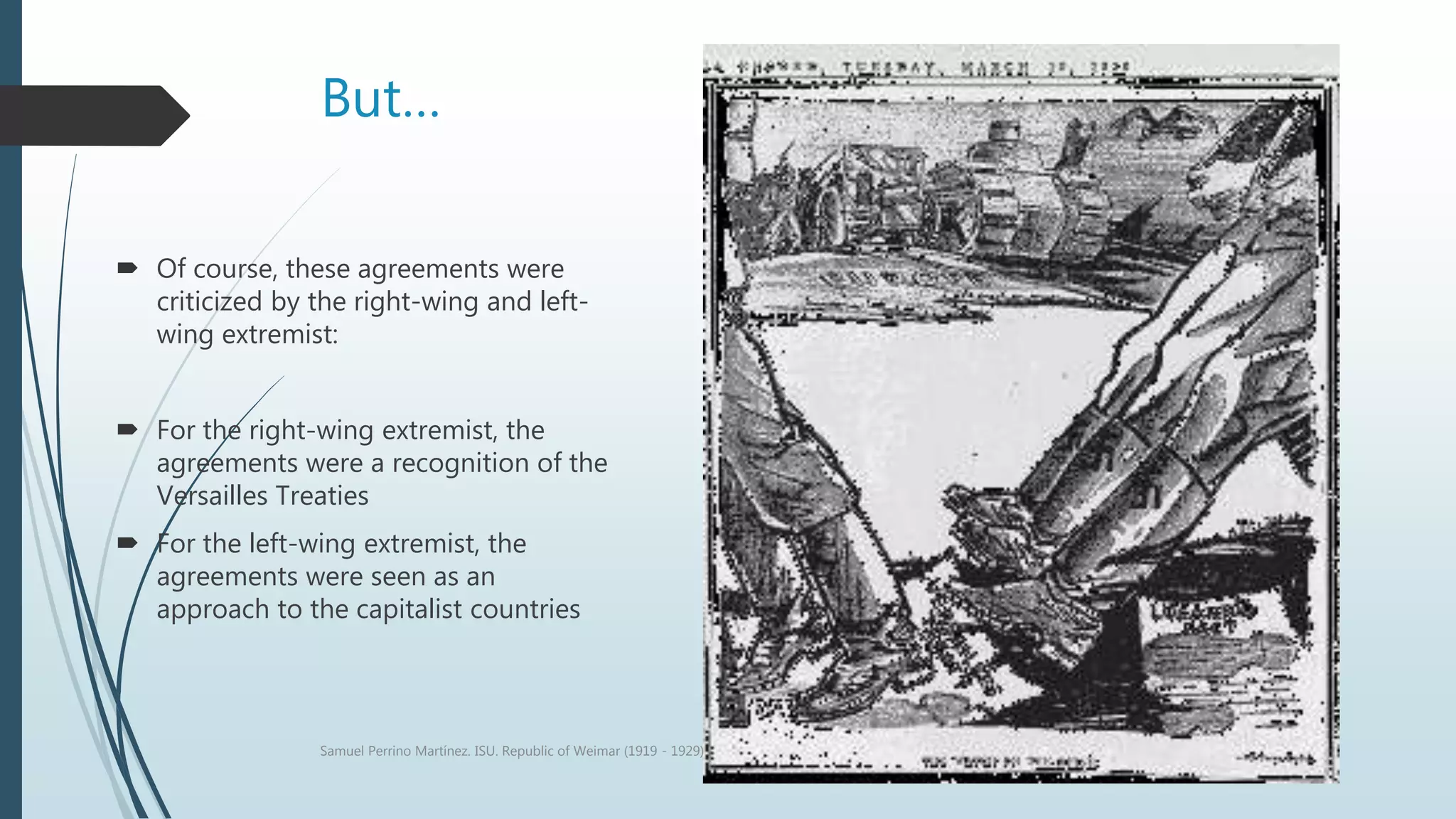
 Of course, these agreements were
criticized by the right-wing and left-
wing extremist:
 For the right-wing extremist, the
agreements were a recognition of the
Versailles Treaties
 For the left-wing extremist, the
agreements were seen as an
approach to the capitalist countries
Samuel Perrino Martínez. ISU. Republic of Weimar (1919 - 1929)
Golden Years Period
 https://www.youtube.com/watch?v=
pbW8mA_cdFg
Samuel Perrino Martínez. ISU. Republic of Weimar (1919 - 1929)

The Republic of Weimar (IGCSE)

  • 1.
    The Republic ofWeimar Samuel Perrino Martínez. ISU. Republic of Weimar (1919 - 1929)
  • 2.
    There is somebasic information you should know about this period  What kind of system?  Periods  1st period:  Problems - Why was the RoW so unpopular? - Attempts to overthrow the RoW  Who was against Weimar?  1923: The turning point: Ruhr crisis and hyperinflation Samuel Perrino Martínez. ISU. Republic of Weimar (1919 - 1929)
  • 3.
    What kind ofsystem?  Parliamentary democracy: The most democratic system in the world ! - Right to vote over the age of 20 - Proportional system - President + Parliament + Chancellor (Division of powers)  Constitution. Main points: - Art. 2: Proportional sytem - Art. 48: Emergency cases Samuel Perrino Martínez. ISU. Republic of Weimar (1919 - 1929)
  • 4.
    Problems  You haveto understand why the Weimar Republic was so unpopular in Germany in the 1920s  Try to distinguish between the general problems (i.e bad economic situation) and the facts in order to have a clear idea. Samuel Perrino Martínez. ISU. Republic of Weimar (1919 - 1929)
  • 5.
    What kind ofproblems? Reparations Stab-in the back idea Samuel Perrino Martínez. ISU. Republic of Weimar (1919 - 1929)
  • 6.
    What kind ofproblems? Economic crisis Distribution of wealth Samuel Perrino Martínez. ISU. Republic of Weimar (1919 - 1929)
  • 7.
    Why was Germanyin such a bad situation?  Treaty of Versailles terms: - Germany lost 10% of land - 12 % of population - 48 % of the iron industry (in favor of …) - African colonies (Togoland and Cameroon) - Germany had to accept the blame for the war - The army was reduced to 100,000 men (no possibility of defense) - Why was the Treaty considered negative for Germany? Samuel Perrino Martínez. ISU. Republic of Weimar (1919 - 1929)
  • 8.
    Treaty of Versailles.German reaction  Diktat: Germany had no option to negotiate the conditions. They even did not participate in the discussions.  How did Germans feel about this? --- We are not obliged to follow these rules if we have the chance Can you argue something against this argument? Samuel Perrino Martínez. ISU. Republic of Weimar (1919 - 1929)
  • 9.
    Diktat Samuel Perrino Martínez.ISU. Republic of Weimar (1919 - 1929)
  • 10.
    Treaty of Versailles. Loss of territory: - Germany lost 10% of the territory - It,s important because many German population was living in this territories. They had two options: - Stay as a minorities - Move to Germany - It,s not just a question of prestige, it,s also a “personal” question. Samuel Perrino Martínez. ISU. Republic of Weimar (1919 - 1929)
  • 11.
    Treaty of Versailles. Disarmament  Germany Army was reduced to 100,000 men. Why was this decision a problem for Germany? - G could not start a new war - G had problems to maintain the order in the country (extremely weak country) - How would be the disarmament fair? Samuel Perrino Martínez. ISU. Republic of Weimar (1919 - 1929)
  • 12.
    Treaty of Versailles War guilt (Art. 234 Treaty of Versailles) The Allied and Associated Governments affirm and Germany accepts the responsibility of Germany and her allies for causing all loss and damage to which the Allied and Associated Governments and their nationals have been subjected as a consequence of the war imposed on them by the aggression of Germany and her allies Germans felt this was very unfair. Also, blame meaned in real terms …. MONEY Samuel Perrino Martínez. ISU. Republic of Weimar (1919 - 1929)
  • 13.
    Samuel Perrino Martínez.ISU. Republic of Weimar (1919 - 1929)
  • 14.
    Were the Germansright?  Partially YES  It is true the conditions of the Treaty were hard for Germany  Partially NO  France wanted to divide Germany into small states, even higher reparations and the complete elimination of the German Army (It could be worse) Samuel Perrino Martínez. ISU. Republic of Weimar (1919 - 1929)
  • 15.
    So… many peoplewere conspiring against the democracy  At that moment, there were different opinions in Germany:  Those in favor of democracy (Majority of population)  Those against the democracy (Extremists: Ultranationalist and Communist, they hated each other) -- Common features: -- They believed in violence as the best way to obtain the power -- They were against democracy (they preferred authoritarian regimes) Samuel Perrino Martínez. ISU. Republic of Weimar (1919 - 1929)
  • 16.
    In favor ofdemocracy  The main party was the Social-Democrat Party (left-wing party), ruled by Ebert  There were also right-wing parties (DDP) and central parties (Zentrum, Catholic Party)  They had different ideas, but they accepted democracy as the best system of government  They represented 80% of German population Samuel Perrino Martínez. ISU. Republic of Weimar (1919 - 1929)
  • 17.
    Those against democracy Left-wing extremist:  They tried to establish a communist rule in Germany  1917: Russian revolution… so why not Germany?  Who --- Working class (they had bad conditions of life, so they did not care about liberties, they just want an equal share of the wealth) Samuel Perrino Martínez. ISU. Republic of Weimar (1919 - 1929)
  • 18.
    Against democracy  SpartacistRevolution (1919)  The Communist tried to seize the power and launch a revolution in Germany  They were able to declare the Independent Socialist Republic of Bavaria  The Government used the Freikorps and the Army to counteract the rebellion  Result --- The rebellion failed and the communist leaders (R.Luxemburg and Liebknecht) were assassinated Samuel Perrino Martínez. ISU. Republic of Weimar (1919 - 1929)
  • 19.
    Those against democracy Right-wing Nationalist:  They thought the Treaty was a complete humiliation for Germany  They wanted an authoritarian and strong regime (similar to the previous situation before the war)  Who --- Mainly composed by ex-soldiers who did not accept the end of the war. They were organized in the Freikorps. Samuel Perrino Martínez. ISU. Republic of Weimar (1919 - 1929)
  • 20.
    Right-wing extremist. TheKapp Putsch  1920  Kapp was a general and he tried to take over the power with 5,000 Freikorps  The government asked for the aid of the workers and they reacted with a general strike  Kapp left the country and the rebellion failed Samuel Perrino Martínez. ISU. Republic of Weimar (1919 - 1929)
  • 21.
    1923. A keyyear  The situation was quite unstable the first years of the Republic of Weimar, but 1923 will be a special year for several crisis: - The Ruhr Crisis - The Munich Putsch - Hyperinflation Samuel Perrino Martínez. ISU. Republic of Weimar (1919 - 1929)
  • 22.
    The Munich Putsch(Beer Hall Putsch)  An unknown Adolf Hitler tried to take the control of the country in a rebellion in Munich  Nazi Party was not very popular at that moment (less than 3% of votes) so he failed (He was able to control a brewery)  He went to prison (11 months) when he wrote Mein Kampf with the main ideas of the Nazis Samuel Perrino Martínez. ISU. Republic of Weimar (1919 - 1929)
  • 23.
    Ruhr crisis  Previoussituation  German solution  Hyperinflation Samuel Perrino Martínez. ISU. Republic of Weimar (1919 - 1929)
  • 24.
    Previous situation  Thereparations commission had determined that Germany should pay 132 billion gold marks in 42 years to the Allied powers Samuel Perrino Martínez. ISU. Republic of Weimar (1919 - 1929)
  • 25.
    Situation  The Frenchwere anxious to enforce the reparations for two reasons: - They hated Germans - They needed the money to pay the American loans Samuel Perrino Martínez. ISU. Republic of Weimar (1919 - 1929)
  • 26.
    Ruhr crisis  Germanshad problems to pay the demanded amount of money, so the French decided to take a hard line approach to Germany: the best way to make Germany pay was …  MAKING USE OF THE FORCE ---- French and Belgium troops invaded the Ruhr (the industrial area of Germany) to “receive” the payment  What would you do if you were a German worker? Samuel Perrino Martínez. ISU. Republic of Weimar (1919 - 1929)
  • 27.
    Ruhr crisis  AsGermany had almost no army (Treaty of Versailles) France took the outputs of the factories and mines of the Ruhr, and shipping them to its territory. Samuel Perrino Martínez. ISU. Republic of Weimar (1919 - 1929)
  • 28.
    Ruhr crisis  Whatwas the German reaction?  German workers refused to cooperate  Sabotage (Flooding of mines, burning factories, destruction of railroads, etc.)  French fought against that. They had the complete control of this area! Samuel Perrino Martínez. ISU. Republic of Weimar (1919 - 1929)
  • 29.
    Samuel Perrino Martínez.ISU. Republic of Weimar (1919 - 1929)
  • 30.
    Samuel Perrino Martínez.ISU. Republic of Weimar (1919 - 1929)
  • 31.
    Ruhr crisis  Whatwas the German reaction?  The Government supported the workers in their strike and sabotage actions. How?  It printed money to pay them. PROBLEM --- The value of the money decreased because it was an artificial measure ---- HYPERINFLATION Samuel Perrino Martínez. ISU. Republic of Weimar (1919 - 1929)
  • 32.
    Samuel Perrino Martínez.ISU. Republic of Weimar (1919 - 1929)
  • 33.
    Samuel Perrino Martínez.ISU. Republic of Weimar (1919 - 1929)
  • 34.
    Consequences of theHyperinflation  The middle class lost its economic power (the money they saved) so they became: - Cynical to democracy - More interested in extremist ideologies (Nazis tried to seize the power in 1923) Samuel Perrino Martínez. ISU. Republic of Weimar (1919 - 1929)
  • 35.
    So, the WeimarRepublic was in a serious trouble  Hyperinflation and bad economic situation  Challenged by the Left and Right extremist  Without a clear answer to the problems of the country  So… in this difficult situation, a new president (Stresseman) took the power after the first years of Ebert.  Would he be able to change the situation?  YES, the Golden Years (1923 – 1929) Samuel Perrino Martínez. ISU. Republic of Weimar (1919 - 1929)
  • 36.
    The Golden Years(1923 – 1929)  After an initial crisis, the Weimar Republic was able to overcome most of the problems in the period from 1923 to 1929 (the Golden Years)  The key figure of this period was Gustave Stresseman (the Minister of Foreign Affairs)  Germany got important achievements in: - The economy - Culture - Politics Samuel Perrino Martínez. ISU. Republic of Weimar (1919 - 1929)
  • 37.
    Economy  He founda solution to solve the problem of Hyperinflation  First, he created a new currency  If Germany was in bad situation, the world would be in a bad situation (because of the reparations) so …  Dawes Plan: - Reparations payments were spread over a longer period - The USA gave loans to Germany - Germany spent the money in infrastructure and modernization of old equipment (good investments) so the quality of life increased (better salaries) --- The economic situation improved so G. could pay the reparations. Samuel Perrino Martínez. ISU. Republic of Weimar (1919 - 1929)
  • 38.
    Dawes Plan Samuel PerrinoMartínez. ISU. Republic of Weimar (1919 - 1929)
  • 39.
    Samuel Perrino Martínez.ISU. Republic of Weimar (1919 - 1929)
  • 40.
    … but  TheGerman economy was completely dependent on American loans, so …  The unemployment began to raise at the end of the Golden Years (social unrest)  Peasants and small business were not especially benefited by Weimar policies Samuel Perrino Martínez. ISU. Republic of Weimar (1919 - 1929)
  • 41.
    Culture  During theKaiser´s time --- Dictatorship and censorship  Weimar Republic brought the freedom of speech --- Cultural Renaissance  George Grosz and Bauhaus design  The cinema industry was the most important in Europe (F.Lang and M.Dietrich) Samuel Perrino Martínez. ISU. Republic of Weimar (1919 - 1929)
  • 42.
    George Grosz Samuel PerrinoMartínez. ISU. Republic of Weimar (1919 - 1929)
  • 43.
    Bauhaus movement Samuel PerrinoMartínez. ISU. Republic of Weimar (1919 - 1929)
  • 44.
    Fritz Lang. Metropolis Thefirst science fiction movie!!Samuel Perrino Martínez. ISU. Republic of Weimar (1919 - 1929)
  • 45.
    But …  Therural Germany saw the new culture as a symbol of decadency  Wandervogel movement: Return to the countryside values (kind of Boy scouts) Samuel Perrino Martínez. ISU. Republic of Weimar (1919 - 1929)
  • 46.
    Politics  The extremist(left and right wing) were weaker during this period (Nazis got 5% of the vote, and Communist did not go further than 15% of the vote)  A GrossKoalition was formed with all democratic parties, so the government was strong Samuel Perrino Martínez. ISU. Republic of Weimar (1919 - 1929)
  • 47.
    … but  Extremistparties were not banned, even if they were against democracy ---- They could establish an organization for the future  People started to accept extremist parties as part of the system Samuel Perrino Martínez. ISU. Republic of Weimar (1919 - 1929)
  • 48.
    Foreign policy  Stressmanreached the Locarno Treaties (1925) where: - Germany recognized the Western borders after the war - The Eastern borders were not defined (Why was this a problem for the future?) - Germany was accepted in the League of Nations - Young Plan (1929): Less reparations for Germany and the foreign troops left Germany Samuel Perrino Martínez. ISU. Republic of Weimar (1919 - 1929)
  • 49.
    Locarno Treaties Samuel PerrinoMartínez. ISU. Republic of Weimar (1919 - 1929)
  • 50.
    But…  Of course,these agreements were criticized by the right-wing and left- wing extremist:  For the right-wing extremist, the agreements were a recognition of the Versailles Treaties  For the left-wing extremist, the agreements were seen as an approach to the capitalist countries Samuel Perrino Martínez. ISU. Republic of Weimar (1919 - 1929)
  • 51.
    Golden Years Period https://www.youtube.com/watch?v= pbW8mA_cdFg Samuel Perrino Martínez. ISU. Republic of Weimar (1919 - 1929)