ACTION RESEARCH
USING FACEBOOK TO PROMOTE
KOREAN EFL LEARNERS’
INTERCULTURAL COMPETENCE
Seunghee Jin, Pennsylvania State University
Language Learning & Technology
http://llt.msu.edu/issues/october2015/action2.pdf
October 2015, Volume 19, Number 3
INTRODUCTION
• Developing foreign language (FL) learners’ intercultural
competence (IC) to make them ‘intercultural speakers’
has been suggested as a major goal in FL education.
• The majority of FL learners have fewer opportunities to
have extensive contact with speakers of target languages.
• Telecollaboration using CMC (Computer-Mediated
Communication) tools has received significant attention in
terms of effective ways to promote IC in the current L2
pedagogy.
• Although the majority of studies have adopted Web 1.0
technology (e.g., email, chat, and web-based discussion
boards), little research has been conducted using the
more recently developed Web 2.0 tools (e.g., blogs,
podcasts, and Twitter) for intercultural learning.
• This study explored the educational possibilities of the
new Web 2.0 tool, Facebook, for Korean EFL learners’
intercultural learning using a classroom-based
telecollaborative project between the U.S. and Korea
Research Question
• To what extent does intercultural
competence take place in the
intercultural interaction through
Facebook? In particular, which IC
components of Byram’s (1997)
model can be exhibited in a
Facebook intercultural exchange?
LITERATURE REVIEW:
Intercultural Competence
• Intercultural competence refers to
“the ability to interact effectively
with people with different cultures
other than one’s own” (Byram, 2000,
p. 297).
• 5 keys:
1. Knowledge
2. intercultural attitudes
3. skills of interpreting and relating
4. skills of discovery and interaction
5. critical cultural awareness
LITERATURE REVIEW: Byram’s
(1997) Model of Intercultural
Communicative Competence
• According to Byram (1997), his
model provides a framework for
specifying objectives when planning
teaching and assessment activities
in that each component of IC serves
as representative teaching goals in
intercultural learning. Accordingly,
this ICC model can serve as a good
guideline and framework for
effective instruction for developing
learners’ IC.
Developing Intercultural
Competence through
Telecollaboration
• In recent years, the technological
tools used in the telecollaborative
projects have moved from Web 1.0
toward the current Web 2.0 tools.
• Facebook is currently the most
popular Web 2.0 social networking
site (SNS), attracting millions of
users.
METHODOLOGY
• Research Project: an intermediate EFL
course at a university in Korea in
collaboration with a communication
course at a university in the U.S. during
the fall semester of 2012.
• Participants: two groups. One group
consisted of 32 Korean EFL learners who
were intermediate-level English language
learners; their ages ranged from 19 to 22
years old. The other group included 20
American undergraduate students who
were first language (L1) speakers of
English and had a background in North
American culture.
METHODOLOGY
• Procedures: the researcher set up a
Facebook group page → participants received
an orientation → joining the group page
• Topics and Tasks on Facebook:
• Phase I (weeks 3–7) tasks were designed
mainly to promote discussion.
• In phase II (weeks 9–11), participants could
choose their own topic for discussion,
reflecting their own interests.
• During phase III (week 13), students were
assigned the task of conducting an
ethnographic interview with their partners
in the U.S.
METHODOLOGY
• Data Collection: virtual
ethnography approach → in-depth
participant observations and
qualitative interviews
• Data Analysis: Byram’s (2000)
assessment guidelines
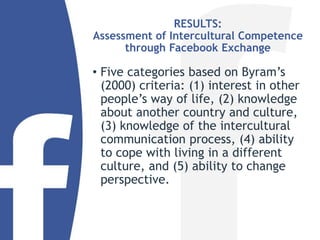
RESULTS:
Assessment of Intercultural Competence
through Facebook Exchange
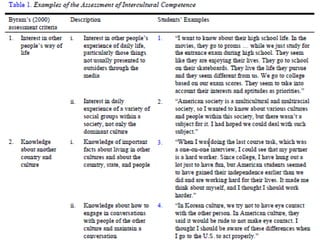
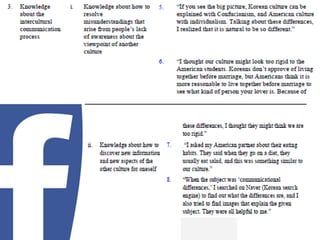
• Five categories based on Byram’s
(2000) criteria: (1) interest in other
people’s way of life, (2) knowledge
about another country and culture,
(3) knowledge of the intercultural
communication process, (4) ability
to cope with living in a different
culture, and (5) ability to change
perspective.
DISCUSSION
AND CONCLUSION
• Facebook use has successfully given the
students in an EFL setting an online
environment for intercultural
communication with the speakers of the
target culture and further enabled
learners to demonstrate their IC through
this opportunity.
• However, the conflicting results in some
components of IC—namely, (a)
knowledge, (b) skills of discovery and
interaction, and (c) critical cultural
awareness—suggest that this type of
intercultural exchange via Facebook
should be revised for future uses to
maximize the effectiveness of fostering
IC.

Week 5 using fb

  • 1.
    ACTION RESEARCH USING FACEBOOKTO PROMOTE KOREAN EFL LEARNERS’ INTERCULTURAL COMPETENCE Seunghee Jin, Pennsylvania State University Language Learning & Technology http://llt.msu.edu/issues/october2015/action2.pdf October 2015, Volume 19, Number 3
  • 2.
    INTRODUCTION • Developing foreignlanguage (FL) learners’ intercultural competence (IC) to make them ‘intercultural speakers’ has been suggested as a major goal in FL education. • The majority of FL learners have fewer opportunities to have extensive contact with speakers of target languages. • Telecollaboration using CMC (Computer-Mediated Communication) tools has received significant attention in terms of effective ways to promote IC in the current L2 pedagogy. • Although the majority of studies have adopted Web 1.0 technology (e.g., email, chat, and web-based discussion boards), little research has been conducted using the more recently developed Web 2.0 tools (e.g., blogs, podcasts, and Twitter) for intercultural learning. • This study explored the educational possibilities of the new Web 2.0 tool, Facebook, for Korean EFL learners’ intercultural learning using a classroom-based telecollaborative project between the U.S. and Korea
  • 3.
    Research Question • Towhat extent does intercultural competence take place in the intercultural interaction through Facebook? In particular, which IC components of Byram’s (1997) model can be exhibited in a Facebook intercultural exchange?
  • 4.
    LITERATURE REVIEW: Intercultural Competence •Intercultural competence refers to “the ability to interact effectively with people with different cultures other than one’s own” (Byram, 2000, p. 297). • 5 keys: 1. Knowledge 2. intercultural attitudes 3. skills of interpreting and relating 4. skills of discovery and interaction 5. critical cultural awareness
  • 5.
    LITERATURE REVIEW: Byram’s (1997)Model of Intercultural Communicative Competence • According to Byram (1997), his model provides a framework for specifying objectives when planning teaching and assessment activities in that each component of IC serves as representative teaching goals in intercultural learning. Accordingly, this ICC model can serve as a good guideline and framework for effective instruction for developing learners’ IC.
  • 6.
    Developing Intercultural Competence through Telecollaboration •In recent years, the technological tools used in the telecollaborative projects have moved from Web 1.0 toward the current Web 2.0 tools. • Facebook is currently the most popular Web 2.0 social networking site (SNS), attracting millions of users.
  • 7.
    METHODOLOGY • Research Project:an intermediate EFL course at a university in Korea in collaboration with a communication course at a university in the U.S. during the fall semester of 2012. • Participants: two groups. One group consisted of 32 Korean EFL learners who were intermediate-level English language learners; their ages ranged from 19 to 22 years old. The other group included 20 American undergraduate students who were first language (L1) speakers of English and had a background in North American culture.
  • 8.
    METHODOLOGY • Procedures: theresearcher set up a Facebook group page → participants received an orientation → joining the group page • Topics and Tasks on Facebook: • Phase I (weeks 3–7) tasks were designed mainly to promote discussion. • In phase II (weeks 9–11), participants could choose their own topic for discussion, reflecting their own interests. • During phase III (week 13), students were assigned the task of conducting an ethnographic interview with their partners in the U.S.
  • 9.
    METHODOLOGY • Data Collection:virtual ethnography approach → in-depth participant observations and qualitative interviews • Data Analysis: Byram’s (2000) assessment guidelines
  • 10.
    RESULTS: Assessment of InterculturalCompetence through Facebook Exchange • Five categories based on Byram’s (2000) criteria: (1) interest in other people’s way of life, (2) knowledge about another country and culture, (3) knowledge of the intercultural communication process, (4) ability to cope with living in a different culture, and (5) ability to change perspective.
  • 14.
    DISCUSSION AND CONCLUSION • Facebookuse has successfully given the students in an EFL setting an online environment for intercultural communication with the speakers of the target culture and further enabled learners to demonstrate their IC through this opportunity. • However, the conflicting results in some components of IC—namely, (a) knowledge, (b) skills of discovery and interaction, and (c) critical cultural awareness—suggest that this type of intercultural exchange via Facebook should be revised for future uses to maximize the effectiveness of fostering IC.