Korea Association of 
Multi-media Assisted Language Learning - 
2014 Annual Conference 
Autonomous Learners' 
Communication in Practice: 
Single and Dual Language 
Eric Hagley 
Virtual Exchange 
Muroran Institute of Technology 
hagley@mmm.muroran-it.ac.jp
Educational goals in participating countries 
Pedagogical basis underpinning international online 
exchanges 
Modality & Tools 
Dual language Online Exchanges 
Single Language Online Exchanges 
Examples of exchange activities 
Outcomes : benefits of online exchanges 
Tips for implementation of dual language tele-collaboration 
activities 
Future study
students with a global 
perspective 
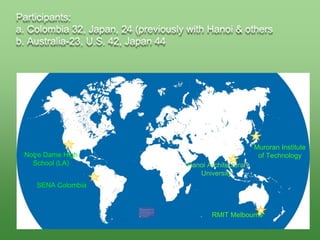
Muroran Institute 
Notre Dame High of Technology 
RMIT Melbourne 
School (LA) 
SENA Colombia 
Hanoi Architectural 
University
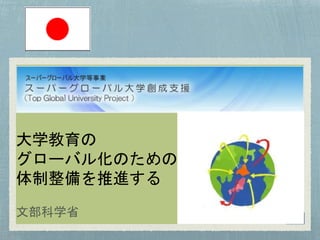
ๅคงๅญฆๆ•™่‚ฒใฎ 
ใ‚ฐใƒญใƒผใƒใƒซๅŒ–ใฎใŸใ‚ใฎ 
ไฝ“ๅˆถๆ•ดๅ‚™ใ‚’ๆŽจ้€ฒใ™ใ‚‹ 
ๆ–‡้ƒจ็ง‘ๅญฆ็œ
4 broad categories as Generic learning outcomes: 
fundamental skills 
people skills 
thinking skills 
personal skills. 
RMIT graduate attributes 
โ€œGlobal in outlook & competence, 
culturally & socially awareโ€
ใ‚ขใƒกใƒชใ‚ซๅค–ๅ›ฝ่ชžๆ•™่‚ฒๆŒ‡้‡ 
ใƒŠใ‚ทใƒงใƒŠใƒซใ‚นใ‚ฟใƒณใƒ€ใƒผใƒ‰(National Standards) 
5Cs 
Communication 
Cultures 
Connections 
Comparisons 
Communities
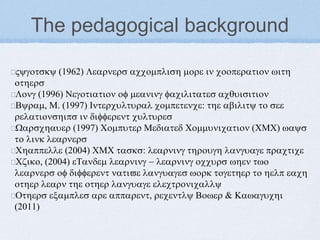
The pedagogical background 
๏‚•Vygotsky (1962) Learners accomplish more in cooperation with 
others 
๏‚•Long (1996) Negotiation of meaning facilitates acquisition 
๏‚•Byram, M. (1997) Intercultural competence: the ability to see 
relationships in different cultures 
๏‚•Warschauer (1997) Computer Mediated Communication (CMC) ways 
to link learners 
๏‚•Chappelle (2004) CMC tasks: learning through language practice 
๏‚•Cziko, (2004) eTandem learning - learning occurs when two 
learners of different native languages work together to help each 
other learn the other language electronically 
๏‚•Others examples are apparent, recently Bower & Kawaguchi 
(2011)
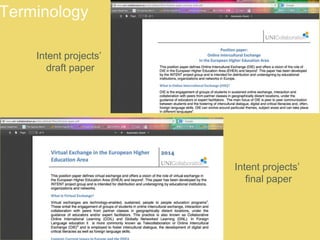
Intent projectsโ€™ 
draft paper 
Intent projectsโ€™ 
final paper
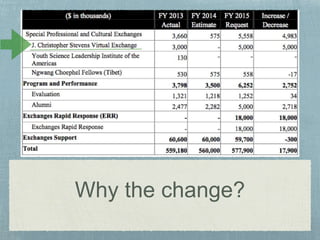
Why the change?
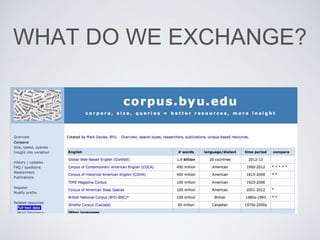
WHAT DO WE EXCHANGE?
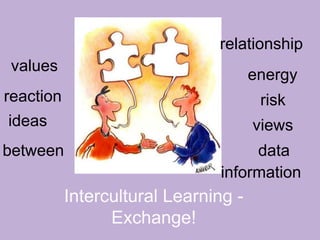
values 
between 
relationship 
energy 
views 
information 
ideas 
data 
reaction 
risk
Recap 
Virtual exchanges are technology-enabled, sustained, people Able to create authentic interactions.
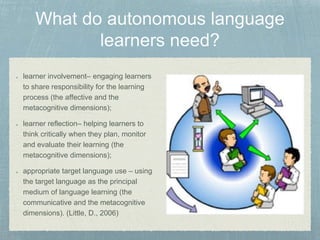
learner involvementโ€“ engaging learners 
to share responsibility for the learning 
process (the affective and the 
metacognitive dimensions); 
learner reflectionโ€“ helping learners to 
think critically when they plan, monitor 
and evaluate their learning (the 
metacognitive dimensions); 
appropriate target language use โ€“ using 
the target language as the principal 
medium of language learning (the 
communicative and the metacognitive 
dimensions). (Little, D., 2006)
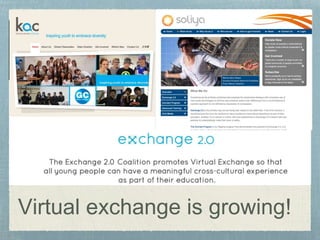
Virtual exchange is growing!
A MODEL FOR 
AUTONOMOUS LANGUAGE 
LEARNING 
MODALITY & TOOLS Synchcronous / Asynchronous text, video and 
audio 
Moodle / Skype 
Single & Dual Language Virtual Exchange
Examples from the 
course 
Letโ€™s cross now to our 
reporter online in the 
course.
Outcomes: benefits of single 
and dual language virtual 
exchange 
Language acquisition outcomes : 
Learner involvement - Increased input and output with statistics to 
prove it! 
Motivation outcomes - target language is the 
principle medium 
Cultural acclimatization 
Personal development - learner reflection 
Built the environment and modeled the 
behavior
Keys for Successful 
Online Exchanges 
Frequent communication between instructors 
Share basic teaching philosophy and objectives 
Monitor studentsโ€™ activities and give constant encouragement 
Integrate exchange into the curriculum 
Develop ways of incorporating exchange into assessment - 
intrinsic and extrinsic motivation 
An understanding of the technology to be used
Get involved! 
Find a partner 
Decide: time frame, topics, assessment methods etc 
Encourage active participation
REFERENCES 
Bower, J. & Kawaguchi, S. (2011). Negotiation of meaning and corrective feedback in Japanese/English e-Tandem. Language 
Learning & Technology, 15(1), 41-71. 
Byram, M. (1997), Teaching and Assessing Intercultural Communicative Competence. Clevedon, Multilingual Matters. 
Chapelle, C. (2004). Hints About CALL Use From Research. Proceedings of CLaSIC 2004: Current Perspectives and Future 
Directions in Foreign Language Teaching and Learning, 114-120. 
Cziko, G. A. (2004). Electronic tandem language learning (eTandem): A third approach to second language learning for the 21st 
century. CALICO Journal, 22, 25-39. 
Hagley, E. (2014). Moodle as a Conduit for International Telecollaboration, Moodle Moot Japan 2014 Proceedings, 13-16. 
Hagley, E. (2014). Collaborative and Cooperative Online Language Exchanges, Journal of Language and Culture of Hokkaido, 12, 
43-50, 
Long, M. (1996). The role of the linguistic environment in second language acquisition. In W. Ritchie & T. Bhatia (Eds.), Handbook 
of research on second language acquisition, 413-468. New York: Academic Press. 
Swain, M. (1985) Communicative competence: Some roles of comprehensible input and comprehensible output in its development. In 
Gass, S. and Madden, C. (Eds.), Input in Second Language Acquisition, 235-256. New York: Newbury House. 
Vygotsky, L. S. (1962). Thought and language. Cambridge: MIT Press. 
Warschauer, M. (1997). Computer-Mediated Collaborative Learning: Theory and Practice. Modern Language Journal, 81(3), pp. 470 
โ€“ 481.

Autonomous Learners' Communication in Practice: Single and Dual Language Virtual Exchange

  • 1.
    Korea Association of Multi-media Assisted Language Learning - 2014 Annual Conference Autonomous Learners' Communication in Practice: Single and Dual Language Eric Hagley Virtual Exchange Muroran Institute of Technology hagley@mmm.muroran-it.ac.jp
  • 3.
    Educational goals inparticipating countries Pedagogical basis underpinning international online exchanges Modality & Tools Dual language Online Exchanges Single Language Online Exchanges Examples of exchange activities Outcomes : benefits of online exchanges Tips for implementation of dual language tele-collaboration activities Future study
  • 4.
    students with aglobal perspective Muroran Institute Notre Dame High of Technology RMIT Melbourne School (LA) SENA Colombia Hanoi Architectural University
  • 5.
  • 6.
    4 broad categoriesas Generic learning outcomes: fundamental skills people skills thinking skills personal skills. RMIT graduate attributes โ€œGlobal in outlook & competence, culturally & socially awareโ€
  • 7.
  • 9.
    The pedagogical background ๏‚•Vygotsky (1962) Learners accomplish more in cooperation with others ๏‚•Long (1996) Negotiation of meaning facilitates acquisition ๏‚•Byram, M. (1997) Intercultural competence: the ability to see relationships in different cultures ๏‚•Warschauer (1997) Computer Mediated Communication (CMC) ways to link learners ๏‚•Chappelle (2004) CMC tasks: learning through language practice ๏‚•Cziko, (2004) eTandem learning - learning occurs when two learners of different native languages work together to help each other learn the other language electronically ๏‚•Others examples are apparent, recently Bower & Kawaguchi (2011)
  • 10.
    Intent projectsโ€™ draftpaper Intent projectsโ€™ final paper
  • 11.
  • 12.
    WHAT DO WEEXCHANGE?
  • 13.
    values between relationship energy views information ideas data reaction risk
  • 14.
    Recap Virtual exchangesare technology-enabled, sustained, people Able to create authentic interactions.
  • 15.
    learner involvementโ€“ engaginglearners to share responsibility for the learning process (the affective and the metacognitive dimensions); learner reflectionโ€“ helping learners to think critically when they plan, monitor and evaluate their learning (the metacognitive dimensions); appropriate target language use โ€“ using the target language as the principal medium of language learning (the communicative and the metacognitive dimensions). (Little, D., 2006)
  • 16.
  • 17.
    A MODEL FOR AUTONOMOUS LANGUAGE LEARNING MODALITY & TOOLS Synchcronous / Asynchronous text, video and audio Moodle / Skype Single & Dual Language Virtual Exchange
  • 18.
    Examples from the course Letโ€™s cross now to our reporter online in the course.
  • 19.
    Outcomes: benefits ofsingle and dual language virtual exchange Language acquisition outcomes : Learner involvement - Increased input and output with statistics to prove it! Motivation outcomes - target language is the principle medium Cultural acclimatization Personal development - learner reflection Built the environment and modeled the behavior
  • 20.
    Keys for Successful Online Exchanges Frequent communication between instructors Share basic teaching philosophy and objectives Monitor studentsโ€™ activities and give constant encouragement Integrate exchange into the curriculum Develop ways of incorporating exchange into assessment - intrinsic and extrinsic motivation An understanding of the technology to be used
  • 21.
    Get involved! Finda partner Decide: time frame, topics, assessment methods etc Encourage active participation
  • 22.
    REFERENCES Bower, J.& Kawaguchi, S. (2011). Negotiation of meaning and corrective feedback in Japanese/English e-Tandem. Language Learning & Technology, 15(1), 41-71. Byram, M. (1997), Teaching and Assessing Intercultural Communicative Competence. Clevedon, Multilingual Matters. Chapelle, C. (2004). Hints About CALL Use From Research. Proceedings of CLaSIC 2004: Current Perspectives and Future Directions in Foreign Language Teaching and Learning, 114-120. Cziko, G. A. (2004). Electronic tandem language learning (eTandem): A third approach to second language learning for the 21st century. CALICO Journal, 22, 25-39. Hagley, E. (2014). Moodle as a Conduit for International Telecollaboration, Moodle Moot Japan 2014 Proceedings, 13-16. Hagley, E. (2014). Collaborative and Cooperative Online Language Exchanges, Journal of Language and Culture of Hokkaido, 12, 43-50, Long, M. (1996). The role of the linguistic environment in second language acquisition. In W. Ritchie & T. Bhatia (Eds.), Handbook of research on second language acquisition, 413-468. New York: Academic Press. Swain, M. (1985) Communicative competence: Some roles of comprehensible input and comprehensible output in its development. In Gass, S. and Madden, C. (Eds.), Input in Second Language Acquisition, 235-256. New York: Newbury House. Vygotsky, L. S. (1962). Thought and language. Cambridge: MIT Press. Warschauer, M. (1997). Computer-Mediated Collaborative Learning: Theory and Practice. Modern Language Journal, 81(3), pp. 470 โ€“ 481.

Editor's Notes