icEurope Intercultural Communication in Europe a Comenius Web Collaboration Project to foster intercultural communication in Englishwww.iceurope-project.euKurt Kohn & Claudia WarthUniversity of TübingenApplied English Linguisticskurt.kohn@uni-tuebingen.declaudia.warth@uni-tuebingen.deWith the support of the EU Lifelong Learning ProgrammeGrant 142672-LLP-1-2008-1-DE-COMENIUS-CMP
ContentsAbout icEuropeThe theoretical and methodological backgroundWhat we have accomplished so far (in the 1st year of the project)References & websites
About icEuropewww.iceurope-project.eu
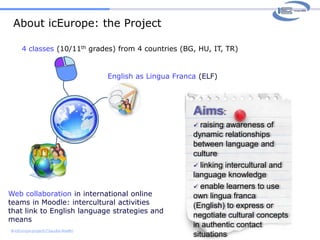
About icEurope: the Project4 classes (10/11th grades) from 4 countries (BG, HU, IT, TR)English as Lingua Franca (ELF)Aims:  raising awareness of dynamic relationships between language and culture
 linking intercultural and language knowledge
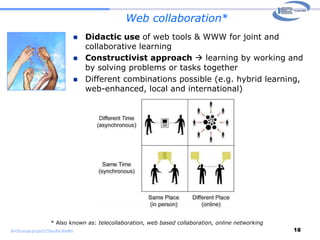
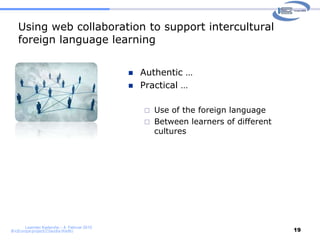
 enable learners to use own lingua franca (English) to express or negotiate cultural concepts in authentic contact situations Web collaboration in international online teams in Moodle: intercultural activities that link to English language strategies and means
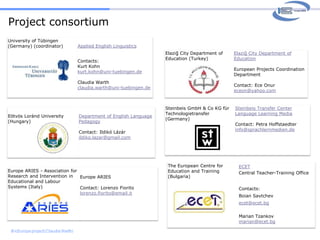
Project consortium
How you can participateUse the icEurope materials & the Moodle platform for your teachingParticipate in one of our free regional workshops (in BG, DE, HU, IT, TR) for teachers, trainers, university (teaching) students or others interested
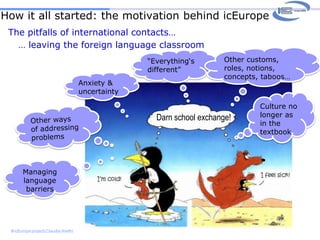
How it all started: the motivation behind icEuropeThe pitfalls of international contacts… … leaving the foreign language classroomOther customs, roles, notions, concepts, taboos…“Everything‘s different”Anxiety & uncertaintyCulture no longer as in the textbookOther ways of addressing problems Darn school exchange!Managing language barriers
The Theoretical & Methodological Background
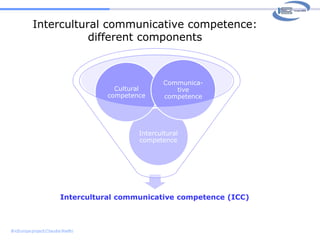
Intercultural communicative competence: different components
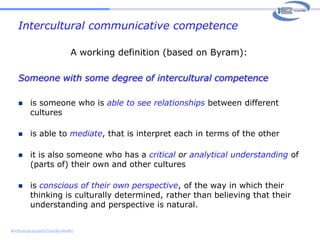
Intercultural communicative competenceA working definition (based on Byram):Someone with some degree of intercultural competence is someone who is ableto see relationships between different culturesis able to mediate, that is interpret each in terms of the otherit is also someone who has a critical or analyticalunderstandingof (parts of) their own and other culturesis conscious of their own perspective, of the way in which their thinking is culturally determined, rather than believing that their understanding and perspective is natural.
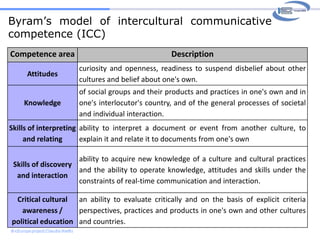
Byram’s model of intercultural communicative competence (ICC)
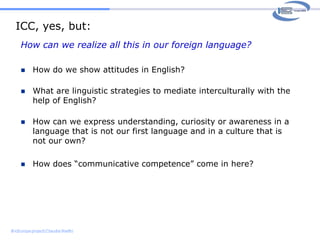
ICC, yes, but:How can we realize all this in our foreign language?How do we show attitudes in English?
What are linguistic strategies to mediate interculturally with the help of English?
How can we express understanding, curiosity or awareness in a language that is not our first language and in a culture that is not our own?
How does “communicative competence” come in here?Communicative competence of non-native speakersScope of explanation Why/how do speakers from the same speech fellowship     manage to understand each other?
 Why/how do speakers from different speech fellowships      manage to understand each other?
 Why/how do emotional factors play a role in supporting     or reducing communicative success?Models of communicative competence Dell Hymes (1972):     accuracy – appropriateness – feasibility – probability Canale & Swain 1980, Canale 1983:     grammatical – socio-linguistic – discourse - strategiclimited explanatory powerCoping with cognitive & emotional divergences Cooperation & face Cooperative imperative – territorial imperative (Widdowson 1979)
 To ensure communicative success, cognitive and emotional divergences require    appropriate cooperative interventions. Everyday communication – intercultural communication Everyday communication and intercultural communication are not different in kind.
 Intercultural communication is often characterised by special types of cognitive and    emotional divergence and thus may require special cooperative interventions.Cooperative interventionsCommunicative purpose in relation to divergences noticing and ascertaining divergences – and related linguistic-communicative moves
 exploring divergences – and related linguistic-communicative moves
 reducing divergences – and related linguistic-communicative movesCommunicative macro functions exchanging information – and illocutionary realisations
 discussing a controversial topic – and illocutionary realisations
 specifying/clarifying procedures
 solving a problem – and illocutionary realisations[Different types of interaction and different levels of complexity]
Intercultural contact tasks for our icEurope explorationsTask designfrom simple to complex (in terms of purpose and function)
 from emotionally neutral to emotionally loadedResearch objectives to analyse cognitive & emotional divergences and related cooperative interventions
 to determine ELF deficiencies and learning needs
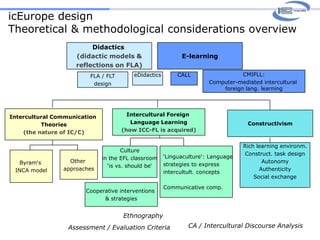
 to develop and evaluate pedagogical modules  icEurope designTheoretical & methodological considerations overviewDidactics (didactic models &reflections on FLA)E-learningCMIFLL:Computer-mediated intercultural foreign lang. learningCALLeDidacticsFLA / FLTdesignIntercultural Communication Theories(the nature of IC/C)Intercultural Foreign Language Learning(how ICC-FL is acquired)ConstructivismRich learning environm.Construct. task designAutonomyAuthenticitySocial exchangeCulturein the EFL classroom‘is vs. should be‘‘Linguaculture‘: Language strategies to express intercultult. concepts Communicative comp.Other approachesByram‘s INCA modelCooperative interventions & strategiesEthnographyCA / Intercultural Discourse AnalysisAssessment / Evaluation Criteria

icEurope Project & Web Collaboration Intro

  • 1.
    icEurope Intercultural Communicationin Europe a Comenius Web Collaboration Project to foster intercultural communication in Englishwww.iceurope-project.euKurt Kohn & Claudia WarthUniversity of TübingenApplied English Linguisticskurt.kohn@uni-tuebingen.declaudia.warth@uni-tuebingen.deWith the support of the EU Lifelong Learning ProgrammeGrant 142672-LLP-1-2008-1-DE-COMENIUS-CMP
  • 2.
    ContentsAbout icEuropeThe theoreticaland methodological backgroundWhat we have accomplished so far (in the 1st year of the project)References & websites
  • 3.
  • 4.
    About icEurope: theProject4 classes (10/11th grades) from 4 countries (BG, HU, IT, TR)English as Lingua Franca (ELF)Aims: raising awareness of dynamic relationships between language and culture
  • 5.
    linking interculturaland language knowledge
  • 6.
    enable learnersto use own lingua franca (English) to express or negotiate cultural concepts in authentic contact situations Web collaboration in international online teams in Moodle: intercultural activities that link to English language strategies and means
  • 7.
  • 8.
    How you canparticipateUse the icEurope materials & the Moodle platform for your teachingParticipate in one of our free regional workshops (in BG, DE, HU, IT, TR) for teachers, trainers, university (teaching) students or others interested
  • 9.
    How it allstarted: the motivation behind icEuropeThe pitfalls of international contacts… … leaving the foreign language classroomOther customs, roles, notions, concepts, taboos…“Everything‘s different”Anxiety & uncertaintyCulture no longer as in the textbookOther ways of addressing problems Darn school exchange!Managing language barriers
  • 10.
    The Theoretical &Methodological Background
  • 11.
  • 12.
    Intercultural communicative competenceAworking definition (based on Byram):Someone with some degree of intercultural competence is someone who is ableto see relationships between different culturesis able to mediate, that is interpret each in terms of the otherit is also someone who has a critical or analyticalunderstandingof (parts of) their own and other culturesis conscious of their own perspective, of the way in which their thinking is culturally determined, rather than believing that their understanding and perspective is natural.
  • 13.
    Byram’s model ofintercultural communicative competence (ICC)
  • 14.
    ICC, yes, but:Howcan we realize all this in our foreign language?How do we show attitudes in English?
  • 15.
    What are linguisticstrategies to mediate interculturally with the help of English?
  • 16.
    How can weexpress understanding, curiosity or awareness in a language that is not our first language and in a culture that is not our own?
  • 17.
    How does “communicativecompetence” come in here?Communicative competence of non-native speakersScope of explanation Why/how do speakers from the same speech fellowship manage to understand each other?
  • 18.
    Why/how dospeakers from different speech fellowships manage to understand each other?
  • 19.
    Why/how doemotional factors play a role in supporting or reducing communicative success?Models of communicative competence Dell Hymes (1972): accuracy – appropriateness – feasibility – probability Canale & Swain 1980, Canale 1983: grammatical – socio-linguistic – discourse - strategiclimited explanatory powerCoping with cognitive & emotional divergences Cooperation & face Cooperative imperative – territorial imperative (Widdowson 1979)
  • 20.
    To ensurecommunicative success, cognitive and emotional divergences require appropriate cooperative interventions. Everyday communication – intercultural communication Everyday communication and intercultural communication are not different in kind.
  • 21.
    Intercultural communicationis often characterised by special types of cognitive and emotional divergence and thus may require special cooperative interventions.Cooperative interventionsCommunicative purpose in relation to divergences noticing and ascertaining divergences – and related linguistic-communicative moves
  • 22.
    exploring divergences– and related linguistic-communicative moves
  • 23.
    reducing divergences– and related linguistic-communicative movesCommunicative macro functions exchanging information – and illocutionary realisations
  • 24.
    discussing acontroversial topic – and illocutionary realisations
  • 25.
  • 26.
    solving aproblem – and illocutionary realisations[Different types of interaction and different levels of complexity]
  • 27.
    Intercultural contact tasksfor our icEurope explorationsTask designfrom simple to complex (in terms of purpose and function)
  • 28.
    from emotionallyneutral to emotionally loadedResearch objectives to analyse cognitive & emotional divergences and related cooperative interventions
  • 29.
    to determineELF deficiencies and learning needs
  • 30.
    to developand evaluate pedagogical modules icEurope designTheoretical & methodological considerations overviewDidactics (didactic models &reflections on FLA)E-learningCMIFLL:Computer-mediated intercultural foreign lang. learningCALLeDidacticsFLA / FLTdesignIntercultural Communication Theories(the nature of IC/C)Intercultural Foreign Language Learning(how ICC-FL is acquired)ConstructivismRich learning environm.Construct. task designAutonomyAuthenticitySocial exchangeCulturein the EFL classroom‘is vs. should be‘‘Linguaculture‘: Language strategies to express intercultult. concepts Communicative comp.Other approachesByram‘s INCA modelCooperative interventions & strategiesEthnographyCA / Intercultural Discourse AnalysisAssessment / Evaluation Criteria