CREATIVE LANGUAGE LEARNING IN MOBILE
ENVIRONMENTS:
ICT SUPPORTED CREATIVITY IN THE LANGO PROJECT
Dr. Alan Bruce, ULS Ireland
Dr. Hedva Vital, Ha’kibbutzim College, Israel
EDEN Conference
Oslo, Norway
12 June 2013
Overview
LANGO – project designed to explore opportunities
offered by new advanced information and
communication technologies in encouragement of
adult learners of less widely used and taught
languages.
Interactive language learning approaches combined
with strong intercultural components: advanced
technological tools motivate language learning and
give insights into culture, traditions and everyday
habits.
LANGO
Language On The Go: e-Calendar to Encourage Language Learning
Project No 519242-LLP-1-2011-1-BG-KA2-KA2MP
Target users:
 Adult language learners (18+)
 People participating in EU mobility for study and
work
 Immigrants
 Other people wishing to develop their language skills
in the target languages for personal reasons (cultural
interest, friends, business contacts, etc.)
Challenges of second language acquisition
• Modern research on challenges and issues around second language
acquisition focus on developing awareness, competence and fluency
• Role of ICT in building language competences, especially for learners
outside formal education systems
• Benefits of learning a language in informal settings
• Process of communicative competence acquisition often given little
attention
• New technologies give opportunities to develop modern learning tools
particularly in learning less widely used languages.
LANGO: Language On the Go
• Innovative e-learning tool to teach learners
Bulgarian, Maltese, Greek and Russian
• ICT assisted language learning
• Language learning through a mobile phone
Specific aims of LANGO
• Enable A1 learners gradually to reach higher levels of target
language
• Introduce and practice frequently used language patterns
• Develop communicative skills: listening comprehension,
spoken interaction, spoken production, basic reading skills
• Motivation: easy language input through real life
communicative situations
• Increase learner’s level of cultural awareness
Informing Issues
• Intercultural learning is integral part of language learning and
needs greater attention.
• European migration patterns increase the numbers required to
learn and speak another language.
• Finding ways to overcome cultural differences,
misunderstanding and disengagement is key component of
communicative competence.
• LANGO integrates cultural knowledge with language learning to
develop mutual accommodation in multicultural societies.
• Creates understanding, respect and dialogue.
Strategic aims
• Provide immediate benefits to adult learners who want
to further their competence in learning less widely
used languages
• Facilitate easy movement of citizens within EU higher
education for purposes of further study or employment
• Promote multilingual and multicultural awareness
among all user groups in the longer term.
Rationale
Addresses initial language learning
Focuses on what people typically need or want to say in initial
communication stages
Integrates technology for individualized and independent learning in
terms of pace, time and place (home, work, on the move, etc.)
Provides access to authentic online learning material
Uses applications which do not require advanced skills, providing
benefits for lower academic levels
Supports improvement of linguistic and digital competence at the
same time
Learning principles
1) functional-notional: learning to recognize
communicative functions and express concepts
and ideas related to these functions
2) situational-topical principle: taking into
account topics and the user needs related to the
most frequent everyday communication
situations
LANGO approach
Language learning activities delivered in a
calendar format: each daily lesson associated
with a particular day of the calendar.
Learner needs to allocate only 10 minutes every
day of the year to maintain and build on
language skills
Introductory part of each lesson and the
instructions are translated into English to
support learners and increase comprehension.
Lesson Structure
1. Introduction – listening and recording of dialogue, short text
or language patterns
2. Daily activity: matching, multiple choice, filling in blanks,
etc.
3. A wordsearch game
The daily wordsearch game available via Facebook widgets
Learning content
• The learning content for each of the four target languages is divided
between generic topics common to A1-A2 language curriculum (CEFR)
and country specific culture topics.
• The content is delivered inside a specifically designed template.
• On the last day of the month users receive a short quiz to check how
well they have learnt the monthly content. This helps users to control
their progress.
• Additional materials to support the learner:
a short grammar reference
a talking dictionary
Types of learning activities
Variety of entertaining learning activities designed to motivate the
learner to practice language patterns without getting bored:
Multiple choice with text, sound or picture
Matching pairs (text or pictures)
Ordering sequences
Media triggers
Categorizing different language areas
Listening to dialogue, recording oneself and listening to learner’s own recording
Wordsearch games based on a sound trigger
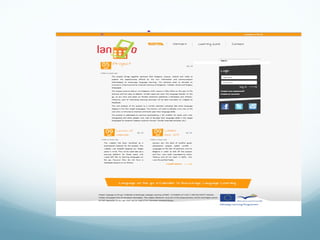
www.lango.eu
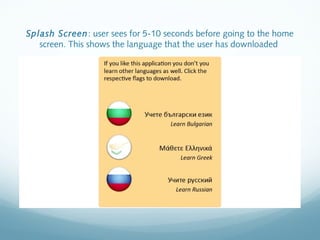
Splash Screen: user sees for 5-10 seconds before going to the home
screen. This shows the language that the user has downloaded
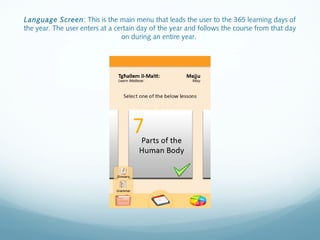
Language Screen: This is the main menu that leads the user to the 365 learning days of
the year. The user enters at a certain day of the year and follows the course from that day
on during an entire year.
Dimensions: Community
• Change
• Inclusion
• Institutional legacies (such as formal schooling)
• Migration
• Narratives of the migrant voyage
• Common connectivity
DIMENSIONS: learning
• Reflective learning
• Ease of access
• Relevance
• Applicability
• Flexibility
• Attractive learning architecture
Dimensions: Personal
• Engagement
• Link to daily life/activities
• Purpose
• Functionality
• Worth and value
• Motivation
• Validation.
Contact
www.lango.eu
Dr. Alan Bruce
abruce@ulsystems.com
Dr. Hedva Vital
hvital@marathon-group.net

LANGO - mobile language learning project (EDEN Conference, Oslo, June 2013)

  • 1.
    CREATIVE LANGUAGE LEARNINGIN MOBILE ENVIRONMENTS: ICT SUPPORTED CREATIVITY IN THE LANGO PROJECT Dr. Alan Bruce, ULS Ireland Dr. Hedva Vital, Ha’kibbutzim College, Israel EDEN Conference Oslo, Norway 12 June 2013
  • 2.
    Overview LANGO – projectdesigned to explore opportunities offered by new advanced information and communication technologies in encouragement of adult learners of less widely used and taught languages. Interactive language learning approaches combined with strong intercultural components: advanced technological tools motivate language learning and give insights into culture, traditions and everyday habits.
  • 3.
    LANGO Language On TheGo: e-Calendar to Encourage Language Learning Project No 519242-LLP-1-2011-1-BG-KA2-KA2MP Target users:  Adult language learners (18+)  People participating in EU mobility for study and work  Immigrants  Other people wishing to develop their language skills in the target languages for personal reasons (cultural interest, friends, business contacts, etc.)
  • 4.
    Challenges of secondlanguage acquisition • Modern research on challenges and issues around second language acquisition focus on developing awareness, competence and fluency • Role of ICT in building language competences, especially for learners outside formal education systems • Benefits of learning a language in informal settings • Process of communicative competence acquisition often given little attention • New technologies give opportunities to develop modern learning tools particularly in learning less widely used languages.
  • 5.
    LANGO: Language Onthe Go • Innovative e-learning tool to teach learners Bulgarian, Maltese, Greek and Russian • ICT assisted language learning • Language learning through a mobile phone
  • 6.
    Specific aims ofLANGO • Enable A1 learners gradually to reach higher levels of target language • Introduce and practice frequently used language patterns • Develop communicative skills: listening comprehension, spoken interaction, spoken production, basic reading skills • Motivation: easy language input through real life communicative situations • Increase learner’s level of cultural awareness
  • 7.
    Informing Issues • Interculturallearning is integral part of language learning and needs greater attention. • European migration patterns increase the numbers required to learn and speak another language. • Finding ways to overcome cultural differences, misunderstanding and disengagement is key component of communicative competence. • LANGO integrates cultural knowledge with language learning to develop mutual accommodation in multicultural societies. • Creates understanding, respect and dialogue.
  • 8.
    Strategic aims • Provideimmediate benefits to adult learners who want to further their competence in learning less widely used languages • Facilitate easy movement of citizens within EU higher education for purposes of further study or employment • Promote multilingual and multicultural awareness among all user groups in the longer term.
  • 9.
    Rationale Addresses initial languagelearning Focuses on what people typically need or want to say in initial communication stages Integrates technology for individualized and independent learning in terms of pace, time and place (home, work, on the move, etc.) Provides access to authentic online learning material Uses applications which do not require advanced skills, providing benefits for lower academic levels Supports improvement of linguistic and digital competence at the same time
  • 10.
    Learning principles 1) functional-notional:learning to recognize communicative functions and express concepts and ideas related to these functions 2) situational-topical principle: taking into account topics and the user needs related to the most frequent everyday communication situations
  • 11.
    LANGO approach Language learningactivities delivered in a calendar format: each daily lesson associated with a particular day of the calendar. Learner needs to allocate only 10 minutes every day of the year to maintain and build on language skills Introductory part of each lesson and the instructions are translated into English to support learners and increase comprehension.
  • 12.
    Lesson Structure 1. Introduction– listening and recording of dialogue, short text or language patterns 2. Daily activity: matching, multiple choice, filling in blanks, etc. 3. A wordsearch game The daily wordsearch game available via Facebook widgets
  • 13.
    Learning content • Thelearning content for each of the four target languages is divided between generic topics common to A1-A2 language curriculum (CEFR) and country specific culture topics. • The content is delivered inside a specifically designed template. • On the last day of the month users receive a short quiz to check how well they have learnt the monthly content. This helps users to control their progress. • Additional materials to support the learner: a short grammar reference a talking dictionary
  • 14.
    Types of learningactivities Variety of entertaining learning activities designed to motivate the learner to practice language patterns without getting bored: Multiple choice with text, sound or picture Matching pairs (text or pictures) Ordering sequences Media triggers Categorizing different language areas Listening to dialogue, recording oneself and listening to learner’s own recording Wordsearch games based on a sound trigger
  • 15.
  • 16.
    Splash Screen: usersees for 5-10 seconds before going to the home screen. This shows the language that the user has downloaded
  • 17.
    Language Screen: Thisis the main menu that leads the user to the 365 learning days of the year. The user enters at a certain day of the year and follows the course from that day on during an entire year.
  • 18.
    Dimensions: Community • Change •Inclusion • Institutional legacies (such as formal schooling) • Migration • Narratives of the migrant voyage • Common connectivity
  • 19.
    DIMENSIONS: learning • Reflectivelearning • Ease of access • Relevance • Applicability • Flexibility • Attractive learning architecture
  • 20.
    Dimensions: Personal • Engagement •Link to daily life/activities • Purpose • Functionality • Worth and value • Motivation • Validation.
  • 21.

Editor's Notes

  • #13 All lessons are structured in the same way and include audio introductions, one activity per day from a choice of activities in the template (e.g. matching, multiple choice, etc.) and a daily wordsearch game.