Language and Power Language and Technology
Objectives “ To explore some issues of language and power that are inherent in a context where English is taught and  learned as a second or foreign language.”  (Study Guide, 2010) Looking at language and power form a classroom perspective through the topic of Technology
Technology influences Language   Language forms used in regional varieties may move into other regions Technology is a means to extend man's reach   Technology can allow us to eavesdrop on conversations legitimately  and  to read texts from a greater range of writers   ( Language and technology, n.d).
Technology influences Language   cont. Internet technologies allow great scope to the individual to write or speak, read or listen.   Different technologies influence spelling in different ways - Text messaging, blogging, online chat, forums and E-mails have led to abbreviations of words   The Web is an endless source of authentic English language communication   ( Language and technology, n.d)
Technology influences Language   cont. Technology increasingly reaches into more and more aspects of our lives.  Nowhere is this influence more obvious than in educational settings ( Casanave, 2004)
Technology-a wonderful source  of  comprehensible input   provides students with:  different learning styles with additional demonstrations concrete examples of concepts being taught in the classroom Multimedia CDs, digital tutorials the Web pro­vide a near endless source of sound, pictures, video, animation mul­timedia that can help situate learning within a mean­ingful context (English Language Learners and Technology, 2005)
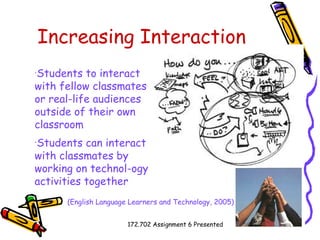
Increasing Interaction Students to interact with fellow classmates or real-life audiences outside of their own classroom Students can interact with classmates by working on technol­ogy activities together   (English Language Learners and Technology, 2005)
Making Learning Authentic Students can go to the Web to listen to sound bytes of authentic conversations on varying topics   (English Language Learners and Technology, 2005)
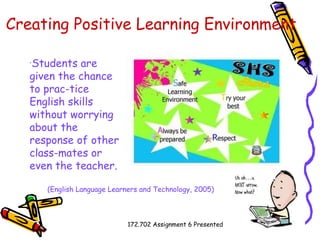
Creating Positive Learning Environment   Students are given the chance to prac­tice English skills without worrying about the response of other class­mates or even the teacher.   (English Language Learners and Technology, 2005)
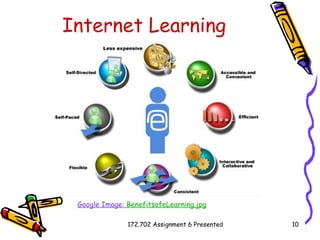
Internet Learning Google Image:  BenefitsofeLearning.jpg
English - the universal language on the Internet? Generally speaking, English is the universal language on the Internet, but it has no official status, and it will never have   The position of English can only be altered by major world-scale political and economical changes   The technology of machine translation may allow people to use their own language in international communication   (English - the universal language on the Internet?  n.d).
Reference   Casanave, C. (2004)  Controversies in second language writing  (pp. 211-223).  Ann Arbor: University of Michigan Press English Language Learners and Technology. ( 2005). Retrieved 5th October  2010 from  http://schoolweb.dysart.org/EdTech/uploads/initiatives/ELD/Vol7_1.pdf English - the universal language on the Internet?  ( n.d). Retrieved 9th  October 2010 from   http://www.cs.tut.fi/~jkorpela/lingua-franca.html   Language and technology. ( n.d). Retrieved 9th October 2010 from  http:// www.teachit.co.uk/armoore/lang/languageandtechnology.htm   Study Guide. (2010). Study guide for Linguistic Analysis. Massey University, School of Language Studies.

Li pres.ppt

  • 1.
    Language and PowerLanguage and Technology
  • 2.
    Objectives “ Toexplore some issues of language and power that are inherent in a context where English is taught and learned as a second or foreign language.” (Study Guide, 2010) Looking at language and power form a classroom perspective through the topic of Technology
  • 3.
    Technology influences Language Language forms used in regional varieties may move into other regions Technology is a means to extend man's reach Technology can allow us to eavesdrop on conversations legitimately and to read texts from a greater range of writers ( Language and technology, n.d).
  • 4.
    Technology influences Language cont. Internet technologies allow great scope to the individual to write or speak, read or listen. Different technologies influence spelling in different ways - Text messaging, blogging, online chat, forums and E-mails have led to abbreviations of words The Web is an endless source of authentic English language communication ( Language and technology, n.d)
  • 5.
    Technology influences Language cont. Technology increasingly reaches into more and more aspects of our lives. Nowhere is this influence more obvious than in educational settings ( Casanave, 2004)
  • 6.
    Technology-a wonderful source of comprehensible input provides students with: different learning styles with additional demonstrations concrete examples of concepts being taught in the classroom Multimedia CDs, digital tutorials the Web pro­vide a near endless source of sound, pictures, video, animation mul­timedia that can help situate learning within a mean­ingful context (English Language Learners and Technology, 2005)
  • 7.
    Increasing Interaction Studentsto interact with fellow classmates or real-life audiences outside of their own classroom Students can interact with classmates by working on technol­ogy activities together (English Language Learners and Technology, 2005)
  • 8.
    Making Learning AuthenticStudents can go to the Web to listen to sound bytes of authentic conversations on varying topics (English Language Learners and Technology, 2005)
  • 9.
    Creating Positive LearningEnvironment Students are given the chance to prac­tice English skills without worrying about the response of other class­mates or even the teacher. (English Language Learners and Technology, 2005)
  • 10.
    Internet Learning GoogleImage: BenefitsofeLearning.jpg
  • 11.
    English - theuniversal language on the Internet? Generally speaking, English is the universal language on the Internet, but it has no official status, and it will never have The position of English can only be altered by major world-scale political and economical changes The technology of machine translation may allow people to use their own language in international communication (English - the universal language on the Internet? n.d).
  • 12.
    Reference Casanave, C. (2004) Controversies in second language writing (pp. 211-223). Ann Arbor: University of Michigan Press English Language Learners and Technology. ( 2005). Retrieved 5th October 2010 from http://schoolweb.dysart.org/EdTech/uploads/initiatives/ELD/Vol7_1.pdf English - the universal language on the Internet? ( n.d). Retrieved 9th October 2010 from http://www.cs.tut.fi/~jkorpela/lingua-franca.html Language and technology. ( n.d). Retrieved 9th October 2010 from http:// www.teachit.co.uk/armoore/lang/languageandtechnology.htm Study Guide. (2010). Study guide for Linguistic Analysis. Massey University, School of Language Studies.