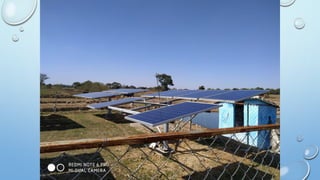
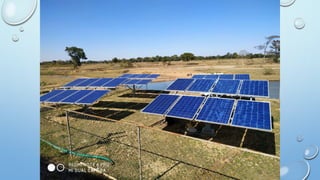
SOLAR POWERED IRRIGATION
SYSTEMS
DR. GAJANAN B. RAJURKAR
PROJECT LEAD
SYNGENTA FOUNDATION INDIA (SFI)
AGRI-ENTREPRENUER GROWTH FOUNDATION (AEGF)
JHARKHAND STATE
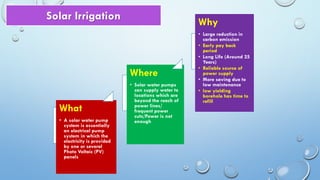
What
• A solar water pump
system is essentially
an electrical pump
system in which the
electricity is provided
by one or several
Photo Voltaic (PV)
panels
Where
• Solar water pumps
can supply water to
locations which are
beyond the reach of
power lines/
frequent power
cuts/Power is not
enough
Why
• Large reduction in
carbon emission
• Early pay back
period
• Long Life (Around 25
Years)
• Reliable source of
power supply
• More saving due to
low maintenance
• low yielding
borehole has time to
refill
Solar Irrigation
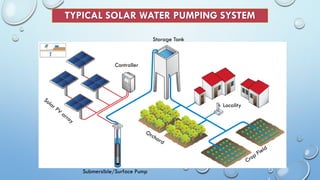
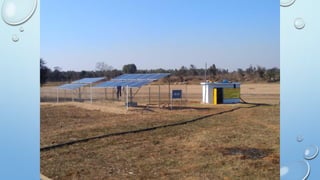
TYPICAL SOLAR WATER PUMPING SYSTEM
Controller
Storage Tank
Submersible/Surface Pump
Locality
ADVANTAGES
• It helps in saving energy.
• There is no fuel cost - as it uses available free sun light.
• No electricity required.
• Can be operated lifelong.
• It works everywhere.
• It is also useful for clean, drinking water sanitation and also irrigation.
• The dependence on rain is reduced
• It creates wealth for farmers by increasing no. Of crops.
DIS-ADVANTAGES
• High initial cost
• Non-working at night
• Solar panel inefficiency. (A solar panel Can convert < 22% of the energy
it gets from the sun into electrical energy)
• Bulky solar panels are required for the
• Large power production
WHAT ARE SOLAR POWER PANELS?
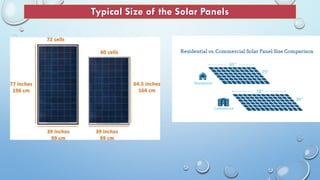
• A solar power panel is made of photovoltaic cells arranged in a configuration that can contain 32, 36,
48, 60, 72 and 96 cells.
• A solar panel comprising 32 cells typically can produce 14.72 volts output (each cell producing about
0.46 volt of electricity).
• These cells are arranged in a frame that is either rectangular or square.
• The size and weight of solar power panels increase as the number of cells increase.
• Solar power panels with higher cell configuration are used in commercial applications to generate
electric power.
HOW DO SOLAR POWER PANELS WORK?
• The cells in a solar power panel are photovoltaic, they absorb energy from the
sun’s rays when exposed to the sun.
• This energy is transferred to the semiconductor creating an electric field
delivering voltage and current.
• Power is derived from the equation P (power) = V (voltage) x i (current). for
instance, a solar power panel comprising 72 cells generates 33.12 v.
Source:
https://economictimes.indiatimes.com/small-biz/productline/power-generation/solar-power-panel-assembly-of-solar-cells-that-can-generate-230-to-275-watts-of-
power/articleshow/69131072.cms?utm_source=contentofinterest&utm_medium=text&utm_campaign=cppst
FEATURES OF SOLAR POWER PANELS
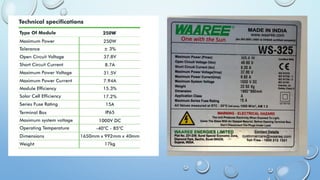
• Solar power panels can come in varying sizes but the common size for commercial applications is
77 x 39 inches and for residential applications, the common size is 65 x 39 inches.
• The size of an average solar panel is dependent on the number of cells (1 cell = 15.6 x 15.6
cm) encapsulated in it and the panels' application.
• The cells produce relatively constant voltage but current can vary with the intensity of light falling
on the solar power panel.
• Photovoltaic solar panels can come in three types – monocrystalline silicon PV panels,
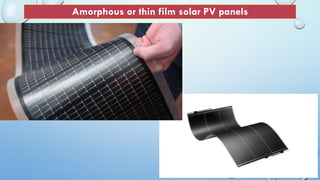
polycrystalline silicon PV panels and amorphous or thin film solar PV panels.
• A typical solar power panel can generate 230 to 325 watts of power.
• Any power generated can be used directly to charge a device that runs on DC current.
• By using an inverter, DC power can be converted to AC to run devices that use AC current
Typical Size of the Solar Panels
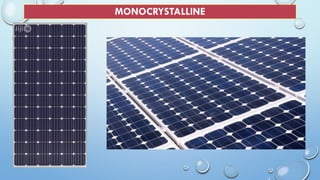
MONOCRYSTALLINE
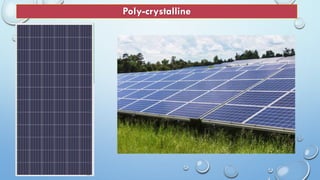
Poly-crystalline
Amorphous or thin film solar PV panels
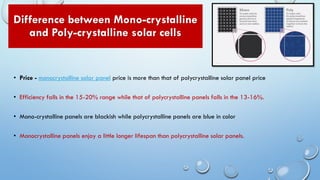
Difference between Mono-crystalline
and Poly-crystalline solar cells
• Price - monocrystalline solar panel price is more than that of polycrystalline solar panel price
• Efficiency falls in the 15-20% range while that of polycrystalline panels falls in the 13-16%.
• Mono-crystalline panels are blackish while polycrystalline panels are blue in color
• Monocrystalline panels enjoy a little longer lifespan than polycrystalline solar panels.
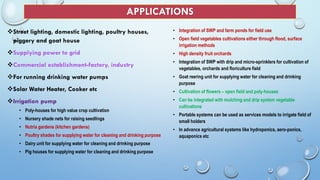
APPLICATIONS
Street lighting, domestic lighting, poultry houses,
piggery and goat house
Supplying power to grid
Commercial establishment-factory, industry
For running drinking water pumps
Solar Water Heater, Cooker etc
Irrigation pump
• Poly-houses for high value crop cultivation
• Nursery shade nets for raising seedlings
• Nutria gardens (kitchen gardens)
• Poultry shades for supplying water for cleaning and drinking purpose
• Dairy unit for supplying water for cleaning and drinking purpose
• Pig houses for supplying water for cleaning and drinking purpose
• Integration of SWP and farm ponds for field use
• Open field vegetables cultivations either through flood, surface
irrigation methods
• High density fruit orchards
• Integration of SWP with drip and micro-sprinklers for cultivation of
vegetables, orchards and floriculture field
• Goat reering unit for supplying water for cleaning and drinking
purpose
• Cultivation of flowers – open field and poly-houses
• Can be integrated with mulching and drip system vegetable
cultivations
• Portable systems can be used as services models to irrigate field of
small holders
• In advance agricultural systems like hydroponics, aero-ponics,
aquaponics etc
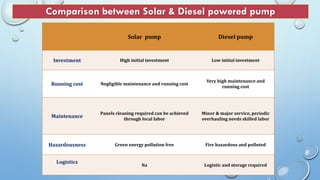
Comparison between Solar & Diesel powered pump
Solar pump Diesel pump
Investment High initial investment Low initial investment
Running cost Negligible maintenance and running cost
Very high maintenance and
running cost
Maintenance
Panels cleaning required can be achieved
through local labor
Minor & major service, periodic
overhauling needs skilled labor
Hazardousness Green energy pollution free Fire hazardous and polluted
Logistics
Na Logistic and storage required
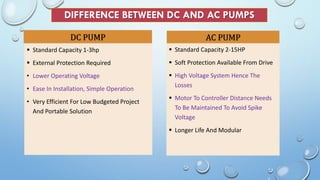
DIFFERENCE BETWEEN DC AND AC PUMPS
DC PUMP AC PUMP
 Standard Capacity 1-3hp
 External Protection Required
• Lower Operating Voltage
• Ease In Installation, Simple Operation
• Very Efficient For Low Budgeted Project
And Portable Solution
 Standard Capacity 2-15HP
 Soft Protection Available From Drive
 High Voltage System Hence The
Losses
 Motor To Controller Distance Needs
To Be Maintained To Avoid Spike
Voltage
 Longer Life And Modular
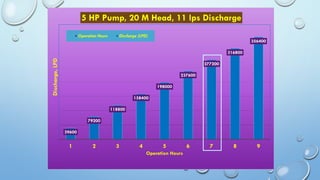
39600
79200
118800
158400
198000
237600
277200
316800
356400
1 2 3 4 5 6 7 8 9
Discharge,LPD
Operation Hours
5 HP Pump, 20 M Head, 11 lps Discharge
Operation Hours Discharge (LPD)
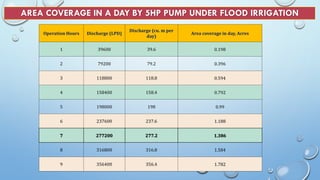
AREA COVERAGE IN A DAY BY 5HP PUMP UNDER FLOOD IRRIGATION
Operation Hours Discharge (LPD)
Discharge (cu. m per
day)
Area coverage in day, Acres
1 39600 39.6 0.198
2 79200 79.2 0.396
3 118800 118.8 0.594
4 158400 158.4 0.792
5 198000 198 0.99
6 237600 237.6 1.188
7 277200 277.2 1.386
8 316800 316.8 1.584
9 356400 356.4 1.782
Sl no Item Description Make Quantity
1 Solar Photovoltaic Plant, make: Waaree Energies 5200 WP
2 Hot Dipped Galvanized PV Mounting structure with civil
foundation
1 Set
3 Double door IP54 CPRI Tested Electrical panel with
Changeover switch
Panel
Greenovera / Changeover make: Hager 1 no
4 VFD with MCB and SPD Schneider Electric 1 Set
5 Data Logger with Power Supply Greenovera 1 Set
6 Earthing set TATA/Reputed 2 nos
7 Lightning Arrester with Isolator, TATA/Reputed 1 Set
8 UV Protected 4 Sq mm DC Cable make Polycab 6 Mtr
9 2.5 sq mm 3 core Flat AC Cable including HDPE Conduit
make:
Polycab 50 Mtr
10 Nut bolts, MC4 connectors, Cable tie 1 Set
11 GI wire with PVC conduit 20 Mtr
12 Surface Pump, make: Texmo/Equivalent 1 no
13 Pump Canopy 1 Set
14 Pump fittings As Required
15 Flexible pipe for Suction Make Diamond 10 Mtr
16 Pipeline and its necessary fittings S N polymer or Jain 1 Job
17 PVC coated wire mesh chain link fencing 1 Set
THANK YOU FOR YOUR
ATTENTION

Week 2:Solar powered lift irrigation system

  • 1.
    SOLAR POWERED IRRIGATION SYSTEMS DR.GAJANAN B. RAJURKAR PROJECT LEAD SYNGENTA FOUNDATION INDIA (SFI) AGRI-ENTREPRENUER GROWTH FOUNDATION (AEGF) JHARKHAND STATE
  • 2.
    What • A solarwater pump system is essentially an electrical pump system in which the electricity is provided by one or several Photo Voltaic (PV) panels Where • Solar water pumps can supply water to locations which are beyond the reach of power lines/ frequent power cuts/Power is not enough Why • Large reduction in carbon emission • Early pay back period • Long Life (Around 25 Years) • Reliable source of power supply • More saving due to low maintenance • low yielding borehole has time to refill Solar Irrigation
  • 3.
    TYPICAL SOLAR WATERPUMPING SYSTEM Controller Storage Tank Submersible/Surface Pump Locality
  • 4.
    ADVANTAGES • It helpsin saving energy. • There is no fuel cost - as it uses available free sun light. • No electricity required. • Can be operated lifelong. • It works everywhere. • It is also useful for clean, drinking water sanitation and also irrigation. • The dependence on rain is reduced • It creates wealth for farmers by increasing no. Of crops.
  • 5.
    DIS-ADVANTAGES • High initialcost • Non-working at night • Solar panel inefficiency. (A solar panel Can convert < 22% of the energy it gets from the sun into electrical energy) • Bulky solar panels are required for the • Large power production
  • 6.
    WHAT ARE SOLARPOWER PANELS? • A solar power panel is made of photovoltaic cells arranged in a configuration that can contain 32, 36, 48, 60, 72 and 96 cells. • A solar panel comprising 32 cells typically can produce 14.72 volts output (each cell producing about 0.46 volt of electricity). • These cells are arranged in a frame that is either rectangular or square. • The size and weight of solar power panels increase as the number of cells increase. • Solar power panels with higher cell configuration are used in commercial applications to generate electric power.
  • 7.
    HOW DO SOLARPOWER PANELS WORK? • The cells in a solar power panel are photovoltaic, they absorb energy from the sun’s rays when exposed to the sun. • This energy is transferred to the semiconductor creating an electric field delivering voltage and current. • Power is derived from the equation P (power) = V (voltage) x i (current). for instance, a solar power panel comprising 72 cells generates 33.12 v. Source: https://economictimes.indiatimes.com/small-biz/productline/power-generation/solar-power-panel-assembly-of-solar-cells-that-can-generate-230-to-275-watts-of- power/articleshow/69131072.cms?utm_source=contentofinterest&utm_medium=text&utm_campaign=cppst
  • 8.
    FEATURES OF SOLARPOWER PANELS • Solar power panels can come in varying sizes but the common size for commercial applications is 77 x 39 inches and for residential applications, the common size is 65 x 39 inches. • The size of an average solar panel is dependent on the number of cells (1 cell = 15.6 x 15.6 cm) encapsulated in it and the panels' application. • The cells produce relatively constant voltage but current can vary with the intensity of light falling on the solar power panel. • Photovoltaic solar panels can come in three types – monocrystalline silicon PV panels, polycrystalline silicon PV panels and amorphous or thin film solar PV panels. • A typical solar power panel can generate 230 to 325 watts of power. • Any power generated can be used directly to charge a device that runs on DC current. • By using an inverter, DC power can be converted to AC to run devices that use AC current
  • 10.
    Typical Size ofthe Solar Panels
  • 11.
  • 12.
  • 13.
    Amorphous or thinfilm solar PV panels
  • 14.
    Difference between Mono-crystalline andPoly-crystalline solar cells • Price - monocrystalline solar panel price is more than that of polycrystalline solar panel price • Efficiency falls in the 15-20% range while that of polycrystalline panels falls in the 13-16%. • Mono-crystalline panels are blackish while polycrystalline panels are blue in color • Monocrystalline panels enjoy a little longer lifespan than polycrystalline solar panels.
  • 15.
    APPLICATIONS Street lighting, domesticlighting, poultry houses, piggery and goat house Supplying power to grid Commercial establishment-factory, industry For running drinking water pumps Solar Water Heater, Cooker etc Irrigation pump • Poly-houses for high value crop cultivation • Nursery shade nets for raising seedlings • Nutria gardens (kitchen gardens) • Poultry shades for supplying water for cleaning and drinking purpose • Dairy unit for supplying water for cleaning and drinking purpose • Pig houses for supplying water for cleaning and drinking purpose • Integration of SWP and farm ponds for field use • Open field vegetables cultivations either through flood, surface irrigation methods • High density fruit orchards • Integration of SWP with drip and micro-sprinklers for cultivation of vegetables, orchards and floriculture field • Goat reering unit for supplying water for cleaning and drinking purpose • Cultivation of flowers – open field and poly-houses • Can be integrated with mulching and drip system vegetable cultivations • Portable systems can be used as services models to irrigate field of small holders • In advance agricultural systems like hydroponics, aero-ponics, aquaponics etc
  • 16.
    Comparison between Solar& Diesel powered pump Solar pump Diesel pump Investment High initial investment Low initial investment Running cost Negligible maintenance and running cost Very high maintenance and running cost Maintenance Panels cleaning required can be achieved through local labor Minor & major service, periodic overhauling needs skilled labor Hazardousness Green energy pollution free Fire hazardous and polluted Logistics Na Logistic and storage required
  • 17.
    DIFFERENCE BETWEEN DCAND AC PUMPS DC PUMP AC PUMP  Standard Capacity 1-3hp  External Protection Required • Lower Operating Voltage • Ease In Installation, Simple Operation • Very Efficient For Low Budgeted Project And Portable Solution  Standard Capacity 2-15HP  Soft Protection Available From Drive  High Voltage System Hence The Losses  Motor To Controller Distance Needs To Be Maintained To Avoid Spike Voltage  Longer Life And Modular
  • 18.
    39600 79200 118800 158400 198000 237600 277200 316800 356400 1 2 34 5 6 7 8 9 Discharge,LPD Operation Hours 5 HP Pump, 20 M Head, 11 lps Discharge Operation Hours Discharge (LPD)
  • 19.
    AREA COVERAGE INA DAY BY 5HP PUMP UNDER FLOOD IRRIGATION Operation Hours Discharge (LPD) Discharge (cu. m per day) Area coverage in day, Acres 1 39600 39.6 0.198 2 79200 79.2 0.396 3 118800 118.8 0.594 4 158400 158.4 0.792 5 198000 198 0.99 6 237600 237.6 1.188 7 277200 277.2 1.386 8 316800 316.8 1.584 9 356400 356.4 1.782
  • 20.
    Sl no ItemDescription Make Quantity 1 Solar Photovoltaic Plant, make: Waaree Energies 5200 WP 2 Hot Dipped Galvanized PV Mounting structure with civil foundation 1 Set 3 Double door IP54 CPRI Tested Electrical panel with Changeover switch Panel Greenovera / Changeover make: Hager 1 no 4 VFD with MCB and SPD Schneider Electric 1 Set 5 Data Logger with Power Supply Greenovera 1 Set 6 Earthing set TATA/Reputed 2 nos 7 Lightning Arrester with Isolator, TATA/Reputed 1 Set 8 UV Protected 4 Sq mm DC Cable make Polycab 6 Mtr 9 2.5 sq mm 3 core Flat AC Cable including HDPE Conduit make: Polycab 50 Mtr 10 Nut bolts, MC4 connectors, Cable tie 1 Set 11 GI wire with PVC conduit 20 Mtr 12 Surface Pump, make: Texmo/Equivalent 1 no 13 Pump Canopy 1 Set 14 Pump fittings As Required 15 Flexible pipe for Suction Make Diamond 10 Mtr 16 Pipeline and its necessary fittings S N polymer or Jain 1 Job 17 PVC coated wire mesh chain link fencing 1 Set
  • 23.
    THANK YOU FORYOUR ATTENTION