Dose Response Relationship
Dr. Asmita Daspute .
Assistant Professor,
Dept. of Environmental Science,
Sbes College Of Science Aurangabad.(Ms)
Dose
 Dose: Amount of chemical administered usually express per unit Body
weight.
 If the dose is administered into the stomach or applied on the skin or into
respiratory tract,
 Transport across the membranes may be incomplete and the absorbed
dose will not the be identical with the dose adminisered
 Estimation of Dose can be made from
 Measurement of environmental and Food concentration
 Food intake
 Inhalation rate
 Appropriate deposition and retention factors
Dose
 The Dose in the organ and Tissues of interest may be estimated-
 Administered Dose or Intake
 Measurement of the concentration in tissues and organ samples
 Measurement of the concentration in excreta or exhaled air.
Responce
 Response and effect are often used interchangeably to denote the biological change either
in individual or in a population.
 Effect – is biological change
 Response – proportion of a population that demonstrates a defined effect. Or
 Incidence rate of effect .
 e,.g.- LD50 value may be described as the dose expected to cause a 50% response in a
population tested for lethal effect of a chemical
Response to chemicals
 Concentration at the site of respective tissue
 Rate of absorption
 Distribution
 Excretion and
 Detoxification of a chemicals
 Tolerance and hypersensitivity to a chemical
 Genetic factors
 State of health
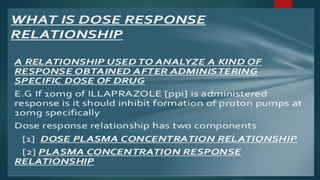
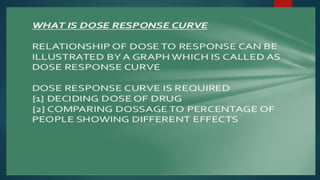
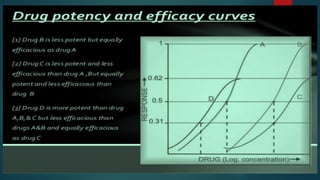
Dose response relationship

Dose response relationship

  • 1.
    Dose Response Relationship Dr.Asmita Daspute . Assistant Professor, Dept. of Environmental Science, Sbes College Of Science Aurangabad.(Ms)
  • 3.
    Dose  Dose: Amountof chemical administered usually express per unit Body weight.  If the dose is administered into the stomach or applied on the skin or into respiratory tract,  Transport across the membranes may be incomplete and the absorbed dose will not the be identical with the dose adminisered  Estimation of Dose can be made from  Measurement of environmental and Food concentration  Food intake  Inhalation rate  Appropriate deposition and retention factors
  • 4.
    Dose  The Dosein the organ and Tissues of interest may be estimated-  Administered Dose or Intake  Measurement of the concentration in tissues and organ samples  Measurement of the concentration in excreta or exhaled air.
  • 5.
    Responce  Response andeffect are often used interchangeably to denote the biological change either in individual or in a population.  Effect – is biological change  Response – proportion of a population that demonstrates a defined effect. Or  Incidence rate of effect .  e,.g.- LD50 value may be described as the dose expected to cause a 50% response in a population tested for lethal effect of a chemical
  • 7.
    Response to chemicals Concentration at the site of respective tissue  Rate of absorption  Distribution  Excretion and  Detoxification of a chemicals  Tolerance and hypersensitivity to a chemical  Genetic factors  State of health