
PEDIATRIC
DRUG DOSE CALCULATIONS
INTRODUCTION
• The medicine doses are calculated based on child’s weight.
• It makes the doses much more precise in children
• Its important that the child’s most recent weight in
kilograms is entered into the record, so that the drug
dosage calculations are accurate.
DEFINITION
It is an appropriate administration of desired strength and
quantity of drugs to infants and neonates to improve their
health condition
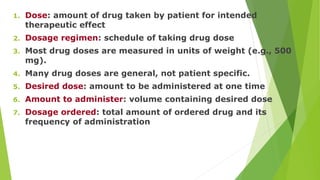
1. Dose: amount of drug taken by patient for intended
therapeutic effect
2. Dosage regimen: schedule of taking drug dose
3. Most drug doses are measured in units of weight (e.g., 500
mg).
4. Many drug doses are general, not patient specific.
5. Desired dose: amount to be administered at one time
6. Amount to administer: volume containing desired dose
7. Dosage ordered: total amount of ordered drug and its
frequency of administration
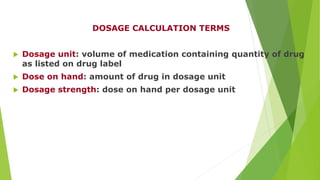
DOSAGE CALCULATION TERMS
 Dosage unit: volume of medication containing quantity of drug
as listed on drug label
 Dose on hand: amount of drug in dosage unit
 Dosage strength: dose on hand per dosage unit
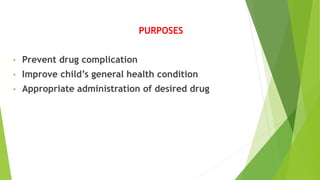
PURPOSES
• Prevent drug complication
• Improve child’s general health condition
• Appropriate administration of desired drug
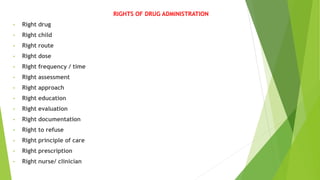
RIGHTS OF DRUG ADMINISTRATION
• Right drug
• Right child
• Right route
• Right dose
• Right frequency / time
• Right assessment
• Right approach
• Right education
• Right evaluation
• Right documentation
• Right to refuse
• Right principle of care
• Right prescription
• Right nurse/ clinician
COMMON FORMULA ‘S
FOR
DRUG CALCULATIONS
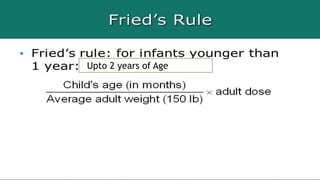
Upto 2 years of Age
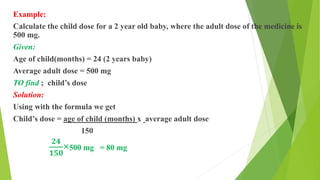
Example:
Calculate the child dose for a 2 year old baby, where the adult dose of the medicine is
500 mg.
Given:
Age of child(months) = 24 (2 years baby)
Average adult dose = 500 mg
TO find ; child’s dose
Solution:
Using with the formula we get
Child’s dose = age of child (months) x average adult dose
150
𝟐𝟒
𝟏𝟓𝟎
×500 mg = 80 mg
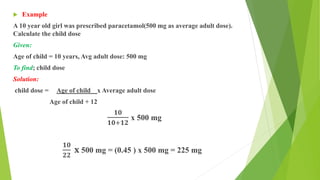
 Example
A 10 year old girl was prescribed paracetamol(500 mg as average adult dose).
Calculate the child dose
Given:
Age of child = 10 years, Avg adult dose: 500 mg
To find; child dose
Solution:
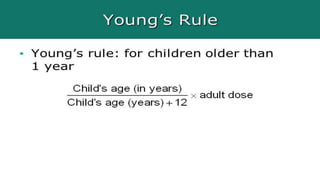
child dose = Age of child x Average adult dose
Age of child + 12
𝟏𝟎
𝟏𝟎+𝟏𝟐
x 500 mg
𝟏𝟎
𝟐𝟐
𝐱 500 mg = (0.45 ) x 500 mg = 225 mg
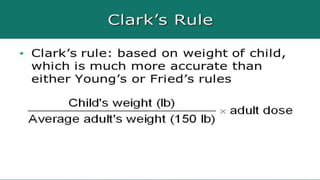
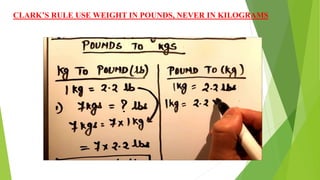
CLARK’S RULE USE WEIGHT IN POUNDS, NEVER IN KILOGRAMS
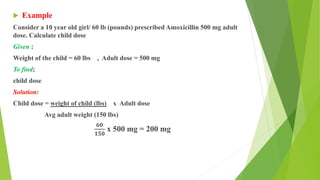
 Example
Consider a 10 year old girl/ 60 lb (pounds) prescribed Amoxicillin 500 mg adult
dose. Calculate child dose
Given :
Weight of the child = 60 lbs , Adult dose = 500 mg
To find;
child dose
Solution:
Child dose = weight of child (lbs) x Adult dose
Avg adult weight (150 lbs)
𝟔𝟎
𝟏𝟓𝟎
x 500 mg = 200 mg
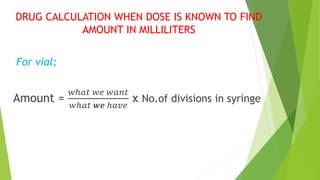
DRUG CALCULATION WHEN DOSE IS KNOWN TO FIND
AMOUNT IN MILLILITERS
For vial;
Amount =
𝑤ℎ𝑎𝑡 𝑤𝑒 𝑤𝑎𝑛𝑡
𝑤ℎ𝑎𝑡 𝒘𝒆 ℎ𝑎𝑣𝑒
x No.of divisions in syringe
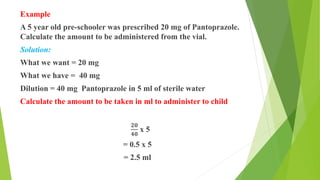
Example
A 5 year old pre-schooler was prescribed 20 mg of Pantoprazole.
Calculate the amount to be administered from the vial.
Solution:
What we want = 20 mg
What we have = 40 mg
Dilution = 40 mg Pantoprazole in 5 ml of sterile water
Calculate the amount to be taken in ml to administer to child
𝟐𝟎
𝟒𝟎
x 5
= 0.5 x 5
= 2.5 ml
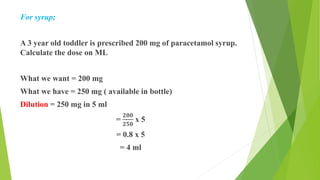
For syrup;
A 3 year old toddler is prescribed 200 mg of paracetamol syrup.
Calculate the dose on ML
What we want = 200 mg
What we have = 250 mg ( available in bottle)
Dilution = 250 mg in 5 ml
=
𝟐𝟎𝟎
𝟐𝟓𝟎
x 5
= 0.8 x 5
= 4 ml
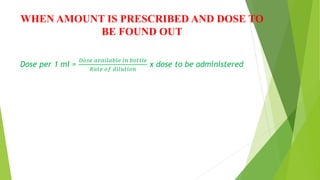
WHEN AMOUNT IS PRESCRIBED AND DOSE TO
BE FOUND OUT
Dose per 1 ml =
𝐷𝑜𝑠𝑒 𝑎𝑣𝑎𝑖𝑙𝑎𝑏𝑙𝑒 𝑖𝑛 𝑏𝑜𝑡𝑡𝑙𝑒
𝑅𝑎𝑡𝑒 𝑜𝑓 𝑑𝑖𝑙𝑢𝑡𝑖𝑜𝑛
x dose to be administered
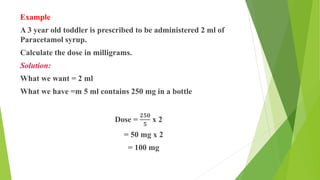
Example
A 3 year old toddler is prescribed to be administered 2 ml of
Paracetamol syrup.
Calculate the dose in milligrams.
Solution:
What we want = 2 ml
What we have =m 5 ml contains 250 mg in a bottle
Dose =
𝟐𝟓𝟎
𝟓
x 2
= 50 mg x 2
= 100 mg
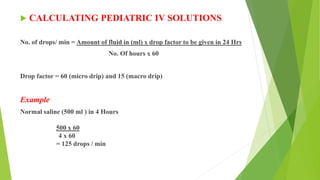
 CALCULATING PEDIATRIC IV SOLUTIONS
No. of drops/ min = Amount of fluid in (ml) x drop factor to be given in 24 Hrs
No. Of hours x 60
Drop factor = 60 (micro drip) and 15 (macro drip)
Example
Normal saline (500 ml ) in 4 Hours
500 x 60
4 x 60
= 125 drops / min
Pediatric drug doses calculations

Pediatric drug doses calculations

  • 1.
  • 2.
    INTRODUCTION • The medicinedoses are calculated based on child’s weight. • It makes the doses much more precise in children • Its important that the child’s most recent weight in kilograms is entered into the record, so that the drug dosage calculations are accurate.
  • 3.
    DEFINITION It is anappropriate administration of desired strength and quantity of drugs to infants and neonates to improve their health condition
  • 4.
    1. Dose: amountof drug taken by patient for intended therapeutic effect 2. Dosage regimen: schedule of taking drug dose 3. Most drug doses are measured in units of weight (e.g., 500 mg). 4. Many drug doses are general, not patient specific. 5. Desired dose: amount to be administered at one time 6. Amount to administer: volume containing desired dose 7. Dosage ordered: total amount of ordered drug and its frequency of administration
  • 5.
    DOSAGE CALCULATION TERMS Dosage unit: volume of medication containing quantity of drug as listed on drug label  Dose on hand: amount of drug in dosage unit  Dosage strength: dose on hand per dosage unit
  • 6.
    PURPOSES • Prevent drugcomplication • Improve child’s general health condition • Appropriate administration of desired drug
  • 7.
    RIGHTS OF DRUGADMINISTRATION • Right drug • Right child • Right route • Right dose • Right frequency / time • Right assessment • Right approach • Right education • Right evaluation • Right documentation • Right to refuse • Right principle of care • Right prescription • Right nurse/ clinician
  • 10.
  • 11.
  • 12.
    Example: Calculate the childdose for a 2 year old baby, where the adult dose of the medicine is 500 mg. Given: Age of child(months) = 24 (2 years baby) Average adult dose = 500 mg TO find ; child’s dose Solution: Using with the formula we get Child’s dose = age of child (months) x average adult dose 150 𝟐𝟒 𝟏𝟓𝟎 ×500 mg = 80 mg
  • 14.
     Example A 10year old girl was prescribed paracetamol(500 mg as average adult dose). Calculate the child dose Given: Age of child = 10 years, Avg adult dose: 500 mg To find; child dose Solution: child dose = Age of child x Average adult dose Age of child + 12 𝟏𝟎 𝟏𝟎+𝟏𝟐 x 500 mg 𝟏𝟎 𝟐𝟐 𝐱 500 mg = (0.45 ) x 500 mg = 225 mg
  • 16.
    CLARK’S RULE USEWEIGHT IN POUNDS, NEVER IN KILOGRAMS
  • 17.
     Example Consider a10 year old girl/ 60 lb (pounds) prescribed Amoxicillin 500 mg adult dose. Calculate child dose Given : Weight of the child = 60 lbs , Adult dose = 500 mg To find; child dose Solution: Child dose = weight of child (lbs) x Adult dose Avg adult weight (150 lbs) 𝟔𝟎 𝟏𝟓𝟎 x 500 mg = 200 mg
  • 18.
    DRUG CALCULATION WHENDOSE IS KNOWN TO FIND AMOUNT IN MILLILITERS For vial; Amount = 𝑤ℎ𝑎𝑡 𝑤𝑒 𝑤𝑎𝑛𝑡 𝑤ℎ𝑎𝑡 𝒘𝒆 ℎ𝑎𝑣𝑒 x No.of divisions in syringe
  • 19.
    Example A 5 yearold pre-schooler was prescribed 20 mg of Pantoprazole. Calculate the amount to be administered from the vial. Solution: What we want = 20 mg What we have = 40 mg Dilution = 40 mg Pantoprazole in 5 ml of sterile water Calculate the amount to be taken in ml to administer to child 𝟐𝟎 𝟒𝟎 x 5 = 0.5 x 5 = 2.5 ml
  • 20.
    For syrup; A 3year old toddler is prescribed 200 mg of paracetamol syrup. Calculate the dose on ML What we want = 200 mg What we have = 250 mg ( available in bottle) Dilution = 250 mg in 5 ml = 𝟐𝟎𝟎 𝟐𝟓𝟎 x 5 = 0.8 x 5 = 4 ml
  • 21.
    WHEN AMOUNT ISPRESCRIBED AND DOSE TO BE FOUND OUT Dose per 1 ml = 𝐷𝑜𝑠𝑒 𝑎𝑣𝑎𝑖𝑙𝑎𝑏𝑙𝑒 𝑖𝑛 𝑏𝑜𝑡𝑡𝑙𝑒 𝑅𝑎𝑡𝑒 𝑜𝑓 𝑑𝑖𝑙𝑢𝑡𝑖𝑜𝑛 x dose to be administered
  • 22.
    Example A 3 yearold toddler is prescribed to be administered 2 ml of Paracetamol syrup. Calculate the dose in milligrams. Solution: What we want = 2 ml What we have =m 5 ml contains 250 mg in a bottle Dose = 𝟐𝟓𝟎 𝟓 x 2 = 50 mg x 2 = 100 mg
  • 23.
     CALCULATING PEDIATRICIV SOLUTIONS No. of drops/ min = Amount of fluid in (ml) x drop factor to be given in 24 Hrs No. Of hours x 60 Drop factor = 60 (micro drip) and 15 (macro drip) Example Normal saline (500 ml ) in 4 Hours 500 x 60 4 x 60 = 125 drops / min