WEB SERVER
DEBASISH DUARAH
Mtech-CSE
Pondicherry University
WEB SITE & WEB SERVER
• Web site : consist of a collection of web pages associated with a particular
hostname
• Web server : is a program to satisfy client request for web resources
• It used to host web pages but there exist different web servers for gaming, storage etc.
HOW IT HANDLES A CLIENT REQUEST ?
• Parsing the request message
• Checking that the URL is authorized
• Associating the URL in the request with a file
name
• Constructing the response message
• Transmitting the response message to the
requesting client
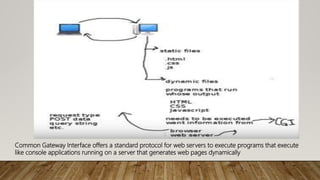
Common Gateway Interface offers a standard protocol for web servers to execute programs that execute
like console applications running on a server that generates web pages dynamically
ACCESS CONTROL
• Authentication
• Identifies the user who originated the request
• Name and password
• Authorization
• Determines which users have access to a particular resource
• Based on the information associated with the HTTP request(host name or ip address)
DYNAMICALLY GENERATED RESPONSES
• Server side include
• Instruct the web server to customize a static resources based on directives in an HTML-like file
• Server script
• Separate program that generates the request resource
• Program run as :
• Part of the server
• A separate process
• Role of web server:
• Associated with the URL with the appropriated script
• To pass the data to and from the script
• Role of script is
• Process the input from the server
• Generate the content to the client
CREATING AND USING COOKIES
• To generate dynamic responses cookies are used
• Browser asked to include a unique cookie in each HTTP request
• If the request doesn't include cookie, the script create a new cookie in the header
of the response message
• Set-cookie: customer:”user30”;version=“1”;path=“/book”
• Subsequent requests from the user would include the cookie
• Cookie: Customer=“user30”;version=“1”;path=“/book”
• Script can use COOKIE as user identifier in the interaction process
SHARING INFORMATION ACROSS REQUEST
• Server retain some information to reduce the overhead of handling future
request:
• Sharing HTTP responses across request
• Cache result is consistent with the primary copy of the information
• Sharing metadata across request
• Translation of url file
• Control information
• http response headers
• Server could also cache
• Current name
• Current date and time
SERVER ARCHITECTURE
• Event driven server architecture
• Process driven server architecture
• Hybrid server architecture
EVENT DRIVEN SERVER ARCHITECTURE
• Has a single process that alternates between servicing
different request
• Allows the server to serialize operation that modify the
same data
• Performs nonblocking systems calls
• Not used in most high end web servers
PROCESS DRIVEN SERVER ARCHITECTURE
• Allocates each request to a separate process
• One master process listens for new connection
• The master process creates or forks a separate process for new
connection.
• Terminate the process after parsing the client request and
transmitting the responses
• To prevent memory leak
• Introduces overhead for switching from one process to another
HYBRID SERVER ARCHITECTURE
• Strengths of the event driven and process driven models
are combined
• Each process would become an event driven server that
alternates between a small collection of request
• A single process has multiple independent threads.
• Main process instructs a separate helper process to
perform time consuming operations

Web server

  • 1.
  • 2.
    WEB SITE &WEB SERVER • Web site : consist of a collection of web pages associated with a particular hostname • Web server : is a program to satisfy client request for web resources • It used to host web pages but there exist different web servers for gaming, storage etc.
  • 3.
    HOW IT HANDLESA CLIENT REQUEST ? • Parsing the request message • Checking that the URL is authorized • Associating the URL in the request with a file name • Constructing the response message • Transmitting the response message to the requesting client
  • 4.
    Common Gateway Interfaceoffers a standard protocol for web servers to execute programs that execute like console applications running on a server that generates web pages dynamically
  • 5.
    ACCESS CONTROL • Authentication •Identifies the user who originated the request • Name and password • Authorization • Determines which users have access to a particular resource • Based on the information associated with the HTTP request(host name or ip address)
  • 6.
    DYNAMICALLY GENERATED RESPONSES •Server side include • Instruct the web server to customize a static resources based on directives in an HTML-like file • Server script • Separate program that generates the request resource • Program run as : • Part of the server • A separate process • Role of web server: • Associated with the URL with the appropriated script • To pass the data to and from the script • Role of script is • Process the input from the server • Generate the content to the client
  • 7.
    CREATING AND USINGCOOKIES • To generate dynamic responses cookies are used • Browser asked to include a unique cookie in each HTTP request • If the request doesn't include cookie, the script create a new cookie in the header of the response message • Set-cookie: customer:”user30”;version=“1”;path=“/book” • Subsequent requests from the user would include the cookie • Cookie: Customer=“user30”;version=“1”;path=“/book” • Script can use COOKIE as user identifier in the interaction process
  • 8.
    SHARING INFORMATION ACROSSREQUEST • Server retain some information to reduce the overhead of handling future request: • Sharing HTTP responses across request • Cache result is consistent with the primary copy of the information • Sharing metadata across request • Translation of url file • Control information • http response headers • Server could also cache • Current name • Current date and time
  • 9.
    SERVER ARCHITECTURE • Eventdriven server architecture • Process driven server architecture • Hybrid server architecture
  • 10.
    EVENT DRIVEN SERVERARCHITECTURE • Has a single process that alternates between servicing different request • Allows the server to serialize operation that modify the same data • Performs nonblocking systems calls • Not used in most high end web servers
  • 12.
    PROCESS DRIVEN SERVERARCHITECTURE • Allocates each request to a separate process • One master process listens for new connection • The master process creates or forks a separate process for new connection. • Terminate the process after parsing the client request and transmitting the responses • To prevent memory leak • Introduces overhead for switching from one process to another
  • 13.
    HYBRID SERVER ARCHITECTURE •Strengths of the event driven and process driven models are combined • Each process would become an event driven server that alternates between a small collection of request • A single process has multiple independent threads. • Main process instructs a separate helper process to perform time consuming operations