13 - 7 - 2016 Krakow
Digicraft and 'Systemic'Thinking
in Digital Humanities
Enrica Salvatori - LabCD - Università di Pisa (DH2016)
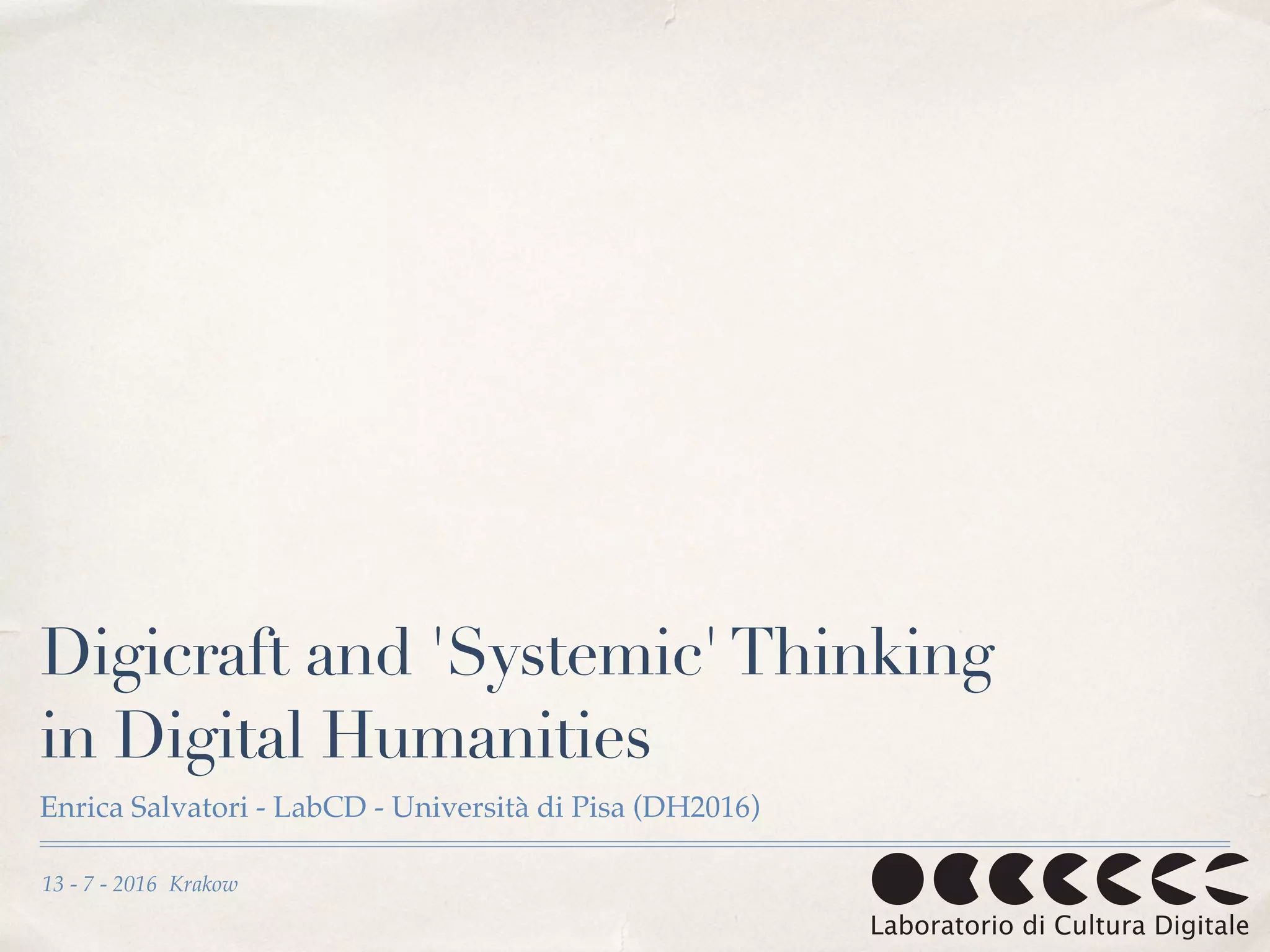
ManfredThaller
2014 - Bologna
Are the Humanities an endangered or
dominant species in the digital ecosystem?
Yes if
1. conceive of themselves as researchers
and not as conversationalists
2. strive for a vision
3. change the epistemology of the
Humanities
4. drive technology and not be driven by it
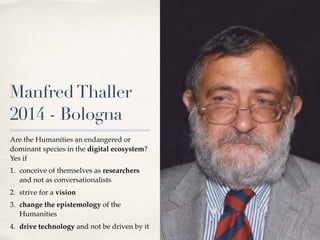
Serge Noiret
2015 - International
Federation of Public
History (IFPH)
Definition of Digital History, Public History,
Digital Public History
✤ Digital History and Digital Public History
are areas of research and not merely new
forms of communication of old
disciplines (Thaller’s point 1)
✤ He answered to Thaller’s items 2 and 3
by proposing a more accurate taxonomy
of DH.
✤ The answer is a more strict definition of
what we are and we do
Do we really need to tell 

what’s DH are?
✤ Each taxonomy of knowledge unavoidably builds
walls and fences that encase the knowledge itself in a
series of sterile boxes
✤ It’s better to focus our attention on what could be our
own vision and on defining DH in terms of the
emerging changes of method in our daily research
and work
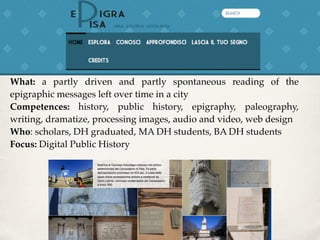
What: a partly driven and partly spontaneous reading of the
epigraphic messages left over time in a city
Competences: history, public history, epigraphy, paleography,
writing, dramatize, processing images, audio and video, web design
Who: scholars, DH graduated, MA DH students, BA DH students
Focus: Digital Public History
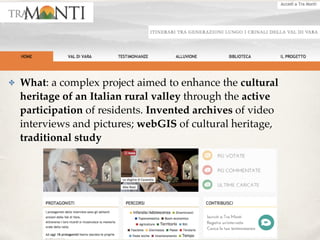
✤ What: a complex project aimed to enhance the cultural
heritage of an Italian rural valley through the active
participation of residents. Invented archives of video
interviews and pictures; webGIS of cultural heritage,
traditional study
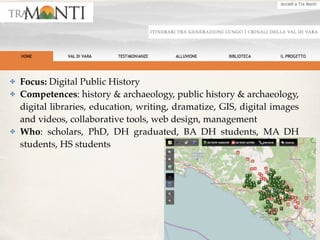
✤ Focus: Digital Public History
✤ Competences: history & archaeology, public history & archaeology,
digital libraries, education, writing, dramatize, GIS, digital images
and videos, collaborative tools, web design, management
✤ Who: scholars, PhD, DH graduated, BA DH students, MA DH
students, HS students
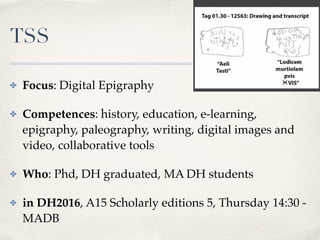
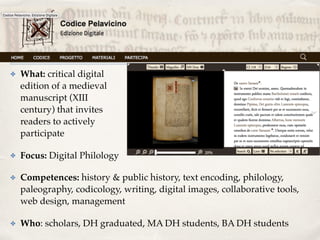
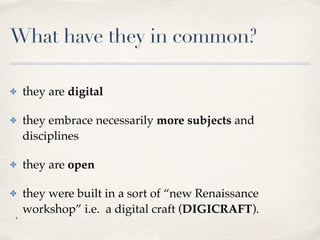
✤ What: a research & education project about
collaborative learning in Canadian and Senegal classic
humanities classes to transcribe and to read Roman
lead tags, using a Digital Autoptic Process (DAP) in a
Web environment
TSS
✤ Focus: Digital Epigraphy
✤ Competences: history, education, e-learning,
epigraphy, paleography, writing, digital images and
video, collaborative tools
✤ Who: Phd, DH graduated, MA DH students
✤ in DH2016, A15 Scholarly editions 5, Thursday 14:30 -
MADB
✤ What: critical digital 

edition of a medieval 

manuscript (XIII

century) that invites 

readers to actively 

participate
✤ Focus: Digital Philology
✤ Competences: history & public history, text encoding, philology,
paleography, codicology, writing, digital images, collaborative tools,
web design, management
✤ Who: scholars, DH graduated, MA DH students, BA DH students
What have they in common?
✤ they are digital
✤ they embrace necessarily more subjects and
disciplines
✤ they are open
✤ they were built in a sort of “new Renaissance
workshop” i.e. a digital craft (DIGICRAFT).
4.
They are digital
This may seem trivial but it is not

✤ these are projects “born digital” 

✤ they could not exist outside the incredible interaction between real
and digital world that it is now our life
Interdisciplinarity is compulsory
✤ DH is an unavoidably and profoundly interdisciplinary field

✤ each project is a complex set of activities and skills that crosses, by its
true nature, several fields, each one with is “new” methodology

✤ this change of practice and approach implies a sort of
methodological revolution, because it requires an organization of
work similar to a Renaissance workshop (a DIGICRAFT) with an
articulated division of labor in relation to several levels of skills

✤ education and training could be provided by the same learners
coordinated by a strong and mature central idea
Openess
✤ A multidisciplinary team has to use
different tools and sustainability requires
using open source tools
✤ A DH project means sharing data not only
among researches but also thinking how to
share the content with the general public
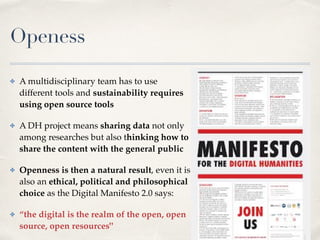
✤ Openness is then a natural result, even it is
also an ethical, political and philosophical
choice as the Digital Manifesto 2.0 says:
✤ “the digital is the realm of the open, open
source, open resources"
The RenaissanceWorkshop
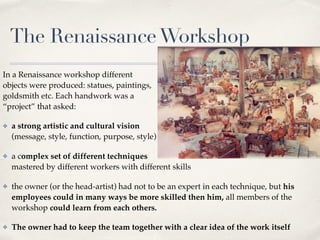
In a Renaissance workshop different 

objects were produced: statues, paintings, 

goldsmith etc. Each handwork was a 

“project” that asked:
✤ a strong artistic and cultural vision 

(message, style, function, purpose, style)
✤ a complex set of different techniques 

mastered by different workers with different skills
✤ the owner (or the head-artist) had not to be an expert in each technique, but his
employees could in many ways be more skilled then him, all members of the
workshop could learn from each others.
✤ The owner had to keep the team together with a clear idea of the work itself
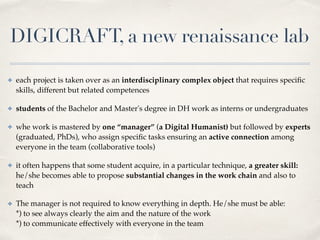
DIGICRAFT, a new renaissance lab
✤ each project is taken over as an interdisciplinary complex object that requires specific
skills, different but related competences
✤ students of the Bachelor and Master's degree in DH work as interns or undergraduates
✤ whe work is mastered by one “manager” (a Digital Humanist) but followed by experts
(graduated, PhDs), who assign specific tasks ensuring an active connection among
everyone in the team (collaborative tools)
✤ it often happens that some student acquire, in a particular technique, a greater skill:
he/she becomes able to propose substantial changes in the work chain and also to
teach
✤ The manager is not required to know everything in depth. He/she must be able: 

*) to see always clearly the aim and the nature of the work 

*) to communicate effectively with everyone in the team
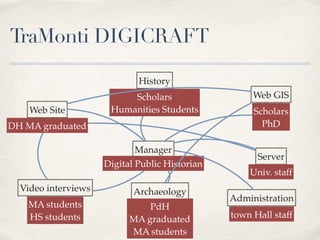
TraMonti DIGICRAFT
Manager
Web Site
History
Video interviews Archaeology
Server
Administration
Digital Public Historian
DH MA graduated
Web GIS
Scholars

PhD
Scholars 

Humanities Students
Univ. staff
town Hall staff
PdH

MA graduated 

MA students
MA students

HS students
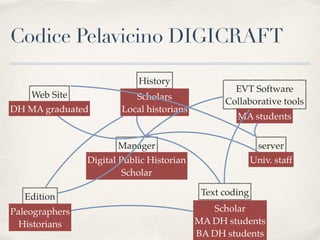
Codice Pelavicino DIGICRAFT
Manager
Web Site
History
server
Text coding
Digital Public Historian

Scholar
DH MA graduated
EVT Software

Collaborative tools
MA students
Scholars 

Local historians
Univ. staff
Scholar
MA DH students

BA DH students
Edition
Paleographers

Historians
A DIGICRAFT is anywhere on a DH project teachers and
students exchange knowledge and leverage this interaction
to offer innovative and effective solutions, combining the
theoretical reasoning with practices and skills


This is possible only if the manager and the team share a
common strong vision of what a DH project is, embracing a
"systemic" or “organic” or “holistic” thinking of DH itself
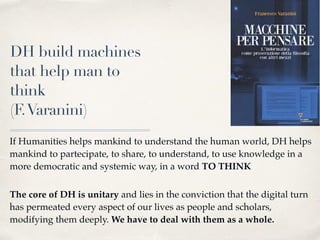
DH build machines
that help man to
think
(F.Varanini)
If Humanities helps mankind to understand the human world, DH helps
mankind to partecipate, to share, to understand, to use knowledge in a
more democratic and systemic way, in a word TO THINK

The core of DH is unitary and lies in the conviction that the digital turn
has permeated every aspect of our lives as people and scholars,
modifying them deeply. We have to deal with them as a whole.
Science & Humanities
✤ since XVIII century hard sciences grounded their epistemology on
reductionism
✤ reductionism believes that studying in depth a feature of a phenomenon
it is the only way to understand it completely by progressive addition
of discoveries
✤ the reductionist approach has been the basis for the scientific revolution
of the modern age, but it also led to an exasperated fragmentation of the
fields of scientific research and to the disjunction between Science and
Humanities
✤ humanities were affected as well and created absurd barriers and hyper-
specialized languages, that closed researches in a lot of walled gardens
HC DH
✤ 70s of XXth century: a vision of Humanities Computing that kept almost
unchanged the traditional disciplines within their rigid internal divisions and
distinguished the humanist from the expert in information technology
✤ today this position is no longer sustainable. The web in first place and the
web 2.0 in the second (but also the Big Data field as well as the Data
Visualization tools) have changed the research landscape and demolish the
barrier between tools, methods and ways of sharing
✤ we are obviously still in a transitional phase. Highly specialized sub-areas
remain and several scholars strive to better define the old / new digital
disciplines (digital history, digital philology and so on), but there is also a
complementary phenomenon pointing to an inclusive and unitary vision of
DH
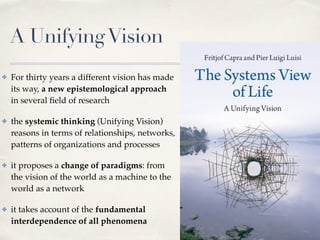
A UnifyingVision
✤ For thirty years a different vision has made
its way, a new epistemological approach
in several field of research
✤ the systemic thinking (Unifying Vision)
reasons in terms of relationships, networks,
patterns of organizations and processes
✤ it proposes a change of paradigms: from
the vision of the world as a machine to the
world as a network
✤ it takes account of the fundamental
interdependence of all phenomena
A change of paradigm
This change of paradigm could and should affect the DH
as well because:
✤ this is in the nature of our work
✤ this is where our practice leads
✤ this is a unique opportunity for DH to find a unitary
vision and to ground its social utility again
enrica.salvatori@unipi.it

Digicraft and 'Systemic' Thinking in Digital Humanities

  • 1.
    13 - 7- 2016 Krakow Digicraft and 'Systemic'Thinking in Digital Humanities Enrica Salvatori - LabCD - Università di Pisa (DH2016)
  • 2.
    ManfredThaller 2014 - Bologna Arethe Humanities an endangered or dominant species in the digital ecosystem? Yes if 1. conceive of themselves as researchers and not as conversationalists 2. strive for a vision 3. change the epistemology of the Humanities 4. drive technology and not be driven by it
  • 3.
    Serge Noiret 2015 -International Federation of Public History (IFPH) Definition of Digital History, Public History, Digital Public History ✤ Digital History and Digital Public History are areas of research and not merely new forms of communication of old disciplines (Thaller’s point 1) ✤ He answered to Thaller’s items 2 and 3 by proposing a more accurate taxonomy of DH. ✤ The answer is a more strict definition of what we are and we do
  • 4.
    Do we reallyneed to tell 
 what’s DH are? ✤ Each taxonomy of knowledge unavoidably builds walls and fences that encase the knowledge itself in a series of sterile boxes ✤ It’s better to focus our attention on what could be our own vision and on defining DH in terms of the emerging changes of method in our daily research and work
  • 5.
    What: a partlydriven and partly spontaneous reading of the epigraphic messages left over time in a city Competences: history, public history, epigraphy, paleography, writing, dramatize, processing images, audio and video, web design Who: scholars, DH graduated, MA DH students, BA DH students Focus: Digital Public History
  • 6.
    ✤ What: acomplex project aimed to enhance the cultural heritage of an Italian rural valley through the active participation of residents. Invented archives of video interviews and pictures; webGIS of cultural heritage, traditional study
  • 7.
    ✤ Focus: DigitalPublic History ✤ Competences: history & archaeology, public history & archaeology, digital libraries, education, writing, dramatize, GIS, digital images and videos, collaborative tools, web design, management ✤ Who: scholars, PhD, DH graduated, BA DH students, MA DH students, HS students
  • 8.
    ✤ What: aresearch & education project about collaborative learning in Canadian and Senegal classic humanities classes to transcribe and to read Roman lead tags, using a Digital Autoptic Process (DAP) in a Web environment
  • 9.
    TSS ✤ Focus: DigitalEpigraphy ✤ Competences: history, education, e-learning, epigraphy, paleography, writing, digital images and video, collaborative tools ✤ Who: Phd, DH graduated, MA DH students ✤ in DH2016, A15 Scholarly editions 5, Thursday 14:30 - MADB
  • 10.
    ✤ What: criticaldigital 
 edition of a medieval 
 manuscript (XIII
 century) that invites 
 readers to actively 
 participate ✤ Focus: Digital Philology ✤ Competences: history & public history, text encoding, philology, paleography, codicology, writing, digital images, collaborative tools, web design, management ✤ Who: scholars, DH graduated, MA DH students, BA DH students
  • 11.
    What have theyin common? ✤ they are digital ✤ they embrace necessarily more subjects and disciplines ✤ they are open ✤ they were built in a sort of “new Renaissance workshop” i.e. a digital craft (DIGICRAFT). 4.
  • 12.
    They are digital Thismay seem trivial but it is not
 ✤ these are projects “born digital” 
 ✤ they could not exist outside the incredible interaction between real and digital world that it is now our life
  • 13.
    Interdisciplinarity is compulsory ✤DH is an unavoidably and profoundly interdisciplinary field
 ✤ each project is a complex set of activities and skills that crosses, by its true nature, several fields, each one with is “new” methodology
 ✤ this change of practice and approach implies a sort of methodological revolution, because it requires an organization of work similar to a Renaissance workshop (a DIGICRAFT) with an articulated division of labor in relation to several levels of skills
 ✤ education and training could be provided by the same learners coordinated by a strong and mature central idea
  • 14.
    Openess ✤ A multidisciplinaryteam has to use different tools and sustainability requires using open source tools ✤ A DH project means sharing data not only among researches but also thinking how to share the content with the general public ✤ Openness is then a natural result, even it is also an ethical, political and philosophical choice as the Digital Manifesto 2.0 says: ✤ “the digital is the realm of the open, open source, open resources"
  • 15.
    The RenaissanceWorkshop In aRenaissance workshop different 
 objects were produced: statues, paintings, 
 goldsmith etc. Each handwork was a 
 “project” that asked: ✤ a strong artistic and cultural vision 
 (message, style, function, purpose, style) ✤ a complex set of different techniques 
 mastered by different workers with different skills ✤ the owner (or the head-artist) had not to be an expert in each technique, but his employees could in many ways be more skilled then him, all members of the workshop could learn from each others. ✤ The owner had to keep the team together with a clear idea of the work itself
  • 16.
    DIGICRAFT, a newrenaissance lab ✤ each project is taken over as an interdisciplinary complex object that requires specific skills, different but related competences ✤ students of the Bachelor and Master's degree in DH work as interns or undergraduates ✤ whe work is mastered by one “manager” (a Digital Humanist) but followed by experts (graduated, PhDs), who assign specific tasks ensuring an active connection among everyone in the team (collaborative tools) ✤ it often happens that some student acquire, in a particular technique, a greater skill: he/she becomes able to propose substantial changes in the work chain and also to teach ✤ The manager is not required to know everything in depth. He/she must be able: 
 *) to see always clearly the aim and the nature of the work 
 *) to communicate effectively with everyone in the team
  • 17.
    TraMonti DIGICRAFT Manager Web Site History Videointerviews Archaeology Server Administration Digital Public Historian DH MA graduated Web GIS Scholars
 PhD Scholars 
 Humanities Students Univ. staff town Hall staff PdH
 MA graduated 
 MA students MA students
 HS students
  • 18.
    Codice Pelavicino DIGICRAFT Manager WebSite History server Text coding Digital Public Historian
 Scholar DH MA graduated EVT Software
 Collaborative tools MA students Scholars 
 Local historians Univ. staff Scholar MA DH students
 BA DH students Edition Paleographers
 Historians
  • 19.
    A DIGICRAFT isanywhere on a DH project teachers and students exchange knowledge and leverage this interaction to offer innovative and effective solutions, combining the theoretical reasoning with practices and skills
 
 This is possible only if the manager and the team share a common strong vision of what a DH project is, embracing a "systemic" or “organic” or “holistic” thinking of DH itself
  • 20.
    DH build machines thathelp man to think (F.Varanini) If Humanities helps mankind to understand the human world, DH helps mankind to partecipate, to share, to understand, to use knowledge in a more democratic and systemic way, in a word TO THINK
 The core of DH is unitary and lies in the conviction that the digital turn has permeated every aspect of our lives as people and scholars, modifying them deeply. We have to deal with them as a whole.
  • 21.
    Science & Humanities ✤since XVIII century hard sciences grounded their epistemology on reductionism ✤ reductionism believes that studying in depth a feature of a phenomenon it is the only way to understand it completely by progressive addition of discoveries ✤ the reductionist approach has been the basis for the scientific revolution of the modern age, but it also led to an exasperated fragmentation of the fields of scientific research and to the disjunction between Science and Humanities ✤ humanities were affected as well and created absurd barriers and hyper- specialized languages, that closed researches in a lot of walled gardens
  • 22.
    HC DH ✤ 70sof XXth century: a vision of Humanities Computing that kept almost unchanged the traditional disciplines within their rigid internal divisions and distinguished the humanist from the expert in information technology ✤ today this position is no longer sustainable. The web in first place and the web 2.0 in the second (but also the Big Data field as well as the Data Visualization tools) have changed the research landscape and demolish the barrier between tools, methods and ways of sharing ✤ we are obviously still in a transitional phase. Highly specialized sub-areas remain and several scholars strive to better define the old / new digital disciplines (digital history, digital philology and so on), but there is also a complementary phenomenon pointing to an inclusive and unitary vision of DH
  • 23.
    A UnifyingVision ✤ Forthirty years a different vision has made its way, a new epistemological approach in several field of research ✤ the systemic thinking (Unifying Vision) reasons in terms of relationships, networks, patterns of organizations and processes ✤ it proposes a change of paradigms: from the vision of the world as a machine to the world as a network ✤ it takes account of the fundamental interdependence of all phenomena
  • 24.
    A change ofparadigm This change of paradigm could and should affect the DH as well because: ✤ this is in the nature of our work ✤ this is where our practice leads ✤ this is a unique opportunity for DH to find a unitary vision and to ground its social utility again
  • 25.