Discovery Tools in Academic 
Libraries: why, what and how? 
Edith Falk 
Chef Librarian 
The Hebrew University Library Authority
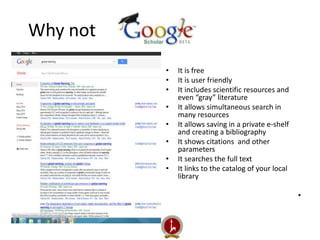
Why not 
• It is free 
• It is user friendly 
• It includes scientific resources and 
even “gray” literature 
• It allows simultaneous search in 
many resources 
• It allows saving in a private e-shelf 
and creating a bibliography 
• It shows citations and other 
parameters 
• It searches the full text 
• It links to the catalog of your local 
library 
•
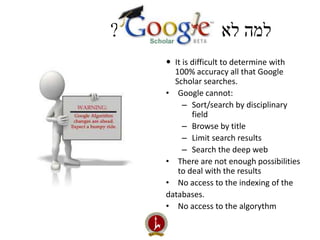
למה לא ? 
 It is difficult to determine with 
100% accuracy all that Google 
Scholar searches. 
• Google cannot: 
– Sort/search by disciplinary 
field 
– Browse by title 
– Limit search results 
– Search the deep web 
• There are not enough possibilities 
to deal with the results 
• No access to the indexing of the 
databases. 
• No access to the algorythm
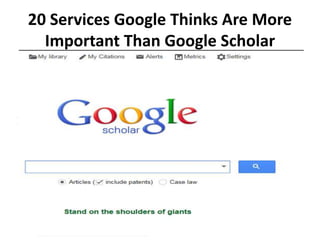
20 Services Google Thinks Are More 
Important Than Google Scholar
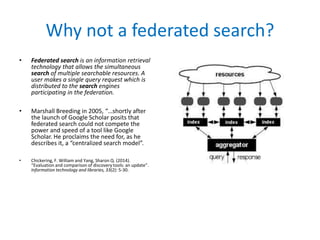
Why not a federated search? 
• Federated search is an information retrieval 
technology that allows the simultaneous 
search of multiple searchable resources. A 
user makes a single query request which is 
distributed to the search engines 
participating in the federation. 
• Marshall Breeding in 2005, “…shortly after 
the launch of Google Scholar posits that 
federated search could not compete the 
power and speed of a tool like Google 
Scholar. He proclaims the need for, as he 
describes it, a “centralized search model”. 
• Chickering, F. William and Yang, Sharon Q. (2014). 
“Evaluation and comparison of discovery tools: an update”. 
Information technology and libraries, 33(2): 5-30.
What are we looking for? 
A Google-like tool, simple • 
and efficient 
A tool that allows • 
searching as many 
resources as possible, 
while allowing limiting 
the searches to resources 
accessible to library 
patrons 
A tool that allows dealing • 
with the list of searches 
in as many ways as 
possible
Discovery Tools
What is a discovery tool? 
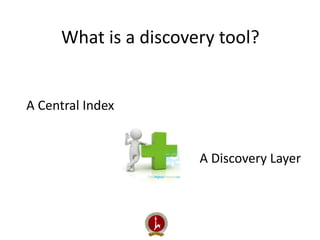
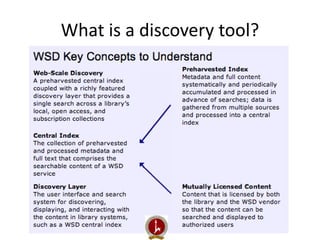
A Central Index 
A Discovery Layer
What is a discovery tool?
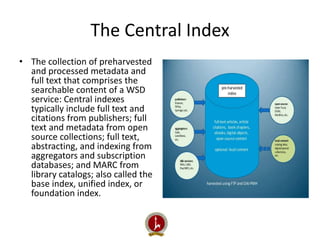
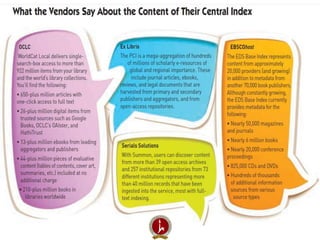
The Central Index 
• The collection of preharvested 
and processed metadata and 
full text that comprises the 
searchable content of a WSD 
service: Central indexes 
typically include full text and 
citations from publishers; full 
text and metadata from open 
source collections; full text, 
abstracting, and indexing from 
aggregators and subscription 
databases; and MARC from 
library catalogs; also called the 
base index, unified index, or 
foundation index.
Evaluating the Central Index 
• parameters: 
– scope of the content, 
– item types, 
– inclusion of the full text 
– richness of the metadata. 
• The central index has to fit 
the library collections on one 
hand and the type of users of 
the library on the other 
hand. 
• Some databases are not 
included in any WSD (for 
example: Scifinder) 
• Some databases are included 
in some WSD and not in 
others (especially Proquest 
and Ebsco) 
• Even when a WSD vendor 
does not include a database, 
it may have basic, citation-level 
metadata for journal 
titles by a certain publisher 
(Elsevier or Springer).
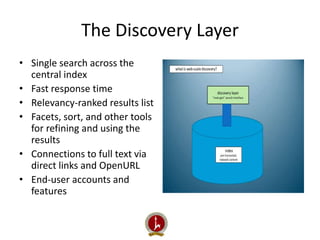
The Discovery Layer 
• Single search across the 
central index 
• Fast response time 
• Relevancy-ranked results list 
• Facets, sort, and other tools 
for refining and using the 
results 
• Connections to full text via 
direct links and OpenURL 
• End-user accounts and 
features
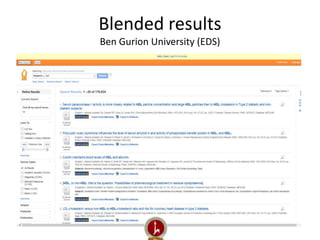
Blended results 
Ben Gurion University (EDS)
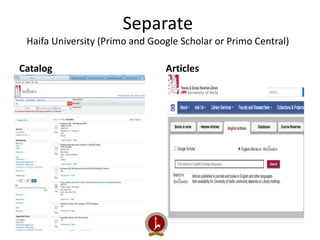
Separate 
Haifa University (Primo and Google Scholar or Primo Central) 
Catalog Articles
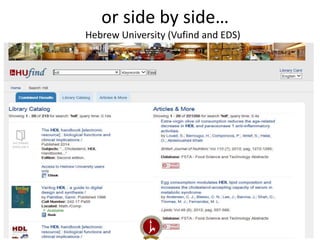
or side by side… 
Hebrew University (Vufind and EDS)
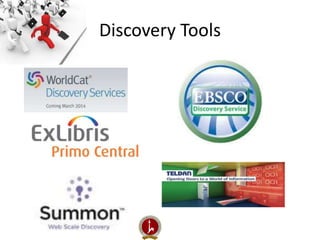
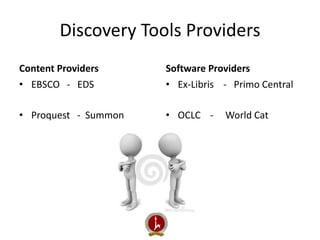
Discovery Tools Providers 
Content Providers Software Providers 
• Ex-Libris - Primo Central 
• OCLC - World Cat 
• EBSCO - EDS 
• Proquest - Summon
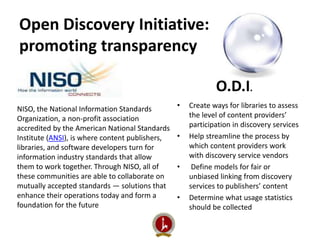
Open Discovery Initiative: 
promoting transparency 
O.D.I. 
• Create ways for libraries to assess 
the level of content providers’ 
participation in discovery services 
• Help streamline the process by 
which content providers work 
with discovery service vendors 
• Define models for fair or 
unbiased linking from discovery 
services to publishers’ content 
• Determine what usage statistics 
should be collected 
NISO, the National Information Standards 
Organization, a non-profit association 
accredited by the American National Standards 
Institute (ANSI), is where content publishers, 
libraries, and software developers turn for 
information industry standards that allow 
them to work together. Through NISO, all of 
these communities are able to collaborate on 
mutually accepted standards — solutions that 
enhance their operations today and form a 
foundation for the future
Thank you for 
your attention! 
Edith Falk,Chief Librarian 
Hebrew University of Jerusalem

K3 edith falk_discoverytoolslibrary

  • 1.
    Discovery Tools inAcademic Libraries: why, what and how? Edith Falk Chef Librarian The Hebrew University Library Authority
  • 3.
    Why not •It is free • It is user friendly • It includes scientific resources and even “gray” literature • It allows simultaneous search in many resources • It allows saving in a private e-shelf and creating a bibliography • It shows citations and other parameters • It searches the full text • It links to the catalog of your local library •
  • 4.
    למה לא ?  It is difficult to determine with 100% accuracy all that Google Scholar searches. • Google cannot: – Sort/search by disciplinary field – Browse by title – Limit search results – Search the deep web • There are not enough possibilities to deal with the results • No access to the indexing of the databases. • No access to the algorythm
  • 5.
    20 Services GoogleThinks Are More Important Than Google Scholar
  • 6.
    Why not afederated search? • Federated search is an information retrieval technology that allows the simultaneous search of multiple searchable resources. A user makes a single query request which is distributed to the search engines participating in the federation. • Marshall Breeding in 2005, “…shortly after the launch of Google Scholar posits that federated search could not compete the power and speed of a tool like Google Scholar. He proclaims the need for, as he describes it, a “centralized search model”. • Chickering, F. William and Yang, Sharon Q. (2014). “Evaluation and comparison of discovery tools: an update”. Information technology and libraries, 33(2): 5-30.
  • 7.
    What are welooking for? A Google-like tool, simple • and efficient A tool that allows • searching as many resources as possible, while allowing limiting the searches to resources accessible to library patrons A tool that allows dealing • with the list of searches in as many ways as possible
  • 8.
  • 9.
    What is adiscovery tool? A Central Index A Discovery Layer
  • 10.
    What is adiscovery tool?
  • 11.
    The Central Index • The collection of preharvested and processed metadata and full text that comprises the searchable content of a WSD service: Central indexes typically include full text and citations from publishers; full text and metadata from open source collections; full text, abstracting, and indexing from aggregators and subscription databases; and MARC from library catalogs; also called the base index, unified index, or foundation index.
  • 13.
    Evaluating the CentralIndex • parameters: – scope of the content, – item types, – inclusion of the full text – richness of the metadata. • The central index has to fit the library collections on one hand and the type of users of the library on the other hand. • Some databases are not included in any WSD (for example: Scifinder) • Some databases are included in some WSD and not in others (especially Proquest and Ebsco) • Even when a WSD vendor does not include a database, it may have basic, citation-level metadata for journal titles by a certain publisher (Elsevier or Springer).
  • 14.
    The Discovery Layer • Single search across the central index • Fast response time • Relevancy-ranked results list • Facets, sort, and other tools for refining and using the results • Connections to full text via direct links and OpenURL • End-user accounts and features
  • 15.
    Blended results BenGurion University (EDS)
  • 16.
    Separate Haifa University(Primo and Google Scholar or Primo Central) Catalog Articles
  • 17.
    or side byside… Hebrew University (Vufind and EDS)
  • 18.
    Discovery Tools Providers Content Providers Software Providers • Ex-Libris - Primo Central • OCLC - World Cat • EBSCO - EDS • Proquest - Summon
  • 19.
    Open Discovery Initiative: promoting transparency O.D.I. • Create ways for libraries to assess the level of content providers’ participation in discovery services • Help streamline the process by which content providers work with discovery service vendors • Define models for fair or unbiased linking from discovery services to publishers’ content • Determine what usage statistics should be collected NISO, the National Information Standards Organization, a non-profit association accredited by the American National Standards Institute (ANSI), is where content publishers, libraries, and software developers turn for information industry standards that allow them to work together. Through NISO, all of these communities are able to collaborate on mutually accepted standards — solutions that enhance their operations today and form a foundation for the future
  • 20.
    Thank you for your attention! Edith Falk,Chief Librarian Hebrew University of Jerusalem