The  Intelligent/Next Generation/Dynamic  Catalogue Birte Christensen-Dalsgaard State and University Library Aarhus, Denmark TICER 2008
Vision:  The Intelligent Information Client A little thing following you, who knows you, knows your different profiles and knows where you are - and based on this can find what is relevant and adequate for your situation. May push information (concert based on your last searches Quality material based on crab searches
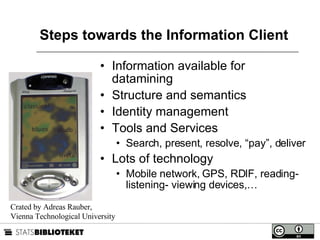
Steps towards the Information Client Information available for datamining Structure and semantics Identity management Tools and Services Search, present, resolve, “pay”, deliver Lots of technology Mobile network, GPS, RDIF, reading- listening- viewing devices,… Crated by Adreas Rauber,  Vienna Technological University
Issues addressed in this presentation Difference between federated search and integrated search Structured versus self organised  Database versus Search Engines Verificative versus explorative search Importance of rank Link to behaviour information require Introduce quality? Importance of user involvement
Outline of presentation Start with the users Federated <-> Integrated search Datamining Ranking The user interface Search strategies SOA – from websites to services Requirement: standards, standards and standards
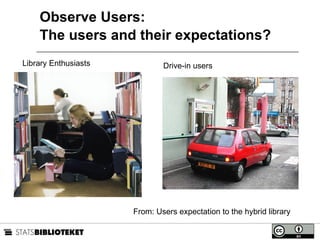
Observe Users: The users and their expectations ? Drive-in users From: Users expectation to the hybrid library Library Enthusiasts
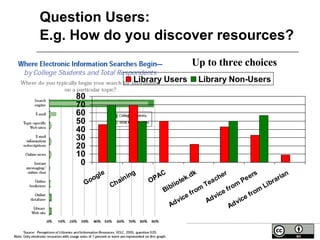
Question Users: E.g. How do you discover resources?  Up to three choices
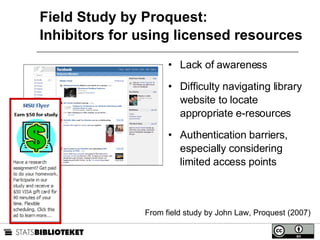
Field Study by Proquest: Inhibitors for using licensed resources Lack of awareness Difficulty navigating library website to locate appropriate e-resources Authentication barriers, especially considering limited access points From field study by John Law, Proquest (2007)
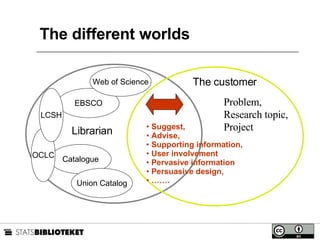
The different worlds Librarian The customer Problem, Research topic, Project EBSCO Web of Science Catalogue Union Catalog OCLC LCSH Suggest, Advise, Supporting information, User involvement Pervasive information Persuasive design, …… .
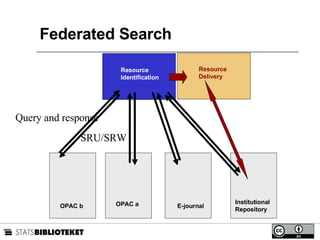
Federated Search OPAC a OPAC b E - journal Institutional  Repository Resource  Identification Query and response SRU/SRW Resource  Delivery
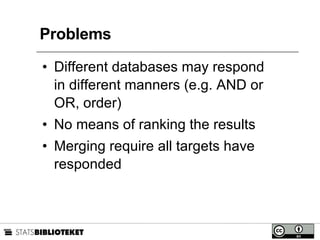
Problems Different databases may respond in different manners (e.g. AND or OR, order) No means of ranking the results Merging require all targets have responded
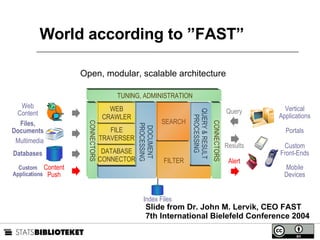
World according to ”FAST” QUERY & RESULT PROCESSING FILTER Query Results Alert Vertical Applications Portals Custom Front-Ends Mobile Devices DATABASE CONNECTOR FILE TRAVERSER WEB CRAWLER Content Push DOCUMENT PROCESSING Web Content Files, Documents Databases Custom Applications Index Files Multimedia Slide from Dr. John M. Lervik, CEO FAST  7th International Bielefeld Conference 2004 Open, modular, scalable architecture CONNECTORS SEARCH CONNECTORS TUNING, ADMINISTRATION
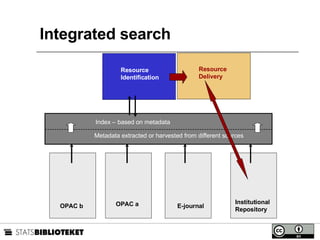
Integrated search OPAC a OPAC b E - journal Institutional  Repository Resource  Identification Metadata extracted or harvested from different sources Index  – based on metadata Resource  Delivery
Problems Need access to all data The more information for each “record” the better Ranking among heterogeneous information resources
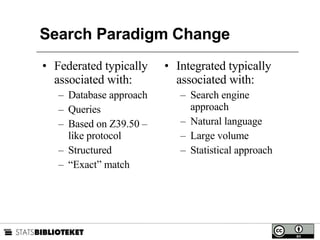
Search Paradigm Change Federated typically associated with: Database approach Queries Based on Z39.50 – like protocol Structured “ Exact” match Integrated typically associated with: Search engine approach Natural language Large volume Statistical approach
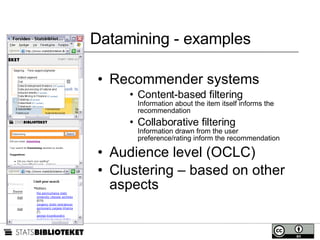
Datamining - examples Recommender systems Content-based filtering Information about the item itself informs the recommendation Collaborative filtering Information drawn from the user preference/rating inform the recommendation Audience level (OCLC) Clustering – based on other aspects
Relevance and quality?  Relevance A library focussed approach How well does the record match the search,  how good is the quality of the material represented by the record,  how well does the material match the needs of the user? A community focussed approach What do others use, circulation User recommendations Individual E.g. importance of publication date Quality Some source are better than others? Big challenge
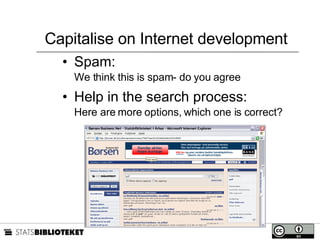
Capitalise on Internet development Spam: We think this is spam- do you agree Help in the search process: Here are more options, which one is correct?
Two Relevant Search Strategies Verificative search – look-up Exact search terms – ideally few answers Can be formulated to many databases: Federated Search Exploratory Search Approximate search terms – where results need refinement Tools to support refinement essential Need to operate on all available data: Integrated Search
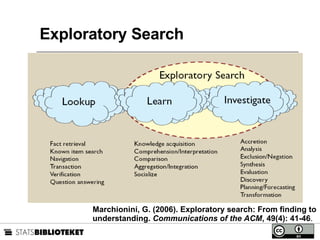
Exploratory Search Marchionini, G. (2006). Exploratory search: From finding to understanding.  Communications of the ACM , 49(4): 41-46 .
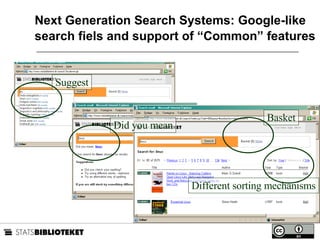
Next Generation Search Systems: Google-like search fiels and support of “Common” features Suggest Did you mean Basket Different sorting mechanisms
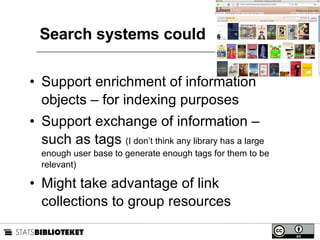
Search systems could Support enrichment of information objects – for indexing purposes Support exchange of information – such as tags  (I don’t think any library has a large enough user base to generate enough tags for them to be relevant) Might take advantage of link collections to group resources
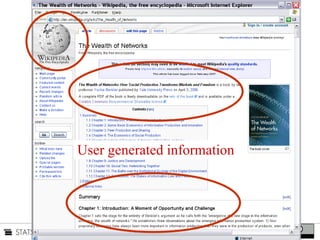
User generated information
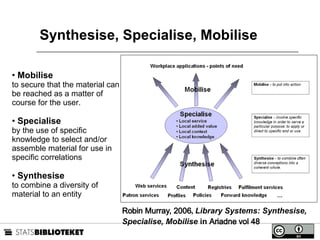
Synthesise, Specialise, Mobilise Robin Murray, 2006 ,  Library Systems: Synthesise, Specialise, Mobilise  in  Ariadne vol 48 Mobilise to secure that the material can be reached as a matter of course for the user.  Specialise by the use of specific knowledge to select and/or assemble material for use in specific correlations Synthesise to combine a diversity of material to an entity
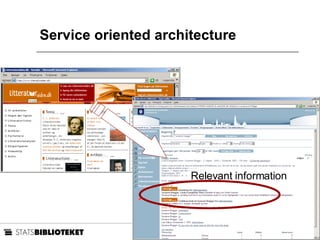
Service oriented architecture Relevant information
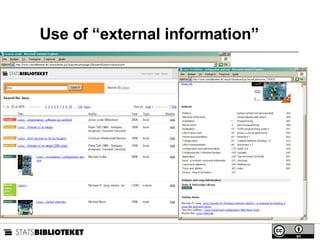
Use of “external information”
Webservices Syndetics (Bowker) Amazon LibraryThing
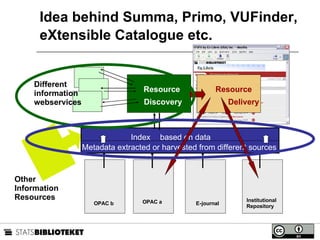
Idea behind Summa, Primo, VUFinder, eXtensible Catalogue etc. OPAC a OPAC b E - journal Institutional  Repository Resource  Discovery Different information  webservices Metadata extracted or harvested from different sources Index  based on data Resource  Delivery Other Information Resources
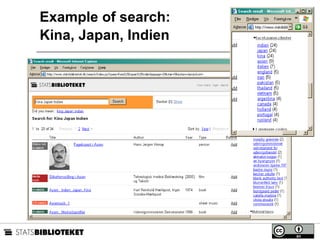
Example of search:  Kina, Japan, Indien
Initiatives Endeca  –  http://www.lib.ncsu.edu/catalog/  Primo  –  http://www.exlibrisgroup.com/primo.htm  Encore  -  http://www.iii.com/encore/splash.html AquaBrowser –  http://www.aquabrowser.com Meresco  –  http://meresco.com/meresco Summa  –  http://www.statsbiblioteket.dk/summa Worldcat local  –  http://www.lib.washington.edu/
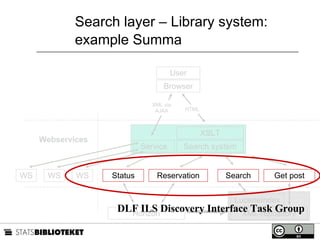
Search layer – Library system: example Summa Horizon LuceneIndex Search system Service Browser XSLT HTML XML via AJAX WS WS WS User XML-repository DLF ILS Discovery Interface Task Group Webservices Status Reservation Search Get post
Standards, standards and standards Introduce semantic Ontologies (OWL) Personalised: Strategy for collecting and sharing information Identity management (SAML2) Tag-, recommendation- etc services Basket – across all information resources Reserve, order material
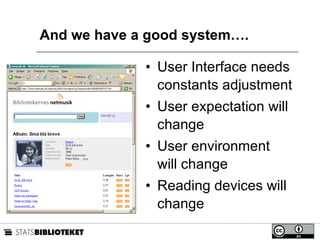
And we have a good system…. User Interface needs constants adjustment User expectation will change User environment will change Reading devices will change
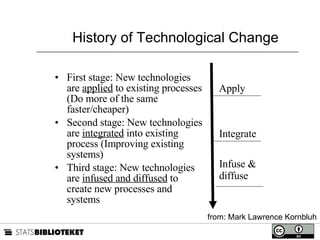
History of Technological Change First stage: New technologies are  applied  to existing processes (Do more of the same faster/cheaper) Second stage: New technologies are  integrated  into existing process (Improving existing systems) Third stage: New technologies are  infused and diffused  to create new processes and systems Apply Integrate Infuse & diffuse from: Mark Lawrence Kornbluh
Questions

Inteligent Catalogue Final

  • 1.
    The Intelligent/NextGeneration/Dynamic Catalogue Birte Christensen-Dalsgaard State and University Library Aarhus, Denmark TICER 2008
  • 2.
    Vision: TheIntelligent Information Client A little thing following you, who knows you, knows your different profiles and knows where you are - and based on this can find what is relevant and adequate for your situation. May push information (concert based on your last searches Quality material based on crab searches
  • 3.
    Steps towards theInformation Client Information available for datamining Structure and semantics Identity management Tools and Services Search, present, resolve, “pay”, deliver Lots of technology Mobile network, GPS, RDIF, reading- listening- viewing devices,… Crated by Adreas Rauber, Vienna Technological University
  • 4.
    Issues addressed inthis presentation Difference between federated search and integrated search Structured versus self organised Database versus Search Engines Verificative versus explorative search Importance of rank Link to behaviour information require Introduce quality? Importance of user involvement
  • 5.
    Outline of presentationStart with the users Federated <-> Integrated search Datamining Ranking The user interface Search strategies SOA – from websites to services Requirement: standards, standards and standards
  • 6.
    Observe Users: Theusers and their expectations ? Drive-in users From: Users expectation to the hybrid library Library Enthusiasts
  • 7.
    Question Users: E.g.How do you discover resources? Up to three choices
  • 8.
    Field Study byProquest: Inhibitors for using licensed resources Lack of awareness Difficulty navigating library website to locate appropriate e-resources Authentication barriers, especially considering limited access points From field study by John Law, Proquest (2007)
  • 9.
    The different worldsLibrarian The customer Problem, Research topic, Project EBSCO Web of Science Catalogue Union Catalog OCLC LCSH Suggest, Advise, Supporting information, User involvement Pervasive information Persuasive design, …… .
  • 10.
    Federated Search OPACa OPAC b E - journal Institutional Repository Resource Identification Query and response SRU/SRW Resource Delivery
  • 11.
    Problems Different databasesmay respond in different manners (e.g. AND or OR, order) No means of ranking the results Merging require all targets have responded
  • 12.
    World according to”FAST” QUERY & RESULT PROCESSING FILTER Query Results Alert Vertical Applications Portals Custom Front-Ends Mobile Devices DATABASE CONNECTOR FILE TRAVERSER WEB CRAWLER Content Push DOCUMENT PROCESSING Web Content Files, Documents Databases Custom Applications Index Files Multimedia Slide from Dr. John M. Lervik, CEO FAST 7th International Bielefeld Conference 2004 Open, modular, scalable architecture CONNECTORS SEARCH CONNECTORS TUNING, ADMINISTRATION
  • 13.
    Integrated search OPACa OPAC b E - journal Institutional Repository Resource Identification Metadata extracted or harvested from different sources Index – based on metadata Resource Delivery
  • 14.
    Problems Need accessto all data The more information for each “record” the better Ranking among heterogeneous information resources
  • 15.
    Search Paradigm ChangeFederated typically associated with: Database approach Queries Based on Z39.50 – like protocol Structured “ Exact” match Integrated typically associated with: Search engine approach Natural language Large volume Statistical approach
  • 16.
    Datamining - examplesRecommender systems Content-based filtering Information about the item itself informs the recommendation Collaborative filtering Information drawn from the user preference/rating inform the recommendation Audience level (OCLC) Clustering – based on other aspects
  • 17.
    Relevance and quality? Relevance A library focussed approach How well does the record match the search, how good is the quality of the material represented by the record, how well does the material match the needs of the user? A community focussed approach What do others use, circulation User recommendations Individual E.g. importance of publication date Quality Some source are better than others? Big challenge
  • 18.
    Capitalise on Internetdevelopment Spam: We think this is spam- do you agree Help in the search process: Here are more options, which one is correct?
  • 19.
    Two Relevant SearchStrategies Verificative search – look-up Exact search terms – ideally few answers Can be formulated to many databases: Federated Search Exploratory Search Approximate search terms – where results need refinement Tools to support refinement essential Need to operate on all available data: Integrated Search
  • 20.
    Exploratory Search Marchionini,G. (2006). Exploratory search: From finding to understanding. Communications of the ACM , 49(4): 41-46 .
  • 21.
    Next Generation SearchSystems: Google-like search fiels and support of “Common” features Suggest Did you mean Basket Different sorting mechanisms
  • 22.
    Search systems couldSupport enrichment of information objects – for indexing purposes Support exchange of information – such as tags (I don’t think any library has a large enough user base to generate enough tags for them to be relevant) Might take advantage of link collections to group resources
  • 23.
  • 24.
    Synthesise, Specialise, MobiliseRobin Murray, 2006 , Library Systems: Synthesise, Specialise, Mobilise in Ariadne vol 48 Mobilise to secure that the material can be reached as a matter of course for the user. Specialise by the use of specific knowledge to select and/or assemble material for use in specific correlations Synthesise to combine a diversity of material to an entity
  • 25.
    Service oriented architectureRelevant information
  • 26.
    Use of “externalinformation”
  • 27.
    Webservices Syndetics (Bowker)Amazon LibraryThing
  • 28.
    Idea behind Summa,Primo, VUFinder, eXtensible Catalogue etc. OPAC a OPAC b E - journal Institutional Repository Resource Discovery Different information webservices Metadata extracted or harvested from different sources Index based on data Resource Delivery Other Information Resources
  • 29.
    Example of search: Kina, Japan, Indien
  • 30.
    Initiatives Endeca – http://www.lib.ncsu.edu/catalog/ Primo – http://www.exlibrisgroup.com/primo.htm Encore - http://www.iii.com/encore/splash.html AquaBrowser – http://www.aquabrowser.com Meresco – http://meresco.com/meresco Summa – http://www.statsbiblioteket.dk/summa Worldcat local – http://www.lib.washington.edu/
  • 31.
    Search layer –Library system: example Summa Horizon LuceneIndex Search system Service Browser XSLT HTML XML via AJAX WS WS WS User XML-repository DLF ILS Discovery Interface Task Group Webservices Status Reservation Search Get post
  • 32.
    Standards, standards andstandards Introduce semantic Ontologies (OWL) Personalised: Strategy for collecting and sharing information Identity management (SAML2) Tag-, recommendation- etc services Basket – across all information resources Reserve, order material
  • 33.
    And we havea good system…. User Interface needs constants adjustment User expectation will change User environment will change Reading devices will change
  • 34.
    History of TechnologicalChange First stage: New technologies are applied to existing processes (Do more of the same faster/cheaper) Second stage: New technologies are integrated into existing process (Improving existing systems) Third stage: New technologies are infused and diffused to create new processes and systems Apply Integrate Infuse & diffuse from: Mark Lawrence Kornbluh
  • 35.