Web 2.0
                       Morad Benyoucef, Cate Huston, Amir Rad, Payam
                                          Sadeghi


Thursday, November 12, 2009
Introduction to Web 2.0


Thursday, November 12, 2009
Introduction to Web 2.0

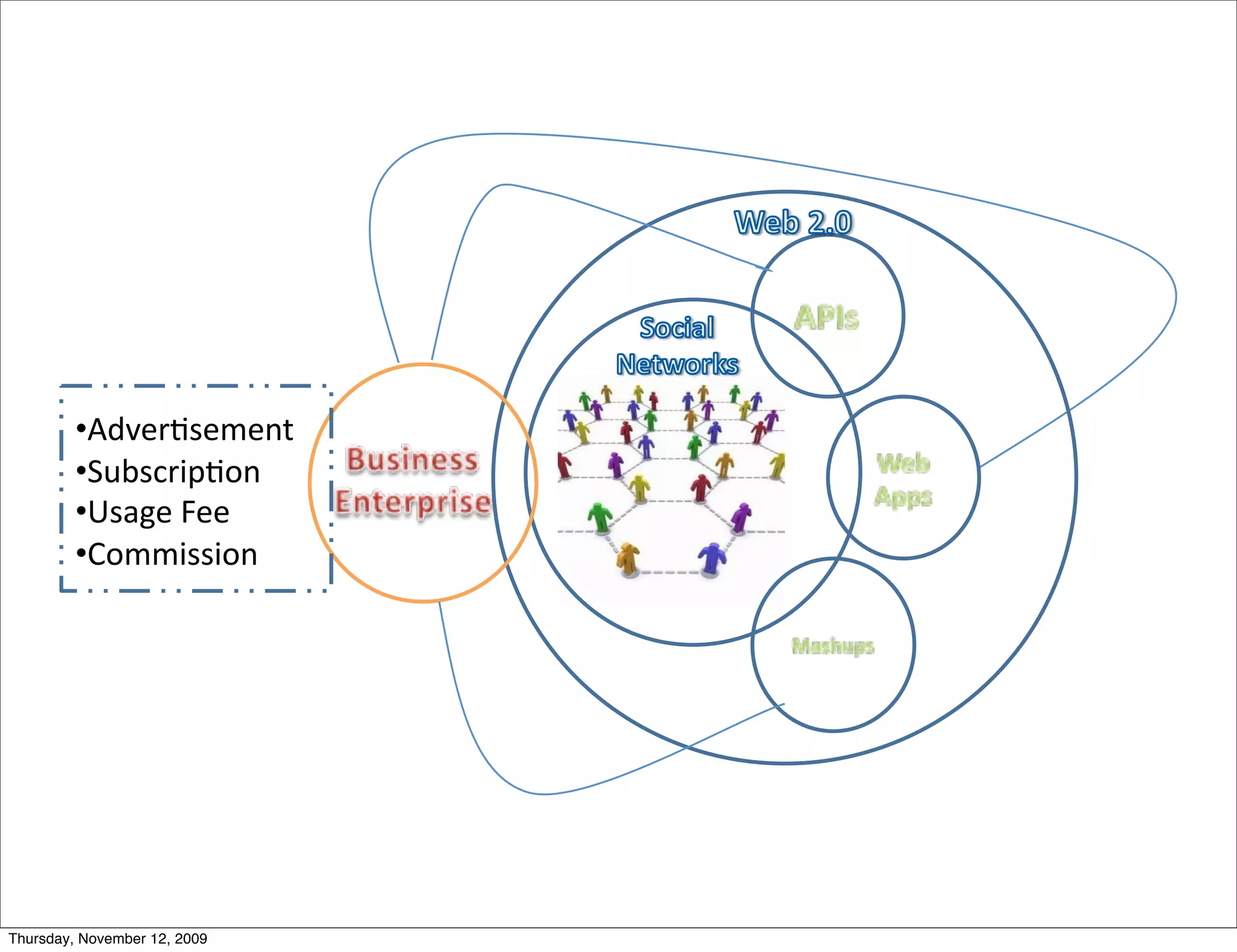
                   • Web 2.0
                   • Principles of Web 2.0
                   • Web 2.0 & collaboration
                   • Decisions 2.0
                   • Enterprise 2.0

Thursday, November 12, 2009
Web 2.0


Thursday, November 12, 2009
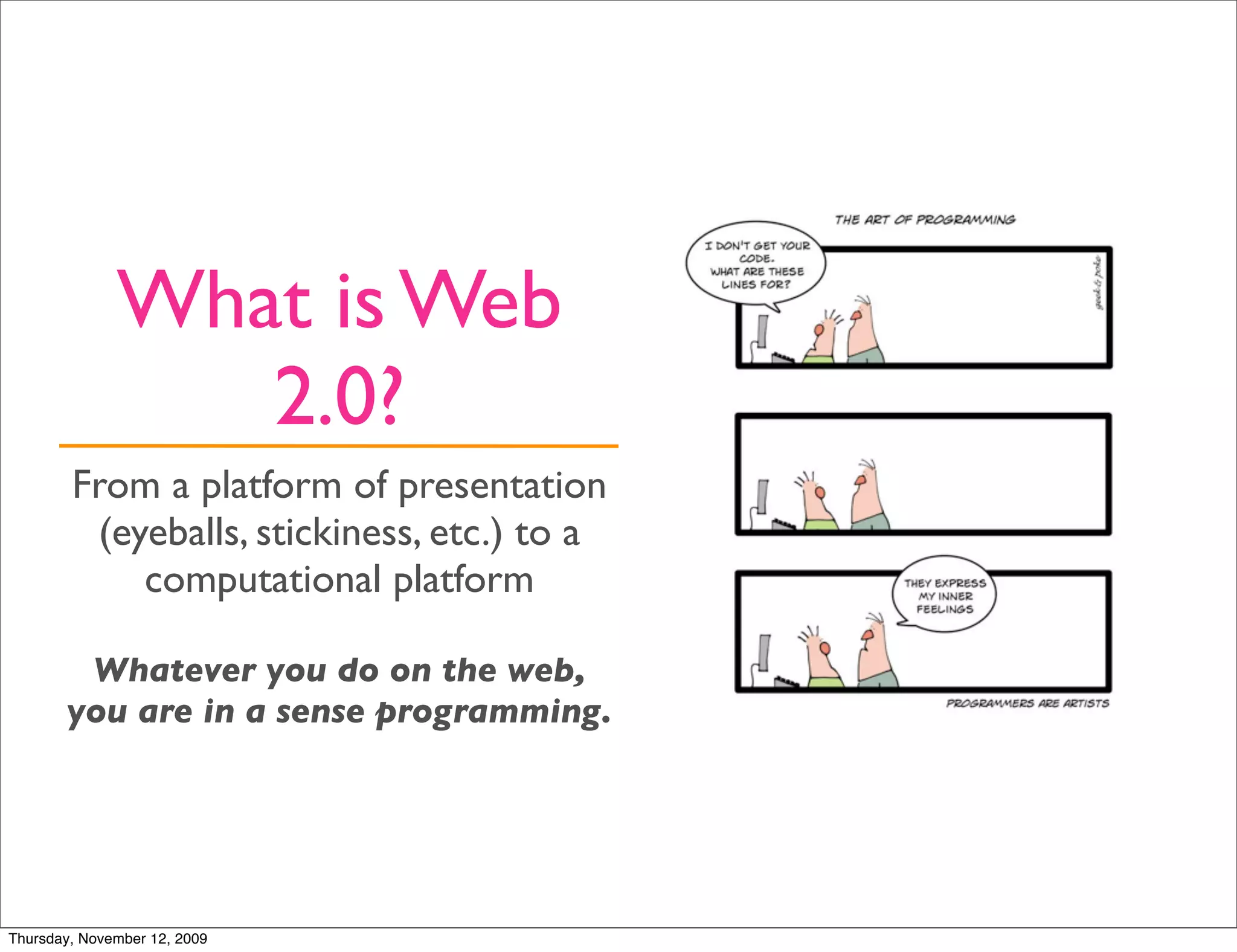
What is Web
                 2.0?
        From a platform of presentation
         (eyeballs, stickiness, etc.) to a
            computational platform

        Whatever you do on the web,
       you are in a sense programming.


Thursday, November 12, 2009
What is Web 2.0?

                         •    Blogs (citizen journalism), wikis, social
                              networks, web services, RSS feeds,
                              recommendations, folxonomies (i.e., folk
                              taxonomies / user created taxonomies /
                              tagging), open APIs, etc.
                         •    Consumers become producers
                              (prosumers)


Thursday, November 12, 2009
What does Web 2.0
               mean to individuals?

                   • participation   • connectedness
                   • collaboration   • rich experiences
                   • conversation    • etc!
                   • community

Thursday, November 12, 2009
What does web 2.0
               mean to organizations?
                   • openness
                   • collaboration
                   • crowd sourcing
                   • empowered and engaged customers/
                              partners/suppliers
                   • etc!
Thursday, November 12, 2009
“Web 2.0 applications support the creation of
                  informal users’ networks facilitating the flow
                     of ideas and knowledge by allowing the
                 efficient generation, dissemination, sharing and
                   editing/refining of informational content” [1]


Thursday, November 12, 2009
Web 2.0 is also called wisdom
                  web, social web, people-centric
                   web, participative web, read/
                         write web, etc. [1]


Thursday, November 12, 2009
Web 2.0 - classification [1]
                                                                Web 2.0!


       Blogs &                  Social                  Content                        Forums /               Content
       Podcasts!                Networks!               Communities!                   Bulletin Boards!       Aggregators!

       Web logs / journals!     Applications allowing   Applications organizing &      Applications for       Applications allowing
                                users to build          sharing a particular type of   exchanging ideas and   users to customize
       Fastest growing
                                personal websites       content!                       information usually    web content using
       category of Web 2.0
                                accessible to others                                   around special         Real Simple
       applications!                                    www.youtube.com (videos)!
                                for exchange of                                        interests!             Syndication (RSS)!
       http://wordpress.org !   personal content and    www.flickr.com (photos)!
                                                                                       www.epinions.com!
                                communication!
                                                   www.digg.com (social
                                                                                       www.python.org !
                                www.facebook.com ! bookmarking)!
                                                        www.wikipedia.org (publicly
                                                        edited encyclopedia) !


Thursday, November 12, 2009
Web 2.0 - main principles                                     [1]


                   •          Service-based, simple and open-source solutions

                         •      Simple interfaces, limited features, customizable
                                applications

                         •      Network effect vs. vendor lock-in

                               •   A user would not switch from Skype to a
                                   competitor if the user’s contacts are also on
                                   Skype


Thursday, November 12, 2009
Web 2.0 - main
          principles [1]
          From software as a product to
          software as a service (Google
                Docs, Salesforce)


Thursday, November 12, 2009
Web 2.0 - main principles                                      [1]

                   •          Continuous and incremental application
                              development requiring user participation

                         •      Users are no longer just consumers, they
                                contribute, review and refine content aggregation
                                of collective intelligence

                         •      Continuous real time improvement of
                                applications based on user feedback

                         •      Software remains under development and
                                improvement as long as it exists (Perpetual Beta)


Thursday, November 12, 2009
Web 2.0 - main principles                                    [1]


                   •          New service based business models and new
                              opportunities for reaching small consumers with
                              low-volume products

                         •      Offer services for free and generate revenue
                                through advertising and/or sponsoring (Google
                                Search, etc.)

                         •      Offer basic services for free and charge a fee
                                for premium services (Ning, etc.)


Thursday, November 12, 2009
Leverage the Long Tail
                   “a retailing concept describing the niche strategy of selling a large number of
                   unique items in relatively small quantities - usually in addition to selling fewer
                           popular items in large quantities.” [Source: en.wikipedia.org/wiki/The_Long_Tail]


Thursday, November 12, 2009
Web 2.0 &
                              collaboration


Thursday, November 12, 2009
Goldcorp Example

                   • Inspired by the Linux story, Goldcorp
                              published its geological data and held a
                              contest for whoever finds gold based on
                              the data
                   • 77 submissions from around the world

Thursday, November 12, 2009
Open market for ideas

                   • http://www.innocentive.com/
                   • P&G: most innovations will come from
                              outside the company
                   • Portfolio of IP (intellectual property) some
                              of it kept private, some of it shared


Thursday, November 12, 2009
Boeing co-innovated a plane
                    on the web with its
                suppliers (considered peers)


Thursday, November 12, 2009
Netflix

                   • The www.Netflix.com crowd-sourcing
                              example
                   • 1 million dollars awarded to a team who
                              created a movie recommendation
                              algorithm


Thursday, November 12, 2009
“There is no crowd in crowd-sourcing. There
                  are only virtuosos, usually uniquely talented,
                  highly trained people who have worked for
                               decades in a field ”
                                  Dan Woods
                 “The Myth of Crowd-sourcing Crowds don't innovate--individuals do.”
                    http://www.forbes.com/2009/09/28/crowdsourcing-enterprise-innovation-technology-cio-
                                                  network-jargonspy.html


Thursday, November 12, 2009
• !"#$%&'$($)*+
         • ,-.'/%01&2)+
         • 3'45$+6$$+
         • 72((0''02)+


Thursday, November 12, 2009
Decisions 2.0


Thursday, November 12, 2009
“companies have always used teams to
                   solve problems, focus groups to explore
                    customer needs, consumer surveys to
                      understand the market and annual
                    meetings to listen to shareholders” [2]


Thursday, November 12, 2009
Decisions 2.0 [2]
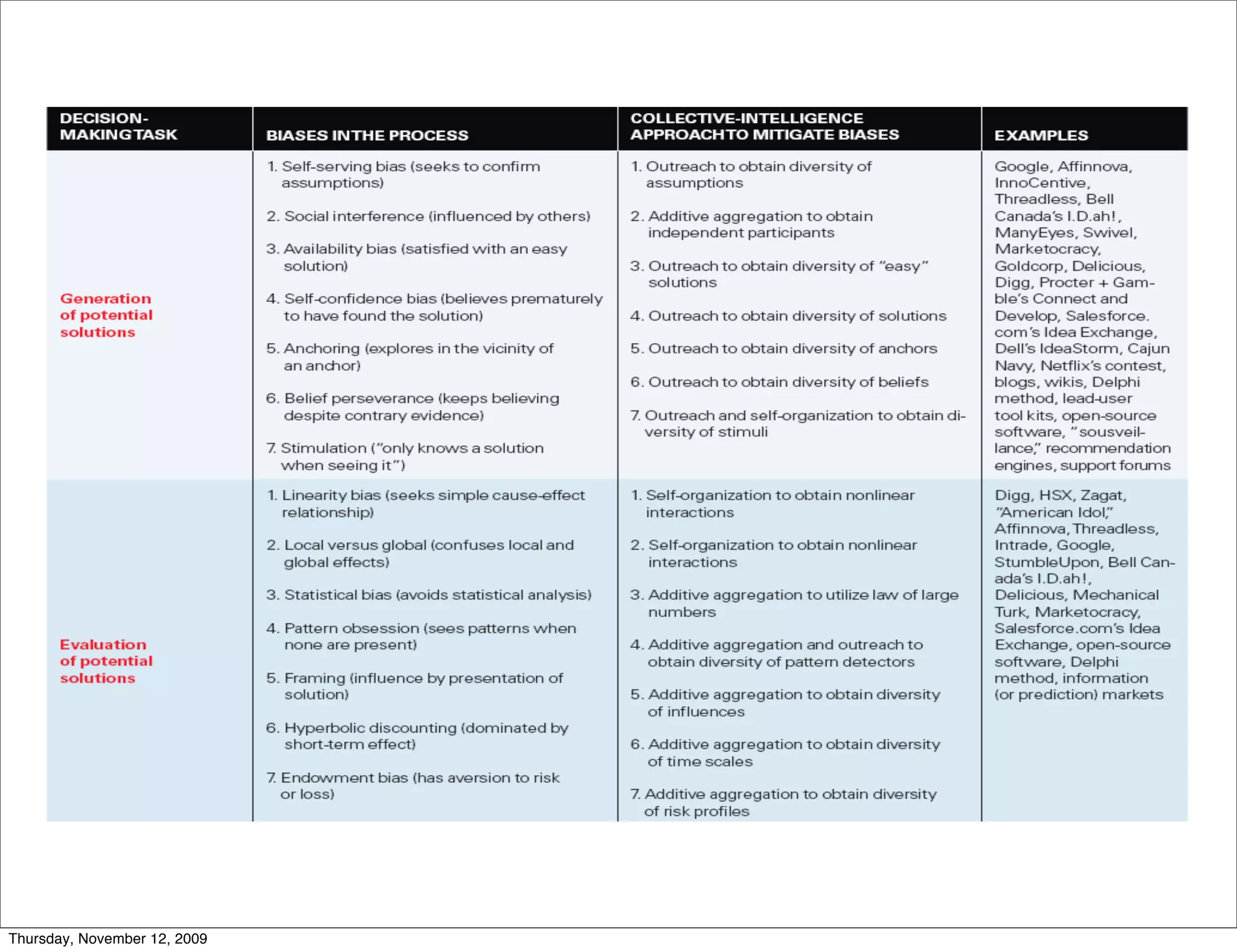
                   •          Today companies can use Web 2.0 (“collective
                              intelligence”, “wisdom of the crowd”, wikis,
                              “crowdsourcing”, etc.) in making decisions

                   •          Decision making can be broken into generation
                              of potential solutions evaluation of those
                              solutions

                   •          These two tasks can be influenced by human
                              biases which can be mitigated using collective
                              intelligence


Thursday, November 12, 2009
Decisions 2.0 [2]
                   •          A study on Collective Intelligence concluded that:

                         •      Tools using collective intelligence have
                                performed better than theorists can explain

                         •      Collective intelligence is better for idea
                                generation than for idea evaluation

                         •      Managers need to consider many key issues
                                when designing collective intelligence tools –
                                from loss of control to balance of diversity to
                                expertise


Thursday, November 12, 2009
Enterprise 2.0


Thursday, November 12, 2009
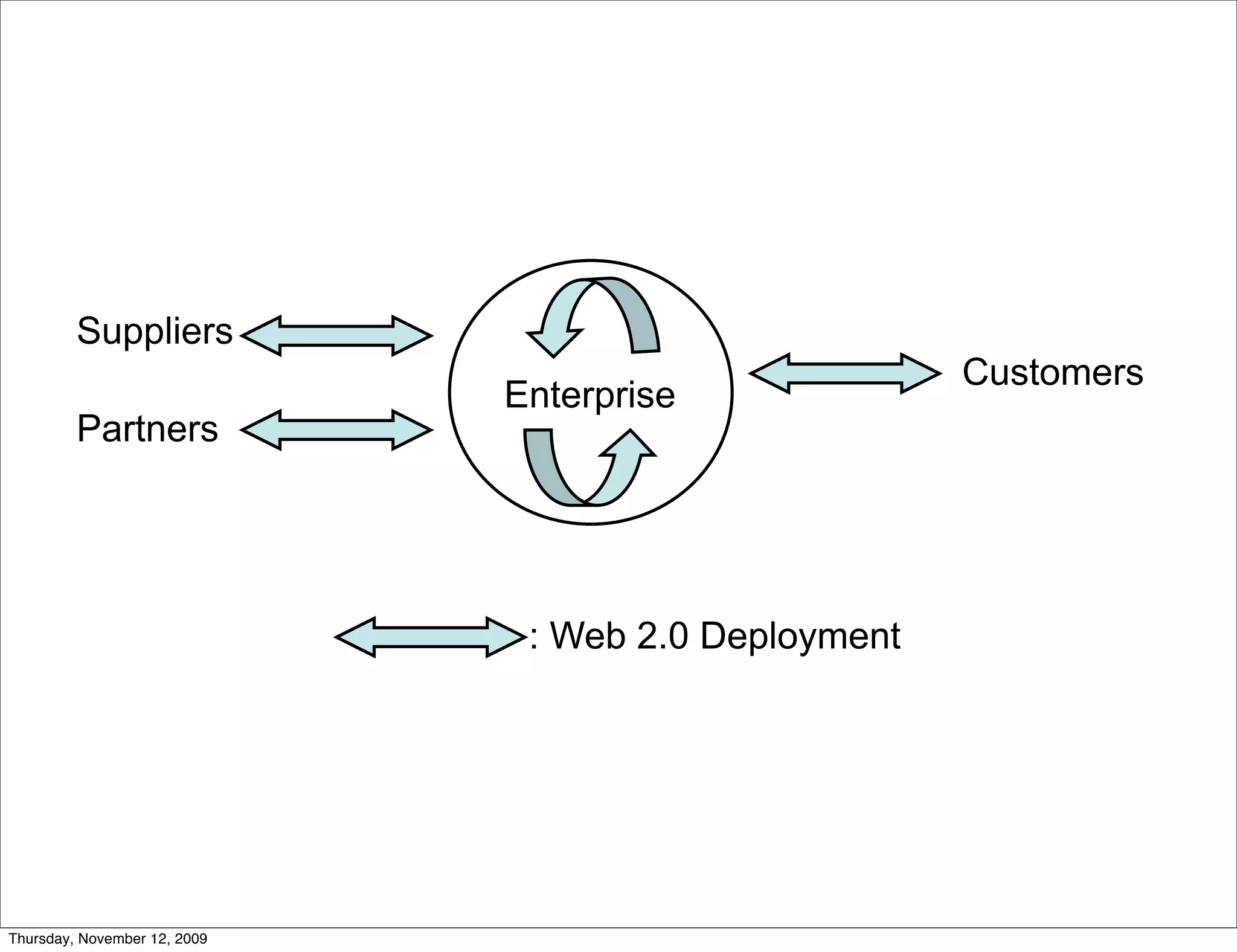
Suppliers
                                                      Customers
                              Enterprise
         Partners


                               : Web 2.0 Deployment


Thursday, November 12, 2009
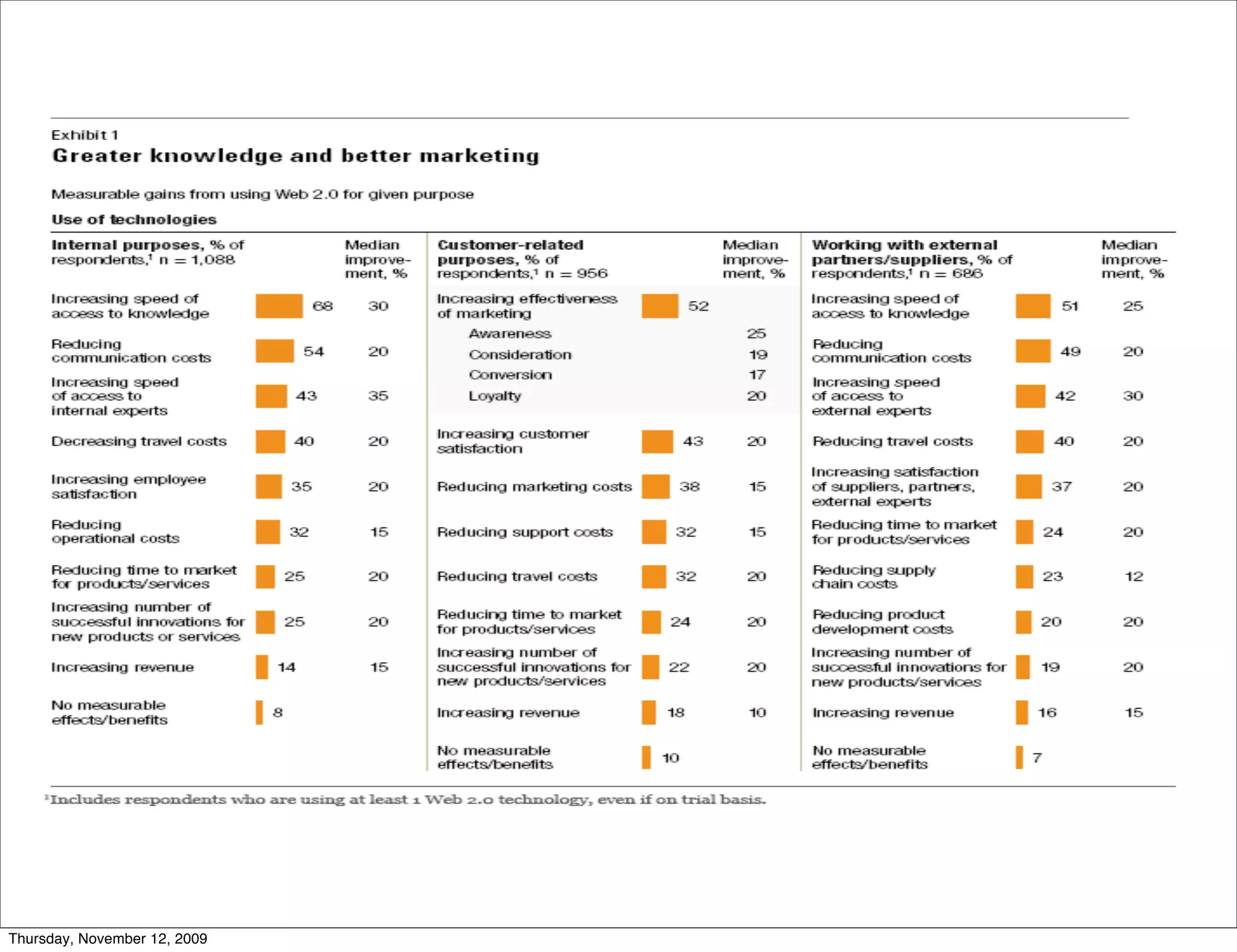
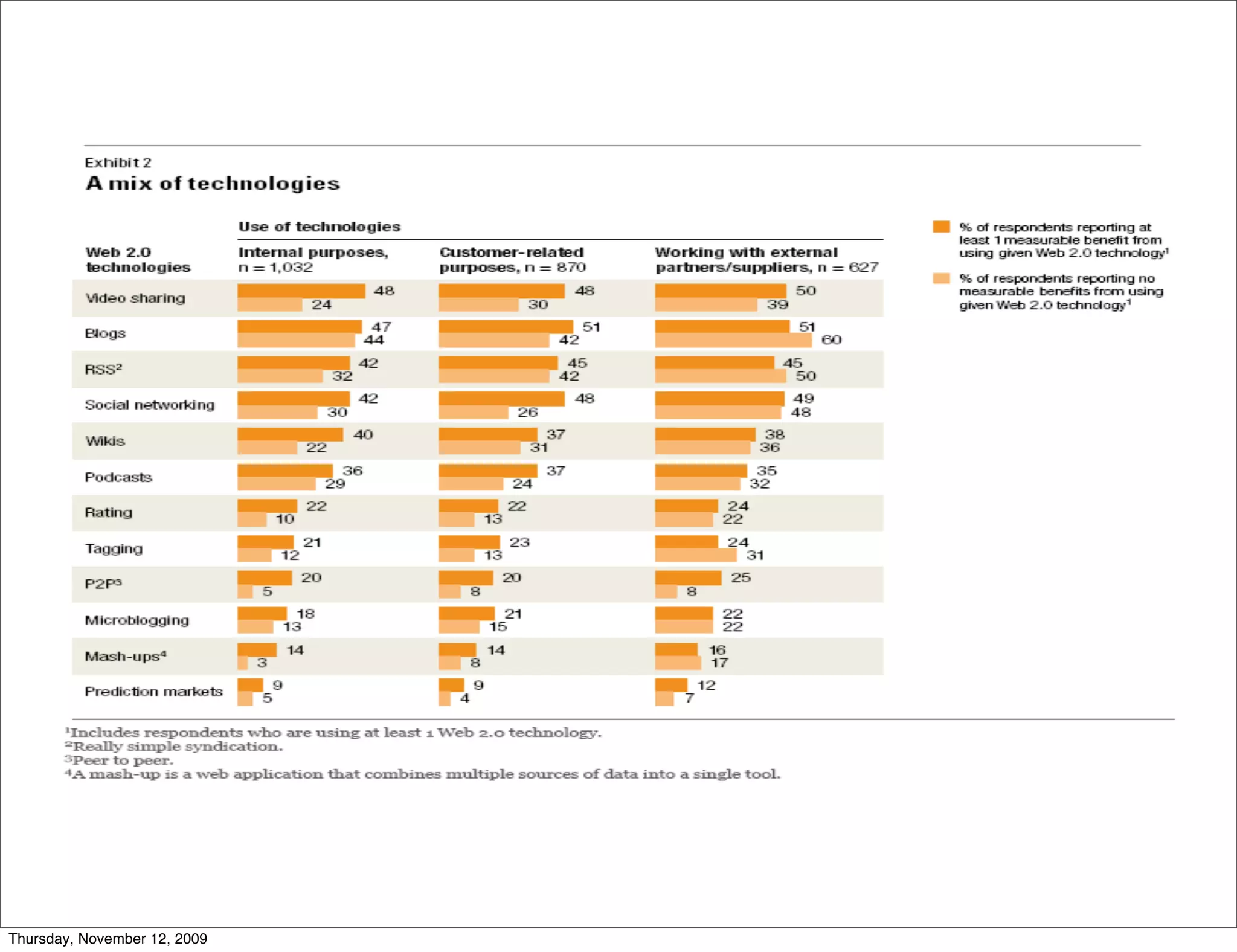
Enterprises and Web 2.0 [3]

                   •          Internally: share ideas, access to knowledge,
                              reduced cost of communication, reduced time to
                              market products, improved customer satisfaction

                   •          Externally: better interactions with organizations
                              and customers, closer ties with customers,
                              increased customer awareness of the company’s
                              products, improved customer satisfaction, joint
                              design with customers, partners and suppliers


Thursday, November 12, 2009
@benyoucef
                http://business.admin.uottawa.ca/~benyoucef/

                morad.benyoucef@googlewave.com


Thursday, November 12, 2009
The Effects of Social
                   Networks on Business


Thursday, November 12, 2009
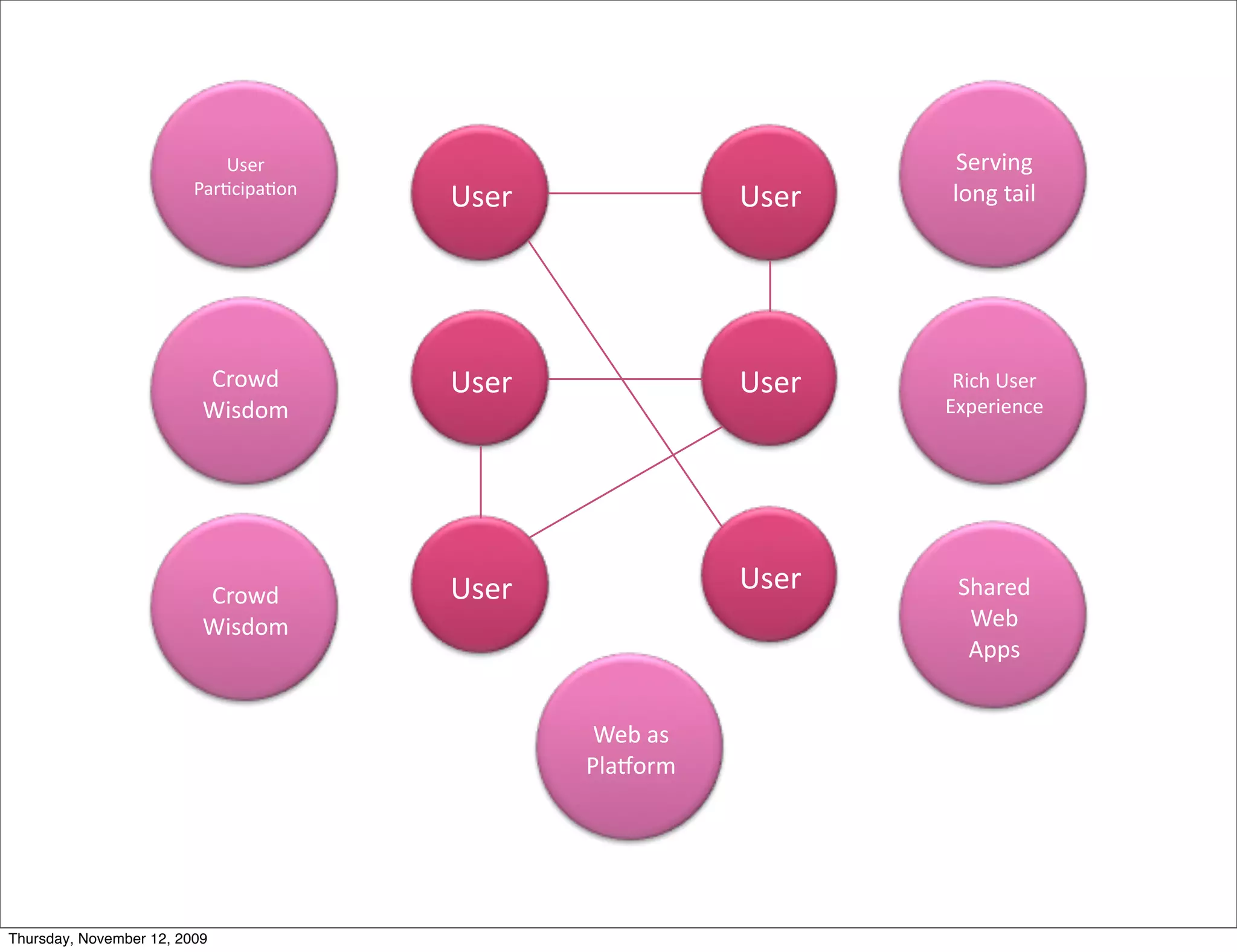
5)."&                                  +."<(8=&
                         2-"67(1-6#8&
                                        5)."&              5)."&   3#8=&>-(3&


                          !"#$%&        5)."&              5)."&    9(7,&5)."&
                          '()%#*&                                  :;1."(.87.&


                          !"#$%&        5)."&              5)."&    +,-".%&
                          '()%#*&                                    './&
                                                                     011)&


                                                 './&-)&
                                                23-4#"*&


Thursday, November 12, 2009
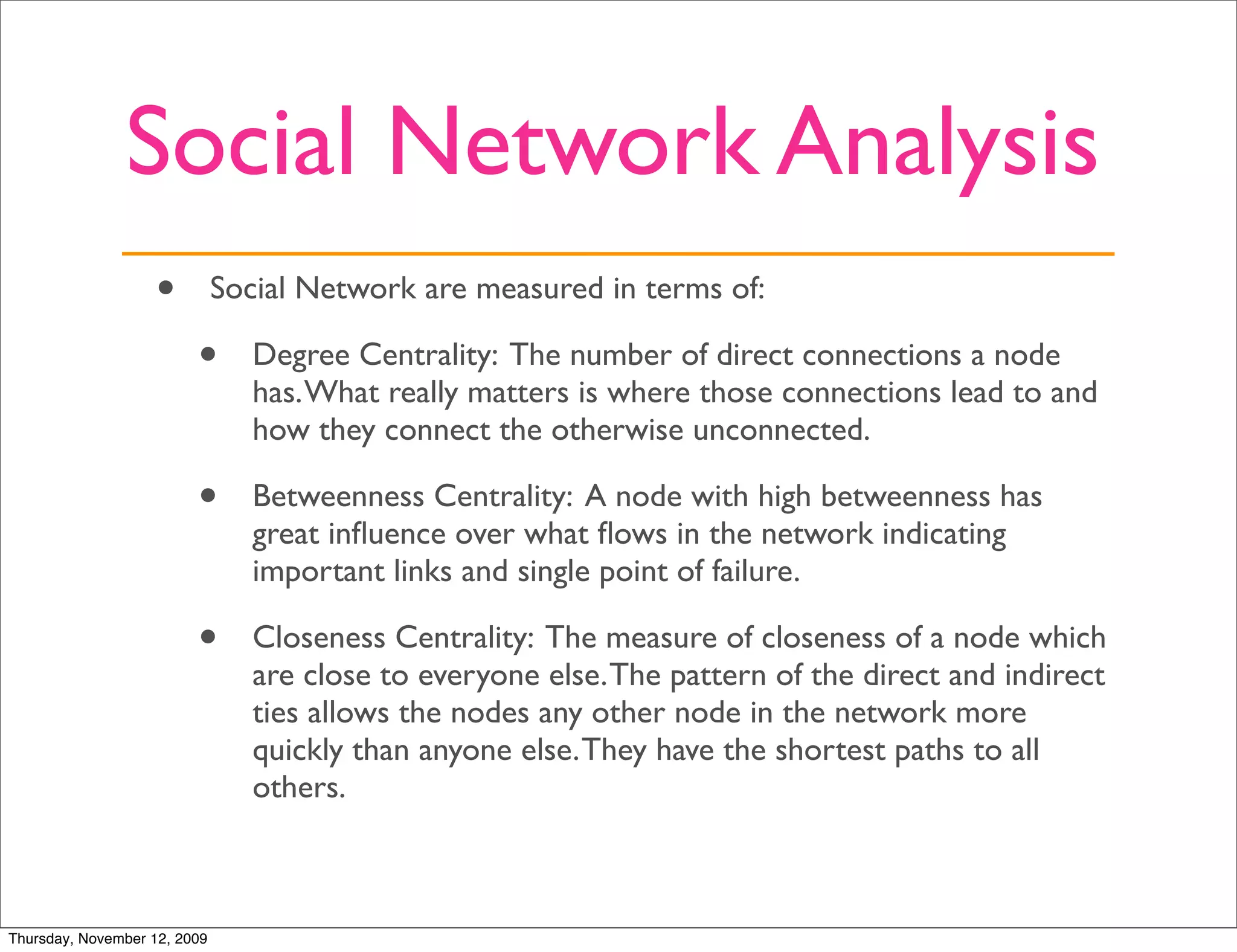
Social Network Analysis
                   •          Social Network are measured in terms of:

                         •       Degree Centrality: The number of direct connections a node
                                 has. What really matters is where those connections lead to and
                                 how they connect the otherwise unconnected.

                         •       Betweenness Centrality: A node with high betweenness has
                                 great influence over what flows in the network indicating
                                 important links and single point of failure.

                         •       Closeness Centrality: The measure of closeness of a node which
                                 are close to everyone else. The pattern of the direct and indirect
                                 ties allows the nodes any other node in the network more
                                 quickly than anyone else. They have the shortest paths to all
                                 others.


Thursday, November 12, 2009
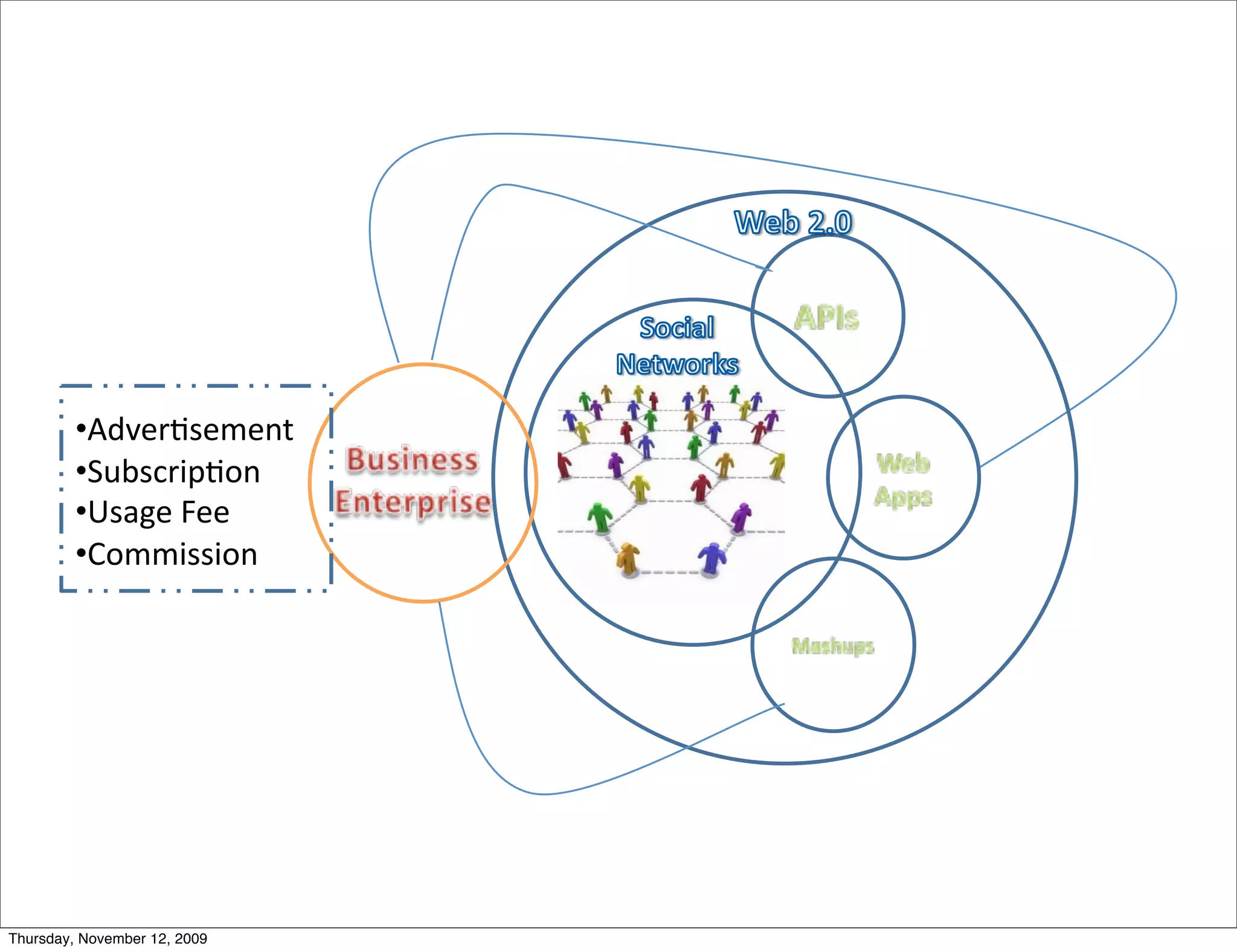
• !"#$%&'$($)*+
         • ,-.'/%01&2)+
         • 3'45$+6$$+
         • 72((0''02)+


Thursday, November 12, 2009
•
     •
         •


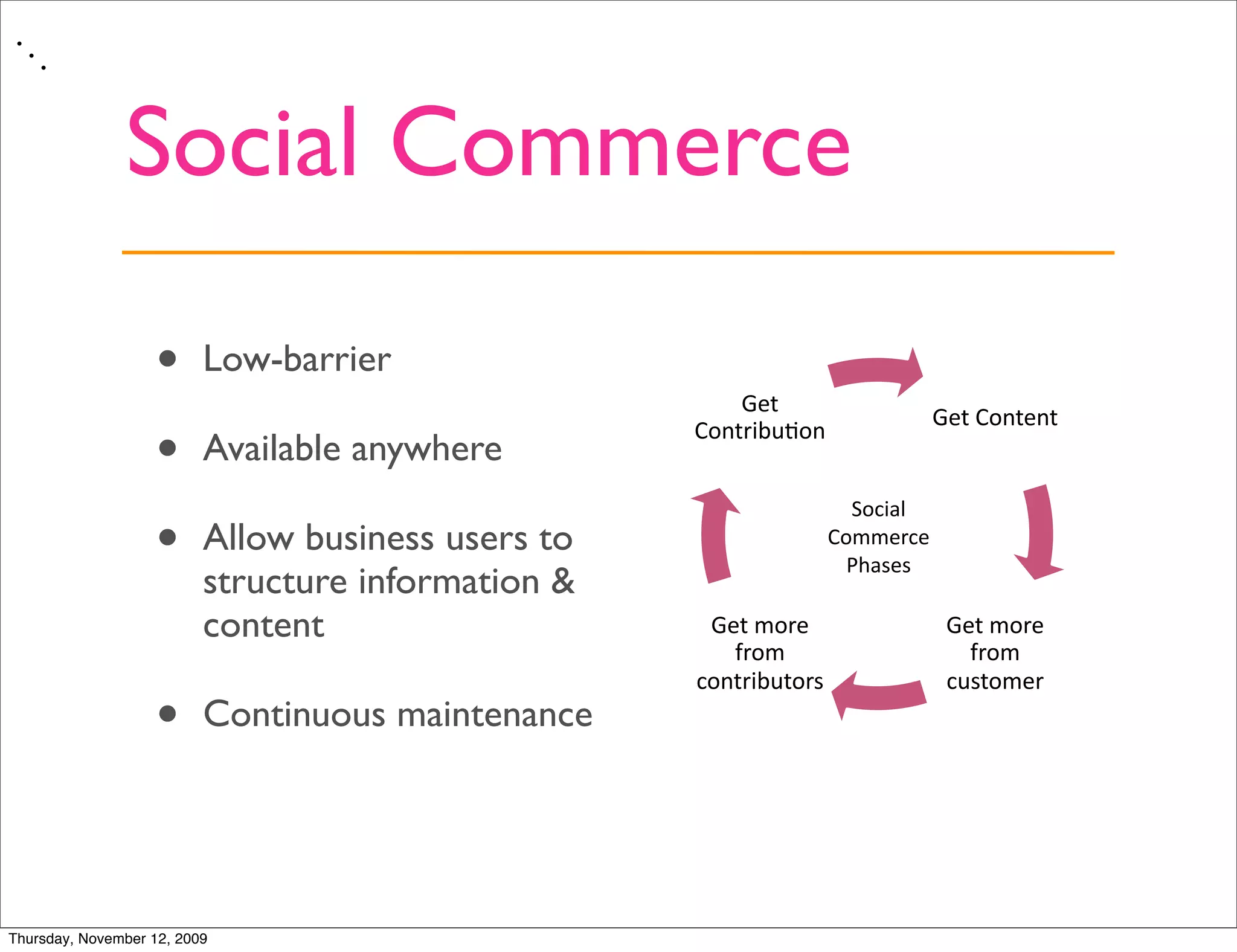
               Social Commerce

                   •      Low-barrier
                                                        !"#$
                                                                        !"#$%&'#"'#$
                   •      Available anywhere
                                                    %&'#)./,0&'$


                                                                  !"#$%&'
                   •      Allow business users to               ("))*+#*'
                                                                  ,-%.*.'
                          structure information &
                          content                    !"#$(&)"$              !"#$(&)"$
                                                       *)&($                  *)&($
                                                    +&'#)./,#&)-$           +,-#&(")$
                   •      Continuous maintenance


Thursday, November 12, 2009
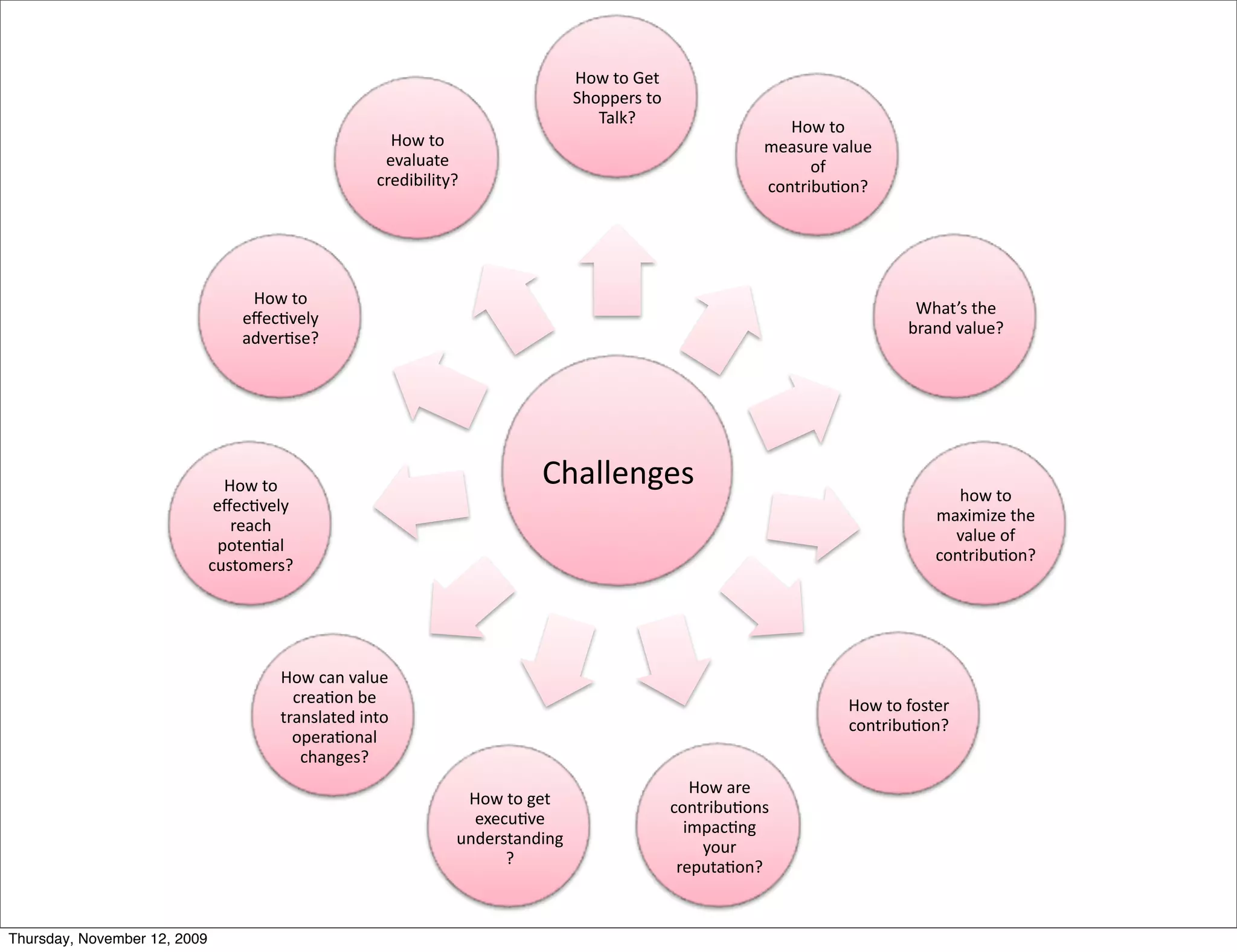
*+,)-+).%-)
                                                                               /"+00%1()-+)
                                                                                  2#$34)
                                                                                                            *+,)-+)
                                                     *+,)-+)                                             5%#(61%)7#$6%)
                                                    %7#$6#-%)                                                  +8)
                                                   91%?:;:$:-B4)                                         9+&-1:;6<+&4)


                                   *+,)-+)
                                                                                                                           ="#->()-"%)
                                  %C%9<7%$B)
                                                                                                                          ;1#&?)7#$6%4)
                                  #?7%1<(%4)


                                 *+,)-+)                                 !"#$$%&'%()
                                                                                                                                 "+,)-+)
                               %C%9<7%$B)
                                                                                                                              5#@:5:A%)-"%)
                                  1%#9")
                                                                                                                                7#$6%)+8)
                                0+-%&<#$)
                                                                                                                              9+&-1:;6<+&4)
                              96(-+5%1(4)


                                      *+,)9#&)7#$6%)
                                        91%#<+&);%)                                                                *+,)-+)8+(-%1)
                                      -1#&($#-%?):&-+)                                                             9+&-1:;6<+&4)
                                        +0%1#<+&#$)
                                         9"#&'%(4))
                                                                                                 *+,)#1%)
                                                                *+,)-+)'%-)                   9+&-1:;6<+&()
                                                                 %@%96<7%)                      :50#9<&')
                                                               6&?%1(-#&?:&'                      B+61)
                                                                     4)                        1%06-#<+&4)


Thursday, November 12, 2009
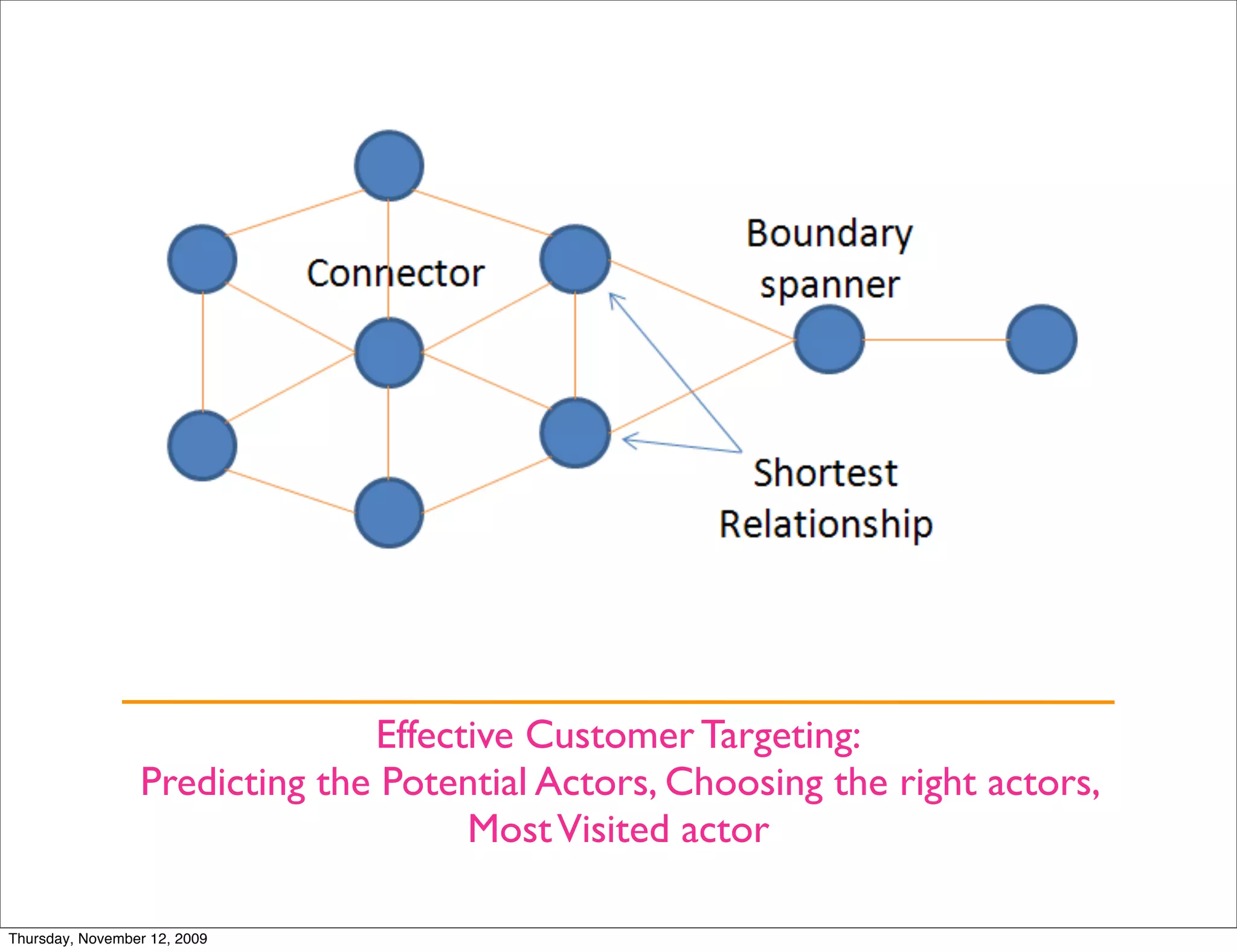
Effective Customer Targeting:
                 Predicting the Potential Actors, Choosing the right actors,
                                     Most Visited actor

Thursday, November 12, 2009
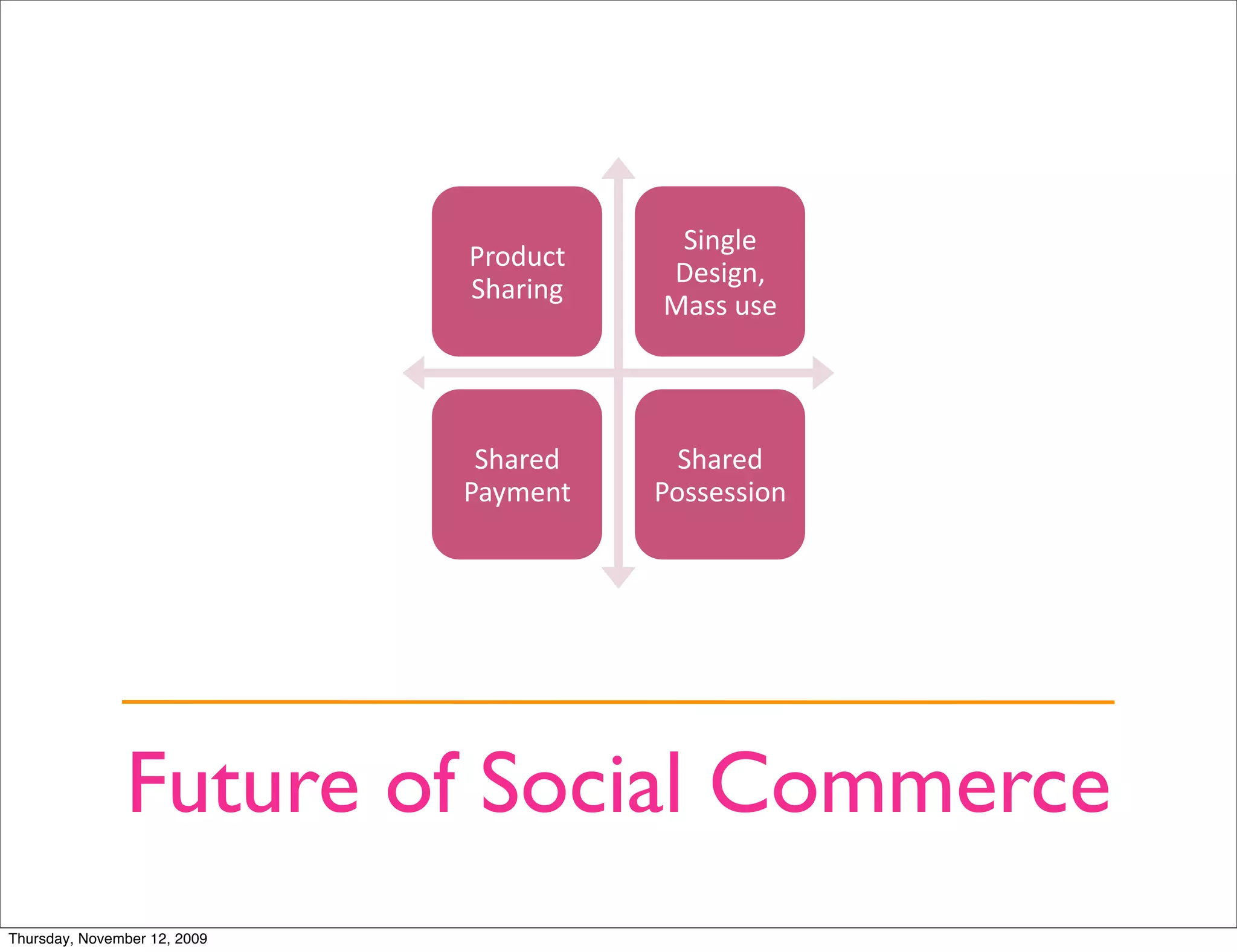
),-./0(
                              !"#$%&'(
                                         102,.-3(
                              )*+",-.(
                                         4+22(%20(


                               )*+"0$(     )*+"0$(
                              !+560-'(   !#22022,#-(


               Future of Social Commerce
Thursday, November 12, 2009
@amir_a_rad
                              a.afrasiabi@uottawa.ca


Thursday, November 12, 2009
Health Care &
                               Health 2.0


Thursday, November 12, 2009
Current Trends in
               Health Care
                   •          Effective health Information Sharing is highly required:

                         •      From Biomedicine to Infomedicine

                   •          Health care models and policies [4] are emerging from
                              disease-centered to patient-centered [5].

                         •      Internet Models as a primary source of health information
                                mainly for:

                                •   Improving collaboration along the health care process.

                                •   Finding timely and personalized health information.


Thursday, November 12, 2009
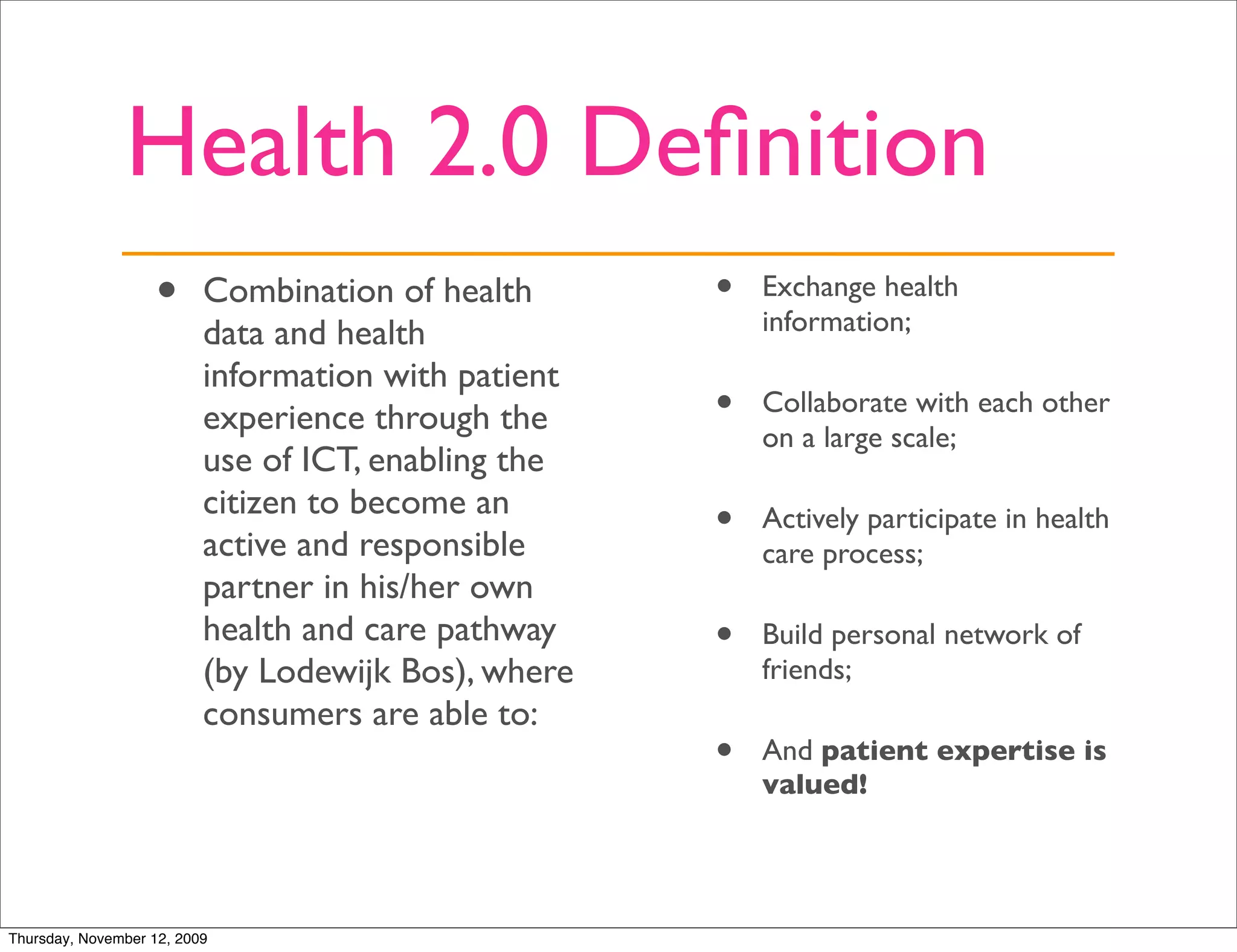
Health 2.0 Definition
                   •      Combination of health      •   Exchange health
                                                         information;
                          data and health
                          information with patient
                          experience through the     •   Collaborate with each other
                                                         on a large scale;
                          use of ICT, enabling the
                          citizen to become an
                          active and responsible
                                                     •   Actively participate in health
                                                         care process;
                          partner in his/her own
                          health and care pathway    •   Build personal network of
                          (by Lodewijk Bos), where       friends;
                          consumers are able to:
                                                     •   And patient expertise is
                                                         valued!


Thursday, November 12, 2009
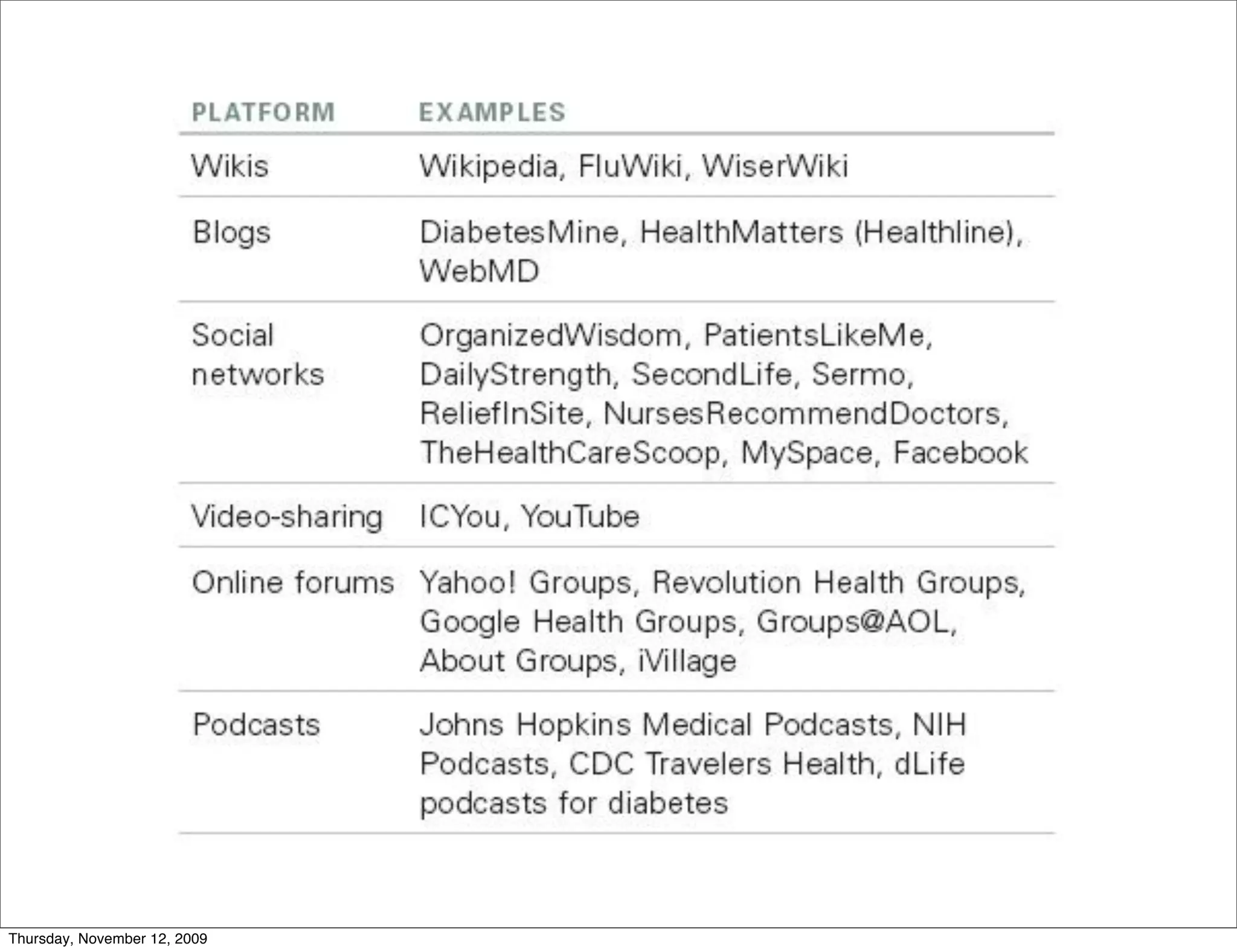
Applications of
                               Health 2.0[6]


Thursday, November 12, 2009
Sources Used to Find or Access
                              Health-Related Information in the
                               Past 12 Months in US, 2008.[6]


Thursday, November 12, 2009
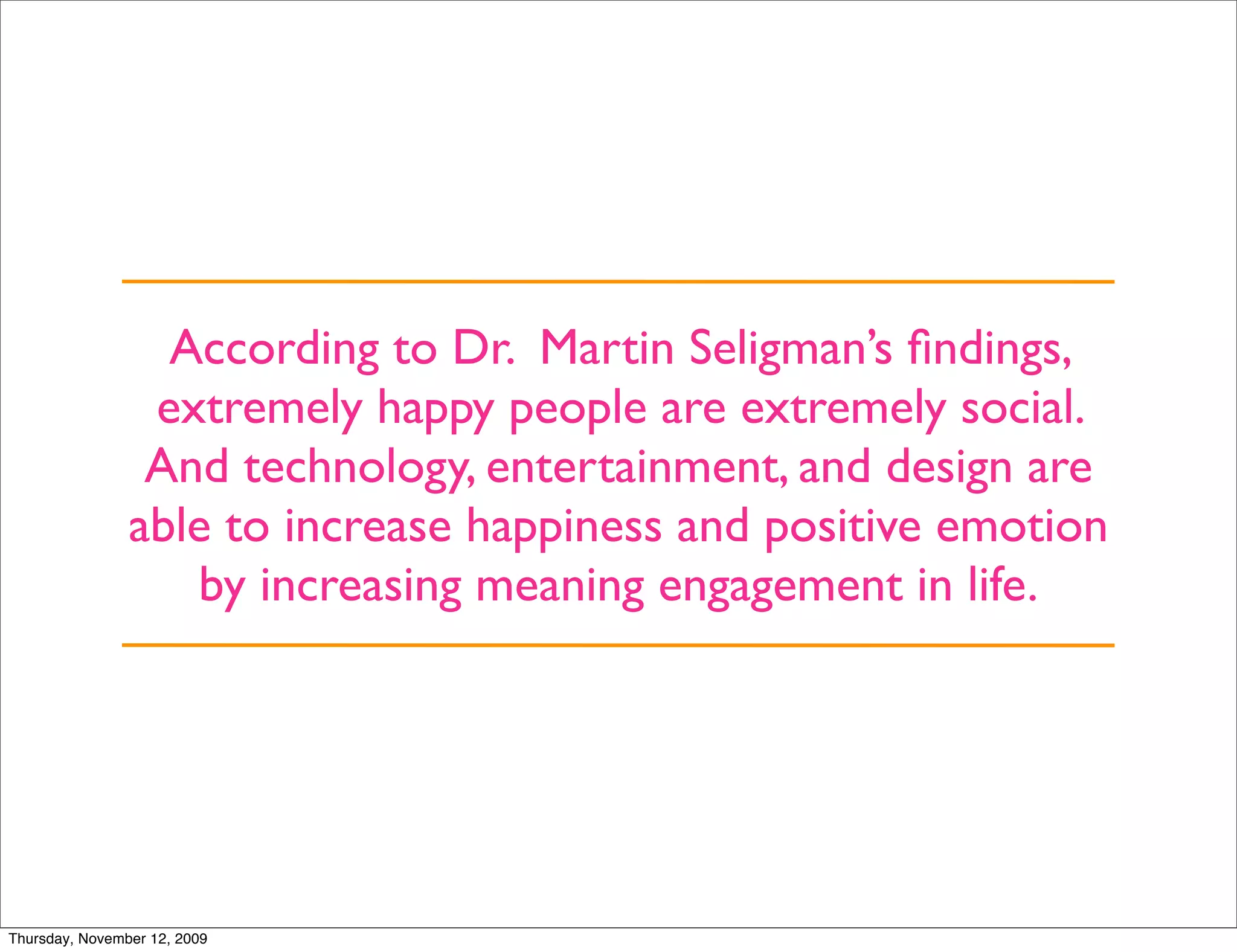
According to Dr. Martin Seligman’s findings,
                 extremely happy people are extremely social.
                 And technology, entertainment, and design are
                able to increase happiness and positive emotion
                   by increasing meaning engagement in life.


Thursday, November 12, 2009
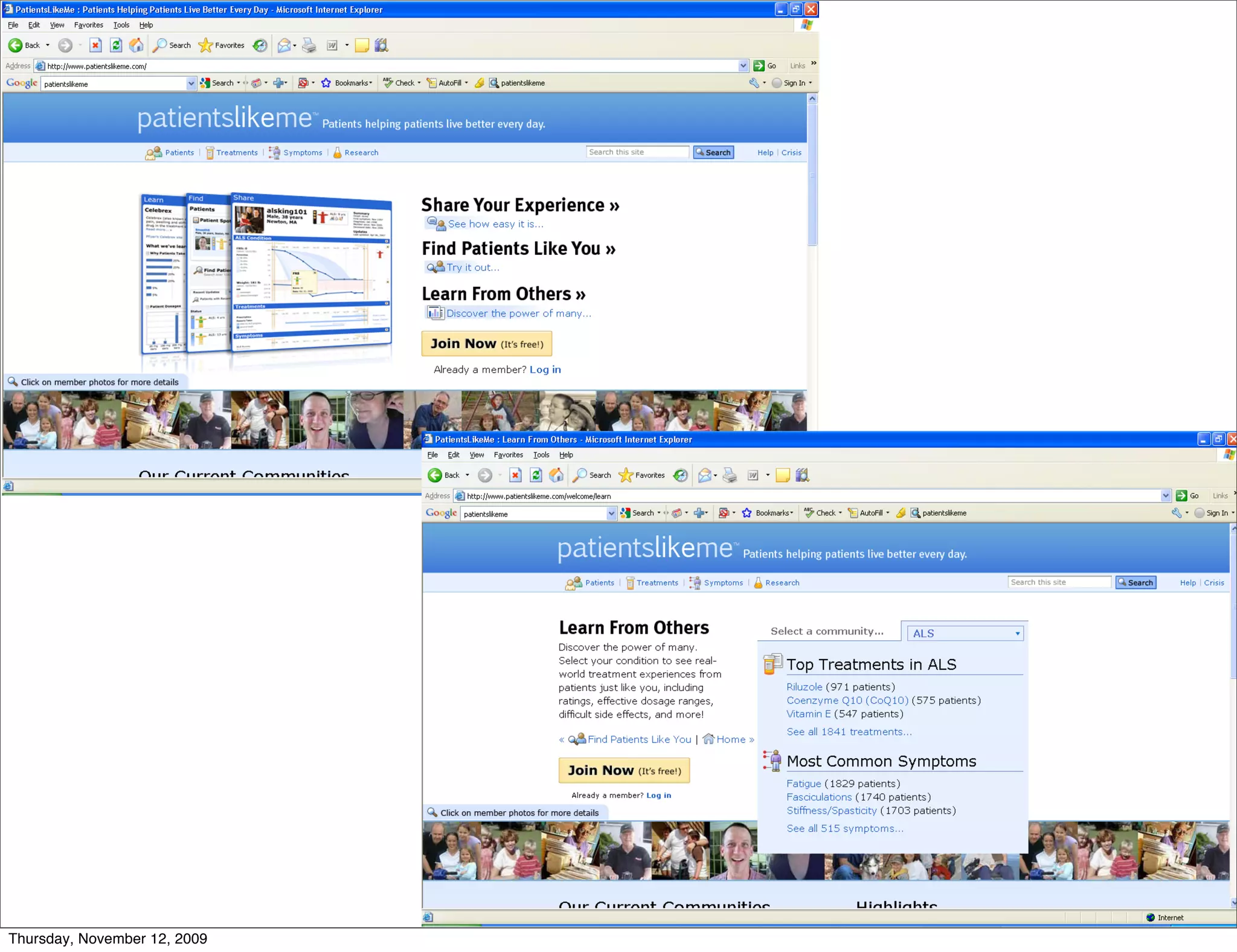
PatientsLikeMe as a
                              Health 2.0 Platform


Thursday, November 12, 2009
Health 2.0
                              Basis Structure


Thursday, November 12, 2009
Swan Health
           2.0 Model [7]


Thursday, November 12, 2009
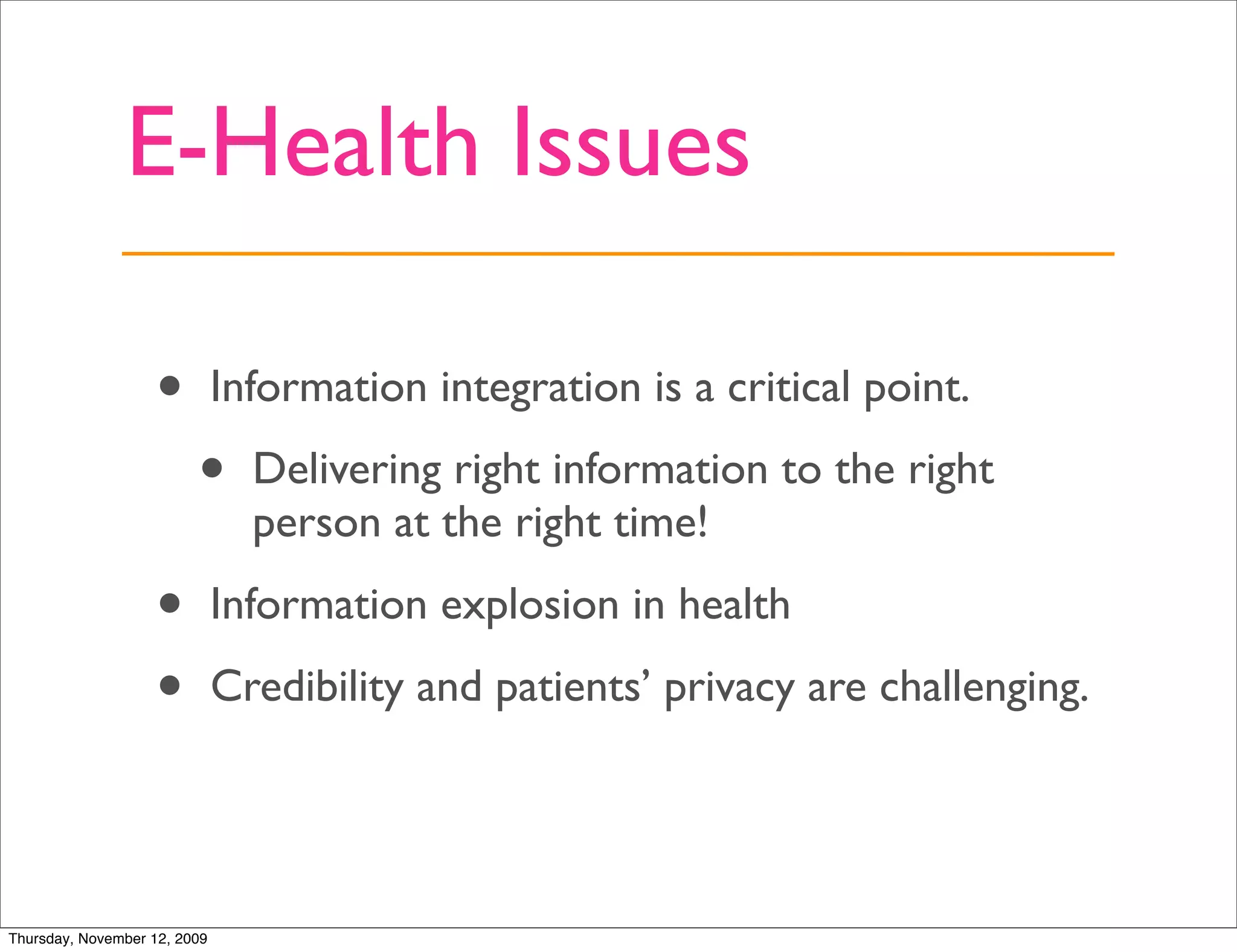
E-Health Issues

                   •          Information integration is a critical point.

                         •      Delivering right information to the right
                                person at the right time!

                   •          Information explosion in health

                   •          Credibility and patients’ privacy are challenging.


Thursday, November 12, 2009
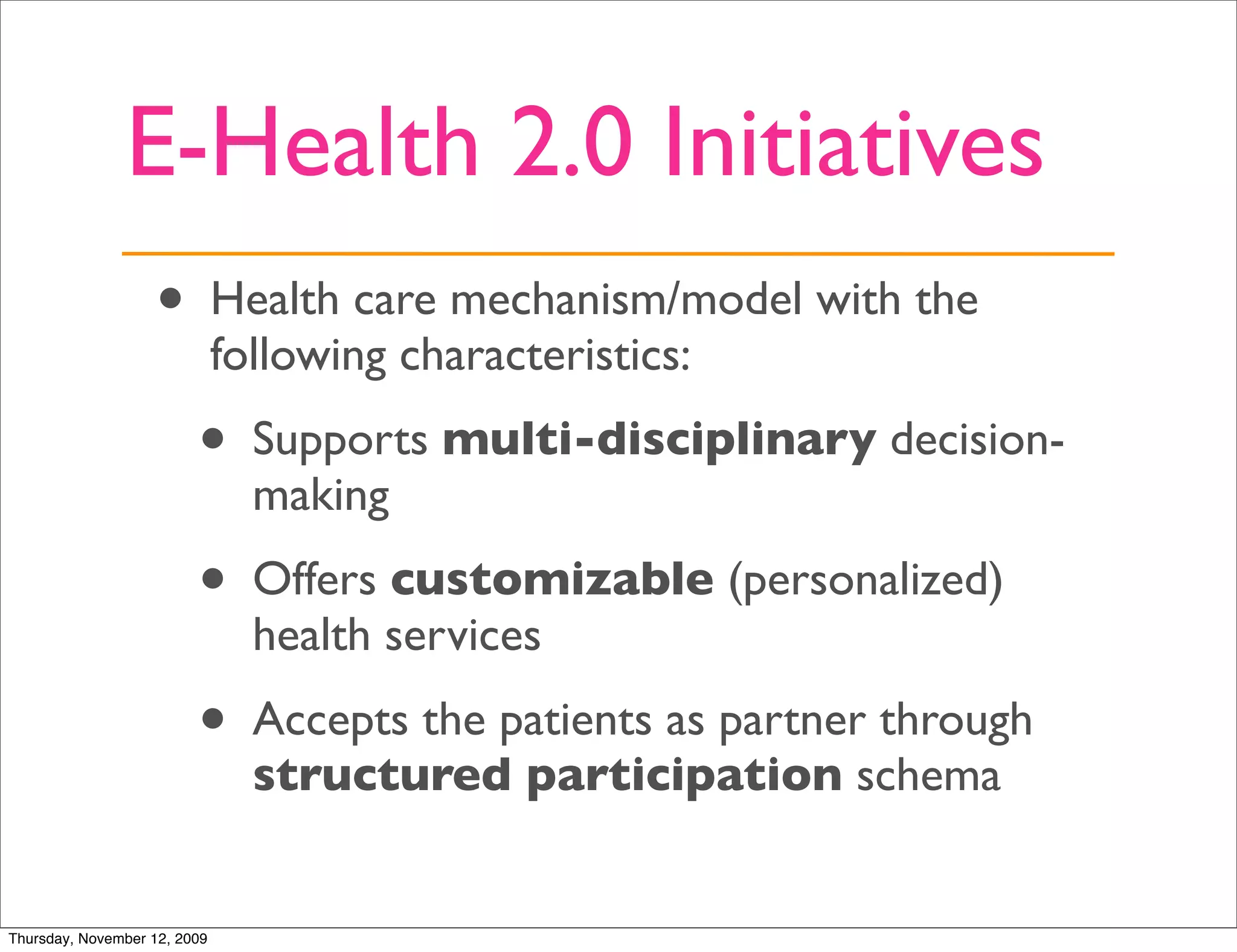
E-Health 2.0 Initiatives
                   •          Health care mechanism/model with the
                              following characteristics:

                         •     Supports multi-disciplinary decision-
                               making

                         •     Offers customizable (personalized)
                               health services
                         •     Accepts the patients as partner through
                               structured participation schema


Thursday, November 12, 2009
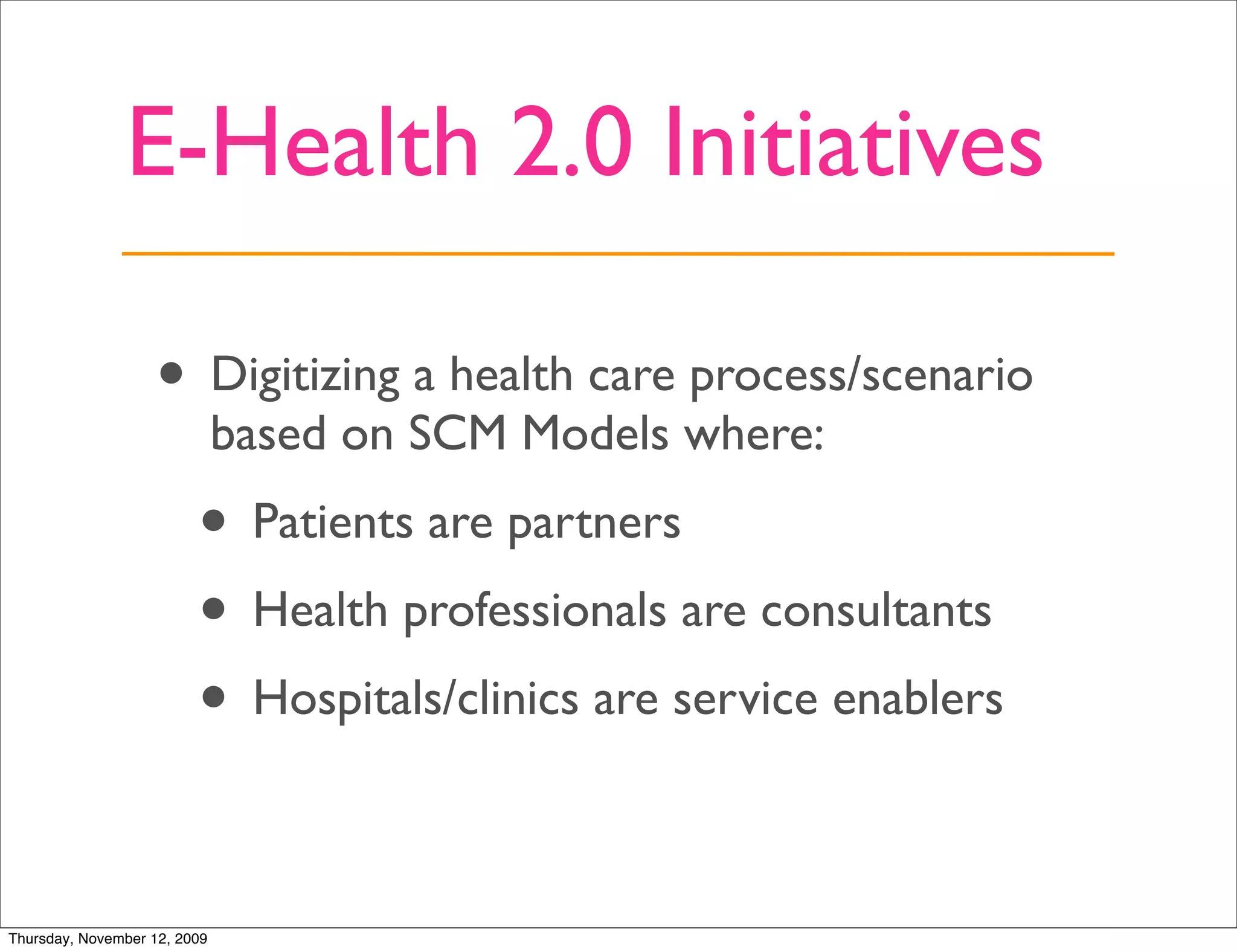
E-Health 2.0 Initiatives

                   • Digitizing a health care process/scenario
                              based on SCM Models where:
                         • Patients are partners
                         • Health professionals are consultants
                         • Hospitals/clinics are service enablers

Thursday, November 12, 2009
@PayamSadeghi
                  http://www.iPayam.com/MyThesis/

                              PSade077@uOttawa.ca


Thursday, November 12, 2009
Conversation 2.0:
                           Twitter

Thursday, November 12, 2009
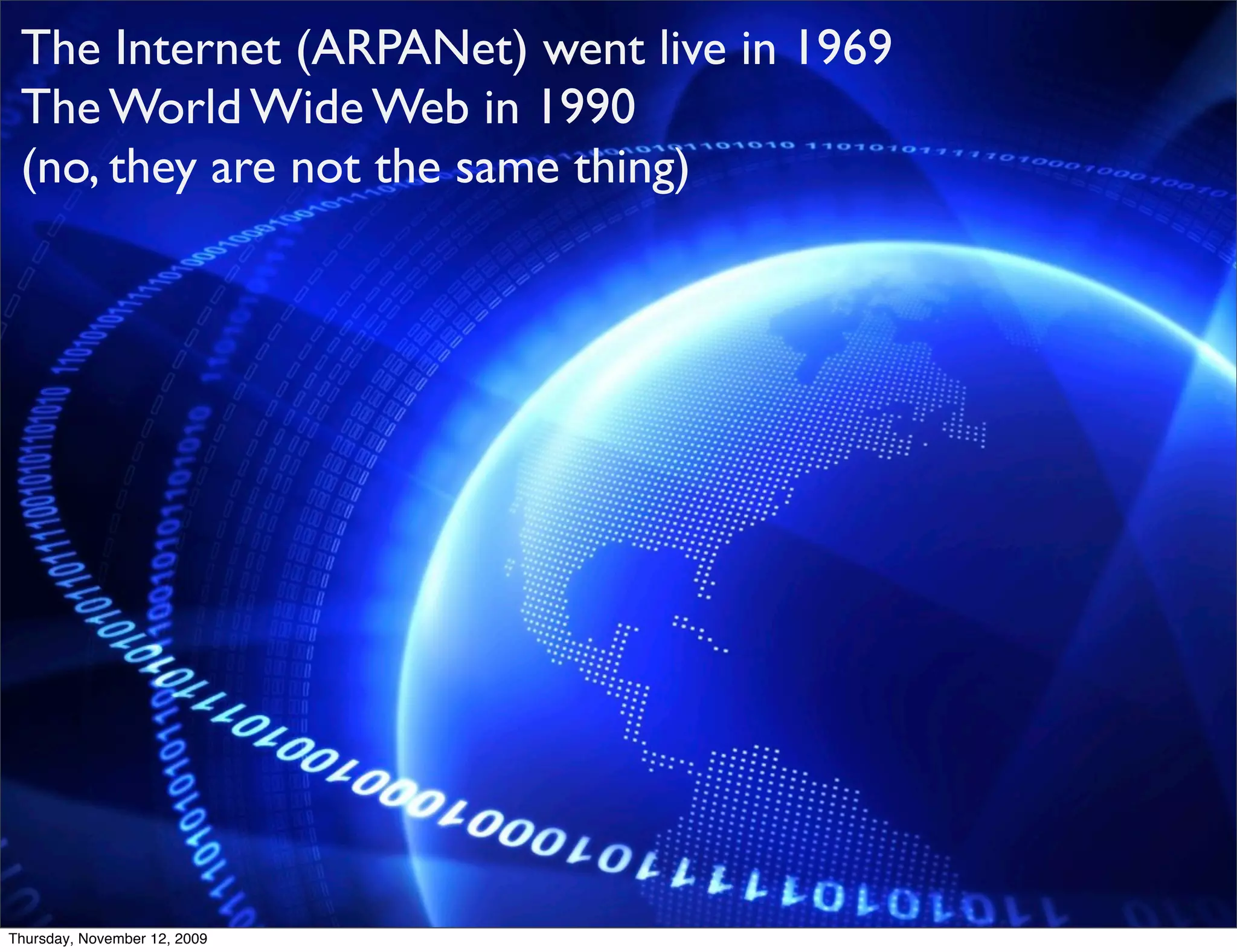
The Internet (ARPANet) went live in 1969
 The World Wide Web in 1990
 (no, they are not the same thing)


Thursday, November 12, 2009
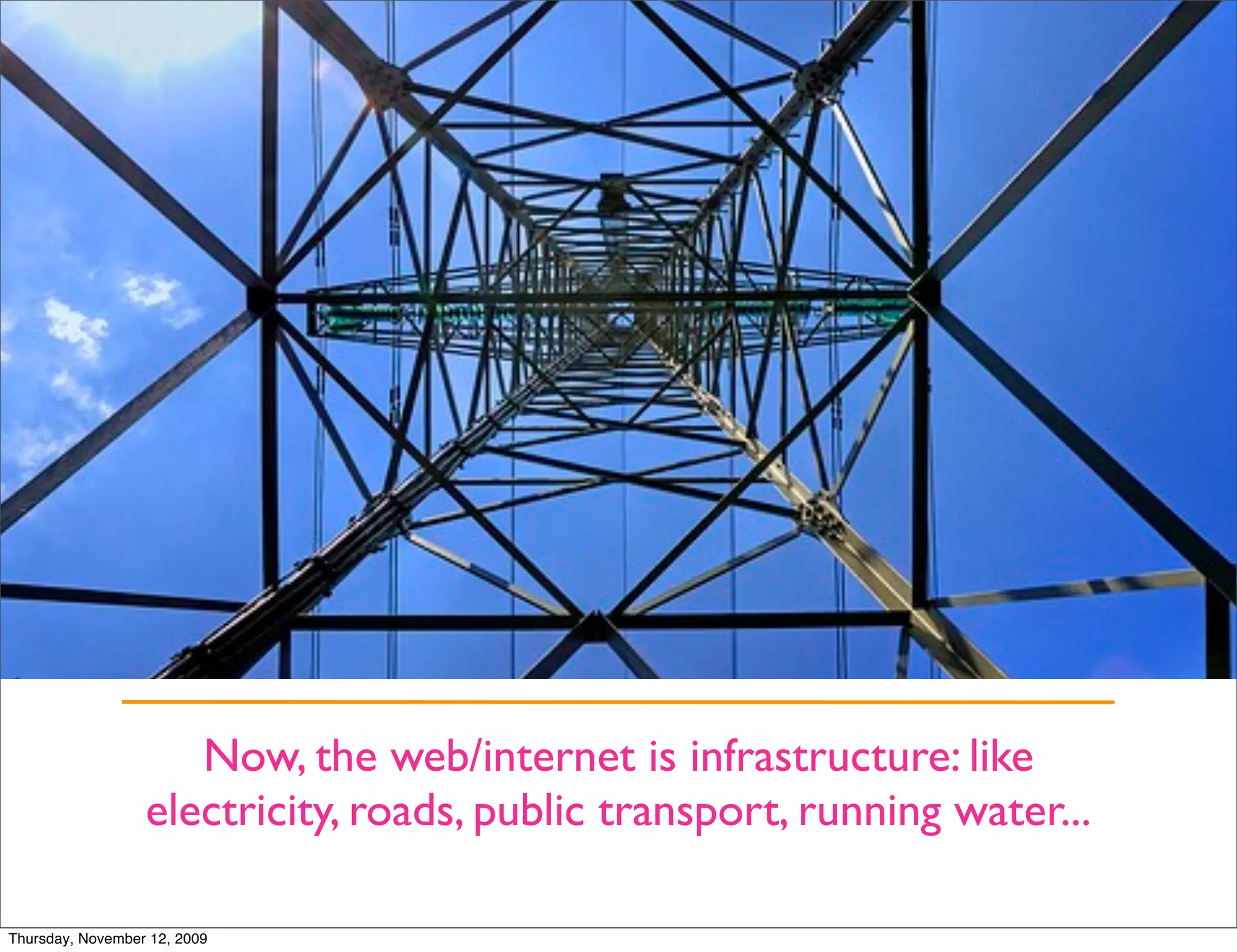
Now, the web/internet is infrastructure: like
                  electricity, roads, public transport, running water...

Thursday, November 12, 2009
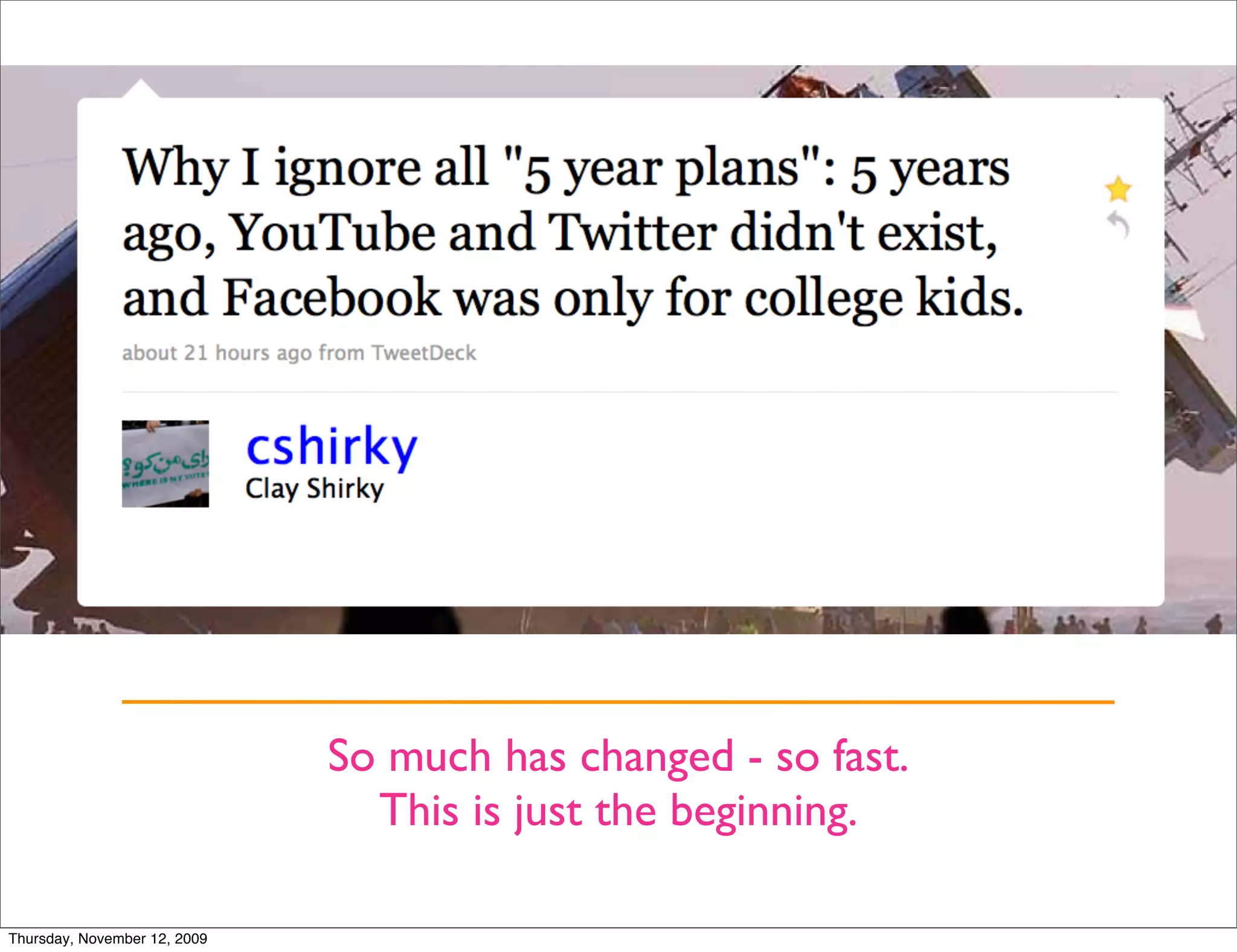
So much has changed - so fast.
                                This is just the beginning.

Thursday, November 12, 2009
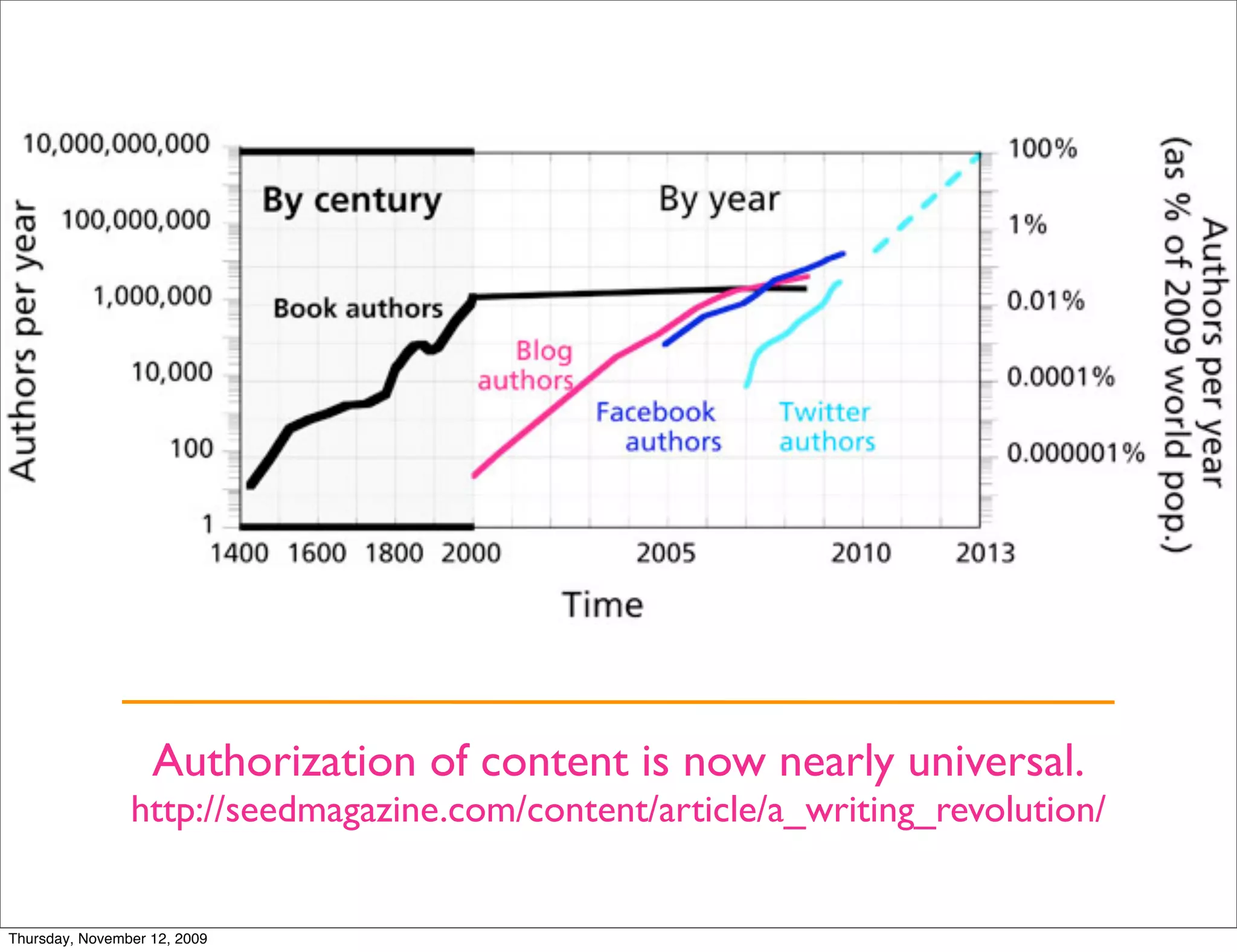
Authorization of content is now nearly universal.
                http://seedmagazine.com/content/article/a_writing_revolution/


Thursday, November 12, 2009
The possibility of “Serendipitous Connections”
                                    The power of “Weak-Tie” relationships


Thursday, November 12, 2009
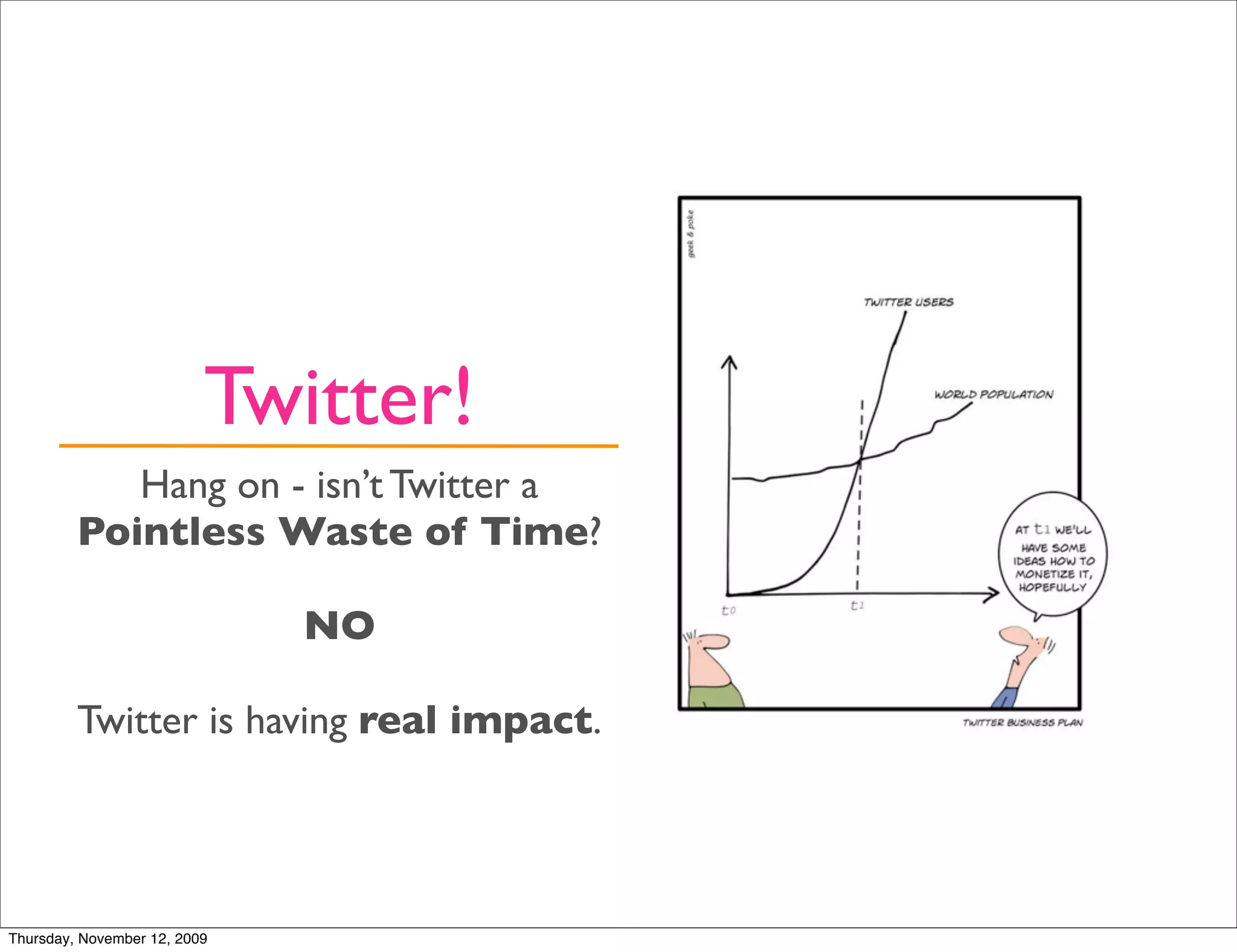
Twitter!
            Hang on - isn’t Twitter a
         Pointless Waste of Time?

                              NO

         Twitter is having real impact.


Thursday, November 12, 2009
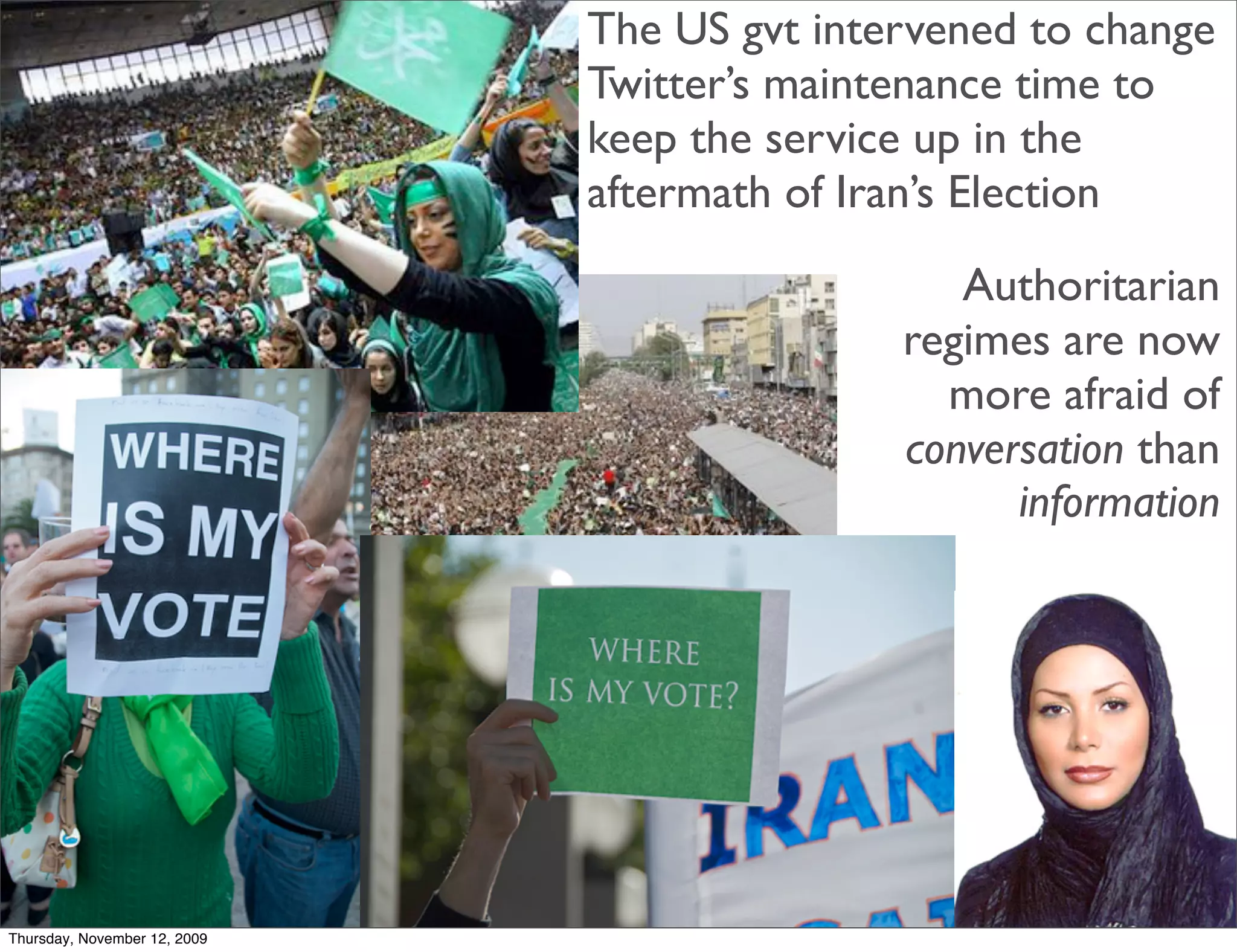
The US gvt intervened to change
                              Twitter’s maintenance time to
                              keep the service up in the
                              aftermath of Iran’s Election
                                                Authoritarian
                                             regimes are now
                                               more afraid of
                                             conversation than
                                                   information


Thursday, November 12, 2009
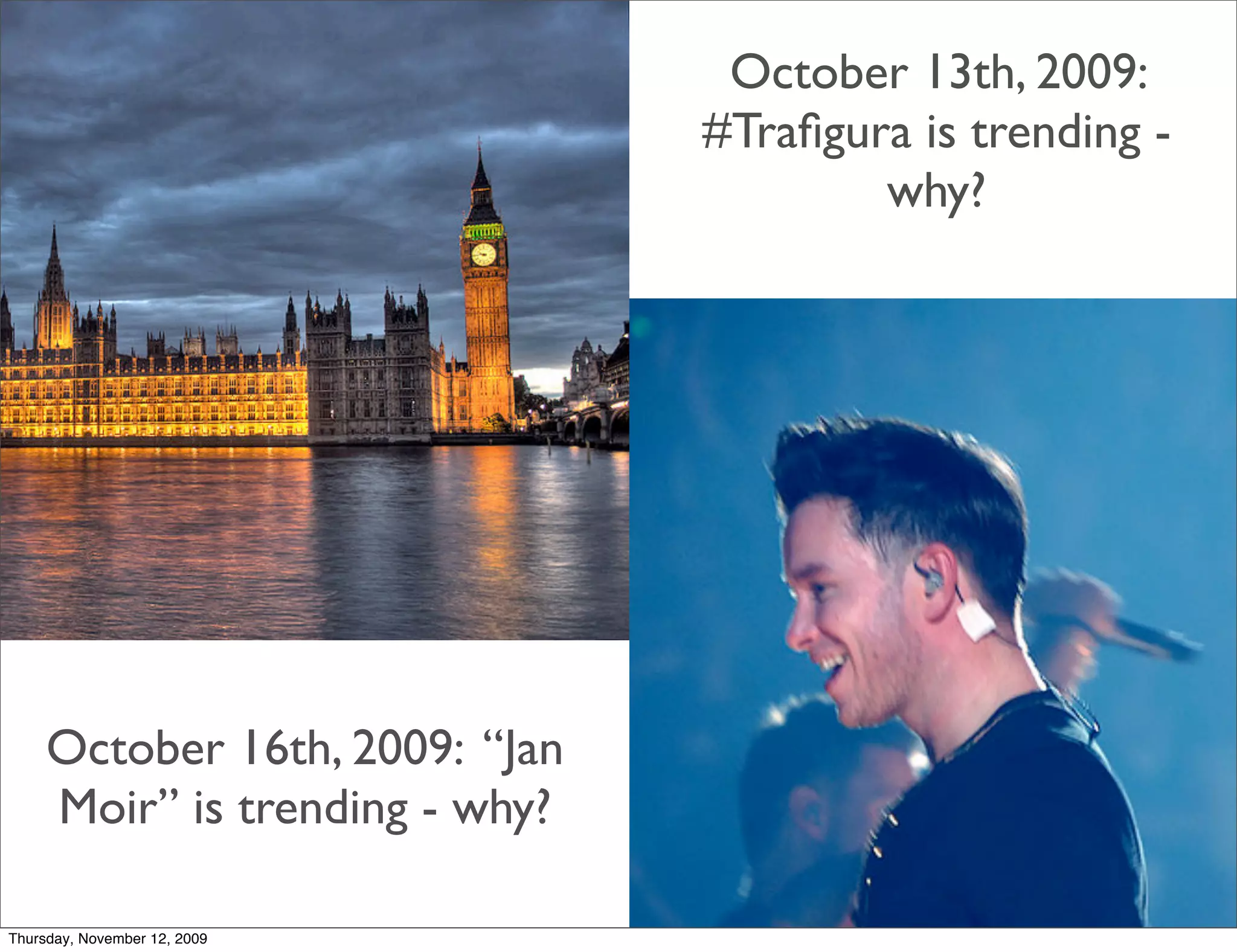
October 13th, 2009:
                                #Trafigura is trending -
                                        why?


     October 16th, 2009: “Jan
     Moir” is trending - why?

Thursday, November 12, 2009
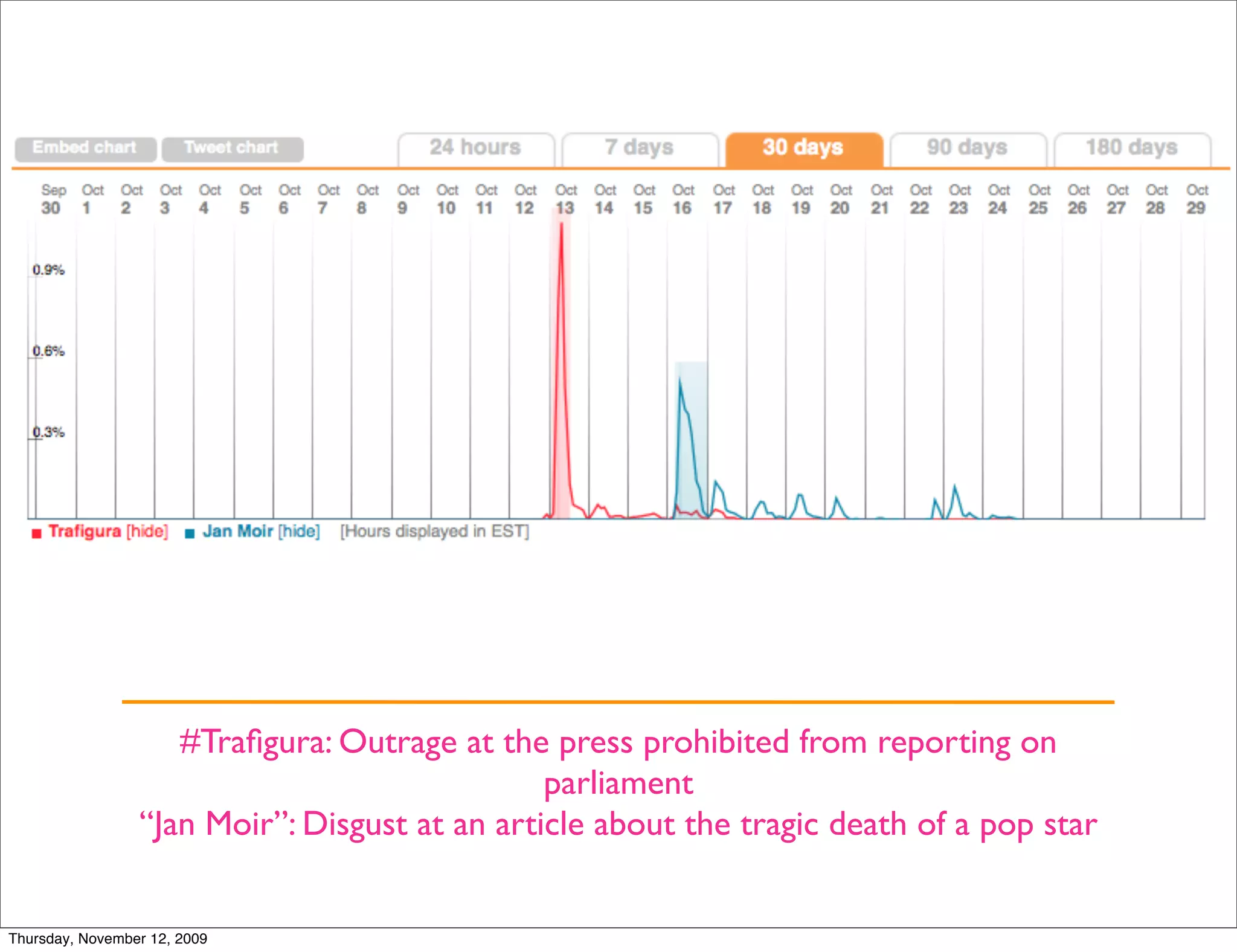
#Trafigura: Outrage at the press prohibited from reporting on
                                               parliament
                 “Jan Moir”: Disgust at an article about the tragic death of a pop star


Thursday, November 12, 2009
Twitter doesn’t just tell us what a
                        person is doing right now, it tells us
                        what’s hot, what people are getting
                            angry/excited/upset about.
                          Twitter captures the moment.


Thursday, November 12, 2009
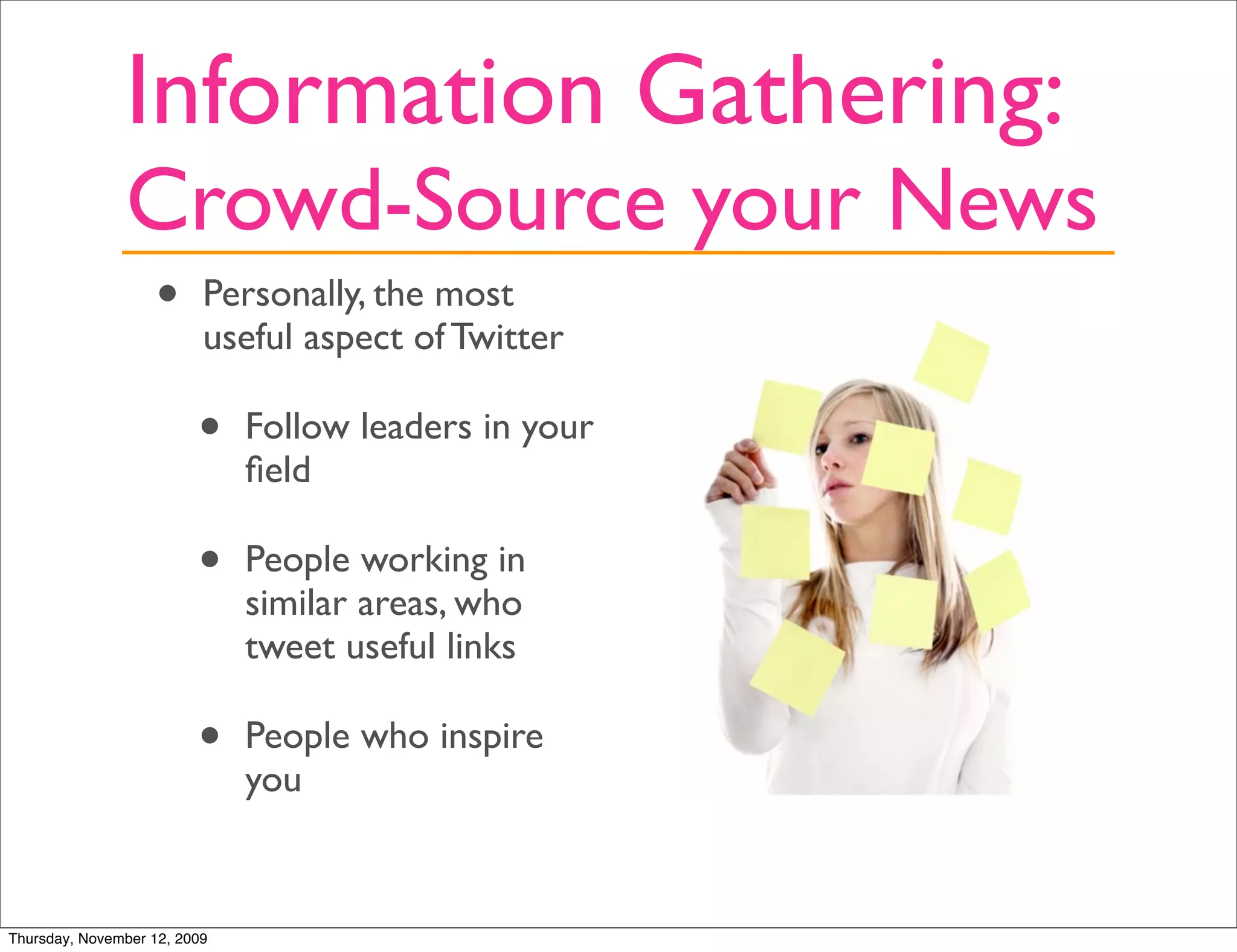
Information Gathering:
               Crowd-Source your News
                   •      Personally, the most
                          useful aspect of Twitter

                         •    Follow leaders in your
                              field

                         •    People working in
                              similar areas, who
                              tweet useful links

                         •    People who inspire
                              you


Thursday, November 12, 2009
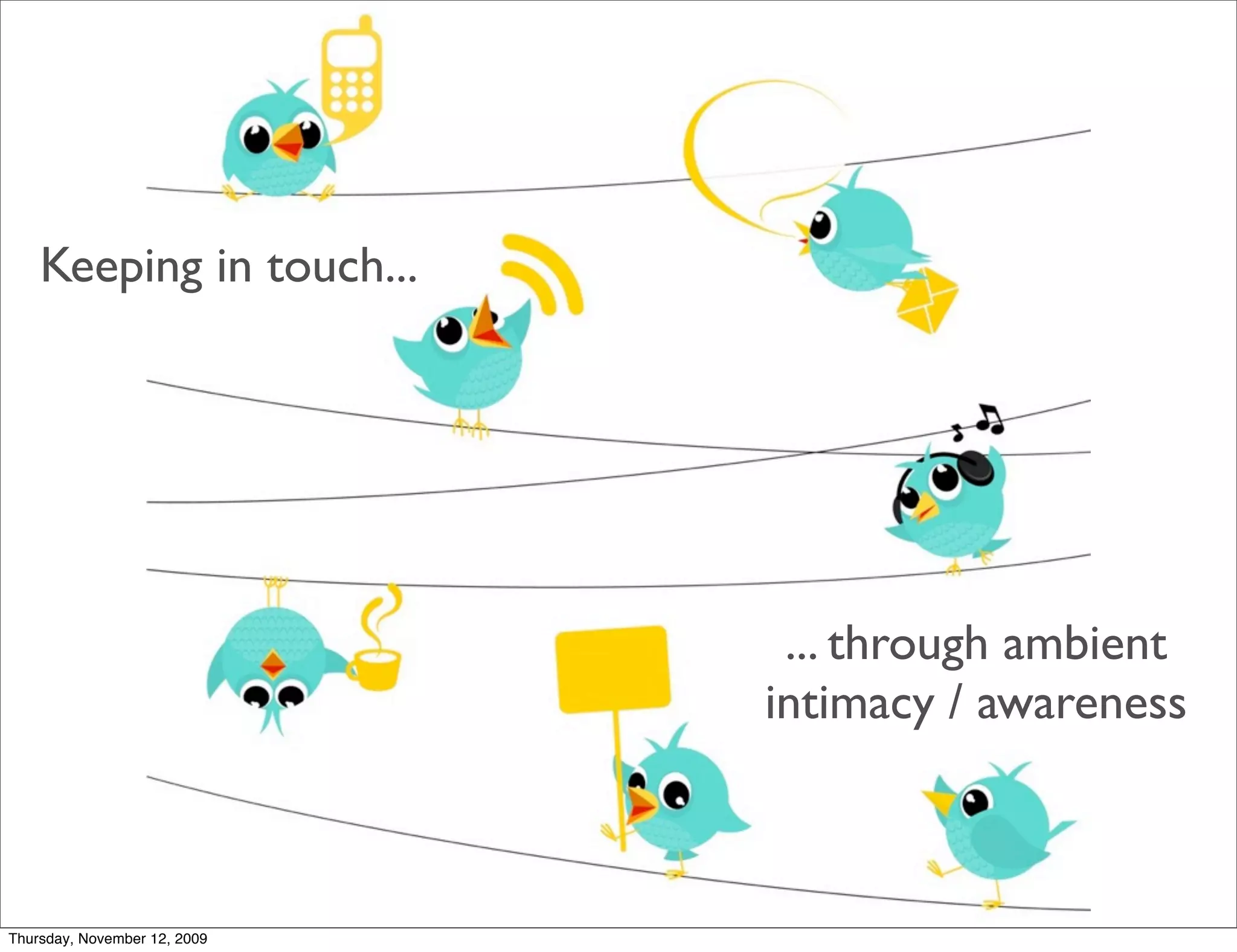
Keeping in touch...


                               ... through ambient
                              intimacy / awareness


Thursday, November 12, 2009
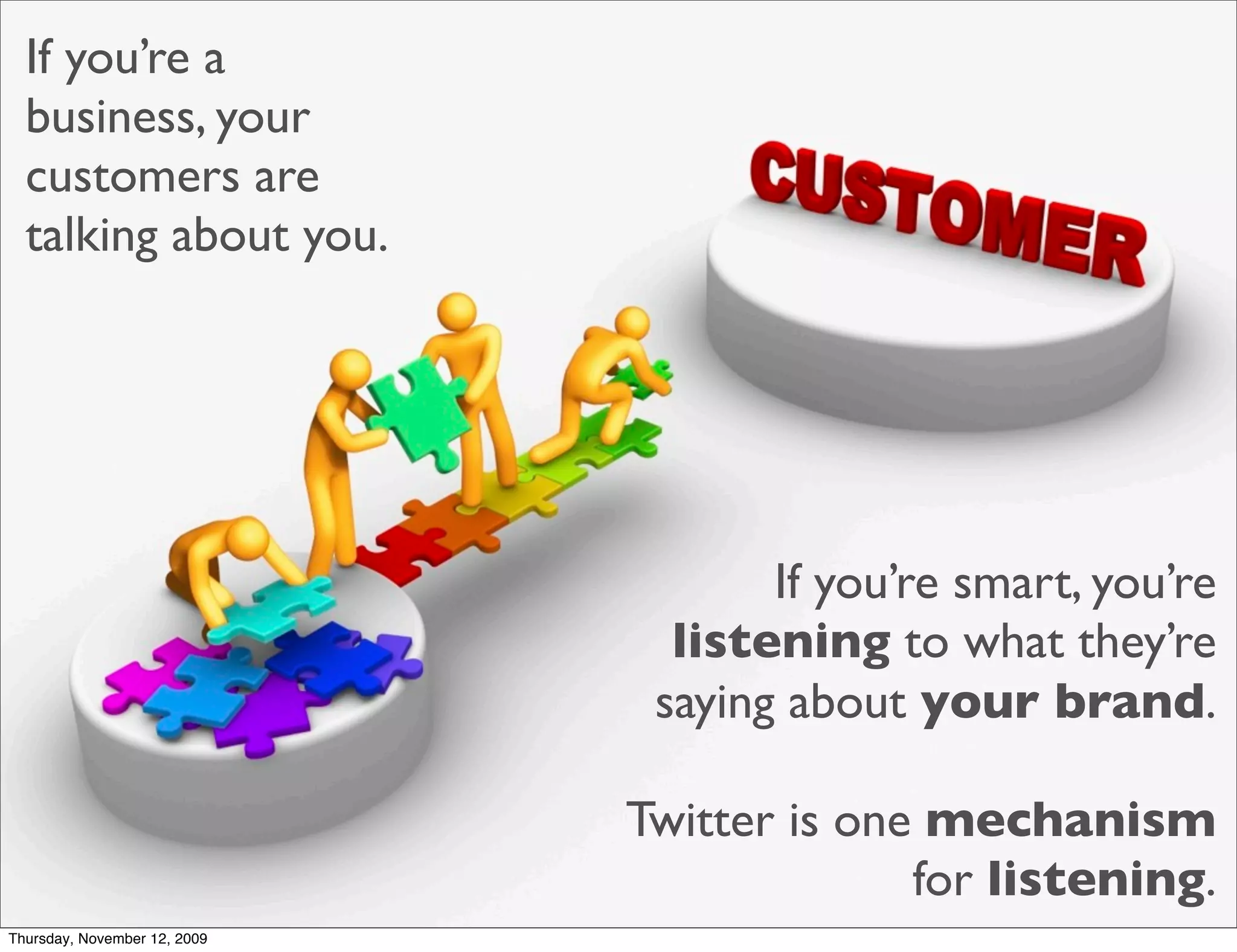
If you’re a
  business, your
  customers are
  talking about you.


                                     If you’re smart, you’re
                                listening to what they’re
                               saying about your brand.

                              Twitter is one mechanism
                                            for listening.
Thursday, November 12, 2009
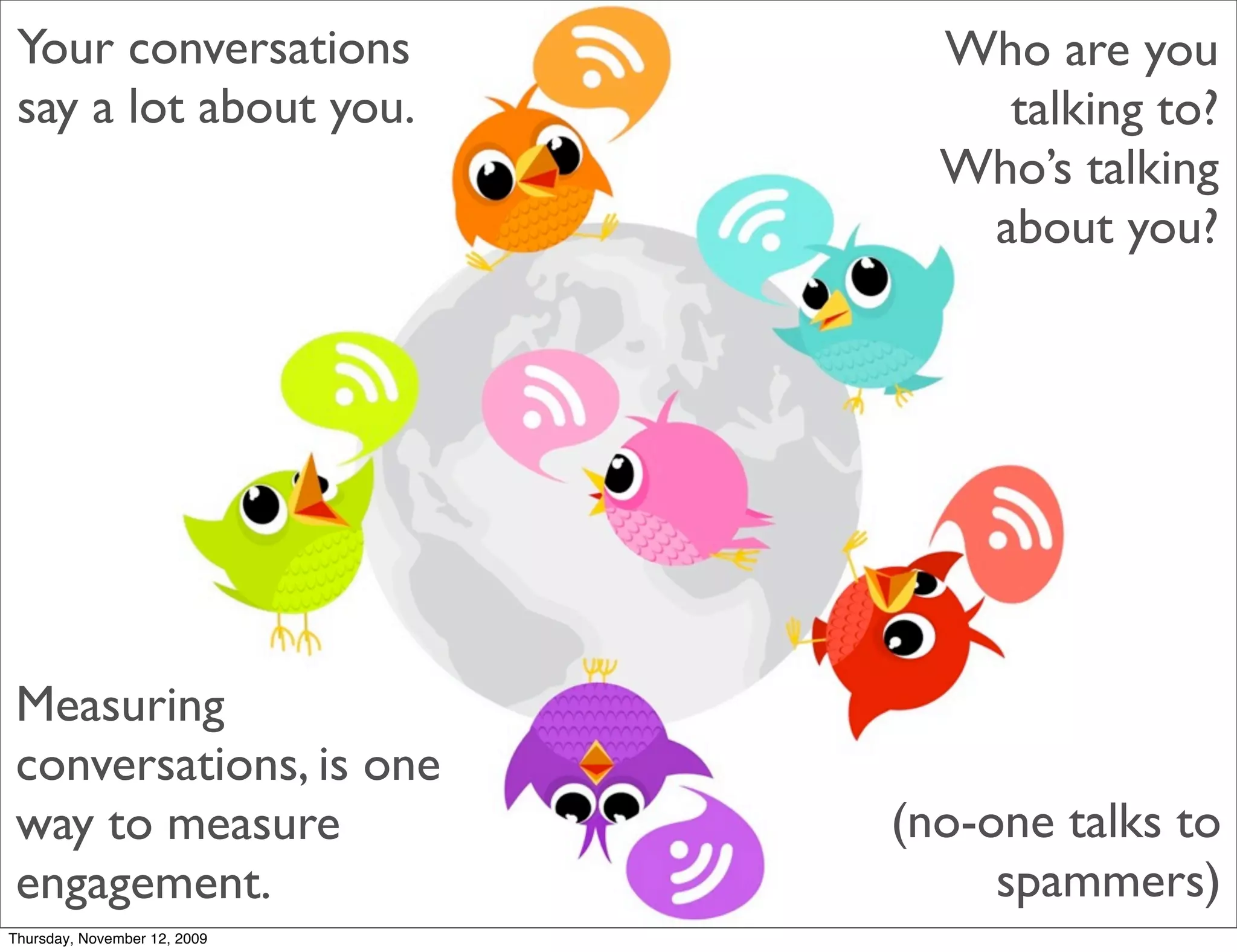
Your conversations             Who are you
 say a lot about you.             talking to?
                                Who’s talking
                                 about you?


Measuring
conversations, is one
way to measure                (no-one talks to
engagement.                        spammers)
Thursday, November 12, 2009
Spammers have caused number of followers
                to became a poor way to measure influence.

Thursday, November 12, 2009
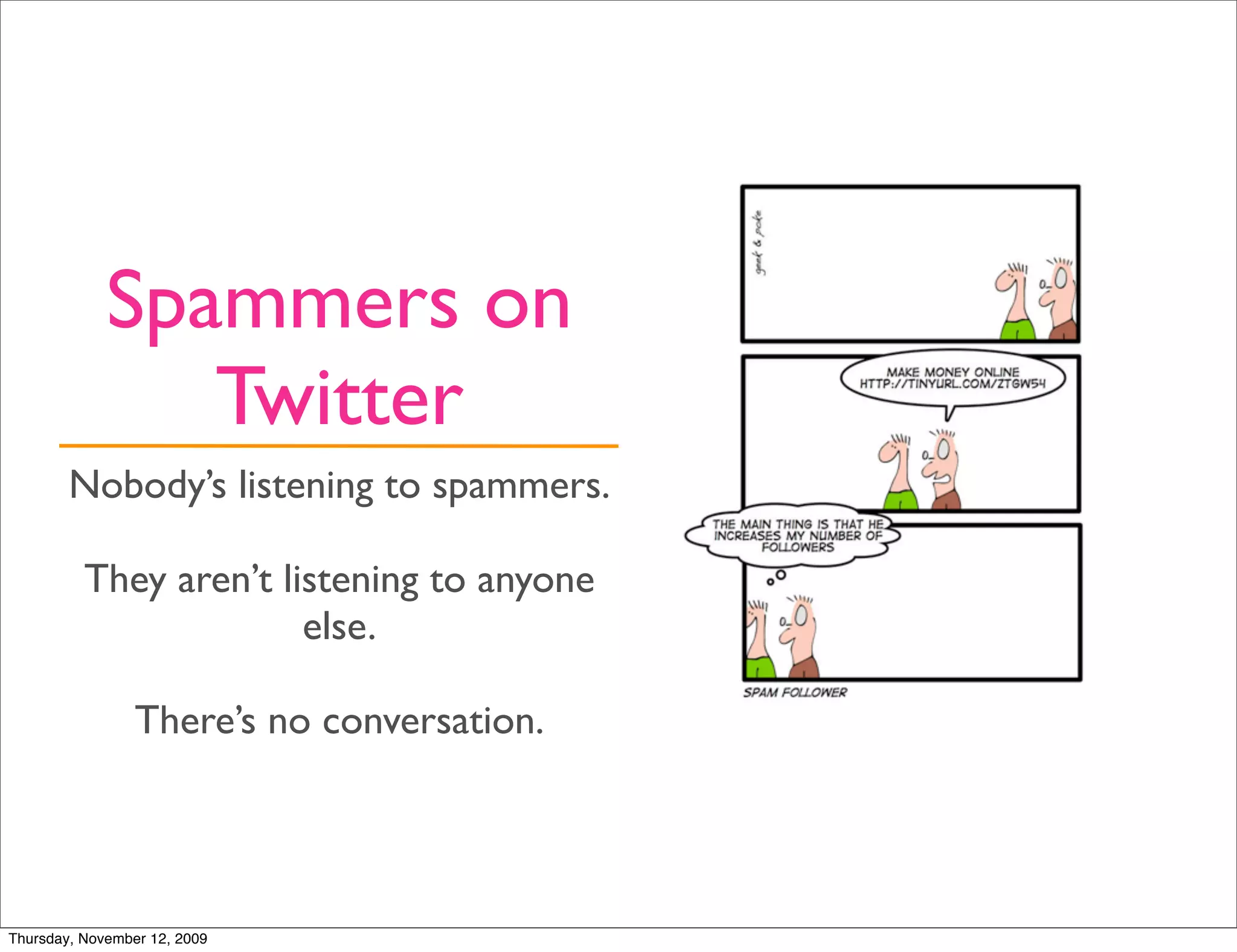
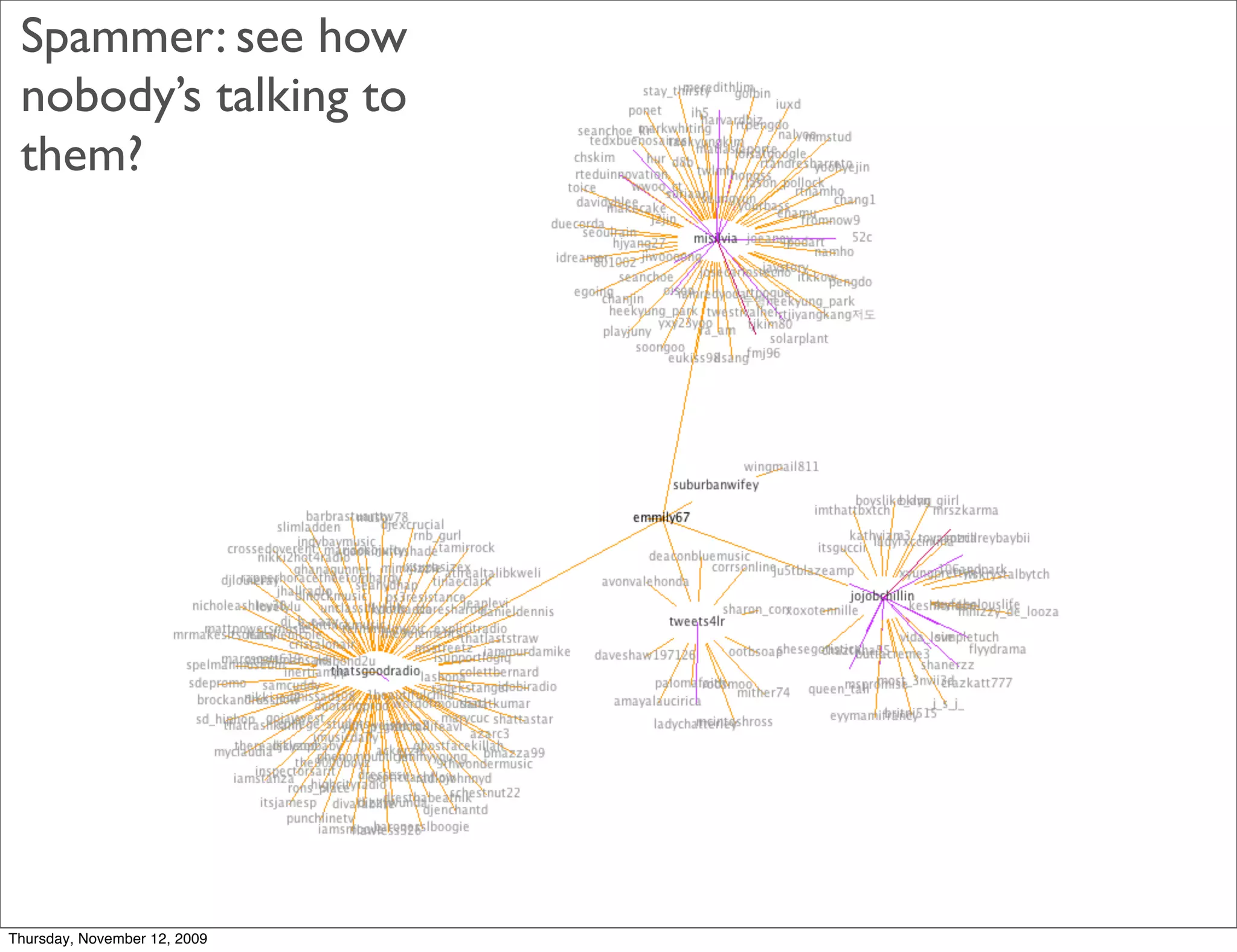
Spammers on
                Twitter
        Nobody’s listening to spammers.

          They aren’t listening to anyone
                        else.

                 There’s no conversation.


Thursday, November 12, 2009
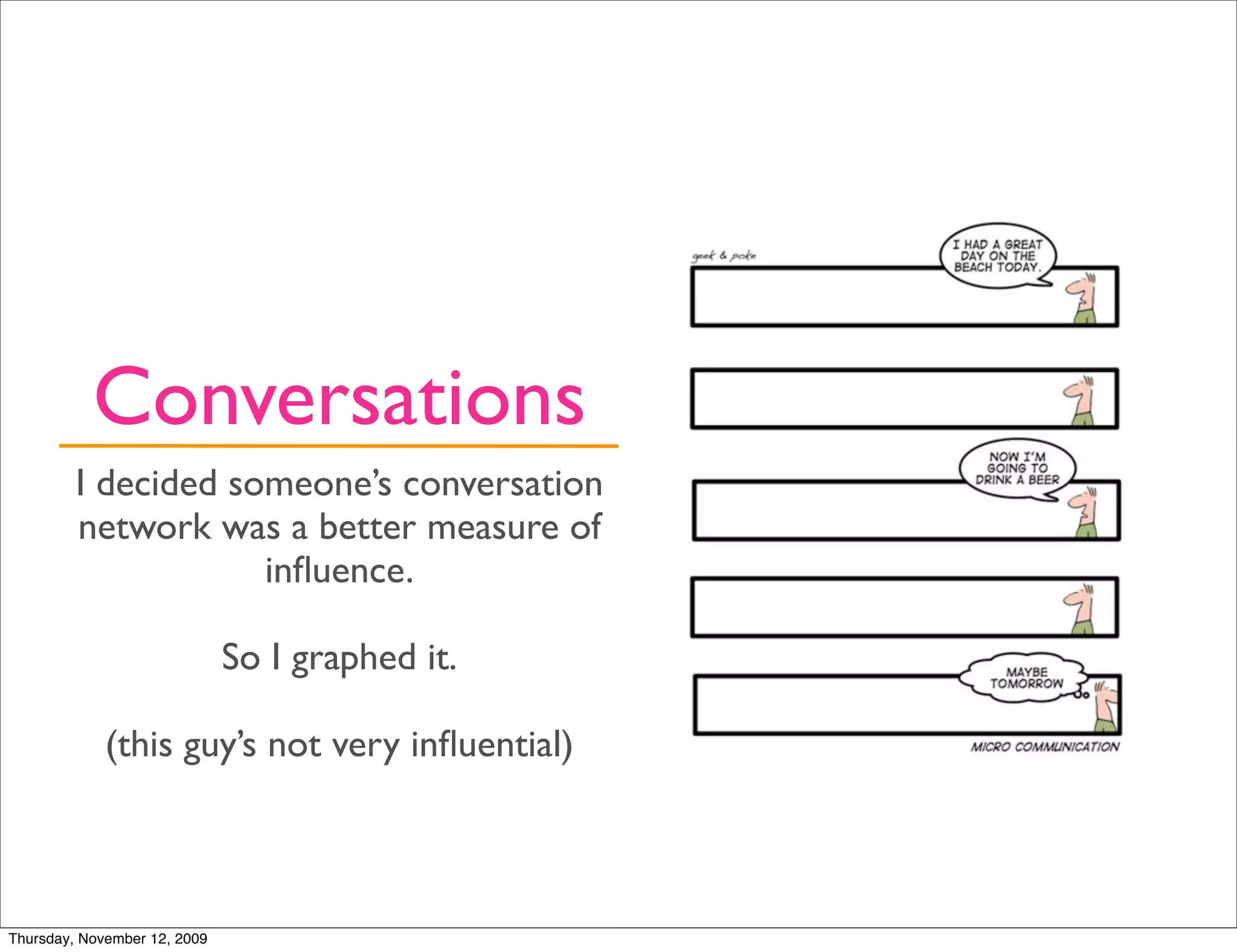
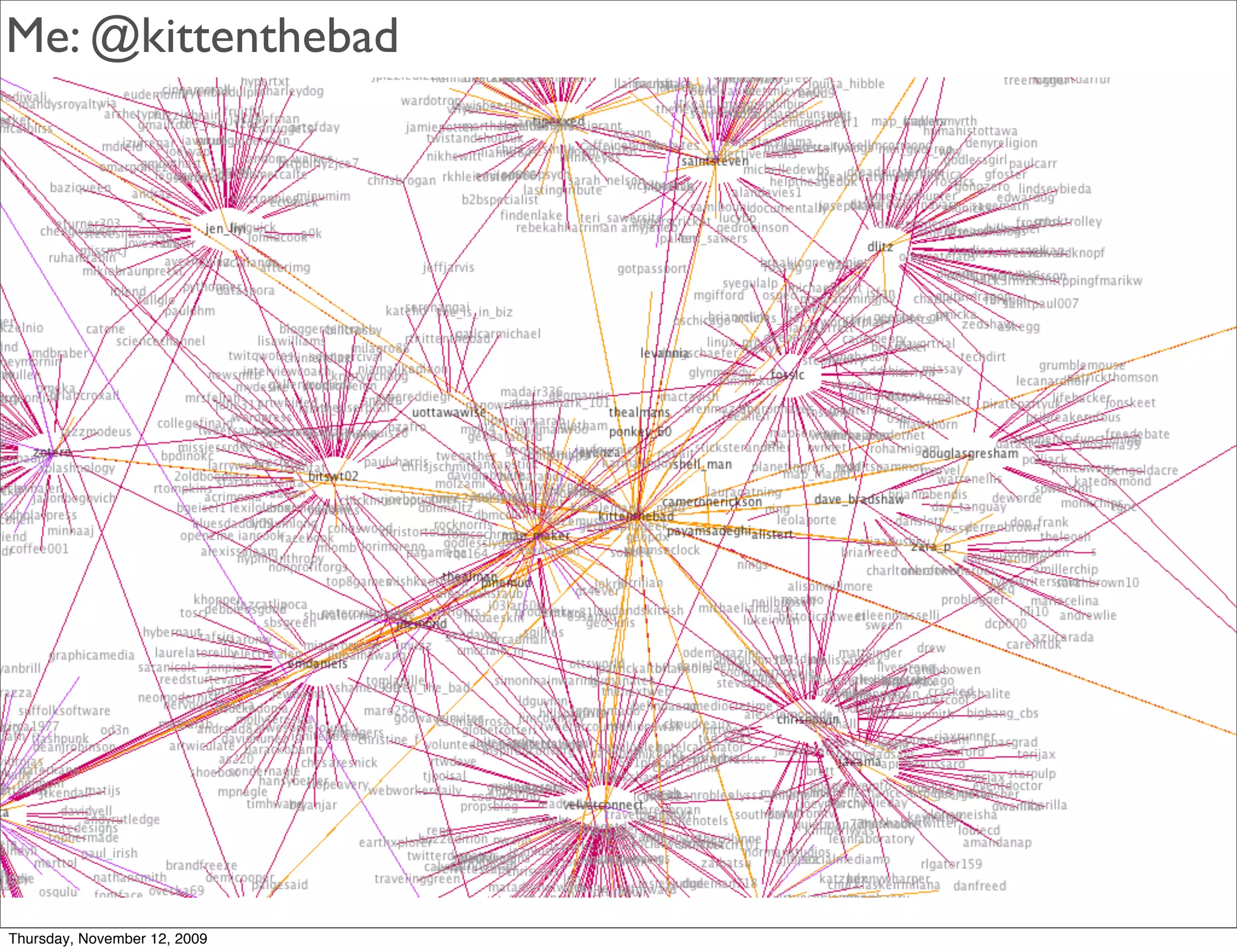
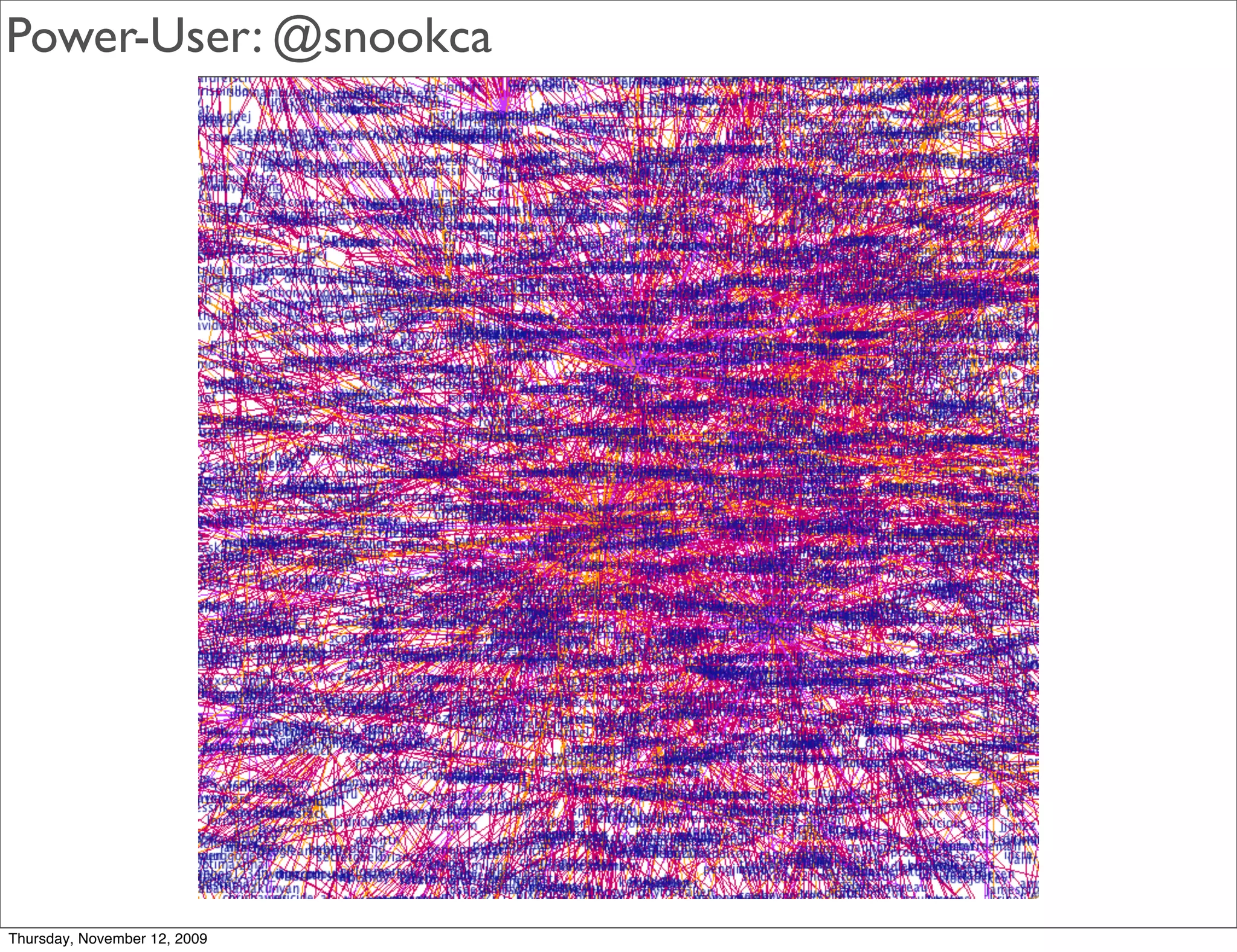
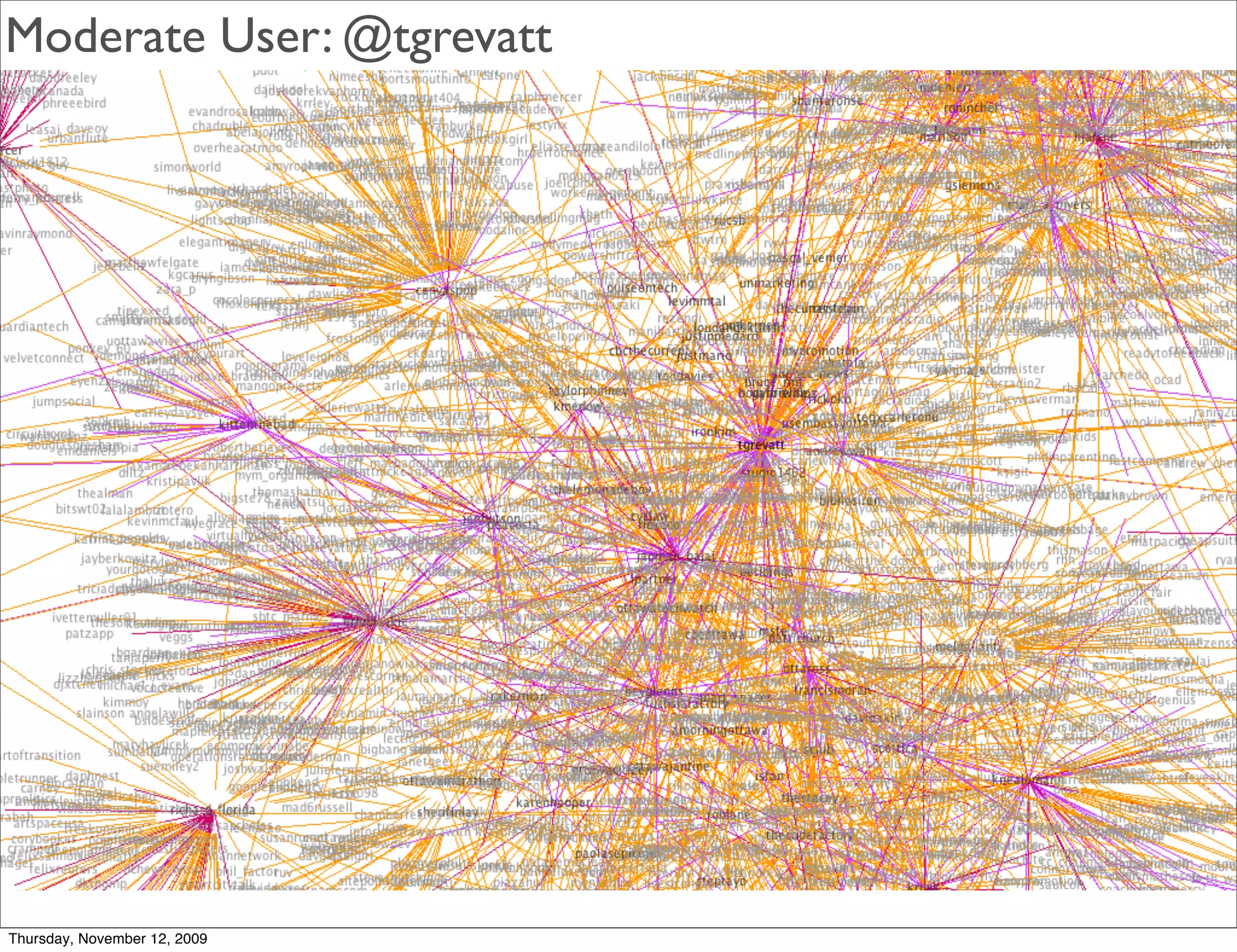
Conversations
         I decided someone’s conversation
         network was a better measure of
                     influence.

                              So I graphed it.

             (this guy’s not very influential)


Thursday, November 12, 2009
Me: @kittenthebad


Thursday, November 12, 2009
Spammer: see how
 nobody’s talking to
 them?


Thursday, November 12, 2009
Power-User: @snookca


Thursday, November 12, 2009
Moderate User: @tgrevatt


Thursday, November 12, 2009
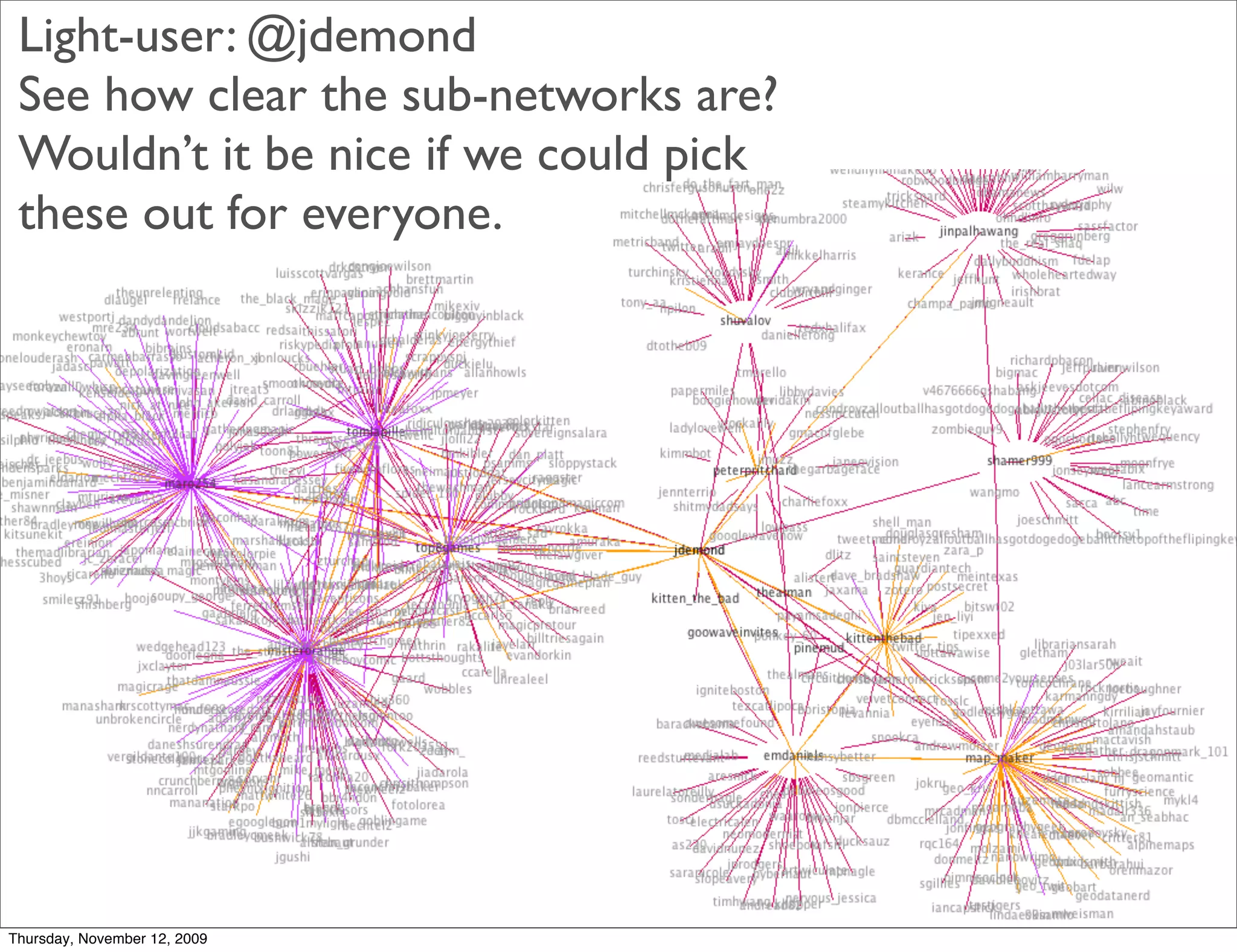
Light-user: @jdemond
 See how clear the sub-networks are?
 Wouldn’t it be nice if we could pick
 these out for everyone.


Thursday, November 12, 2009
@kittenthebad
                http://kittenthebad.wordpress.com/

                          catehuston@googlewave.com


Thursday, November 12, 2009
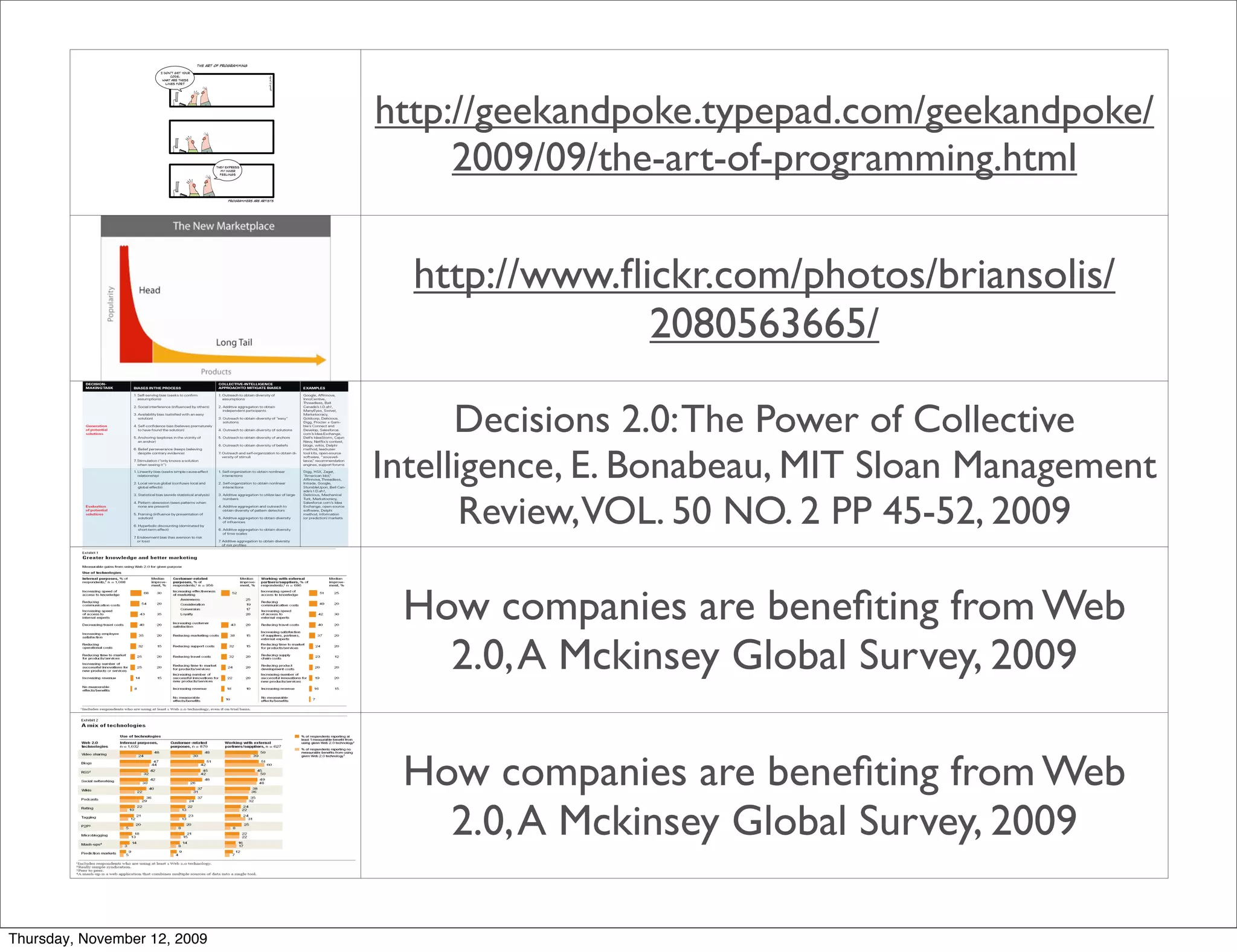
http://geekandpoke.typepad.com/geekandpoke/
                                   2009/09/the-art-of-programming.html

                                http://www.flickr.com/photos/briansolis/
                                             2080563665/

                                    Decisions 2.0: The Power of Collective
                              Intelligence, E. Bonabeau, MIT Sloan Management
                                     Review,VOL. 50 NO. 2 PP 45-52, 2009

                               How companies are benefiting from Web
                                 2.0, A Mckinsey Global Survey, 2009

                               How companies are benefiting from Web
                                 2.0, A Mckinsey Global Survey, 2009

Thursday, November 12, 2009
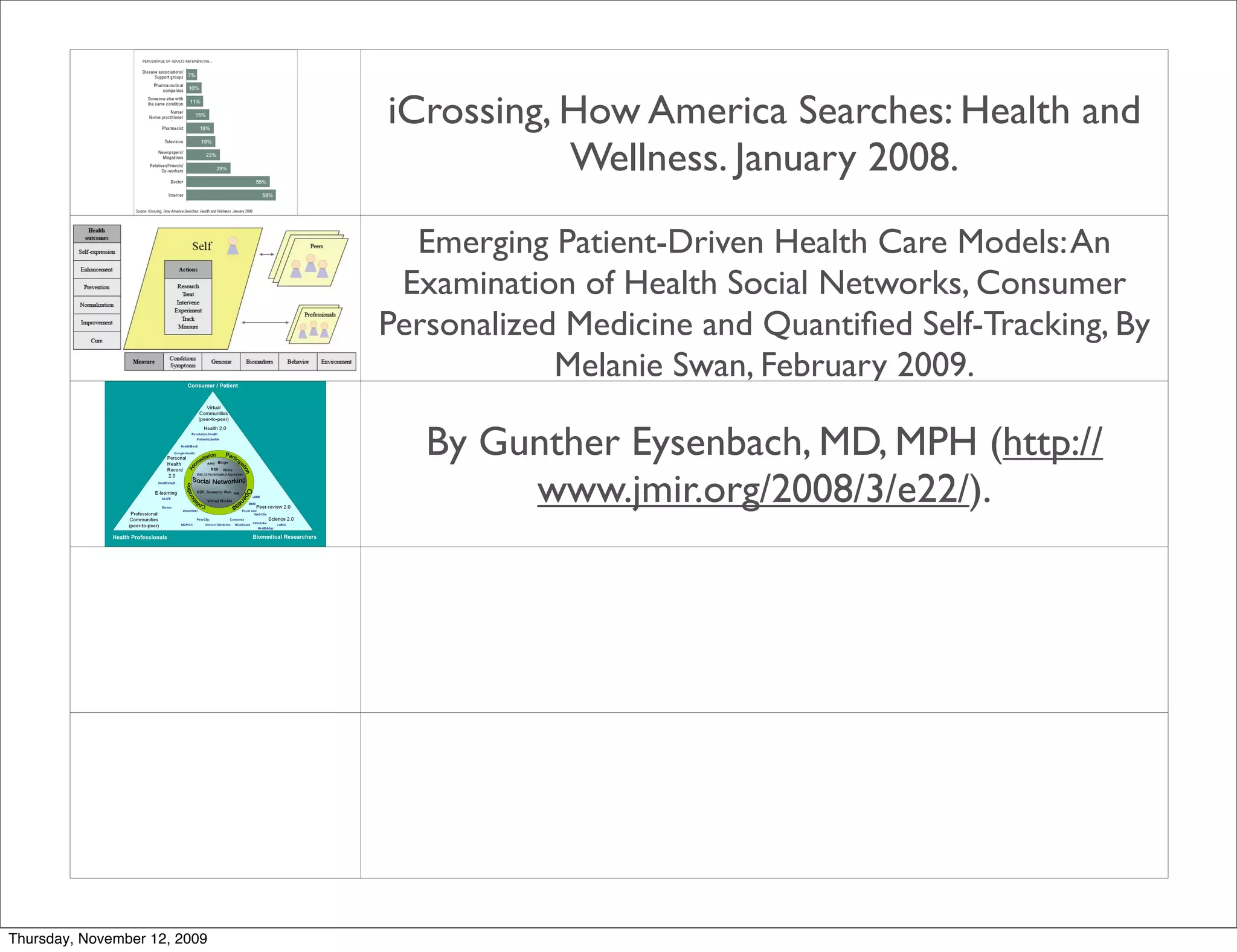
iCrossing, How America Searches: Health and
                                         Wellness. January 2008.

                                Emerging Patient-Driven Health Care Models: An
                               Examination of Health Social Networks, Consumer
                              Personalized Medicine and Quantified Self-Tracking, By
                                          Melanie Swan, February 2009.

                                 By Gunther Eysenbach, MD, MPH (http://
                                      www.jmir.org/2008/3/e22/).


Thursday, November 12, 2009
iStockPhoto


                                 http://www.flickr.com/photos/
                                 22746515@N02/3554570745/


                                          iStockPhoto


                              http://spinster.blogs.com/rak/2009/06/
                                             green.html

                              http://spinster.blogs.com/rak/2009/06/
                                             green.html

Thursday, November 12, 2009
http://whatothersmissed.blogspot.com/
                                      2009/06/round-up.html

                                http://www.flickr.com/photos/ari/
                                         3644667355/

                                http://www.flickr.com/photos/ari/
                                         3625401150/

                                  http://www.flickr.com/photos/
                                  24960504@N06/3581090321

                               http://commons.wikimedia.org/wiki/
                              File:British_Houses_of_Parliament.jpg

Thursday, November 12, 2009
http://trendistic.com/trafigura/jan-moir/_30-
                                                   days

                               http://seedmagazine.com/content/article/
                                         a_writing_revolution/

                                   http://geekandpoke.typepad.com/
                                geekandpoke/2009/04/twitter-business-
                                               plan.html

                                             iStockPhoto


                                             iStockPhoto


Thursday, November 12, 2009
iStockPhoto


                                            iStockPhoto


                                            iStockPhoto


                                  http://geekandpoke.typepad.com/
                              geekandpoke/2009/02/spam-followers.html

                                   http://geekandpoke.typepad.com/
                              geekandpoke/2009/07/micro-messages.html

Thursday, November 12, 2009
References
                   •          [1] Web 2.0: Conceptual Foundations and
                              Marketing Issues, E. Constantinides and S. J.
                              Fountain, Journal of Direct, Data and Digital
                              Marketing Practice,VOL. 9 NO. 3 PP 231-244, 2008

                   •          [2] Decisions 2.0: The Power of Collective
                              Intelligence, E. Bonabeau, MIT Sloan Management
                              Review,VOL. 50 NO. 2 PP 45-52, 2009

                   •          [3] How companies are benefiting from Web 2.0, A
                              Mckinsey Global Survey, 2009


Thursday, November 12, 2009
References
                   •          [4] Web 2.0 systems supporting childhood chronic disease management:
                              A pattern language representation of a general architecture. By Toomas
                              Timpka and et al, November 2008.

                   •          [5] Expanding patient-centered care to empower patients and assist
                              providers. By M. W. Stanton, May 2002)

                   •          [6] iCrossing, How America Searches: Health and Wellness. January 2008.

                   •          [7] Emerging Patient-Driven Health Care Models: An Examination of
                              Health Social Networks, Consumer Personalized Medicine and
                              Quantified Self-Tracking, By Melanie Swan, February 2009.

                   •          [8] By Gunther Eysenbach, MD, MPH (http://www.jmir.org/2008/3/e22/).


Thursday, November 12, 2009

Web 2.0

  • 1.
    Web 2.0 Morad Benyoucef, Cate Huston, Amir Rad, Payam Sadeghi Thursday, November 12, 2009
  • 2.
    Introduction to Web2.0 Thursday, November 12, 2009
  • 3.
    Introduction to Web2.0 • Web 2.0 • Principles of Web 2.0 • Web 2.0 & collaboration • Decisions 2.0 • Enterprise 2.0 Thursday, November 12, 2009
  • 4.
  • 5.
    What is Web 2.0? From a platform of presentation (eyeballs, stickiness, etc.) to a computational platform Whatever you do on the web, you are in a sense programming. Thursday, November 12, 2009
  • 6.
    What is Web2.0? • Blogs (citizen journalism), wikis, social networks, web services, RSS feeds, recommendations, folxonomies (i.e., folk taxonomies / user created taxonomies / tagging), open APIs, etc. • Consumers become producers (prosumers) Thursday, November 12, 2009
  • 7.
    What does Web2.0 mean to individuals? • participation • connectedness • collaboration • rich experiences • conversation • etc! • community Thursday, November 12, 2009
  • 8.
    What does web2.0 mean to organizations? • openness • collaboration • crowd sourcing • empowered and engaged customers/ partners/suppliers • etc! Thursday, November 12, 2009
  • 9.
    “Web 2.0 applicationssupport the creation of informal users’ networks facilitating the flow of ideas and knowledge by allowing the efficient generation, dissemination, sharing and editing/refining of informational content” [1] Thursday, November 12, 2009
  • 10.
    Web 2.0 isalso called wisdom web, social web, people-centric web, participative web, read/ write web, etc. [1] Thursday, November 12, 2009
  • 11.
    Web 2.0 -classification [1] Web 2.0! Blogs & Social Content Forums / Content Podcasts! Networks! Communities! Bulletin Boards! Aggregators! Web logs / journals! Applications allowing Applications organizing & Applications for Applications allowing users to build sharing a particular type of exchanging ideas and users to customize Fastest growing personal websites content! information usually web content using category of Web 2.0 accessible to others around special Real Simple applications! www.youtube.com (videos)! for exchange of interests! Syndication (RSS)! http://wordpress.org ! personal content and www.flickr.com (photos)! www.epinions.com! communication! www.digg.com (social www.python.org ! www.facebook.com ! bookmarking)! www.wikipedia.org (publicly edited encyclopedia) ! Thursday, November 12, 2009
  • 12.
    Web 2.0 -main principles [1] • Service-based, simple and open-source solutions • Simple interfaces, limited features, customizable applications • Network effect vs. vendor lock-in • A user would not switch from Skype to a competitor if the user’s contacts are also on Skype Thursday, November 12, 2009
  • 13.
    Web 2.0 -main principles [1] From software as a product to software as a service (Google Docs, Salesforce) Thursday, November 12, 2009
  • 14.
    Web 2.0 -main principles [1] • Continuous and incremental application development requiring user participation • Users are no longer just consumers, they contribute, review and refine content aggregation of collective intelligence • Continuous real time improvement of applications based on user feedback • Software remains under development and improvement as long as it exists (Perpetual Beta) Thursday, November 12, 2009
  • 15.
    Web 2.0 -main principles [1] • New service based business models and new opportunities for reaching small consumers with low-volume products • Offer services for free and generate revenue through advertising and/or sponsoring (Google Search, etc.) • Offer basic services for free and charge a fee for premium services (Ning, etc.) Thursday, November 12, 2009
  • 16.
    Leverage the LongTail “a retailing concept describing the niche strategy of selling a large number of unique items in relatively small quantities - usually in addition to selling fewer popular items in large quantities.” [Source: en.wikipedia.org/wiki/The_Long_Tail] Thursday, November 12, 2009
  • 17.
    Web 2.0 & collaboration Thursday, November 12, 2009
  • 18.
    Goldcorp Example • Inspired by the Linux story, Goldcorp published its geological data and held a contest for whoever finds gold based on the data • 77 submissions from around the world Thursday, November 12, 2009
  • 19.
    Open market forideas • http://www.innocentive.com/ • P&G: most innovations will come from outside the company • Portfolio of IP (intellectual property) some of it kept private, some of it shared Thursday, November 12, 2009
  • 20.
    Boeing co-innovated aplane on the web with its suppliers (considered peers) Thursday, November 12, 2009
  • 21.
    Netflix • The www.Netflix.com crowd-sourcing example • 1 million dollars awarded to a team who created a movie recommendation algorithm Thursday, November 12, 2009
  • 22.
    “There is nocrowd in crowd-sourcing. There are only virtuosos, usually uniquely talented, highly trained people who have worked for decades in a field ” Dan Woods “The Myth of Crowd-sourcing Crowds don't innovate--individuals do.” http://www.forbes.com/2009/09/28/crowdsourcing-enterprise-innovation-technology-cio- network-jargonspy.html Thursday, November 12, 2009
  • 23.
    • !"#$%&'$($)*+ • ,-.'/%01&2)+ • 3'45$+6$$+ • 72((0''02)+ Thursday, November 12, 2009
  • 24.
  • 25.
    “companies have alwaysused teams to solve problems, focus groups to explore customer needs, consumer surveys to understand the market and annual meetings to listen to shareholders” [2] Thursday, November 12, 2009
  • 26.
    Decisions 2.0 [2] • Today companies can use Web 2.0 (“collective intelligence”, “wisdom of the crowd”, wikis, “crowdsourcing”, etc.) in making decisions • Decision making can be broken into generation of potential solutions evaluation of those solutions • These two tasks can be influenced by human biases which can be mitigated using collective intelligence Thursday, November 12, 2009
  • 27.
  • 28.
    Decisions 2.0 [2] • A study on Collective Intelligence concluded that: • Tools using collective intelligence have performed better than theorists can explain • Collective intelligence is better for idea generation than for idea evaluation • Managers need to consider many key issues when designing collective intelligence tools – from loss of control to balance of diversity to expertise Thursday, November 12, 2009
  • 29.
  • 30.
    Suppliers Customers Enterprise Partners : Web 2.0 Deployment Thursday, November 12, 2009
  • 31.
    Enterprises and Web2.0 [3] • Internally: share ideas, access to knowledge, reduced cost of communication, reduced time to market products, improved customer satisfaction • Externally: better interactions with organizations and customers, closer ties with customers, increased customer awareness of the company’s products, improved customer satisfaction, joint design with customers, partners and suppliers Thursday, November 12, 2009
  • 32.
  • 33.
  • 34.
    @benyoucef http://business.admin.uottawa.ca/~benyoucef/ morad.benyoucef@googlewave.com Thursday, November 12, 2009
  • 35.
    The Effects ofSocial Networks on Business Thursday, November 12, 2009
  • 36.
    5)."& +."<(8=& 2-"67(1-6#8& 5)."& 5)."& 3#8=&>-(3& !"#$%& 5)."& 5)."& 9(7,&5)."& '()%#*& :;1."(.87.& !"#$%& 5)."& 5)."& +,-".%& '()%#*& './& 011)& './&-)& 23-4#"*& Thursday, November 12, 2009
  • 37.
    Social Network Analysis • Social Network are measured in terms of: • Degree Centrality: The number of direct connections a node has. What really matters is where those connections lead to and how they connect the otherwise unconnected. • Betweenness Centrality: A node with high betweenness has great influence over what flows in the network indicating important links and single point of failure. • Closeness Centrality: The measure of closeness of a node which are close to everyone else. The pattern of the direct and indirect ties allows the nodes any other node in the network more quickly than anyone else. They have the shortest paths to all others. Thursday, November 12, 2009
  • 38.
    • !"#$%&'$($)*+ • ,-.'/%01&2)+ • 3'45$+6$$+ • 72((0''02)+ Thursday, November 12, 2009
  • 39.
    • • Social Commerce • Low-barrier !"#$ !"#$%&'#"'#$ • Available anywhere %&'#)./,0&'$ !"#$%&' • Allow business users to ("))*+#*' ,-%.*.' structure information & content !"#$(&)"$ !"#$(&)"$ *)&($ *)&($ +&'#)./,#&)-$ +,-#&(")$ • Continuous maintenance Thursday, November 12, 2009
  • 40.
    *+,)-+).%-) /"+00%1()-+) 2#$34) *+,)-+) *+,)-+) 5%#(61%)7#$6%) %7#$6#-%) +8) 91%?:;:$:-B4) 9+&-1:;6<+&4) *+,)-+) ="#->()-"%) %C%9<7%$B) ;1#&?)7#$6%4) #?7%1<(%4) *+,)-+) !"#$$%&'%() "+,)-+) %C%9<7%$B) 5#@:5:A%)-"%) 1%#9") 7#$6%)+8) 0+-%&<#$) 9+&-1:;6<+&4) 96(-+5%1(4) *+,)9#&)7#$6%) 91%#<+&);%) *+,)-+)8+(-%1) -1#&($#-%?):&-+) 9+&-1:;6<+&4) +0%1#<+&#$) 9"#&'%(4)) *+,)#1%) *+,)-+)'%-) 9+&-1:;6<+&() %@%96<7%) :50#9<&') 6&?%1(-#&?:&' B+61) 4) 1%06-#<+&4) Thursday, November 12, 2009
  • 41.
    Effective Customer Targeting: Predicting the Potential Actors, Choosing the right actors, Most Visited actor Thursday, November 12, 2009
  • 42.
    ),-./0( !"#$%&'( 102,.-3( )*+",-.( 4+22(%20( )*+"0$( )*+"0$( !+560-'( !#22022,#-( Future of Social Commerce Thursday, November 12, 2009
  • 43.
    @amir_a_rad a.afrasiabi@uottawa.ca Thursday, November 12, 2009
  • 44.
    Health Care & Health 2.0 Thursday, November 12, 2009
  • 45.
    Current Trends in Health Care • Effective health Information Sharing is highly required: • From Biomedicine to Infomedicine • Health care models and policies [4] are emerging from disease-centered to patient-centered [5]. • Internet Models as a primary source of health information mainly for: • Improving collaboration along the health care process. • Finding timely and personalized health information. Thursday, November 12, 2009
  • 46.
    Health 2.0 Definition • Combination of health • Exchange health information; data and health information with patient experience through the • Collaborate with each other on a large scale; use of ICT, enabling the citizen to become an active and responsible • Actively participate in health care process; partner in his/her own health and care pathway • Build personal network of (by Lodewijk Bos), where friends; consumers are able to: • And patient expertise is valued! Thursday, November 12, 2009
  • 47.
    Applications of Health 2.0[6] Thursday, November 12, 2009
  • 48.
  • 49.
    Sources Used toFind or Access Health-Related Information in the Past 12 Months in US, 2008.[6] Thursday, November 12, 2009
  • 50.
    According to Dr.Martin Seligman’s findings, extremely happy people are extremely social. And technology, entertainment, and design are able to increase happiness and positive emotion by increasing meaning engagement in life. Thursday, November 12, 2009
  • 51.
    PatientsLikeMe as a Health 2.0 Platform Thursday, November 12, 2009
  • 52.
  • 53.
    Health 2.0 Basis Structure Thursday, November 12, 2009
  • 54.
    Swan Health 2.0 Model [7] Thursday, November 12, 2009
  • 55.
    E-Health Issues • Information integration is a critical point. • Delivering right information to the right person at the right time! • Information explosion in health • Credibility and patients’ privacy are challenging. Thursday, November 12, 2009
  • 56.
    E-Health 2.0 Initiatives • Health care mechanism/model with the following characteristics: • Supports multi-disciplinary decision- making • Offers customizable (personalized) health services • Accepts the patients as partner through structured participation schema Thursday, November 12, 2009
  • 57.
    E-Health 2.0 Initiatives • Digitizing a health care process/scenario based on SCM Models where: • Patients are partners • Health professionals are consultants • Hospitals/clinics are service enablers Thursday, November 12, 2009
  • 58.
    @PayamSadeghi http://www.iPayam.com/MyThesis/ PSade077@uOttawa.ca Thursday, November 12, 2009
  • 59.
    Conversation 2.0: Twitter Thursday, November 12, 2009
  • 60.
    The Internet (ARPANet)went live in 1969 The World Wide Web in 1990 (no, they are not the same thing) Thursday, November 12, 2009
  • 61.
    Now, the web/internetis infrastructure: like electricity, roads, public transport, running water... Thursday, November 12, 2009
  • 62.
    So much haschanged - so fast. This is just the beginning. Thursday, November 12, 2009
  • 63.
    Authorization of contentis now nearly universal. http://seedmagazine.com/content/article/a_writing_revolution/ Thursday, November 12, 2009
  • 64.
  • 65.
    The possibility of“Serendipitous Connections” The power of “Weak-Tie” relationships Thursday, November 12, 2009
  • 66.
    Twitter! Hang on - isn’t Twitter a Pointless Waste of Time? NO Twitter is having real impact. Thursday, November 12, 2009
  • 67.
    The US gvtintervened to change Twitter’s maintenance time to keep the service up in the aftermath of Iran’s Election Authoritarian regimes are now more afraid of conversation than information Thursday, November 12, 2009
  • 68.
    October 13th, 2009: #Trafigura is trending - why? October 16th, 2009: “Jan Moir” is trending - why? Thursday, November 12, 2009
  • 69.
    #Trafigura: Outrage atthe press prohibited from reporting on parliament “Jan Moir”: Disgust at an article about the tragic death of a pop star Thursday, November 12, 2009
  • 70.
    Twitter doesn’t justtell us what a person is doing right now, it tells us what’s hot, what people are getting angry/excited/upset about. Twitter captures the moment. Thursday, November 12, 2009
  • 71.
    Information Gathering: Crowd-Source your News • Personally, the most useful aspect of Twitter • Follow leaders in your field • People working in similar areas, who tweet useful links • People who inspire you Thursday, November 12, 2009
  • 72.
    Keeping in touch... ... through ambient intimacy / awareness Thursday, November 12, 2009
  • 73.
    If you’re a business, your customers are talking about you. If you’re smart, you’re listening to what they’re saying about your brand. Twitter is one mechanism for listening. Thursday, November 12, 2009
  • 74.
    Your conversations Who are you say a lot about you. talking to? Who’s talking about you? Measuring conversations, is one way to measure (no-one talks to engagement. spammers) Thursday, November 12, 2009
  • 75.
    Spammers have causednumber of followers to became a poor way to measure influence. Thursday, November 12, 2009
  • 76.
    Spammers on Twitter Nobody’s listening to spammers. They aren’t listening to anyone else. There’s no conversation. Thursday, November 12, 2009
  • 77.
    Conversations I decided someone’s conversation network was a better measure of influence. So I graphed it. (this guy’s not very influential) Thursday, November 12, 2009
  • 78.
  • 79.
    Spammer: see how nobody’s talking to them? Thursday, November 12, 2009
  • 80.
  • 81.
  • 82.
    Light-user: @jdemond Seehow clear the sub-networks are? Wouldn’t it be nice if we could pick these out for everyone. Thursday, November 12, 2009
  • 83.
    @kittenthebad http://kittenthebad.wordpress.com/ catehuston@googlewave.com Thursday, November 12, 2009
  • 84.
    http://geekandpoke.typepad.com/geekandpoke/ 2009/09/the-art-of-programming.html http://www.flickr.com/photos/briansolis/ 2080563665/ Decisions 2.0: The Power of Collective Intelligence, E. Bonabeau, MIT Sloan Management Review,VOL. 50 NO. 2 PP 45-52, 2009 How companies are benefiting from Web 2.0, A Mckinsey Global Survey, 2009 How companies are benefiting from Web 2.0, A Mckinsey Global Survey, 2009 Thursday, November 12, 2009
  • 85.
    iCrossing, How AmericaSearches: Health and Wellness. January 2008. Emerging Patient-Driven Health Care Models: An Examination of Health Social Networks, Consumer Personalized Medicine and Quantified Self-Tracking, By Melanie Swan, February 2009. By Gunther Eysenbach, MD, MPH (http:// www.jmir.org/2008/3/e22/). Thursday, November 12, 2009
  • 86.
    iStockPhoto http://www.flickr.com/photos/ 22746515@N02/3554570745/ iStockPhoto http://spinster.blogs.com/rak/2009/06/ green.html http://spinster.blogs.com/rak/2009/06/ green.html Thursday, November 12, 2009
  • 87.
    http://whatothersmissed.blogspot.com/ 2009/06/round-up.html http://www.flickr.com/photos/ari/ 3644667355/ http://www.flickr.com/photos/ari/ 3625401150/ http://www.flickr.com/photos/ 24960504@N06/3581090321 http://commons.wikimedia.org/wiki/ File:British_Houses_of_Parliament.jpg Thursday, November 12, 2009
  • 88.
    http://trendistic.com/trafigura/jan-moir/_30- days http://seedmagazine.com/content/article/ a_writing_revolution/ http://geekandpoke.typepad.com/ geekandpoke/2009/04/twitter-business- plan.html iStockPhoto iStockPhoto Thursday, November 12, 2009
  • 89.
    iStockPhoto iStockPhoto iStockPhoto http://geekandpoke.typepad.com/ geekandpoke/2009/02/spam-followers.html http://geekandpoke.typepad.com/ geekandpoke/2009/07/micro-messages.html Thursday, November 12, 2009
  • 90.
    References • [1] Web 2.0: Conceptual Foundations and Marketing Issues, E. Constantinides and S. J. Fountain, Journal of Direct, Data and Digital Marketing Practice,VOL. 9 NO. 3 PP 231-244, 2008 • [2] Decisions 2.0: The Power of Collective Intelligence, E. Bonabeau, MIT Sloan Management Review,VOL. 50 NO. 2 PP 45-52, 2009 • [3] How companies are benefiting from Web 2.0, A Mckinsey Global Survey, 2009 Thursday, November 12, 2009
  • 91.
    References • [4] Web 2.0 systems supporting childhood chronic disease management: A pattern language representation of a general architecture. By Toomas Timpka and et al, November 2008. • [5] Expanding patient-centered care to empower patients and assist providers. By M. W. Stanton, May 2002) • [6] iCrossing, How America Searches: Health and Wellness. January 2008. • [7] Emerging Patient-Driven Health Care Models: An Examination of Health Social Networks, Consumer Personalized Medicine and Quantified Self-Tracking, By Melanie Swan, February 2009. • [8] By Gunther Eysenbach, MD, MPH (http://www.jmir.org/2008/3/e22/). Thursday, November 12, 2009