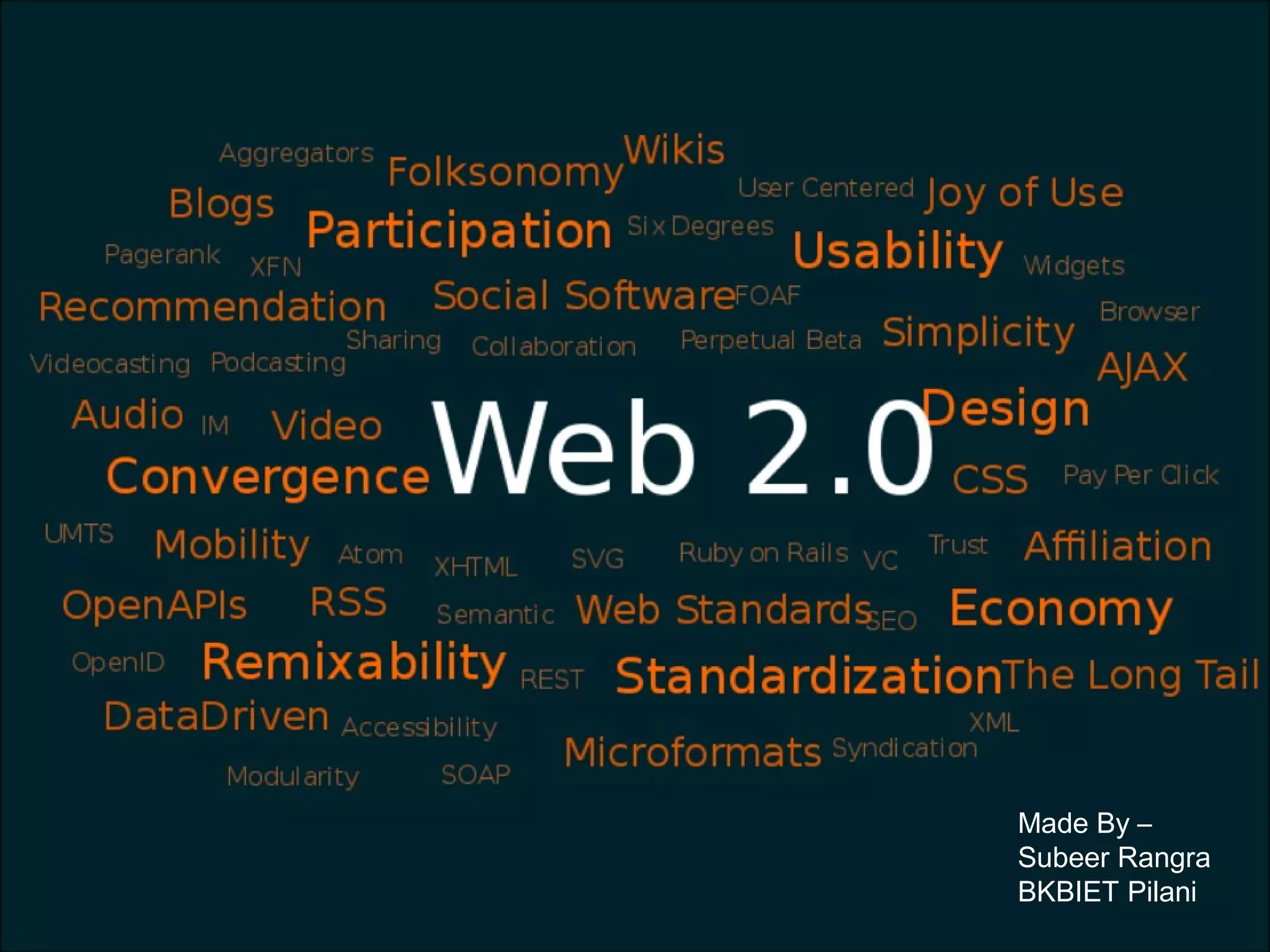
Made By –
Subeer Rangra
BKBIET Pilani
• The concept of "Web 2.0" began with a conference
  brainstorming session between O'Reilly and MediaLive
  International in 2004
• The phrase "Web 2.0" hints at an improved form of the
  World Wide Web
• Emphasizing tools and platforms that enable the user to
  Tag, Blog, Comment, Modify, Augment, Rank, etc.
• The more explicit synonym of "Participatory Web"
• Focus on efficient and humane information flow
“There are no products, only solutions”

• Not what customer wants but why they
  want
• Need orientation rather than product
• A problem solving approach
• Active participation of people and
  networks
• Simple Solutions
• Every individual is unique.
 • Some people want to be different
 • Allow them to choose instead of forcing them to
   use what you have made
 • The less they are forced the more they will be
   Interested
 • Make them feel home
e.g.
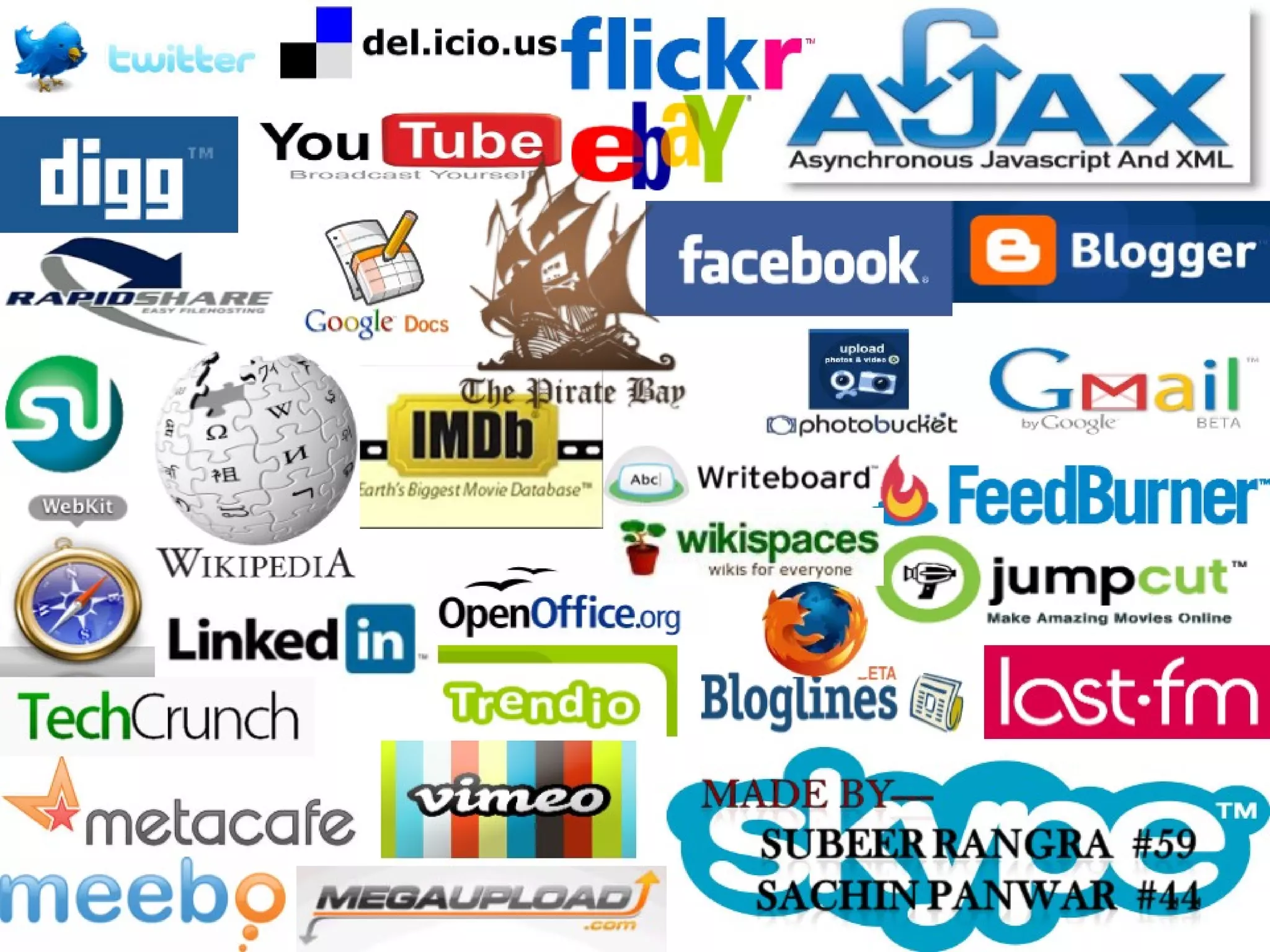
• My yahoo, iGoogle, Myspace , Flikr ,Twitter.
• Firefox add-ons .
• Redefining search by intelligent networks.
• Cloud computing
• Warez legalization by advertisements
• P2P sharing over special servers
• Free for all data banks like Wikipedia
• Specific forums for specific uses
e.g. torrents, rapidshare, megaupload,
• Merging social networking and buisness
• Use of micro bloggers
• Advertisement according to consumer
  preference
• Use of public forums for specific ads.
e.g. facebook, twitter, BlogSpot, Google Ad
Sense.
Network effects from user contribution are the key to
market dominance in Web 2.0 era

The Wisdom of crowds – User add value
•   Amazon, ebay - User reviews, similar items, most popular
•   Blogger – useful and most viewed blogs get paid
•   Wikipedia – content can be added/edited by any web user
•   Flickr – tagging images
•   Firefox – users make specific addons
•   Cloudmark – Spam emails
Some systems, designed to encourage
participation
• Pay people to do it
• Discussions over social networks
• Get volunteers to perform the same task
  o   Inspired by the open source community
• Mutual benefits e.g. P2P sharing
  - Many companies maintain their facebook
  pages
• But only a small percentage of users will go to
  the trouble of adding value to your applications
  via explicit means.
• So web 2.0 companies set aggregating user data
  and building value as side effect of ordinary use
  of the application.
• It requires radical experiment in trust and totally
  new business models.
• Also creates a need for radical changes over
  prevailing business polices
• Every significant application to date has
  been backed by a specialized databases
  o   E.g. Amazon, Google, Ebay , IMDB.
• Database management is the core
  competency of Web 2.0 companies
• Cloud computing decreases need for
  large databases
• “infoware” rather than merely “software”
• Control over data has led to market control and
  oversized financial returns.
• It will provide a sustainable competitive
  advantage to the company.
• Personal data over social networking sites must
  be protected.
• Especially if data sources are expensive to
  create or amenable to increasing returns via
  network effects.
• Race is to own certain classes of core data e.g.
  naukri.com, 99acre, yahoo, Microsoft skydrive,
  IMDB.
• “Release Early and Release Often”
• Perpetual BETA >>testing phase
• Daily operations must become a core
  competency
• Constant feedback for improved products
• Software will cease to perform unless it is
  maintained on a daily basis
• Automate the maintenance and update
  process
• Real time monitoring of user behavior
• Microsoft – upgrades every 2-3 days
• Flickr- Deploy new build up to every half hour

“Put two or three new features on some part of the site
everyday, and if user don’t adopt them, take them out. If
they like them roll them out on entire site” - Anonymous
• The PC is no longer the only access device for
  internet applications, handheld devices redefine
  the information age
• New communication techniques also facilitate this
  phenomena
• Applications that are limited to a single device are
  less valuable than those that are connected.
• Design your application from the get-go to
  integrate services across handheld devices, PCs,
  and internet servers.
• Various open source freeware take a major share
  of the market.
Recruitment:
Due to the cutting-edge underlying technologies and
usability-focused interfaces (the ‘cool’ factor)
Organizations adopting Web 2.0 tend to attract
sophisticated, high-caliber technical candidates.

Reduced cost:
Not only are Web 2.0 offerings low-cost, but the same
techniques can also be applied to existing (non-Web 2.0)
products and services, lowering costs.
e.g. wikis can enable your users to build documentation
and knowledge base systems, with relatively little
investment from yourself.
Loyalty
The open, participatory Web 2.0 environment encourages
user contribution, enhancing customer loyalty and lifespan.

Marketing
By taking advantage of the above mentioned benefits,
marketing and PR teams can implement low-cost, wide-
coverage, viral strategies.

Search Engine Optimization (SEO)
Web 2.0 delivery mechanisms - such as Blogs and RSS -
significantly enhance search engine exposure through their
distributed nature
In the year and a half since, the term "Web
2.0" has clearly taken hold, with more than
9.5 million citations in Google.
          2006                      2008
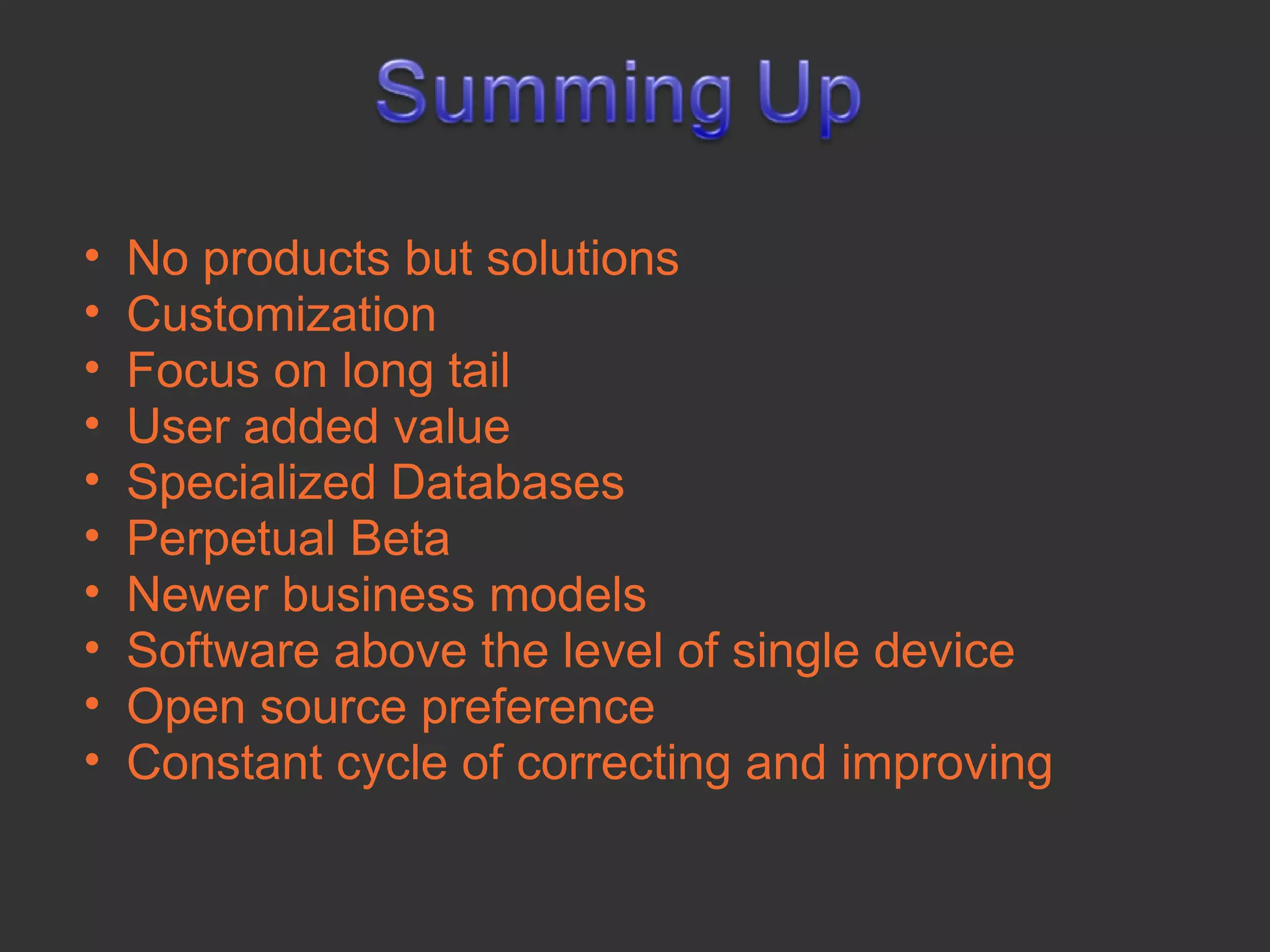
•   No products but solutions
•   Customization
•   Focus on long tail
•   User added value
•   Specialized Databases
•   Perpetual Beta
•   Newer business models
•   Software above the level of single device
•   Open source preference
•   Constant cycle of correcting and improving
Web 2.0
Web 2.0
Web 2.0

Web 2.0

  • 1.
    Made By – SubeerRangra BKBIET Pilani
  • 3.
    • The conceptof "Web 2.0" began with a conference brainstorming session between O'Reilly and MediaLive International in 2004 • The phrase "Web 2.0" hints at an improved form of the World Wide Web • Emphasizing tools and platforms that enable the user to Tag, Blog, Comment, Modify, Augment, Rank, etc. • The more explicit synonym of "Participatory Web" • Focus on efficient and humane information flow
  • 4.
    “There are noproducts, only solutions” • Not what customer wants but why they want • Need orientation rather than product • A problem solving approach • Active participation of people and networks • Simple Solutions
  • 5.
    • Every individualis unique. • Some people want to be different • Allow them to choose instead of forcing them to use what you have made • The less they are forced the more they will be Interested • Make them feel home e.g. • My yahoo, iGoogle, Myspace , Flikr ,Twitter. • Firefox add-ons .
  • 6.
    • Redefining searchby intelligent networks. • Cloud computing • Warez legalization by advertisements • P2P sharing over special servers • Free for all data banks like Wikipedia • Specific forums for specific uses e.g. torrents, rapidshare, megaupload,
  • 7.
    • Merging socialnetworking and buisness • Use of micro bloggers • Advertisement according to consumer preference • Use of public forums for specific ads. e.g. facebook, twitter, BlogSpot, Google Ad Sense.
  • 8.
    Network effects fromuser contribution are the key to market dominance in Web 2.0 era The Wisdom of crowds – User add value • Amazon, ebay - User reviews, similar items, most popular • Blogger – useful and most viewed blogs get paid • Wikipedia – content can be added/edited by any web user • Flickr – tagging images • Firefox – users make specific addons • Cloudmark – Spam emails
  • 9.
    Some systems, designedto encourage participation • Pay people to do it • Discussions over social networks • Get volunteers to perform the same task o Inspired by the open source community • Mutual benefits e.g. P2P sharing - Many companies maintain their facebook pages
  • 10.
    • But onlya small percentage of users will go to the trouble of adding value to your applications via explicit means. • So web 2.0 companies set aggregating user data and building value as side effect of ordinary use of the application. • It requires radical experiment in trust and totally new business models. • Also creates a need for radical changes over prevailing business polices
  • 11.
    • Every significantapplication to date has been backed by a specialized databases o E.g. Amazon, Google, Ebay , IMDB. • Database management is the core competency of Web 2.0 companies • Cloud computing decreases need for large databases • “infoware” rather than merely “software”
  • 12.
    • Control overdata has led to market control and oversized financial returns. • It will provide a sustainable competitive advantage to the company. • Personal data over social networking sites must be protected. • Especially if data sources are expensive to create or amenable to increasing returns via network effects. • Race is to own certain classes of core data e.g. naukri.com, 99acre, yahoo, Microsoft skydrive, IMDB.
  • 13.
    • “Release Earlyand Release Often” • Perpetual BETA >>testing phase • Daily operations must become a core competency • Constant feedback for improved products • Software will cease to perform unless it is maintained on a daily basis
  • 14.
    • Automate themaintenance and update process • Real time monitoring of user behavior • Microsoft – upgrades every 2-3 days • Flickr- Deploy new build up to every half hour “Put two or three new features on some part of the site everyday, and if user don’t adopt them, take them out. If they like them roll them out on entire site” - Anonymous
  • 15.
    • The PCis no longer the only access device for internet applications, handheld devices redefine the information age • New communication techniques also facilitate this phenomena • Applications that are limited to a single device are less valuable than those that are connected. • Design your application from the get-go to integrate services across handheld devices, PCs, and internet servers. • Various open source freeware take a major share of the market.
  • 16.
    Recruitment: Due to thecutting-edge underlying technologies and usability-focused interfaces (the ‘cool’ factor) Organizations adopting Web 2.0 tend to attract sophisticated, high-caliber technical candidates. Reduced cost: Not only are Web 2.0 offerings low-cost, but the same techniques can also be applied to existing (non-Web 2.0) products and services, lowering costs. e.g. wikis can enable your users to build documentation and knowledge base systems, with relatively little investment from yourself.
  • 17.
    Loyalty The open, participatoryWeb 2.0 environment encourages user contribution, enhancing customer loyalty and lifespan. Marketing By taking advantage of the above mentioned benefits, marketing and PR teams can implement low-cost, wide- coverage, viral strategies. Search Engine Optimization (SEO) Web 2.0 delivery mechanisms - such as Blogs and RSS - significantly enhance search engine exposure through their distributed nature
  • 18.
    In the yearand a half since, the term "Web 2.0" has clearly taken hold, with more than 9.5 million citations in Google. 2006 2008
  • 19.
    No products but solutions • Customization • Focus on long tail • User added value • Specialized Databases • Perpetual Beta • Newer business models • Software above the level of single device • Open source preference • Constant cycle of correcting and improving