
Mariano Aguirre Paredes
A short  introduction Internet is a global system of interconnected  computer networks  that interchange  data . Created by the USA Air Force  ARPANET   October 29, 1969   Internet <> World Wide Web As of June 30, 2008, 1.463 billion people use the Internet according to Internet World Stats


Web 1.0 was Commerce Web 2.0 is People - Ross Mayfield  http :// ross.typepad.com /   Web 2.0 seems to be like Pink Floyd lyrics: It can mean different things to different people, depending upon the your state of mind. - Kevin Maney  http :// www.kevinmaney.com /
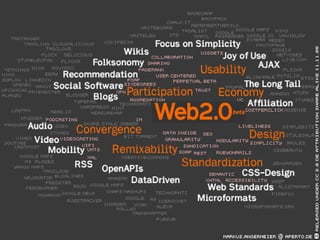
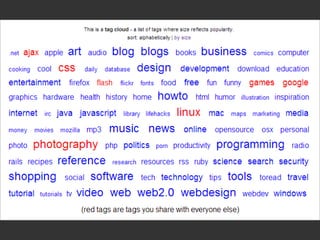
The origins The concept of &quot; Web 2.0 &quot; began with a conference brainstorming session between  O'Reilly  and MediaLive International  in 2004 The phrase &quot;Web 2.0&quot; hints at an improved form of the World Wide Web  Emphasize tools and platforms that enable the user to Tag, Blog, Comment, Modify, Augment, Rank, etc. The more explicit synonym of  &quot;Participatory Web&quot;
 
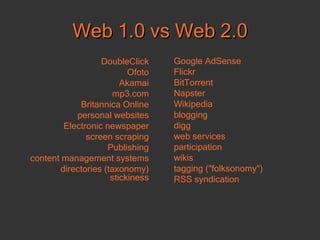
Web 1.0 vs Web 2.0 DoubleClick Ofoto Akamai mp3.com Britannica Online personal websites Electronic newspaper screen scraping Publishing content management systems directories (taxonomy) stickiness Google AdSense Flickr BitTorrent Napster Wikipedia blogging digg web services participation wikis tagging (&quot;folksonomy&quot;) RSS syndication
Key points RIA  ( Flash, AJAX , XML, Drag&Drop) SOA  ( Feeds, RSS, WS, mush-up ) iGoogle netvibes Social web
Principles of Web 2.0 &quot;For corporate people, the Web is a platform for business. For marketers, the Web is a platform for communications. For journalists, the Web is a platform for new media. For geeks, the Web is a platform for software development.  And so on.&quot; Richard  MacManus
No Products but Services “ There are no products, only solutions” Not  what  customer wants but  why  they want A problem solving approach Simple Solutions
Customization Every individual is unique Some people want to be different Allow him to choose instead of forcing him to use what you have made Make him feel home e.g. My yahoo, Google Homepage, myspace Firefox extensions e.g. (This slide is better for  reading online )
Customization Every individual is unique Allow him to choose instead of forcing him to use what you have made Some people want to be different Make him feel home e.g. My yahoo, Google Homepage, myspace, my naukri?? Firefox extensions e.g (This slide is better for  taking printouts) .
Focus on the “Long Tail” Reach out to the entire web To the edges and not just to the centre, to the long tail and not the just the head Leverage customer-self service  e.g. Google, StumbleUpon, orkut  RSS
Harnessing Collective Intelligence Network effects from user contribution are the key to market dominance in Web 2.0 era The Wisdom of crowds – Users add value Amazon, ebay - User reviews, similar items, most popular,  Wikipedia – content can be added/edited by any web user, Flickr – tagging images (eoi, pug, rock climbing…) Rockola.fm – tagging songs
 
Harnessing Collective Intelligence Some systems, designed to encourage participation   Pay for people to do it – ‘gimme five’ Get volunteers to perform the same task Inspired by the open source community Mutual benefits e.g. P2P sharing
Harnessing Collective Intelligence But only a small percentage of users will go to the trouble of adding value to your applications via explicit means. Therefore web 2.0 companies set inclusive defaults for aggregating user data and building value as side effect of ordinary use of the application.  It requires radical experiment in trust “ with enough eyeballs, all bugs are shallow”  -  Eric Raymond
Specialized Database Every significant application to date has been backed by a specialized database E.g. Amazon, Google, Ebay Database management is the core competency of Web 2.0 companies “ infoware” rather than merely “software”
End of the Software Release Cycle “ Release Early and Release Often” “ Perpetual BETA” Real time monitoring of user behavior Microsoft – upgrades every 2-3 yr Flickr- Deploy new build up to every half hr “ Put two or three new features on some part of the site everyday, and if user don’t adopt them, take them out. If they like them roll them out on entire site” - Anonymous
Software above the level of a Single Device The PC is no longer the only access device for internet applications Applications that are limited to a single device are less valuable than those that are connected.  Design your application from the get-go to integrate services across handheld devices, PCs, and internet servers.
Benefits of Web 2.0 Reduced cost:   Not only are Web 2.0 offerings low-cost, but the same techniques can also be applied to existing (non-Web 2.0) products and services, lowering costs.  Quality controls are increasing: The Ikea case Kryptonite unbreakable locks
Summing Up No products but solutions Customization ability Focus on long tail Users add value Specialized Database Perpetual Beta Software above the level of single device Youtube search:  The   Machine   is   Us
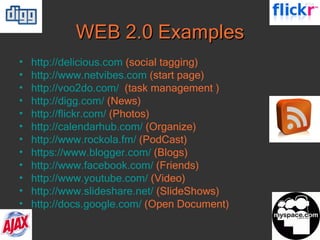
WEB 2.0 Examples http://delicious.com   (social tagging) http://www.netvibes.com   (start page) http://voo2do. com /   (task management ) http:// digg.com /   (News) http:// flickr.com /   (Photos) http:// calendarhub.com /   (Organize) http:// www.rockola.fm /   (PodCast) https://www.blogger.com/   (Blogs) http:// www.facebook.com /   (Friends) http:// www.youtube.com /   (Video) http://www.slideshare.net/   (SlideShows) http://docs.google.com/   (Open Document)
What Next ??
Web 3.0 This term that has been coined to describe the Semantic Web  It promises to “organize the world’s information”  Can reason about information and make new conclusions
Basic concepts http://en.wikipedia.org/wiki/Web_2 http:// en.wikipedia.org/wiki/Social_networking http:// en.wikipedia.org/wiki/Wikis http:// en.wikipedia.org/wiki/Folksonomy http:// en.wikipedia.org/wiki/Blog http://slideshare.net/glutzky/virtual-educa-las-aplicaciones-web-20 http://slideshare.net/dmcdowell/web-20-6952
Thank you ! Mariano Aguirre Paredes (maguirrep@gmail.com)

EOI Web 20

  • 1.
  • 2.
    A short introduction Internet is a global system of interconnected  computer networks  that interchange  data . Created by the USA Air Force ARPANET October 29, 1969 Internet <> World Wide Web As of June 30, 2008, 1.463 billion people use the Internet according to Internet World Stats
  • 3.
  • 4.
  • 5.
  • 6.
    Web 1.0 wasCommerce Web 2.0 is People - Ross Mayfield http :// ross.typepad.com / Web 2.0 seems to be like Pink Floyd lyrics: It can mean different things to different people, depending upon the your state of mind. - Kevin Maney http :// www.kevinmaney.com /
  • 7.
    The origins Theconcept of &quot; Web 2.0 &quot; began with a conference brainstorming session between O'Reilly and MediaLive International in 2004 The phrase &quot;Web 2.0&quot; hints at an improved form of the World Wide Web Emphasize tools and platforms that enable the user to Tag, Blog, Comment, Modify, Augment, Rank, etc. The more explicit synonym of &quot;Participatory Web&quot;
  • 8.
  • 9.
    Web 1.0 vs Web2.0 DoubleClick Ofoto Akamai mp3.com Britannica Online personal websites Electronic newspaper screen scraping Publishing content management systems directories (taxonomy) stickiness Google AdSense Flickr BitTorrent Napster Wikipedia blogging digg web services participation wikis tagging (&quot;folksonomy&quot;) RSS syndication
  • 10.
    Key points RIA ( Flash, AJAX , XML, Drag&Drop) SOA ( Feeds, RSS, WS, mush-up ) iGoogle netvibes Social web
  • 11.
    Principles of Web2.0 &quot;For corporate people, the Web is a platform for business. For marketers, the Web is a platform for communications. For journalists, the Web is a platform for new media. For geeks, the Web is a platform for software development. And so on.&quot; Richard MacManus
  • 12.
    No Products butServices “ There are no products, only solutions” Not what customer wants but why they want A problem solving approach Simple Solutions
  • 13.
    Customization Every individualis unique Some people want to be different Allow him to choose instead of forcing him to use what you have made Make him feel home e.g. My yahoo, Google Homepage, myspace Firefox extensions e.g. (This slide is better for reading online )
  • 14.
    Customization Every individualis unique Allow him to choose instead of forcing him to use what you have made Some people want to be different Make him feel home e.g. My yahoo, Google Homepage, myspace, my naukri?? Firefox extensions e.g (This slide is better for taking printouts) .
  • 15.
    Focus on the“Long Tail” Reach out to the entire web To the edges and not just to the centre, to the long tail and not the just the head Leverage customer-self service e.g. Google, StumbleUpon, orkut RSS
  • 16.
    Harnessing Collective IntelligenceNetwork effects from user contribution are the key to market dominance in Web 2.0 era The Wisdom of crowds – Users add value Amazon, ebay - User reviews, similar items, most popular, Wikipedia – content can be added/edited by any web user, Flickr – tagging images (eoi, pug, rock climbing…) Rockola.fm – tagging songs
  • 17.
  • 18.
    Harnessing Collective IntelligenceSome systems, designed to encourage participation Pay for people to do it – ‘gimme five’ Get volunteers to perform the same task Inspired by the open source community Mutual benefits e.g. P2P sharing
  • 19.
    Harnessing Collective IntelligenceBut only a small percentage of users will go to the trouble of adding value to your applications via explicit means. Therefore web 2.0 companies set inclusive defaults for aggregating user data and building value as side effect of ordinary use of the application. It requires radical experiment in trust “ with enough eyeballs, all bugs are shallow” - Eric Raymond
  • 20.
    Specialized Database Everysignificant application to date has been backed by a specialized database E.g. Amazon, Google, Ebay Database management is the core competency of Web 2.0 companies “ infoware” rather than merely “software”
  • 21.
    End of theSoftware Release Cycle “ Release Early and Release Often” “ Perpetual BETA” Real time monitoring of user behavior Microsoft – upgrades every 2-3 yr Flickr- Deploy new build up to every half hr “ Put two or three new features on some part of the site everyday, and if user don’t adopt them, take them out. If they like them roll them out on entire site” - Anonymous
  • 22.
    Software above thelevel of a Single Device The PC is no longer the only access device for internet applications Applications that are limited to a single device are less valuable than those that are connected. Design your application from the get-go to integrate services across handheld devices, PCs, and internet servers.
  • 23.
    Benefits of Web2.0 Reduced cost: Not only are Web 2.0 offerings low-cost, but the same techniques can also be applied to existing (non-Web 2.0) products and services, lowering costs. Quality controls are increasing: The Ikea case Kryptonite unbreakable locks
  • 24.
    Summing Up Noproducts but solutions Customization ability Focus on long tail Users add value Specialized Database Perpetual Beta Software above the level of single device Youtube search: The Machine is Us
  • 25.
    WEB 2.0 Exampleshttp://delicious.com (social tagging) http://www.netvibes.com (start page) http://voo2do. com / (task management ) http:// digg.com / (News) http:// flickr.com / (Photos) http:// calendarhub.com / (Organize) http:// www.rockola.fm / (PodCast) https://www.blogger.com/ (Blogs) http:// www.facebook.com / (Friends) http:// www.youtube.com / (Video) http://www.slideshare.net/ (SlideShows) http://docs.google.com/ (Open Document)
  • 26.
  • 27.
    Web 3.0 Thisterm that has been coined to describe the Semantic Web It promises to “organize the world’s information” Can reason about information and make new conclusions
  • 28.
    Basic concepts http://en.wikipedia.org/wiki/Web_2http:// en.wikipedia.org/wiki/Social_networking http:// en.wikipedia.org/wiki/Wikis http:// en.wikipedia.org/wiki/Folksonomy http:// en.wikipedia.org/wiki/Blog http://slideshare.net/glutzky/virtual-educa-las-aplicaciones-web-20 http://slideshare.net/dmcdowell/web-20-6952
  • 29.
    Thank you !Mariano Aguirre Paredes (maguirrep@gmail.com)