Computer Science and Engineering
Reliable Positioning with Hybrid
Antenna Model for Aerial Wireless
Sensor and Actor Networks
Kai Li*, Mustafa ̇Ilhan Akbas†, Damla Turgut†, Salil S.
Kanhere*, and Sanjay Jha*
*School of Computer Science & Engineering,
The University of New South Wales
†Department of Electrical Engineering & Computer Science,
University of Central Florida
Monday, 24 March 14
School of Computer Science and Engineering
Outline
✦ Research Background
✦ Challenges
✦ Flight and Antenna Model
✦ Communications with the Antenna Model
✦ Performance Evaluation
✦ Conclusion
Monday, 24 March 14
School of Computer Science and Engineering
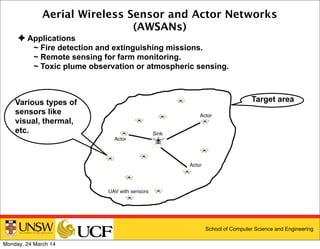
Aerial Wireless Sensor and Actor Networks
(AWSANs)
✦ Applications
~ Fire detection and extinguishing missions.
~ Remote sensing for farm monitoring.
~ Toxic plume observation or atmospheric sensing.
Monday, 24 March 14
School of Computer Science and Engineering
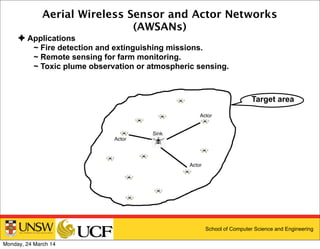
Aerial Wireless Sensor and Actor Networks
(AWSANs)
✦ Applications
~ Fire detection and extinguishing missions.
~ Remote sensing for farm monitoring.
~ Toxic plume observation or atmospheric sensing.
Target area
Monday, 24 March 14
School of Computer Science and Engineering
Aerial Wireless Sensor and Actor Networks
(AWSANs)
✦ Applications
~ Fire detection and extinguishing missions.
~ Remote sensing for farm monitoring.
~ Toxic plume observation or atmospheric sensing.
Various types of
sensors like
visual, thermal,
etc.
Target area
Monday, 24 March 14
School of Computer Science and Engineering
Positioning in AWSANs
✦ 2-D positioning strategies become NP-Hard in 3-D space.
✦ For dynamic positioning of the actors in 3-D space with local
communication.
Monday, 24 March 14
School of Computer Science and Engineering
Positioning in AWSANs
✦ 2-D positioning strategies become NP-Hard in 3-D space.
✦ For dynamic positioning of the actors in 3-D space with local
communication.
✦ The previous work: APAWSAN which adopts VSEPR theory was
proposed to build a self-configuring dynamic network architecture.
~ Akbas, Mustafa Ilhan, and Damla Turgut. "APAWSAN: Actor positioning for aerial wireless sensor
and actor networks." Local Computer Networks (LCN), 2011 IEEE 36th Conference on. IEEE, 2011.
Monday, 24 March 14
School of Computer Science and Engineering
Outline
✦ Research Background
✦ Challenges
✦ Flight and Antenna Model
✦ Communications with the Antenna Model
✦ Performance Evaluation
✦ Conclusion
Monday, 24 March 14
School of Computer Science and Engineering
Challenges on Communications in AWSANs
✦ For the coverage:
✦ The proposed strategy must provide high connectivity and
coverage.
Monday, 24 March 14
School of Computer Science and Engineering
Challenges on Communications in AWSANs
✦ For the coverage:
✦ The proposed strategy must provide high connectivity and
coverage.
✦ For the communications:
✦ In real-world 3-D scenarios, the positioning strategy is adapted to
~ a quick neighbor discovery during flight in 3-D space
~ varying signal strength which depends on the antenna
orientation
~ reorganization requirements in case of topology changes
Monday, 24 March 14
School of Computer Science and Engineering
Outline
✦ Research Background
✦ Challenges
✦ Flight and Antenna Model
✦ Communications with the Antenna Model
✦ Performance Evaluation
✦ Conclusion
Monday, 24 March 14
School of Computer Science and Engineering
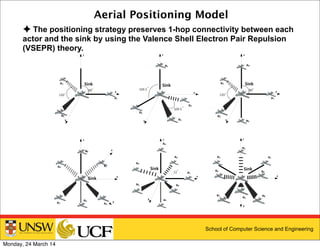
Aerial Positioning Model
✦ The positioning strategy preserves 1-hop connectivity between each
actor and the sink by using the Valence Shell Electron Pair Repulsion
(VSEPR) theory.
Monday, 24 March 14
School of Computer Science and Engineering
Aerial Positioning Model
✦ The positioning strategy preserves 1-hop connectivity between each
actor and the sink by using the Valence Shell Electron Pair Repulsion
(VSEPR) theory.
Monday, 24 March 14
School of Computer Science and Engineering
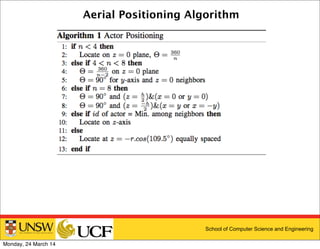
Aerial Positioning Algorithm
Monday, 24 March 14
School of Computer Science and Engineering
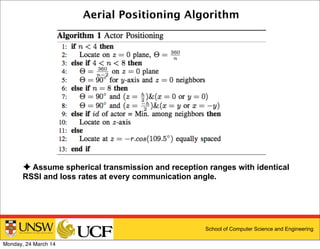
Aerial Positioning Algorithm
✦ Assume spherical transmission and reception ranges with identical
RSSI and loss rates at every communication angle.
Monday, 24 March 14
School of Computer Science and Engineering
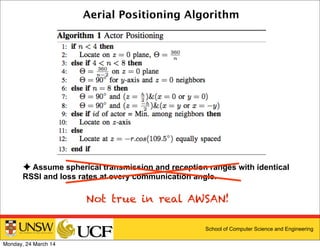
Aerial Positioning Algorithm
✦ Assume spherical transmission and reception ranges with identical
RSSI and loss rates at every communication angle.
Not true in real AWSAN!
Monday, 24 March 14
School of Computer Science and Engineering
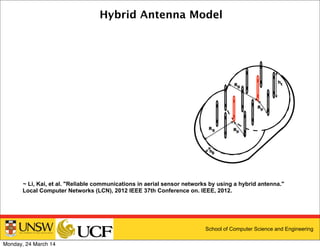
Hybrid Antenna Model
~ Li, Kai, et al. "Reliable communications in aerial sensor networks by using a hybrid antenna."
Local Computer Networks (LCN), 2012 IEEE 37th Conference on. IEEE, 2012.
Monday, 24 March 14
School of Computer Science and Engineering
Hybrid Antenna Model
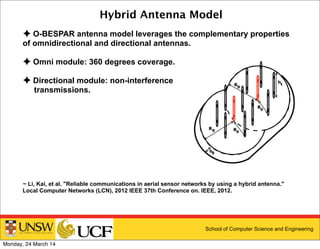
✦ O-BESPAR antenna model leverages the complementary properties
of omnidirectional and directional antennas.
✦ Omni module: 360 degrees coverage.
✦ Directional module: non-interference
transmissions.
~ Li, Kai, et al. "Reliable communications in aerial sensor networks by using a hybrid antenna."
Local Computer Networks (LCN), 2012 IEEE 37th Conference on. IEEE, 2012.
Monday, 24 March 14
School of Computer Science and Engineering
Outline
✦ Research Background
✦ Challenges
✦ Flight and Antenna Model
✦ Communications with the Antenna Model
✦ Performance Evaluation
✦ Conclusion
Monday, 24 March 14
School of Computer Science and Engineering
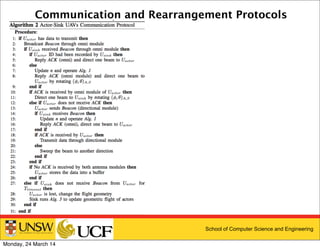
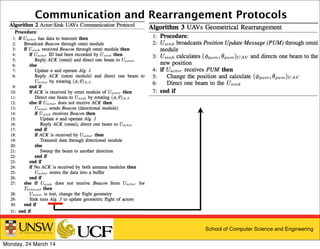
Communication and Rearrangement Protocols
Monday, 24 March 14
School of Computer Science and Engineering
Communication and Rearrangement Protocols
Monday, 24 March 14
School of Computer Science and Engineering
Outline
✦ Research Background
✦ Challenges
✦ Flight and Antenna Model
✦ Communications with the Antenna Model
✦ Performance Evaluation
✦ Conclusion
Monday, 24 March 14
School of Computer Science and Engineering
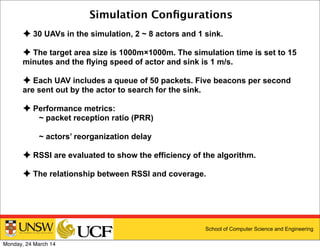
Simulation Configurations
✦ 30 UAVs in the simulation, 2 ~ 8 actors and 1 sink.
✦ The target area size is 1000m×1000m. The simulation time is set to 15
minutes and the flying speed of actor and sink is 1 m/s.
✦ Each UAV includes a queue of 50 packets. Five beacons per second
are sent out by the actor to search for the sink.
✦ Performance metrics:
~ packet reception ratio (PRR)
~ actors’ reorganization delay
✦ RSSI are evaluated to show the efficiency of the algorithm.
✦ The relationship between RSSI and coverage.
Monday, 24 March 14
School of Computer Science and Engineering
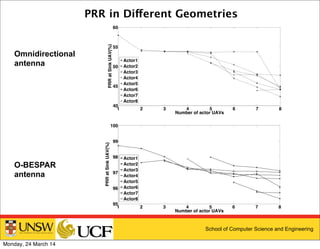
PRR in Different Geometries
1 2 3 4 5 6 7 8
40
45
50
55
60
Number of actor UAVs
PRRatSinkUAV(%)
Actor1
Actor2
Actor3
Actor4
Actor5
Actor6
Actor7
Actor8
1 2 3 4 5 6 7 8
95
96
97
98
99
100
Number of actor UAVs
PRRatSinkUAV(%)
Actor1
Actor2
Actor3
Actor4
Actor5
Actor6
Actor7
Actor8
Omnidirectional
antenna
O-BESPAR
antenna
Monday, 24 March 14
School of Computer Science and Engineering
Reorganization Time Delay
2 3 4 5 6 7 8
0.4
0.5
0.6
0.7
0.8
0.9
1
Number of actor UAVs
Time(sec)
O−BESPAR Antenna
Omni Antenna
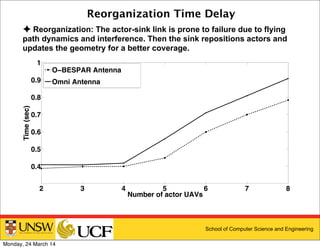
✦ Reorganization: The actor-sink link is prone to failure due to flying
path dynamics and interference. Then the sink repositions actors and
updates the geometry for a better coverage.
Monday, 24 March 14
School of Computer Science and Engineering
Antenna Orientation and Coverage
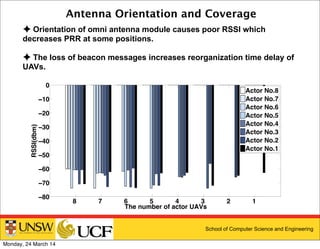
✦ Orientation of omni antenna module causes poor RSSI which
decreases PRR at some positions.
✦ The loss of beacon messages increases reorganization time delay of
UAVs.
8 7 6 5 4 3 2 1
−80
−70
−60
−50
−40
−30
−20
−10
0
The number of actor UAVs
RSSI(dbm)
Actor No.8
Actor No.7
Actor No.6
Actor No.5
Actor No.4
Actor No.3
Actor No.2
Actor No.1
Monday, 24 March 14
School of Computer Science and Engineering
Coverage Values of Geometry Flight
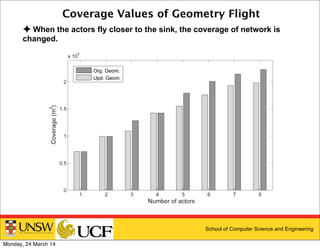
✦ When the actors fly closer to the sink, the coverage of network is
changed.
Monday, 24 March 14
School of Computer Science and Engineering
Outline
✦ Research Background
✦ Challenges
✦ Flight and Antenna Model
✦ Communications with the Antenna Model
✦ Performance Evaluation
✦ Conclusion
Monday, 24 March 14
School of Computer Science and Engineering
Conclusion
✦ This work
~ Apply the actor positioning strategy to real-world scenarios by
utilizing hybrid antenna (O-BESPAR).
~ Use VSEPR theory to form the geometries of UAVs.
~ Propose communication and rearrangement protocols.
~ Evaluate the positioning strategy with antenna model by packet
reception rate and actors’ reorganization delay.
~ Discuss the effect of antenna orientation on the coverage.
Monday, 24 March 14
School of Computer Science and Engineering
Thank You!
Kai Li
PhD student
Email: kail@cse.unsw.edu.au
Monday, 24 March 14
School of Computer Science and Engineering
Blank Page
Monday, 24 March 14

Reliable Positioning with Hybrid Antenna Model for Aerial Wireless Sensor and Actor Networks

  • 1.
    Computer Science andEngineering Reliable Positioning with Hybrid Antenna Model for Aerial Wireless Sensor and Actor Networks Kai Li*, Mustafa ̇Ilhan Akbas†, Damla Turgut†, Salil S. Kanhere*, and Sanjay Jha* *School of Computer Science & Engineering, The University of New South Wales †Department of Electrical Engineering & Computer Science, University of Central Florida Monday, 24 March 14
  • 2.
    School of ComputerScience and Engineering Outline ✦ Research Background ✦ Challenges ✦ Flight and Antenna Model ✦ Communications with the Antenna Model ✦ Performance Evaluation ✦ Conclusion Monday, 24 March 14
  • 3.
    School of ComputerScience and Engineering Aerial Wireless Sensor and Actor Networks (AWSANs) ✦ Applications ~ Fire detection and extinguishing missions. ~ Remote sensing for farm monitoring. ~ Toxic plume observation or atmospheric sensing. Monday, 24 March 14
  • 4.
    School of ComputerScience and Engineering Aerial Wireless Sensor and Actor Networks (AWSANs) ✦ Applications ~ Fire detection and extinguishing missions. ~ Remote sensing for farm monitoring. ~ Toxic plume observation or atmospheric sensing. Target area Monday, 24 March 14
  • 5.
    School of ComputerScience and Engineering Aerial Wireless Sensor and Actor Networks (AWSANs) ✦ Applications ~ Fire detection and extinguishing missions. ~ Remote sensing for farm monitoring. ~ Toxic plume observation or atmospheric sensing. Various types of sensors like visual, thermal, etc. Target area Monday, 24 March 14
  • 6.
    School of ComputerScience and Engineering Positioning in AWSANs ✦ 2-D positioning strategies become NP-Hard in 3-D space. ✦ For dynamic positioning of the actors in 3-D space with local communication. Monday, 24 March 14
  • 7.
    School of ComputerScience and Engineering Positioning in AWSANs ✦ 2-D positioning strategies become NP-Hard in 3-D space. ✦ For dynamic positioning of the actors in 3-D space with local communication. ✦ The previous work: APAWSAN which adopts VSEPR theory was proposed to build a self-configuring dynamic network architecture. ~ Akbas, Mustafa Ilhan, and Damla Turgut. "APAWSAN: Actor positioning for aerial wireless sensor and actor networks." Local Computer Networks (LCN), 2011 IEEE 36th Conference on. IEEE, 2011. Monday, 24 March 14
  • 8.
    School of ComputerScience and Engineering Outline ✦ Research Background ✦ Challenges ✦ Flight and Antenna Model ✦ Communications with the Antenna Model ✦ Performance Evaluation ✦ Conclusion Monday, 24 March 14
  • 9.
    School of ComputerScience and Engineering Challenges on Communications in AWSANs ✦ For the coverage: ✦ The proposed strategy must provide high connectivity and coverage. Monday, 24 March 14
  • 10.
    School of ComputerScience and Engineering Challenges on Communications in AWSANs ✦ For the coverage: ✦ The proposed strategy must provide high connectivity and coverage. ✦ For the communications: ✦ In real-world 3-D scenarios, the positioning strategy is adapted to ~ a quick neighbor discovery during flight in 3-D space ~ varying signal strength which depends on the antenna orientation ~ reorganization requirements in case of topology changes Monday, 24 March 14
  • 11.
    School of ComputerScience and Engineering Outline ✦ Research Background ✦ Challenges ✦ Flight and Antenna Model ✦ Communications with the Antenna Model ✦ Performance Evaluation ✦ Conclusion Monday, 24 March 14
  • 12.
    School of ComputerScience and Engineering Aerial Positioning Model ✦ The positioning strategy preserves 1-hop connectivity between each actor and the sink by using the Valence Shell Electron Pair Repulsion (VSEPR) theory. Monday, 24 March 14
  • 13.
    School of ComputerScience and Engineering Aerial Positioning Model ✦ The positioning strategy preserves 1-hop connectivity between each actor and the sink by using the Valence Shell Electron Pair Repulsion (VSEPR) theory. Monday, 24 March 14
  • 14.
    School of ComputerScience and Engineering Aerial Positioning Algorithm Monday, 24 March 14
  • 15.
    School of ComputerScience and Engineering Aerial Positioning Algorithm ✦ Assume spherical transmission and reception ranges with identical RSSI and loss rates at every communication angle. Monday, 24 March 14
  • 16.
    School of ComputerScience and Engineering Aerial Positioning Algorithm ✦ Assume spherical transmission and reception ranges with identical RSSI and loss rates at every communication angle. Not true in real AWSAN! Monday, 24 March 14
  • 17.
    School of ComputerScience and Engineering Hybrid Antenna Model ~ Li, Kai, et al. "Reliable communications in aerial sensor networks by using a hybrid antenna." Local Computer Networks (LCN), 2012 IEEE 37th Conference on. IEEE, 2012. Monday, 24 March 14
  • 18.
    School of ComputerScience and Engineering Hybrid Antenna Model ✦ O-BESPAR antenna model leverages the complementary properties of omnidirectional and directional antennas. ✦ Omni module: 360 degrees coverage. ✦ Directional module: non-interference transmissions. ~ Li, Kai, et al. "Reliable communications in aerial sensor networks by using a hybrid antenna." Local Computer Networks (LCN), 2012 IEEE 37th Conference on. IEEE, 2012. Monday, 24 March 14
  • 19.
    School of ComputerScience and Engineering Outline ✦ Research Background ✦ Challenges ✦ Flight and Antenna Model ✦ Communications with the Antenna Model ✦ Performance Evaluation ✦ Conclusion Monday, 24 March 14
  • 20.
    School of ComputerScience and Engineering Communication and Rearrangement Protocols Monday, 24 March 14
  • 21.
    School of ComputerScience and Engineering Communication and Rearrangement Protocols Monday, 24 March 14
  • 22.
    School of ComputerScience and Engineering Outline ✦ Research Background ✦ Challenges ✦ Flight and Antenna Model ✦ Communications with the Antenna Model ✦ Performance Evaluation ✦ Conclusion Monday, 24 March 14
  • 23.
    School of ComputerScience and Engineering Simulation Configurations ✦ 30 UAVs in the simulation, 2 ~ 8 actors and 1 sink. ✦ The target area size is 1000m×1000m. The simulation time is set to 15 minutes and the flying speed of actor and sink is 1 m/s. ✦ Each UAV includes a queue of 50 packets. Five beacons per second are sent out by the actor to search for the sink. ✦ Performance metrics: ~ packet reception ratio (PRR) ~ actors’ reorganization delay ✦ RSSI are evaluated to show the efficiency of the algorithm. ✦ The relationship between RSSI and coverage. Monday, 24 March 14
  • 24.
    School of ComputerScience and Engineering PRR in Different Geometries 1 2 3 4 5 6 7 8 40 45 50 55 60 Number of actor UAVs PRRatSinkUAV(%) Actor1 Actor2 Actor3 Actor4 Actor5 Actor6 Actor7 Actor8 1 2 3 4 5 6 7 8 95 96 97 98 99 100 Number of actor UAVs PRRatSinkUAV(%) Actor1 Actor2 Actor3 Actor4 Actor5 Actor6 Actor7 Actor8 Omnidirectional antenna O-BESPAR antenna Monday, 24 March 14
  • 25.
    School of ComputerScience and Engineering Reorganization Time Delay 2 3 4 5 6 7 8 0.4 0.5 0.6 0.7 0.8 0.9 1 Number of actor UAVs Time(sec) O−BESPAR Antenna Omni Antenna ✦ Reorganization: The actor-sink link is prone to failure due to flying path dynamics and interference. Then the sink repositions actors and updates the geometry for a better coverage. Monday, 24 March 14
  • 26.
    School of ComputerScience and Engineering Antenna Orientation and Coverage ✦ Orientation of omni antenna module causes poor RSSI which decreases PRR at some positions. ✦ The loss of beacon messages increases reorganization time delay of UAVs. 8 7 6 5 4 3 2 1 −80 −70 −60 −50 −40 −30 −20 −10 0 The number of actor UAVs RSSI(dbm) Actor No.8 Actor No.7 Actor No.6 Actor No.5 Actor No.4 Actor No.3 Actor No.2 Actor No.1 Monday, 24 March 14
  • 27.
    School of ComputerScience and Engineering Coverage Values of Geometry Flight ✦ When the actors fly closer to the sink, the coverage of network is changed. Monday, 24 March 14
  • 28.
    School of ComputerScience and Engineering Outline ✦ Research Background ✦ Challenges ✦ Flight and Antenna Model ✦ Communications with the Antenna Model ✦ Performance Evaluation ✦ Conclusion Monday, 24 March 14
  • 29.
    School of ComputerScience and Engineering Conclusion ✦ This work ~ Apply the actor positioning strategy to real-world scenarios by utilizing hybrid antenna (O-BESPAR). ~ Use VSEPR theory to form the geometries of UAVs. ~ Propose communication and rearrangement protocols. ~ Evaluate the positioning strategy with antenna model by packet reception rate and actors’ reorganization delay. ~ Discuss the effect of antenna orientation on the coverage. Monday, 24 March 14
  • 30.
    School of ComputerScience and Engineering Thank You! Kai Li PhD student Email: kail@cse.unsw.edu.au Monday, 24 March 14
  • 31.
    School of ComputerScience and Engineering Blank Page Monday, 24 March 14