Problem context Mapping onto graphs Graph spectral properties Problem formalization Results
Spectrum Analytic Approach for Cooperative
Navigation of Connected and Autonomous
Vehicles
Harish Chintakunta1 Mustafa ˙Ilhan Akba¸s2
1Department of Electrical and Computer Engineering
Florida Polytechnic University
2Electrical, Computer, Software and Systems Engineering
Embry-Riddle Aeronautical University
9th ACM International Symposium on Design and Analysis of Intelligent Vehicular
Networks and Applications (DIVANET)
November 25, 2019
Harish Chintakunta1
, Mustafa ˙Ilhan Akba¸s2
FPU & ERAU
Spectrum Analytic Approach for Cooperative Navigation of Connected and Autonomous Vehicles
Problem context Mapping onto graphs Graph spectral properties Problem formalization Results
Emergency vehicle navigation
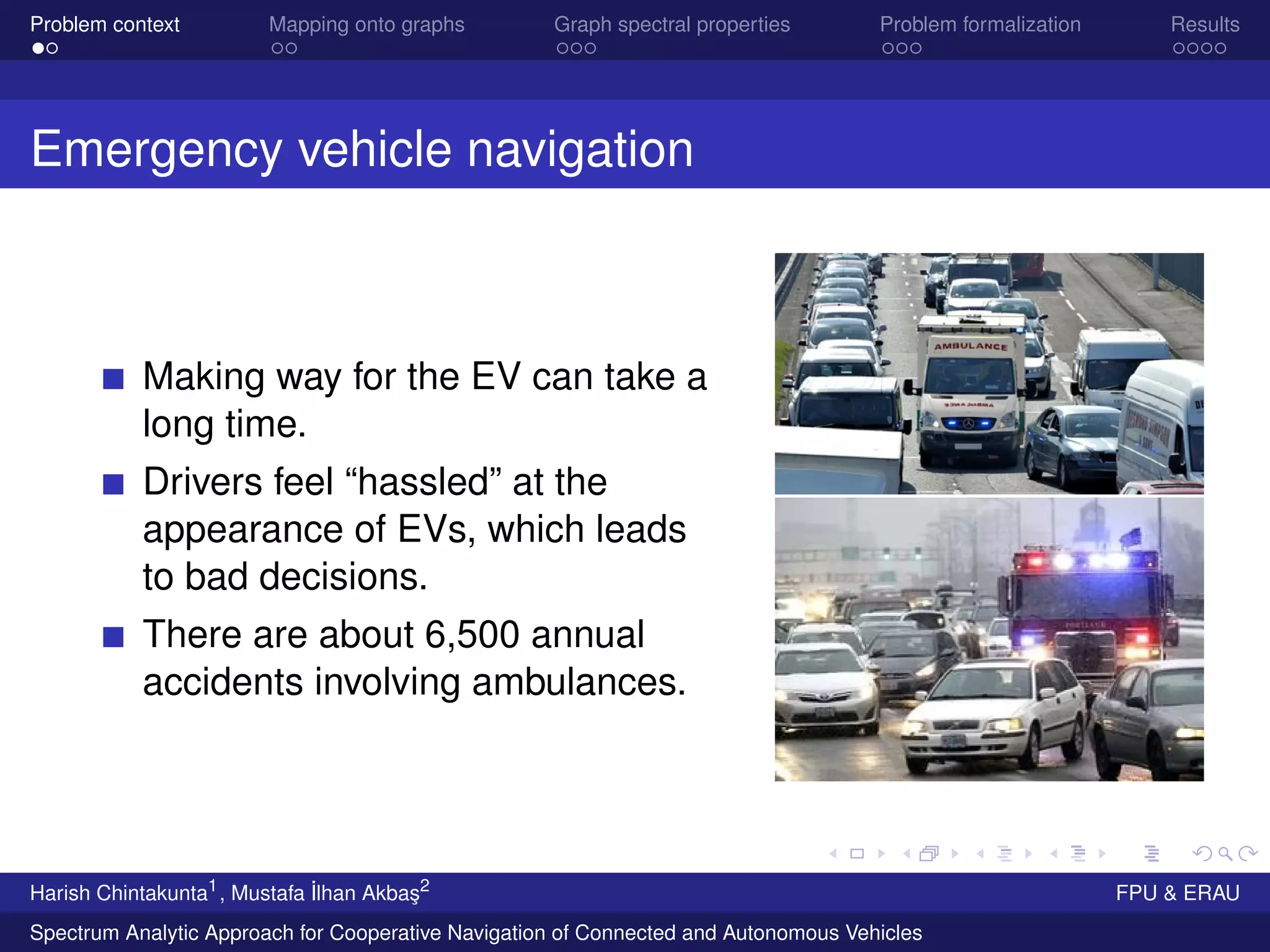
Making way for the EV can take a
long time.
Drivers feel “hassled” at the
appearance of EVs, which leads
to bad decisions.
There are about 6,500 annual
accidents involving ambulances.
Harish Chintakunta1
, Mustafa ˙Ilhan Akba¸s2
FPU & ERAU
Spectrum Analytic Approach for Cooperative Navigation of Connected and Autonomous Vehicles
Problem context Mapping onto graphs Graph spectral properties Problem formalization Results
Advantages of Connected Autonomous Vehicles (CAVs)
Vehicles can be notified well in advance about an
approaching EV.
Complex cooperative behavior amongst CAVs can assist
the navigation of EVs.
EV itself being autonomous can enable complex path
planning algorithm to optimize travel time, saving lives.
Harish Chintakunta1
, Mustafa ˙Ilhan Akba¸s2
FPU & ERAU
Spectrum Analytic Approach for Cooperative Navigation of Connected and Autonomous Vehicles
Problem context Mapping onto graphs Graph spectral properties Problem formalization Results
Our view of the problem
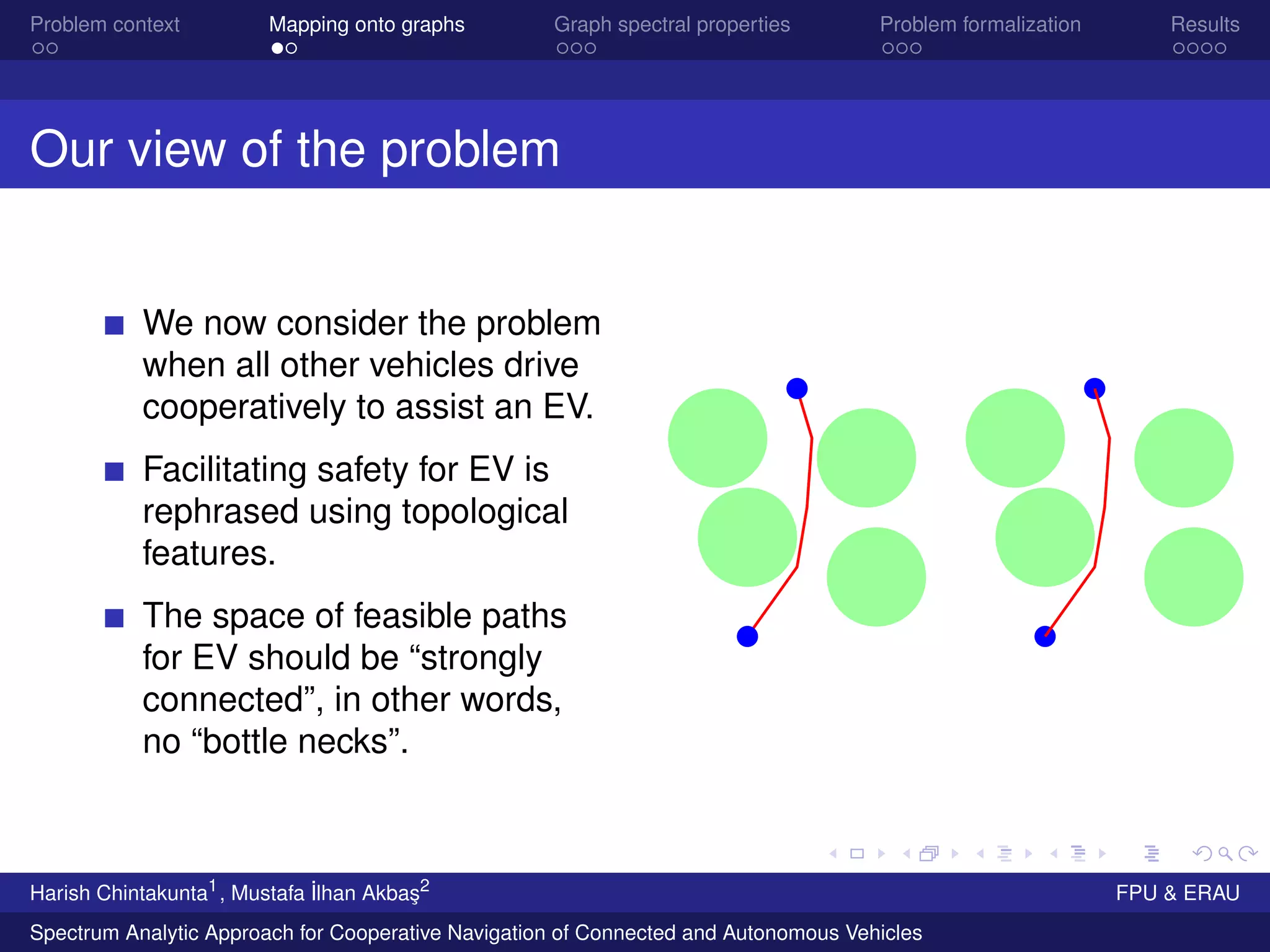
We now consider the problem
when all other vehicles drive
cooperatively to assist an EV.
Facilitating safety for EV is
rephrased using topological
features.
The space of feasible paths
for EV should be “strongly
connected”, in other words,
no “bottle necks”.
Harish Chintakunta1
, Mustafa ˙Ilhan Akba¸s2
FPU & ERAU
Spectrum Analytic Approach for Cooperative Navigation of Connected and Autonomous Vehicles
Problem context Mapping onto graphs Graph spectral properties Problem formalization Results
Formulation in terms of graph theory
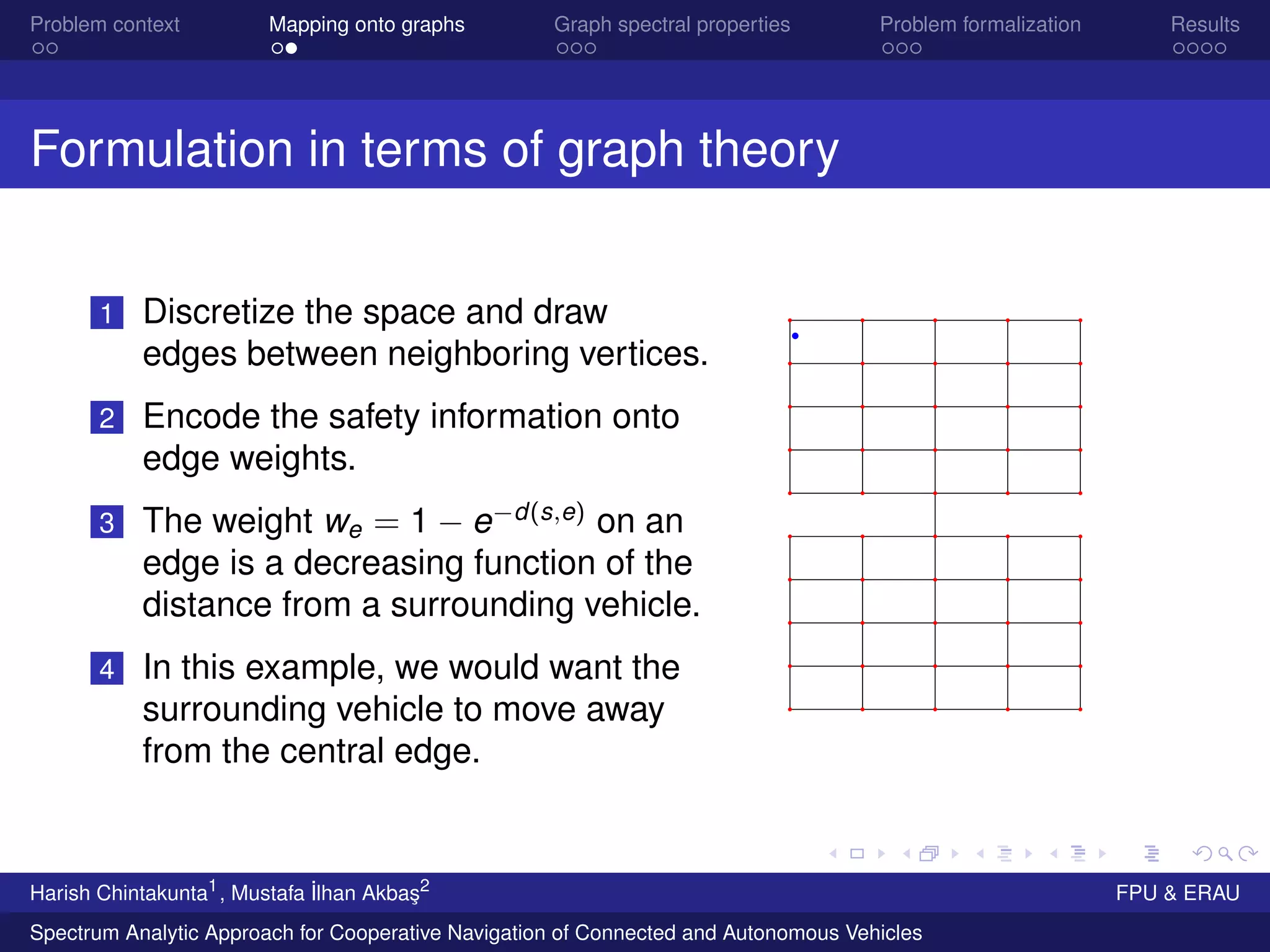
1 Discretize the space and draw
edges between neighboring vertices.
2 Encode the safety information onto
edge weights.
3 The weight we = 1 − e−d(s,e)
on an
edge is a decreasing function of the
distance from a surrounding vehicle.
4 In this example, we would want the
surrounding vehicle to move away
from the central edge.
Harish Chintakunta1
, Mustafa ˙Ilhan Akba¸s2
FPU & ERAU
Spectrum Analytic Approach for Cooperative Navigation of Connected and Autonomous Vehicles
Problem context Mapping onto graphs Graph spectral properties Problem formalization Results
Inspiration from spectral properties
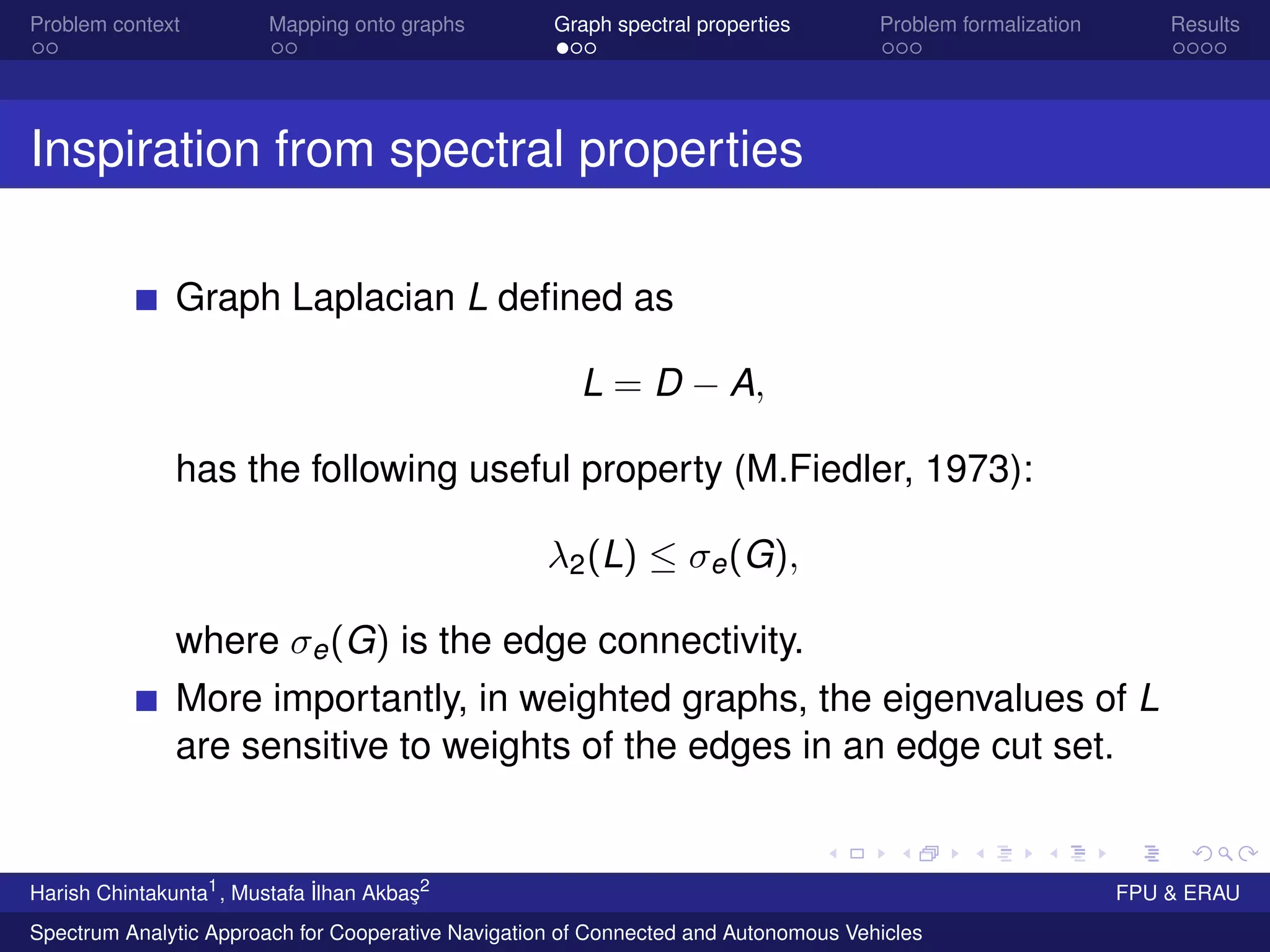
Graph Laplacian L defined as
L = D − A,
has the following useful property (M.Fiedler, 1973):
λ2(L) ≤ σe(G),
where σe(G) is the edge connectivity.
More importantly, in weighted graphs, the eigenvalues of L
are sensitive to weights of the edges in an edge cut set.
Harish Chintakunta1
, Mustafa ˙Ilhan Akba¸s2
FPU & ERAU
Spectrum Analytic Approach for Cooperative Navigation of Connected and Autonomous Vehicles
Problem context Mapping onto graphs Graph spectral properties Problem formalization Results
Properties of λ2(L)
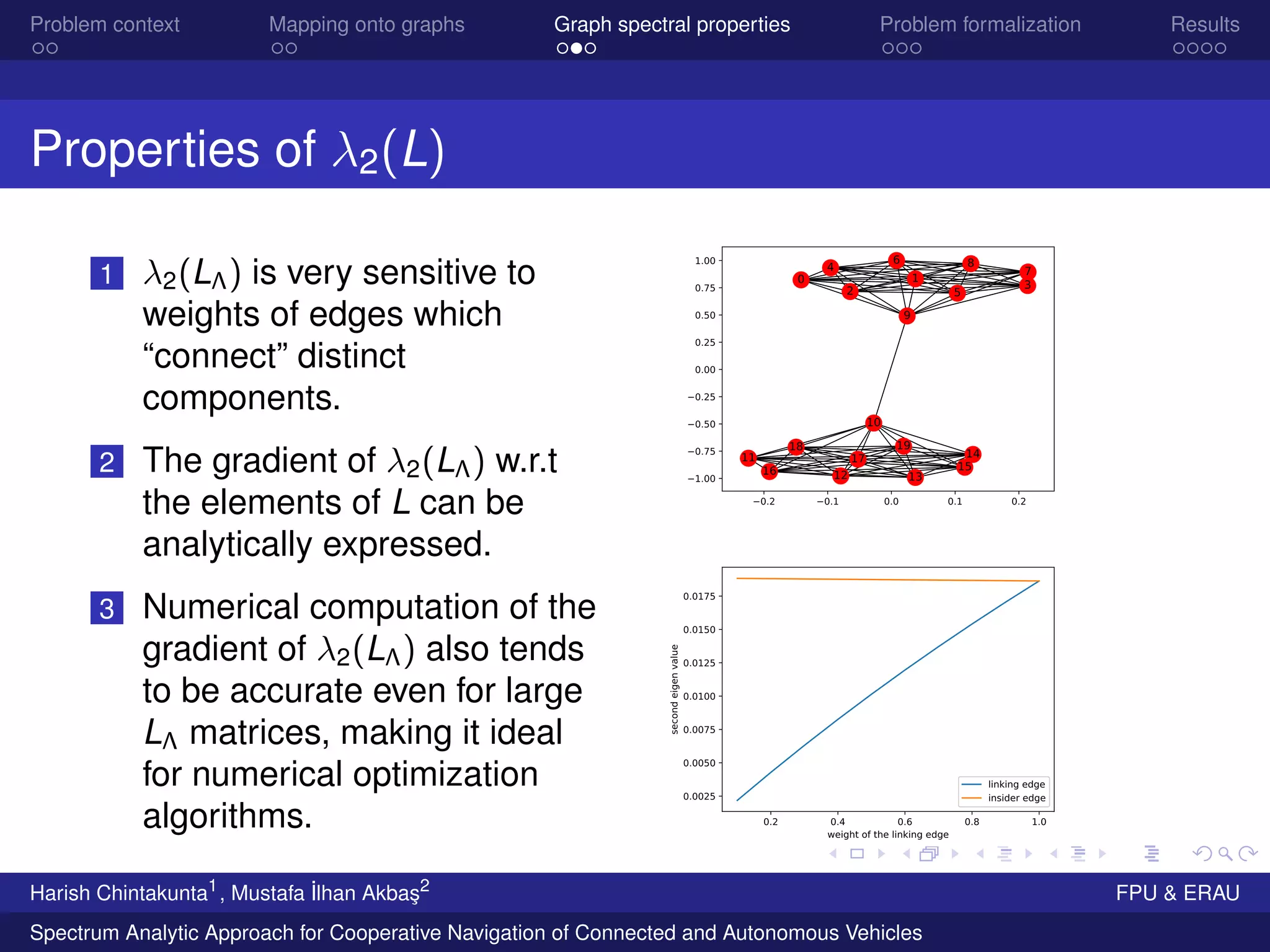
1 λ2(LΛ) is very sensitive to
weights of edges which
“connect” distinct
components.
2 The gradient of λ2(LΛ) w.r.t
the elements of L can be
analytically expressed.
3 Numerical computation of the
gradient of λ2(LΛ) also tends
to be accurate even for large
LΛ matrices, making it ideal
for numerical optimization
algorithms.
−0.2 −0.1 0.0 0.1 0.2
−1.00
−0.75
−0.50
−0.25
0.00
0.25
0.50
0.75
1.00
0 1
2
3
4
5
6
7
8
9
10
11
12 13
14
15
16
17
18 19
0.2 0.4 0.6 0.8 1.0
weight of the linking edge
0.0025
0.0050
0.0075
0.0100
0.0125
0.0150
0.0175
secondeigenvalue
linking edge
insider edge
Harish Chintakunta1
, Mustafa ˙Ilhan Akba¸s2
FPU & ERAU
Spectrum Analytic Approach for Cooperative Navigation of Connected and Autonomous Vehicles
Problem context Mapping onto graphs Graph spectral properties Problem formalization Results
λ2(L) as a function of vehicle position
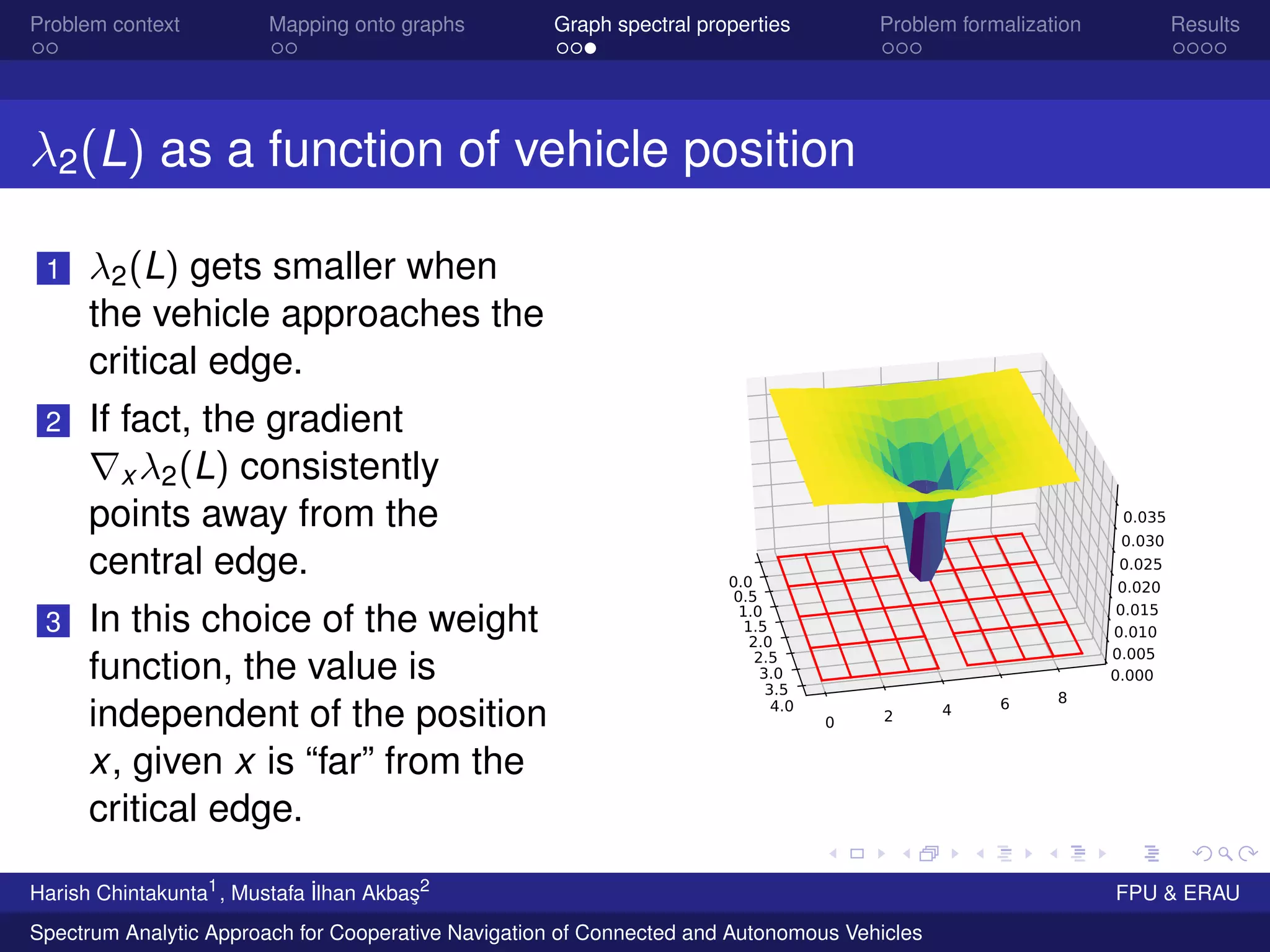
1 λ2(L) gets smaller when
the vehicle approaches the
critical edge.
2 If fact, the gradient
x λ2(L) consistently
points away from the
central edge.
3 In this choice of the weight
function, the value is
independent of the position
x, given x is “far” from the
critical edge.
0.0
0.5
1.0
1.5
2.0
2.5
3.0
3.5
4.0
0
2
4
6
8
0.000
0.005
0.010
0.015
0.020
0.025
0.030
0.035
Harish Chintakunta1
, Mustafa ˙Ilhan Akba¸s2
FPU & ERAU
Spectrum Analytic Approach for Cooperative Navigation of Connected and Autonomous Vehicles
Problem context Mapping onto graphs Graph spectral properties Problem formalization Results
Putting things together
Construct a graph G = (V, E) with discretized points in the
space as vertices, and edges between vertices in a
geometrical neighborhood.
Λ : configuration of the obstacles.
Assign weights wΛ : E → [0, 1], where wΛ(e) is a function
of distances between the edge and all other obstacles.
LΛ((ui, uj)) =
−wΛ((ui, uj)), ui = uj
uk =ui
wΛ((ui, uk )), ui = uj
The second eigenvalue λ2(LΛ) will serve as a good
measure for connectivity.
Harish Chintakunta1
, Mustafa ˙Ilhan Akba¸s2
FPU & ERAU
Spectrum Analytic Approach for Cooperative Navigation of Connected and Autonomous Vehicles
Problem context Mapping onto graphs Graph spectral properties Problem formalization Results
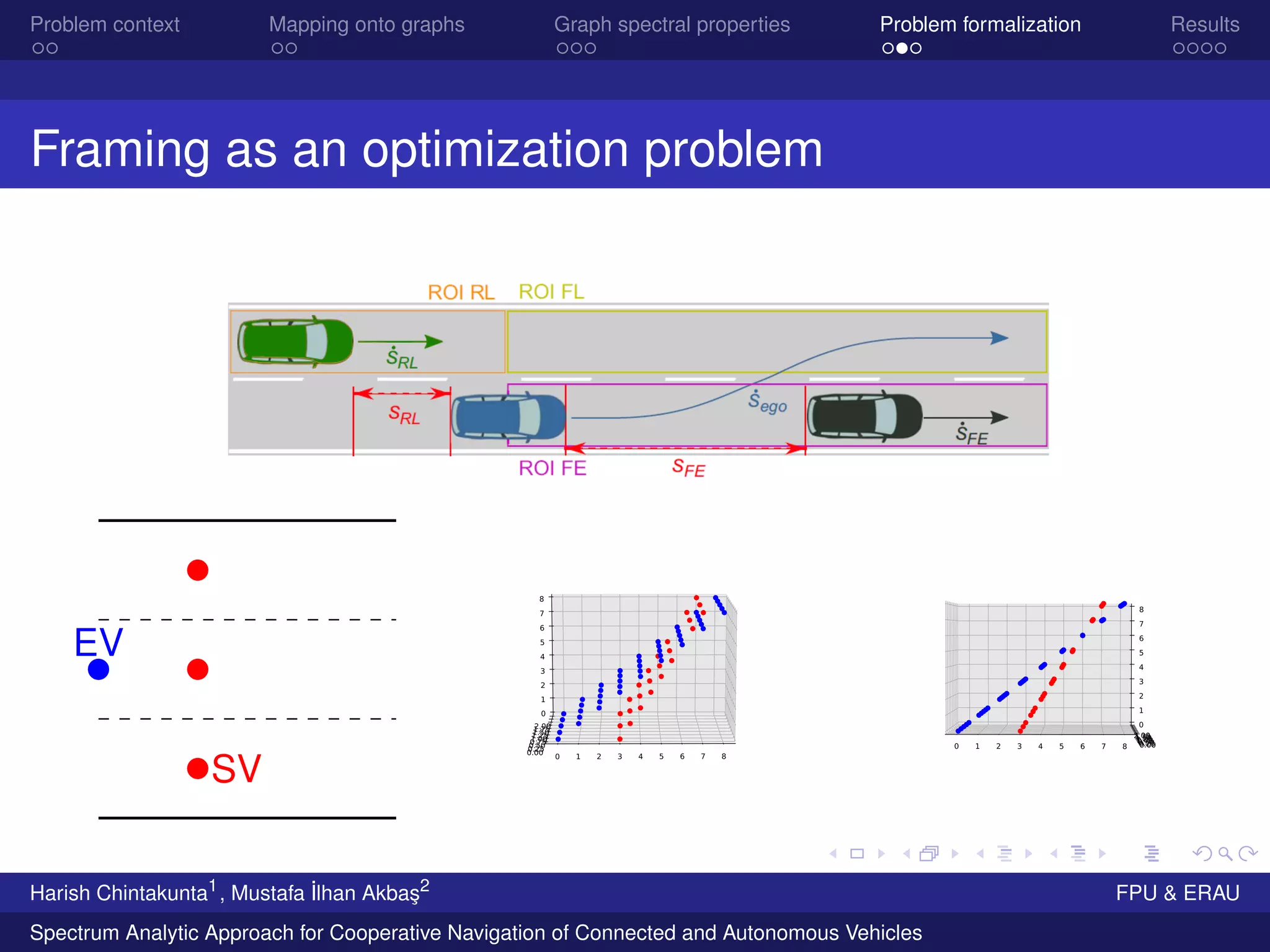
Framing as an optimization problem
EV
SV
0 1 2 3 4 5 6 7 8
0.00
0.25
0.50
0.75
1.00
1.25
1.50
1.75
2.00
0
1
2
3
4
5
6
7
8
0 1 2 3 4 5 6 7 8 0.000.250.500.751.001.251.501.752.00
0
1
2
3
4
5
6
7
8
Harish Chintakunta1
, Mustafa ˙Ilhan Akba¸s2
FPU & ERAU
Spectrum Analytic Approach for Cooperative Navigation of Connected and Autonomous Vehicles
Problem context Mapping onto graphs Graph spectral properties Problem formalization Results
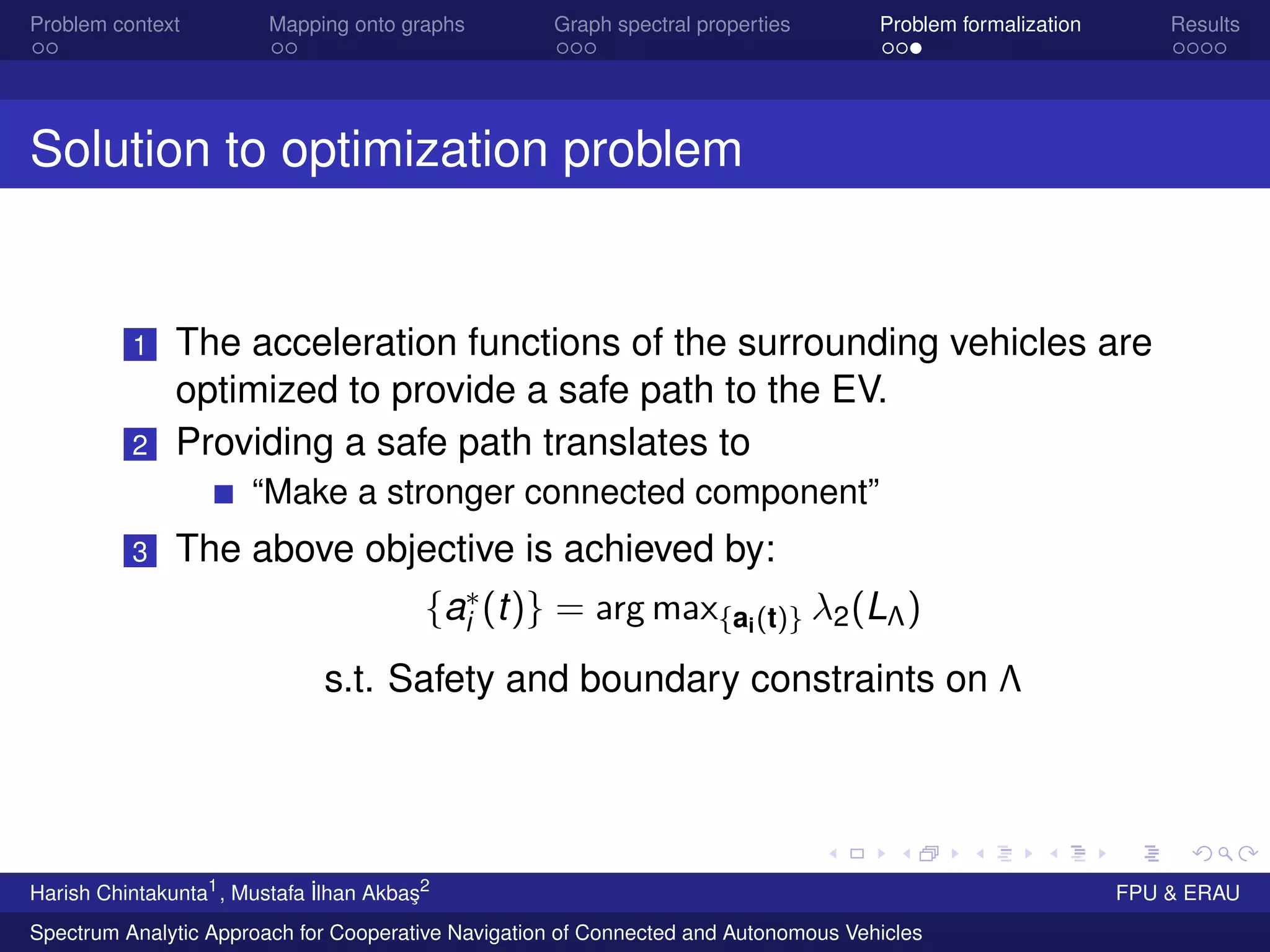
Solution to optimization problem
1 The acceleration functions of the surrounding vehicles are
optimized to provide a safe path to the EV.
2 Providing a safe path translates to
“Make a stronger connected component”
3 The above objective is achieved by:
{a∗
i (t)} = arg max{ai(t)} λ2(LΛ)
s.t. Safety and boundary constraints on Λ
Harish Chintakunta1
, Mustafa ˙Ilhan Akba¸s2
FPU & ERAU
Spectrum Analytic Approach for Cooperative Navigation of Connected and Autonomous Vehicles
Problem context Mapping onto graphs Graph spectral properties Problem formalization Results
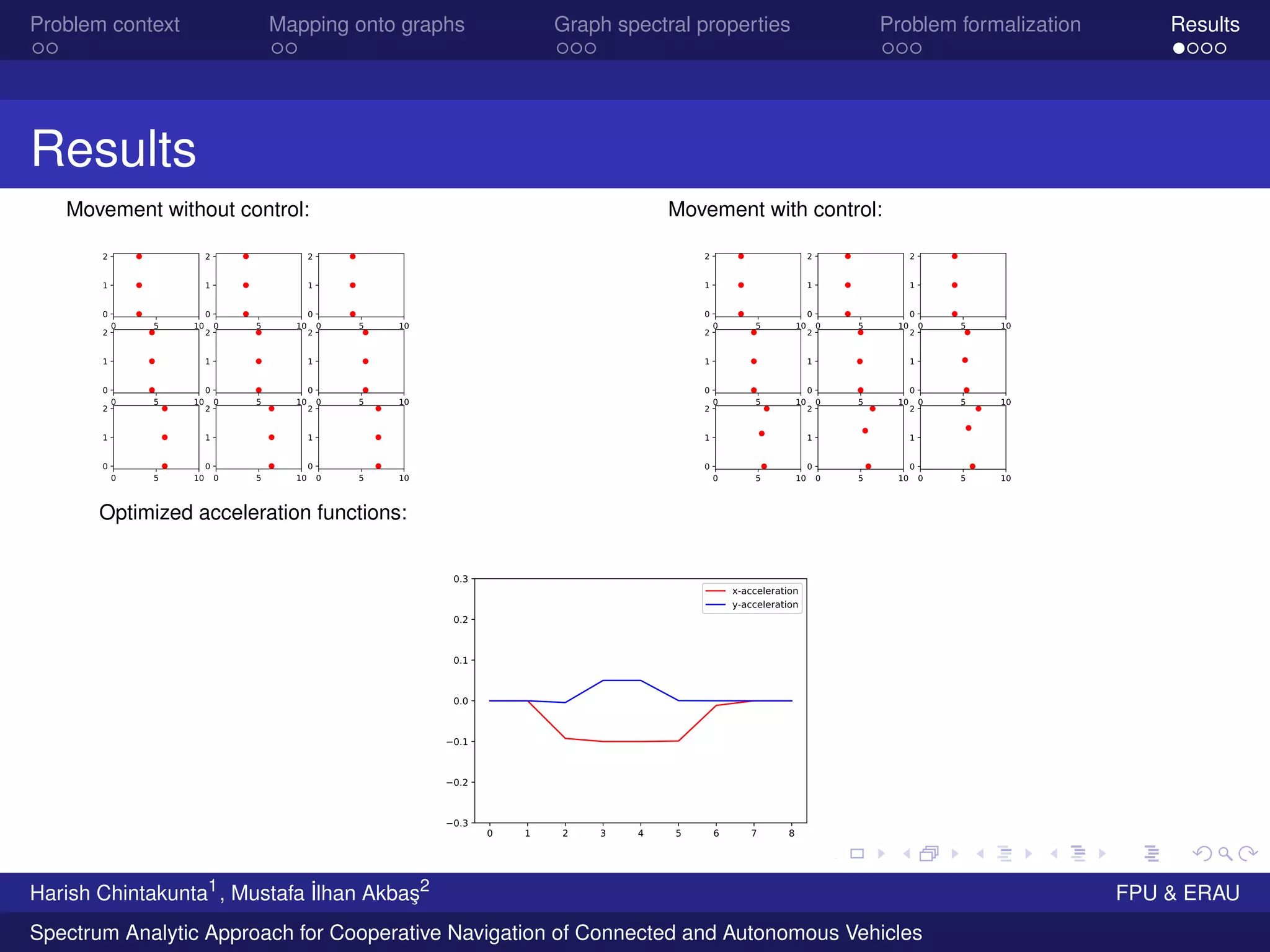
Results
Movement without control:
0 5 10
0
1
2
0 5 10
0
1
2
0 5 10
0
1
2
0 5 10
0
1
2
0 5 10
0
1
2
0 5 10
0
1
2
0 5 10
0
1
2
0 5 10
0
1
2
0 5 10
0
1
2
Movement with control:
0 5 10
0
1
2
0 5 10
0
1
2
0 5 10
0
1
2
0 5 10
0
1
2
0 5 10
0
1
2
0 5 10
0
1
2
0 5 10
0
1
2
0 5 10
0
1
2
0 5 10
0
1
2
Optimized acceleration functions:
0 1 2 3 4 5 6 7 8
−0.3
−0.2
−0.1
0.0
0.1
0.2
0.3
x-acceleration
y-acceleration
Harish Chintakunta1
, Mustafa ˙Ilhan Akba¸s2
FPU & ERAU
Spectrum Analytic Approach for Cooperative Navigation of Connected and Autonomous Vehicles
Problem context Mapping onto graphs Graph spectral properties Problem formalization Results
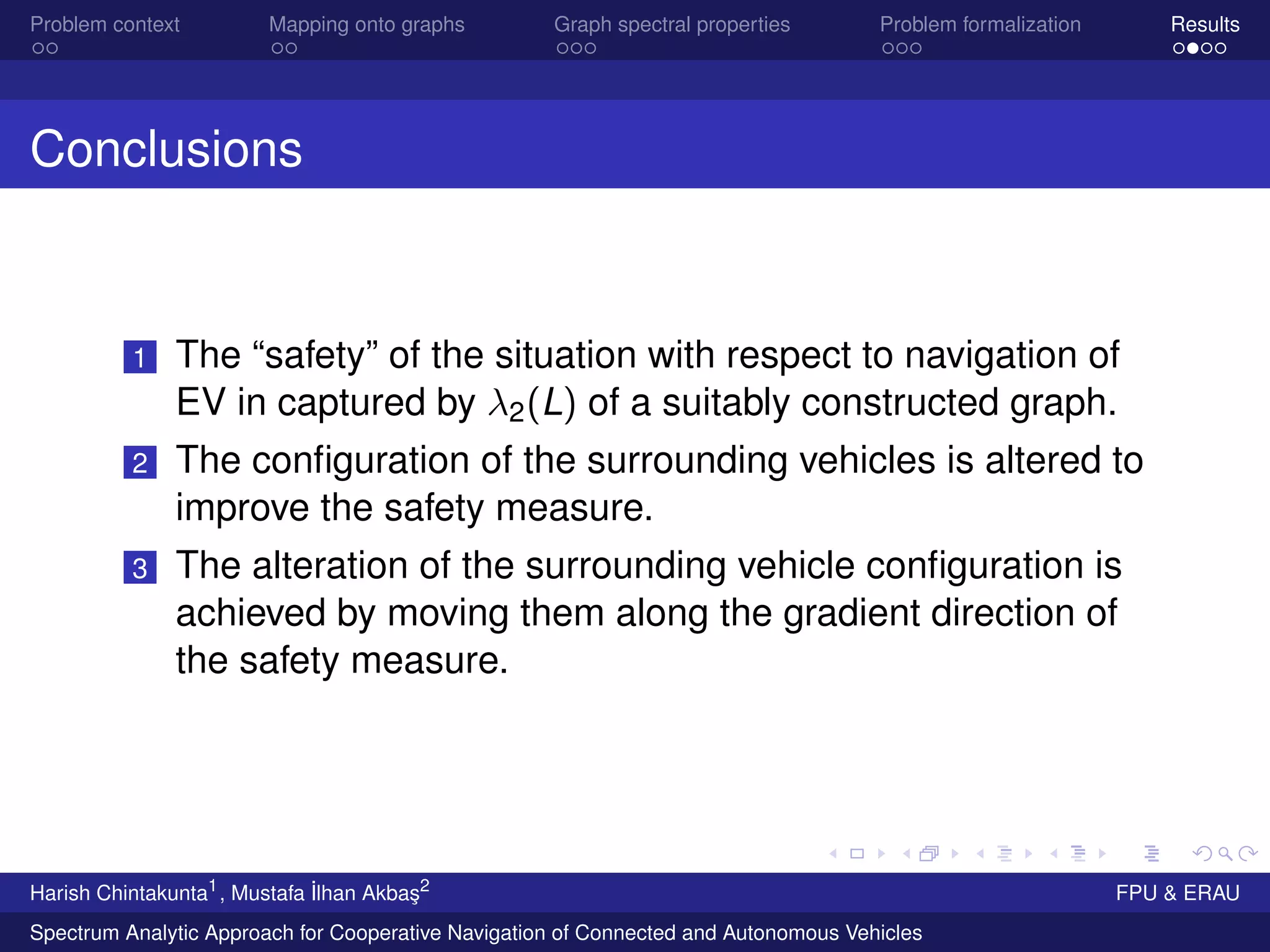
Conclusions
1 The “safety” of the situation with respect to navigation of
EV in captured by λ2(L) of a suitably constructed graph.
2 The configuration of the surrounding vehicles is altered to
improve the safety measure.
3 The alteration of the surrounding vehicle configuration is
achieved by moving them along the gradient direction of
the safety measure.
Harish Chintakunta1
, Mustafa ˙Ilhan Akba¸s2
FPU & ERAU
Spectrum Analytic Approach for Cooperative Navigation of Connected and Autonomous Vehicles
Problem context Mapping onto graphs Graph spectral properties Problem formalization Results
Future directions
1 Distributed algorithms to compute the gradient of the
configuration.
2 Statistical analysis in a realistic traffic situation.
3 Deeper understanding of the theoretical aspects of Fiedler
vector in the context of optimal cooperative driving.
Harish Chintakunta1
, Mustafa ˙Ilhan Akba¸s2
FPU & ERAU
Spectrum Analytic Approach for Cooperative Navigation of Connected and Autonomous Vehicles
Problem context Mapping onto graphs Graph spectral properties Problem formalization Results
Thank you!!
Harish Chintakunta1
, Mustafa ˙Ilhan Akba¸s2
FPU & ERAU
Spectrum Analytic Approach for Cooperative Navigation of Connected and Autonomous Vehicles

Spectrum Analytic Approach for Cooperative Navigation of Connected and Autonomous Vehicles

  • 1.
    Problem context Mappingonto graphs Graph spectral properties Problem formalization Results Spectrum Analytic Approach for Cooperative Navigation of Connected and Autonomous Vehicles Harish Chintakunta1 Mustafa ˙Ilhan Akba¸s2 1Department of Electrical and Computer Engineering Florida Polytechnic University 2Electrical, Computer, Software and Systems Engineering Embry-Riddle Aeronautical University 9th ACM International Symposium on Design and Analysis of Intelligent Vehicular Networks and Applications (DIVANET) November 25, 2019 Harish Chintakunta1 , Mustafa ˙Ilhan Akba¸s2 FPU & ERAU Spectrum Analytic Approach for Cooperative Navigation of Connected and Autonomous Vehicles
  • 2.
    Problem context Mappingonto graphs Graph spectral properties Problem formalization Results Emergency vehicle navigation Making way for the EV can take a long time. Drivers feel “hassled” at the appearance of EVs, which leads to bad decisions. There are about 6,500 annual accidents involving ambulances. Harish Chintakunta1 , Mustafa ˙Ilhan Akba¸s2 FPU & ERAU Spectrum Analytic Approach for Cooperative Navigation of Connected and Autonomous Vehicles
  • 3.
    Problem context Mappingonto graphs Graph spectral properties Problem formalization Results Advantages of Connected Autonomous Vehicles (CAVs) Vehicles can be notified well in advance about an approaching EV. Complex cooperative behavior amongst CAVs can assist the navigation of EVs. EV itself being autonomous can enable complex path planning algorithm to optimize travel time, saving lives. Harish Chintakunta1 , Mustafa ˙Ilhan Akba¸s2 FPU & ERAU Spectrum Analytic Approach for Cooperative Navigation of Connected and Autonomous Vehicles
  • 4.
    Problem context Mappingonto graphs Graph spectral properties Problem formalization Results Our view of the problem We now consider the problem when all other vehicles drive cooperatively to assist an EV. Facilitating safety for EV is rephrased using topological features. The space of feasible paths for EV should be “strongly connected”, in other words, no “bottle necks”. Harish Chintakunta1 , Mustafa ˙Ilhan Akba¸s2 FPU & ERAU Spectrum Analytic Approach for Cooperative Navigation of Connected and Autonomous Vehicles
  • 5.
    Problem context Mappingonto graphs Graph spectral properties Problem formalization Results Formulation in terms of graph theory 1 Discretize the space and draw edges between neighboring vertices. 2 Encode the safety information onto edge weights. 3 The weight we = 1 − e−d(s,e) on an edge is a decreasing function of the distance from a surrounding vehicle. 4 In this example, we would want the surrounding vehicle to move away from the central edge. Harish Chintakunta1 , Mustafa ˙Ilhan Akba¸s2 FPU & ERAU Spectrum Analytic Approach for Cooperative Navigation of Connected and Autonomous Vehicles
  • 6.
    Problem context Mappingonto graphs Graph spectral properties Problem formalization Results Inspiration from spectral properties Graph Laplacian L defined as L = D − A, has the following useful property (M.Fiedler, 1973): λ2(L) ≤ σe(G), where σe(G) is the edge connectivity. More importantly, in weighted graphs, the eigenvalues of L are sensitive to weights of the edges in an edge cut set. Harish Chintakunta1 , Mustafa ˙Ilhan Akba¸s2 FPU & ERAU Spectrum Analytic Approach for Cooperative Navigation of Connected and Autonomous Vehicles
  • 7.
    Problem context Mappingonto graphs Graph spectral properties Problem formalization Results Properties of λ2(L) 1 λ2(LΛ) is very sensitive to weights of edges which “connect” distinct components. 2 The gradient of λ2(LΛ) w.r.t the elements of L can be analytically expressed. 3 Numerical computation of the gradient of λ2(LΛ) also tends to be accurate even for large LΛ matrices, making it ideal for numerical optimization algorithms. −0.2 −0.1 0.0 0.1 0.2 −1.00 −0.75 −0.50 −0.25 0.00 0.25 0.50 0.75 1.00 0 1 2 3 4 5 6 7 8 9 10 11 12 13 14 15 16 17 18 19 0.2 0.4 0.6 0.8 1.0 weight of the linking edge 0.0025 0.0050 0.0075 0.0100 0.0125 0.0150 0.0175 secondeigenvalue linking edge insider edge Harish Chintakunta1 , Mustafa ˙Ilhan Akba¸s2 FPU & ERAU Spectrum Analytic Approach for Cooperative Navigation of Connected and Autonomous Vehicles
  • 8.
    Problem context Mappingonto graphs Graph spectral properties Problem formalization Results λ2(L) as a function of vehicle position 1 λ2(L) gets smaller when the vehicle approaches the critical edge. 2 If fact, the gradient x λ2(L) consistently points away from the central edge. 3 In this choice of the weight function, the value is independent of the position x, given x is “far” from the critical edge. 0.0 0.5 1.0 1.5 2.0 2.5 3.0 3.5 4.0 0 2 4 6 8 0.000 0.005 0.010 0.015 0.020 0.025 0.030 0.035 Harish Chintakunta1 , Mustafa ˙Ilhan Akba¸s2 FPU & ERAU Spectrum Analytic Approach for Cooperative Navigation of Connected and Autonomous Vehicles
  • 9.
    Problem context Mappingonto graphs Graph spectral properties Problem formalization Results Putting things together Construct a graph G = (V, E) with discretized points in the space as vertices, and edges between vertices in a geometrical neighborhood. Λ : configuration of the obstacles. Assign weights wΛ : E → [0, 1], where wΛ(e) is a function of distances between the edge and all other obstacles. LΛ((ui, uj)) = −wΛ((ui, uj)), ui = uj uk =ui wΛ((ui, uk )), ui = uj The second eigenvalue λ2(LΛ) will serve as a good measure for connectivity. Harish Chintakunta1 , Mustafa ˙Ilhan Akba¸s2 FPU & ERAU Spectrum Analytic Approach for Cooperative Navigation of Connected and Autonomous Vehicles
  • 10.
    Problem context Mappingonto graphs Graph spectral properties Problem formalization Results Framing as an optimization problem EV SV 0 1 2 3 4 5 6 7 8 0.00 0.25 0.50 0.75 1.00 1.25 1.50 1.75 2.00 0 1 2 3 4 5 6 7 8 0 1 2 3 4 5 6 7 8 0.000.250.500.751.001.251.501.752.00 0 1 2 3 4 5 6 7 8 Harish Chintakunta1 , Mustafa ˙Ilhan Akba¸s2 FPU & ERAU Spectrum Analytic Approach for Cooperative Navigation of Connected and Autonomous Vehicles
  • 11.
    Problem context Mappingonto graphs Graph spectral properties Problem formalization Results Solution to optimization problem 1 The acceleration functions of the surrounding vehicles are optimized to provide a safe path to the EV. 2 Providing a safe path translates to “Make a stronger connected component” 3 The above objective is achieved by: {a∗ i (t)} = arg max{ai(t)} λ2(LΛ) s.t. Safety and boundary constraints on Λ Harish Chintakunta1 , Mustafa ˙Ilhan Akba¸s2 FPU & ERAU Spectrum Analytic Approach for Cooperative Navigation of Connected and Autonomous Vehicles
  • 12.
    Problem context Mappingonto graphs Graph spectral properties Problem formalization Results Results Movement without control: 0 5 10 0 1 2 0 5 10 0 1 2 0 5 10 0 1 2 0 5 10 0 1 2 0 5 10 0 1 2 0 5 10 0 1 2 0 5 10 0 1 2 0 5 10 0 1 2 0 5 10 0 1 2 Movement with control: 0 5 10 0 1 2 0 5 10 0 1 2 0 5 10 0 1 2 0 5 10 0 1 2 0 5 10 0 1 2 0 5 10 0 1 2 0 5 10 0 1 2 0 5 10 0 1 2 0 5 10 0 1 2 Optimized acceleration functions: 0 1 2 3 4 5 6 7 8 −0.3 −0.2 −0.1 0.0 0.1 0.2 0.3 x-acceleration y-acceleration Harish Chintakunta1 , Mustafa ˙Ilhan Akba¸s2 FPU & ERAU Spectrum Analytic Approach for Cooperative Navigation of Connected and Autonomous Vehicles
  • 13.
    Problem context Mappingonto graphs Graph spectral properties Problem formalization Results Conclusions 1 The “safety” of the situation with respect to navigation of EV in captured by λ2(L) of a suitably constructed graph. 2 The configuration of the surrounding vehicles is altered to improve the safety measure. 3 The alteration of the surrounding vehicle configuration is achieved by moving them along the gradient direction of the safety measure. Harish Chintakunta1 , Mustafa ˙Ilhan Akba¸s2 FPU & ERAU Spectrum Analytic Approach for Cooperative Navigation of Connected and Autonomous Vehicles
  • 14.
    Problem context Mappingonto graphs Graph spectral properties Problem formalization Results Future directions 1 Distributed algorithms to compute the gradient of the configuration. 2 Statistical analysis in a realistic traffic situation. 3 Deeper understanding of the theoretical aspects of Fiedler vector in the context of optimal cooperative driving. Harish Chintakunta1 , Mustafa ˙Ilhan Akba¸s2 FPU & ERAU Spectrum Analytic Approach for Cooperative Navigation of Connected and Autonomous Vehicles
  • 15.
    Problem context Mappingonto graphs Graph spectral properties Problem formalization Results Thank you!! Harish Chintakunta1 , Mustafa ˙Ilhan Akba¸s2 FPU & ERAU Spectrum Analytic Approach for Cooperative Navigation of Connected and Autonomous Vehicles