Presentation
On
WHITE BLOOD CELLS
-By Akanksha Lahase
OBJECTIVES
At the end of presentation group will be able to discuss:
1) Introduction of WBC
2) Classification of WBC
3) Production and formation of WBCs
4) Disease of WBC
LEUCOCYTES
 White blood cells or leucocytes are defined as a
white or colorless blood cells (corpuscle).
 They are capable of amoeboid movement
 Its chief functions is to protect the body against
micro organisms causing disease.
LEUCOCYTES
 Leucocytes are formed in the bone marrow from
myeloid stem cells and some being formed in the
lymph nodes from lymphoid stem cells.
 Leucocytes are the units of the body’s resistance to
infection, disease
CLASSIFCATION
 They are classified in two main groups which are
granular or agranular.
 This is dependent on whether they contain
conspicuous ( visible) chemical filled cytoplasmic
granules ( vesicles), that are made visible by
staining.
DIFFERENCES BETWEEN
AGRANULAR AND GRANULAR
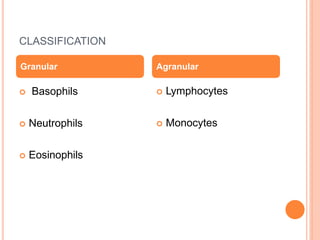
CLASSIFICATION
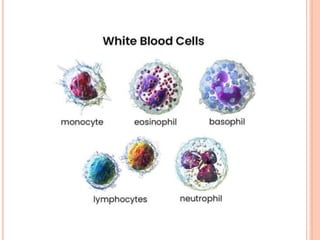
 Lymphocytes
 Monocytes
Granular
 Basophils
 Neutrophils
 Eosinophils
Agranular
GRANULAR LEUCOCYTES
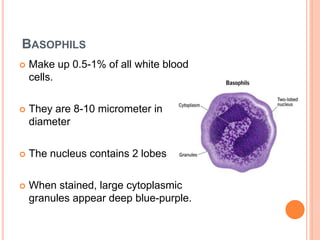
BASOPHILS
 Make up 0.5-1% of all white blood
cells.
 They are 8-10 micrometer in
diameter
 The nucleus contains 2 lobes
 When stained, large cytoplasmic
granules appear deep blue-purple.
BASOPHILS FUNCTION
Liberate heparin, histamine, and
serotonin in allergic reactions that
intensify the overall inflammatory
response.
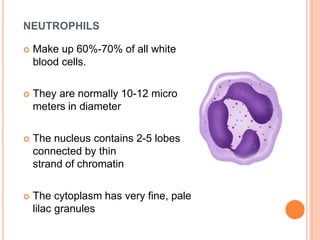
NEUTROPHILS
 Make up 60%-70% of all white
blood cells.
 They are normally 10-12 micro
meters in diameter
 The nucleus contains 2-5 lobes
connected by thin
strand of chromatin
 The cytoplasm has very fine, pale
lilac granules
NEUTROPHILS FUNCTION
 Its functions as a phagocyte
 Destroy bacteria with lysozyme, defensins and
strong oxidocents such as superoxide anions,
hydrogen peroxide and hydrochlorite anion.
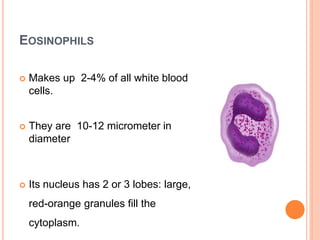
EOSINOPHILS
 Makes up 2-4% of all white blood
cells.
 They are 10-12 micrometer in
diameter
 Its nucleus has 2 or 3 lobes: large,
red-orange granules fill the
cytoplasm.
EOSINOPHILS FUNCTION
 Combat the effects of histamine in allergic
reactions,
 Phagocytize antigen-antibody complexes
 Destroy certain parasitic worms.
AGRANULAR LEUCOCYTES
MONOCYTES
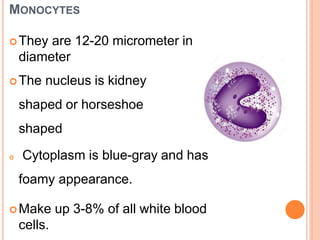
They are 12-20 micrometer in
diameter
The nucleus is kidney
shaped or horseshoe
shaped
 Cytoplasm is blue-gray and has
foamy appearance.
Make up 3-8% of all white blood
cells.
MONOCYTES FUNCTION
 Phagocytosis this occurs after they transform into
fixed or wandering macrophages.
LYMPHOCYTES
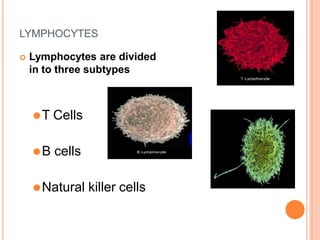
 Lymphocytes are divided
in to three subtypes
⚫T Cells
⚫B cells
⚫Natural killer cells
LEUCOCYTES
Make up 20-25% of all white blood cells.
Small lymphocytes are 6-9 micrometer in
diameter
 large lymphocytes are 10-14 micrometer
in diameter
LYMPHOCYTES
 nucleus is round or slightly indented
 cytoplasm forms a rim around the nucleus
that looks sky blue
 the larger the cell, the more cytoplasm is
visible.
LEUCOCYTES FUNCTION
 Mediate immune responses, including antigen-
antibody reactions.
 B cells develop into plasma cell, which secrete
antibodies.
 T cells attack invading viruses, cancer cells and
transplanted tissue cells.
 Natural killer cells attack a wide variety of
infectious microbes and certain spontaneously
arising tumor cells.
Leukocytes Disorders:
Leukemia refers to cancerous
conditions involving white blood cells.
Leukemia are named according to
abnormal white blood cells involved.
Myelocytic leukemia- involves
myeloblasts
Lymphocytic leukemia- involves
lymphocytes
Acute leukemia involves blast- type
cells and primarily affects children
Chronic leukemia is more prevalent in
older people.
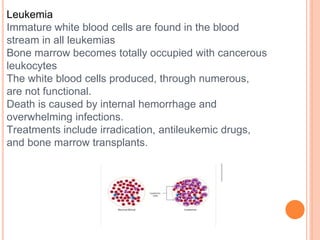
Leukemia
Immature white blood cells are found in the blood
stream in all leukemias
Bone marrow becomes totally occupied with cancerous
leukocytes
The white blood cells produced, through numerous,
are not functional.
Death is caused by internal hemorrhage and
overwhelming infections.
Treatments include irradication, antileukemic drugs,
and bone marrow transplants.
SUMMARY
White blood cells are part of the
body’s immune system. They help
the body fight infection and other
diseases. Types of white blood
cells are granulocytes(neutrophils,
eosinophils and basophils)
monocytes and lymphocytes(T
cells and B cells)
677245031123
CONCLUSION
WBCs exhibit specific and distinct functions that cooperate to form
the basis of the immune system. Together, they are able to provide a
quick, efficient, specefic and long lasting response to invading
pathogens
REFERENCE
1) N. Geetha, Textbook of physiology for
Nursing students, Edition 1,P.no 35 to 42
2) Wiley Blackwell, Fundamentals of
anatomy and physiology for nursing and
healthcare students, Edition 2,P.no 93 to
110
3) Dr. AK Jain, physiology for BSC
nursing, Edition 1,P.no 120 to 126
4) D. Venkatesh, Basis of Medical
physiology for nursing students, Edition
1,P.no 120 to 126
677245031123
akankshaphysio. pptx.pptxggbmkbbvfhvdddf

akankshaphysio. pptx.pptxggbmkbbvfhvdddf

  • 1.
  • 2.
    OBJECTIVES At the endof presentation group will be able to discuss: 1) Introduction of WBC 2) Classification of WBC 3) Production and formation of WBCs 4) Disease of WBC
  • 4.
    LEUCOCYTES  White bloodcells or leucocytes are defined as a white or colorless blood cells (corpuscle).  They are capable of amoeboid movement  Its chief functions is to protect the body against micro organisms causing disease.
  • 5.
    LEUCOCYTES  Leucocytes areformed in the bone marrow from myeloid stem cells and some being formed in the lymph nodes from lymphoid stem cells.  Leucocytes are the units of the body’s resistance to infection, disease
  • 6.
    CLASSIFCATION  They areclassified in two main groups which are granular or agranular.  This is dependent on whether they contain conspicuous ( visible) chemical filled cytoplasmic granules ( vesicles), that are made visible by staining.
  • 7.
  • 8.
    CLASSIFICATION  Lymphocytes  Monocytes Granular Basophils  Neutrophils  Eosinophils Agranular
  • 10.
  • 11.
    BASOPHILS  Make up0.5-1% of all white blood cells.  They are 8-10 micrometer in diameter  The nucleus contains 2 lobes  When stained, large cytoplasmic granules appear deep blue-purple.
  • 12.
    BASOPHILS FUNCTION Liberate heparin,histamine, and serotonin in allergic reactions that intensify the overall inflammatory response.
  • 13.
    NEUTROPHILS  Make up60%-70% of all white blood cells.  They are normally 10-12 micro meters in diameter  The nucleus contains 2-5 lobes connected by thin strand of chromatin  The cytoplasm has very fine, pale lilac granules
  • 14.
    NEUTROPHILS FUNCTION  Itsfunctions as a phagocyte  Destroy bacteria with lysozyme, defensins and strong oxidocents such as superoxide anions, hydrogen peroxide and hydrochlorite anion.
  • 15.
    EOSINOPHILS  Makes up2-4% of all white blood cells.  They are 10-12 micrometer in diameter  Its nucleus has 2 or 3 lobes: large, red-orange granules fill the cytoplasm.
  • 16.
    EOSINOPHILS FUNCTION  Combatthe effects of histamine in allergic reactions,  Phagocytize antigen-antibody complexes  Destroy certain parasitic worms.
  • 17.
  • 18.
    MONOCYTES They are 12-20micrometer in diameter The nucleus is kidney shaped or horseshoe shaped  Cytoplasm is blue-gray and has foamy appearance. Make up 3-8% of all white blood cells.
  • 19.
    MONOCYTES FUNCTION  Phagocytosisthis occurs after they transform into fixed or wandering macrophages.
  • 20.
    LYMPHOCYTES  Lymphocytes aredivided in to three subtypes ⚫T Cells ⚫B cells ⚫Natural killer cells
  • 21.
    LEUCOCYTES Make up 20-25%of all white blood cells. Small lymphocytes are 6-9 micrometer in diameter  large lymphocytes are 10-14 micrometer in diameter
  • 22.
    LYMPHOCYTES  nucleus isround or slightly indented  cytoplasm forms a rim around the nucleus that looks sky blue  the larger the cell, the more cytoplasm is visible.
  • 23.
    LEUCOCYTES FUNCTION  Mediateimmune responses, including antigen- antibody reactions.  B cells develop into plasma cell, which secrete antibodies.  T cells attack invading viruses, cancer cells and transplanted tissue cells.  Natural killer cells attack a wide variety of infectious microbes and certain spontaneously arising tumor cells.
  • 24.
    Leukocytes Disorders: Leukemia refersto cancerous conditions involving white blood cells. Leukemia are named according to abnormal white blood cells involved. Myelocytic leukemia- involves myeloblasts Lymphocytic leukemia- involves lymphocytes Acute leukemia involves blast- type cells and primarily affects children Chronic leukemia is more prevalent in older people.
  • 25.
    Leukemia Immature white bloodcells are found in the blood stream in all leukemias Bone marrow becomes totally occupied with cancerous leukocytes The white blood cells produced, through numerous, are not functional. Death is caused by internal hemorrhage and overwhelming infections. Treatments include irradication, antileukemic drugs, and bone marrow transplants.
  • 26.
    SUMMARY White blood cellsare part of the body’s immune system. They help the body fight infection and other diseases. Types of white blood cells are granulocytes(neutrophils, eosinophils and basophils) monocytes and lymphocytes(T cells and B cells) 677245031123
  • 27.
    CONCLUSION WBCs exhibit specificand distinct functions that cooperate to form the basis of the immune system. Together, they are able to provide a quick, efficient, specefic and long lasting response to invading pathogens
  • 28.
    REFERENCE 1) N. Geetha,Textbook of physiology for Nursing students, Edition 1,P.no 35 to 42 2) Wiley Blackwell, Fundamentals of anatomy and physiology for nursing and healthcare students, Edition 2,P.no 93 to 110 3) Dr. AK Jain, physiology for BSC nursing, Edition 1,P.no 120 to 126 4) D. Venkatesh, Basis of Medical physiology for nursing students, Edition 1,P.no 120 to 126 677245031123