Watershed Assessment Modeling to
Identify Critical Sources of Pollution and
Evaluate Effectiveness of Conservation
Management Practices
Nichole Embertson, Ph.D.
Science and Planning Coordinator
Whatcom Conservation District
SWCS Conference | July 31, 2018
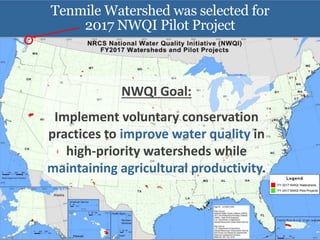
Tenmile Watershed was selected for
2017 NWQI Pilot Project
NWQI Goal:
Implement voluntary conservation
practices to improve water quality in
high-priority watersheds while
maintaining agricultural productivity.
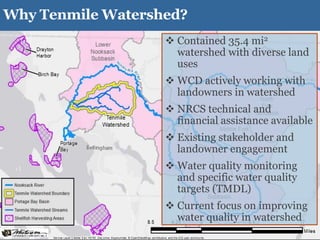
 Contained 35.4 mi2
watershed with diverse land
uses
 WCD actively working with
landowners in watershed
 NRCS technical and
financial assistance available
 Existing stakeholder and
landowner engagement
 Water quality monitoring
and specific water quality
targets (TMDL)
 Current focus on improving
water quality in watershed
Why Tenmile Watershed?
Phosphorus Nitrogen
Suspended
Solids
Pathogens
Watershed Assessment
Identify Water Quality Concerns
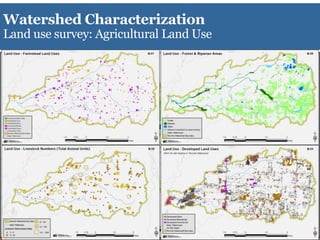
Watershed Characterization
Land use survey: Agricultural Land Use
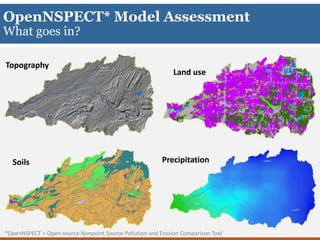
OpenNSPECT* Model Assessment
What goes in?
Topography
Soils
Land use
Precipitation
*OpenNSPECT = Open-source Nonpoint Source Pollution and Erosion Comparison Tool
OpenNSPECT* Model Assessment
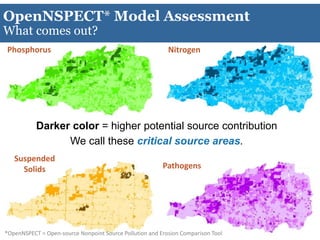
What comes out?
Phosphorus
Suspended
Solids
Nitrogen
Pathogens
Darker color = higher potential source contribution
We call these critical source areas.
*OpenNSPECT = Open-source Nonpoint Source Pollution and Erosion Comparison Tool
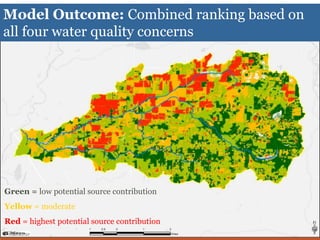
Model Outcome: Combined ranking based on
all four water quality concerns
Green = low potential source contribution
Yellow = moderate
Red = highest potential source contribution
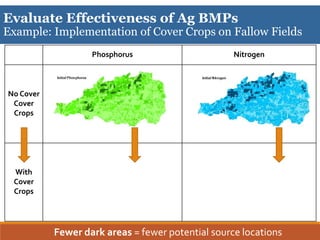
Fewer dark areas = fewer potential source locations
Evaluate Effectiveness of Ag BMPs
Example: Implementation of Cover Crops on Fallow Fields
Phosphorus Nitrogen
No Cover
Cover
Crops
With
Cover
Crops
What Can We Do With Modeling
Results?
 Focus planning efforts in critical source areas or
specific land uses
 Evaluate the effectiveness of various BMPs by land
use type and practice
 Determine the impact and potential effectiveness of
NRCS programs in an area
 Focus cost-share priorities and funding
 Adapt outreach materials and efforts to meet the
social considerations of landowners in a watershed
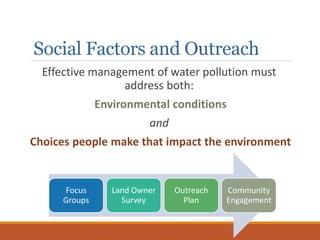
Social Factors and Outreach
Effective management of water pollution must
address both:
Environmental conditions
and
Choices people make that impact the environment
Focus
Groups
Land Owner
Survey
Outreach
Plan
Community
Engagement
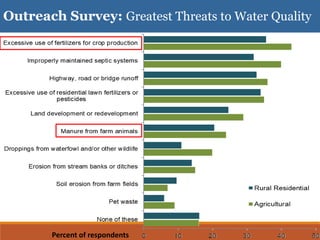
Greatest Threats to Water Quality
Percent of respondents
Outreach Survey: Greatest Threats to Water Quality
Percent of respondents
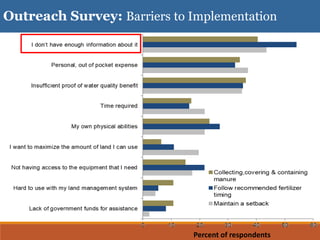
Outreach Survey: Barriers to Implementation
34
33
32
31
31
31
28
27
21
21
16
16
15
13
10
7
2
7
0 10 20 30 40
Department of Health
Whatcom Family Farmers
Whatcom Conservation District
Laurel Watershed Improvement District
Tenmile Clean Water Project
WSU University Extension
Whatcom Farm Bureau
Other local landowners, friends, etc.
WA State Department of Agriculture (WSDA)
WA State Department of Ecology
Farm Service Agency
Natural Resources Conservation Service…
A local farm and garden center
Local livestock group
U.S. Environmental Protection Agency (EPA )
Whatcom County
Fertilizer or seed sales people
Some other agency or organization
Percent of Respondants
All respondents (n=177)
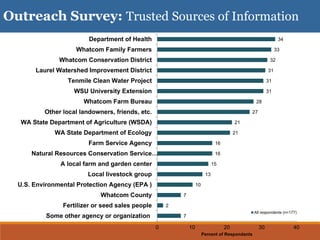
Outreach Survey: Trusted Sources of Information
Overall Outcomes of Tenmile
Watershed Assessment
 Characterization of Tenmile Watershed
 Identify high risk land uses and effective conservation practices
 Understand social factors affecting BMP implementation and
how to address specific to watershed
 Outreach to landowners is now targeted based on watershed,
impact modeling and community
 Better, strategic allocation of resources (time, $) and efforts
informed by the watershed assessment
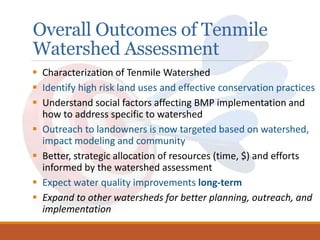
 Expect water quality improvements long-term
 Expand to other watersheds for better planning, outreach, and
implementation
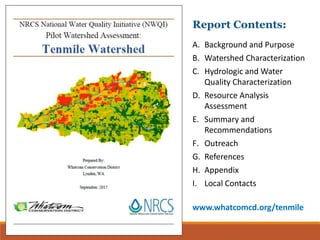
Report Contents:
A. Background and Purpose
B. Watershed Characterization
C. Hydrologic and Water
Quality Characterization
D. Resource Analysis
Assessment
E. Summary and
Recommendations
F. Outreach
G. References
H. Appendix
I. Local Contacts
www.whatcomcd.org/tenmile
Disclaimer: The reproduction or use of any of the images or content within
this document is not allowed without prior approval from the creator.
Nichole M. Embertson, Ph.D.
Science and Planning Coordinator
Whatcom Conservation District
O: (360) 526-2381 x 126
E: nembertson@whatcomcd.org
www.whatcomcd.org/tenmile
Thanks Project Team!
Megan Harris
Aneka Sweeney
Andrew Phay
WCD and NRCS Staff
Questions?

Watershed assessment modelling

  • 1.
    Watershed Assessment Modelingto Identify Critical Sources of Pollution and Evaluate Effectiveness of Conservation Management Practices Nichole Embertson, Ph.D. Science and Planning Coordinator Whatcom Conservation District SWCS Conference | July 31, 2018
  • 2.
    Tenmile Watershed wasselected for 2017 NWQI Pilot Project NWQI Goal: Implement voluntary conservation practices to improve water quality in high-priority watersheds while maintaining agricultural productivity.
  • 3.
     Contained 35.4mi2 watershed with diverse land uses  WCD actively working with landowners in watershed  NRCS technical and financial assistance available  Existing stakeholder and landowner engagement  Water quality monitoring and specific water quality targets (TMDL)  Current focus on improving water quality in watershed Why Tenmile Watershed?
  • 4.
  • 5.
    Watershed Characterization Land usesurvey: Agricultural Land Use
  • 6.
    OpenNSPECT* Model Assessment Whatgoes in? Topography Soils Land use Precipitation *OpenNSPECT = Open-source Nonpoint Source Pollution and Erosion Comparison Tool
  • 7.
    OpenNSPECT* Model Assessment Whatcomes out? Phosphorus Suspended Solids Nitrogen Pathogens Darker color = higher potential source contribution We call these critical source areas. *OpenNSPECT = Open-source Nonpoint Source Pollution and Erosion Comparison Tool
  • 8.
    Model Outcome: Combinedranking based on all four water quality concerns Green = low potential source contribution Yellow = moderate Red = highest potential source contribution
  • 9.
    Fewer dark areas= fewer potential source locations Evaluate Effectiveness of Ag BMPs Example: Implementation of Cover Crops on Fallow Fields Phosphorus Nitrogen No Cover Cover Crops With Cover Crops
  • 10.
    What Can WeDo With Modeling Results?  Focus planning efforts in critical source areas or specific land uses  Evaluate the effectiveness of various BMPs by land use type and practice  Determine the impact and potential effectiveness of NRCS programs in an area  Focus cost-share priorities and funding  Adapt outreach materials and efforts to meet the social considerations of landowners in a watershed
  • 11.
    Social Factors andOutreach Effective management of water pollution must address both: Environmental conditions and Choices people make that impact the environment Focus Groups Land Owner Survey Outreach Plan Community Engagement
  • 12.
    Greatest Threats toWater Quality Percent of respondents Outreach Survey: Greatest Threats to Water Quality
  • 13.
    Percent of respondents OutreachSurvey: Barriers to Implementation
  • 14.
    34 33 32 31 31 31 28 27 21 21 16 16 15 13 10 7 2 7 0 10 2030 40 Department of Health Whatcom Family Farmers Whatcom Conservation District Laurel Watershed Improvement District Tenmile Clean Water Project WSU University Extension Whatcom Farm Bureau Other local landowners, friends, etc. WA State Department of Agriculture (WSDA) WA State Department of Ecology Farm Service Agency Natural Resources Conservation Service… A local farm and garden center Local livestock group U.S. Environmental Protection Agency (EPA ) Whatcom County Fertilizer or seed sales people Some other agency or organization Percent of Respondants All respondents (n=177) Outreach Survey: Trusted Sources of Information
  • 15.
    Overall Outcomes ofTenmile Watershed Assessment  Characterization of Tenmile Watershed  Identify high risk land uses and effective conservation practices  Understand social factors affecting BMP implementation and how to address specific to watershed  Outreach to landowners is now targeted based on watershed, impact modeling and community  Better, strategic allocation of resources (time, $) and efforts informed by the watershed assessment  Expect water quality improvements long-term  Expand to other watersheds for better planning, outreach, and implementation
  • 16.
    Report Contents: A. Backgroundand Purpose B. Watershed Characterization C. Hydrologic and Water Quality Characterization D. Resource Analysis Assessment E. Summary and Recommendations F. Outreach G. References H. Appendix I. Local Contacts www.whatcomcd.org/tenmile
  • 17.
    Disclaimer: The reproductionor use of any of the images or content within this document is not allowed without prior approval from the creator. Nichole M. Embertson, Ph.D. Science and Planning Coordinator Whatcom Conservation District O: (360) 526-2381 x 126 E: nembertson@whatcomcd.org www.whatcomcd.org/tenmile Thanks Project Team! Megan Harris Aneka Sweeney Andrew Phay WCD and NRCS Staff Questions?

Editor's Notes

  • #4 22 pilot watersheds Approx 200 eligible NWQI watersheds
  • #5 22 pilot watersheds Approx 200 eligible NWQI watersheds
  • #6 Section C covers: Water Quantity, including relative contribution of the Tenmile Watershed to the Lower Nooksack River and seasonality of water quantity Water Quality (pathogens N, P, and Sediment) Map shows monitoring stations in the watershed- 10 monitoring stations for pathogens. 1 monitoring station for N, P, and Sediment that is sampled on a project basis (not currently being sampled) Historic USGS Gauge station (not active since 2012)
  • #9 Meg to edit
  • #10 Model outputs: Potential Critical Source Areas Darker color = higher potential source contribution.
  • #12 As we move forward to implementation and evaluate implementation these things will continue to be important: Ongoing water quality monitoring (PIC, WCWP) Data management and water quality trend analysis in partnership with the WCWP Implementation monitoring (track metrics such as landowner contacts, conservation practices installed) Flow monitoring in Tenmile and Nooksack Basin Effectiveness monitoring (edge of field) in our region Farm planning, landowner interaction, and outreach
  • #14 WHY SOCIAL INDICATORS? Effective management of Nonpoint Source (NPS) water pollution requires addressing both environmental conditions and the choices people make that impact the environment. To do this, your project may have to influence people’s awareness, skills, attitudes, capacity, or constraints related to water quality improvement. Letters were mailed to rural residential landowners with a printed link to an online survey. Paper surveys were mailed to landowners engaging in agricultural practices, with a reminder letter that included a printed link to an online version. 186 respondents submitted a survey with at least a quarter of the questions completed. Partial surveys were included in the analysis. Analysis includes comparisons between agricultural respondents (who have some form of agricultural land usage on their property) and residential respondents (no agriculture). Agricultural (n=112) Residential (no known agricultural activities) (n=74)
  • #15 In your opinion, which of these, if any, pose the greatest threat for water quality in your area? Respondents were presented with ten different potential threats to water quality and asked to identify which pose the greatest threat. The top ranked threats were “excessive use of fertilizers for crop production,” followed closely by “improperly maintained septic systems,” “highway, road or bridge runoff,” and “excessive use of residential lawn fertilizers or pesticides.” Respondents who use their land for agricultural purposes had slightly different perceptions compared to residential respondents. This was noted especially among agricultural respondents who live in a CSA . These respondents were especially likely to cite road runoff, improperly maintained septic systems, and droppings from waterfowl or other wildlife when compared to residential respondents . excessive use of fertilizers for both farm and lawn ranked highest.  and timing and rate of fertilizer application was one of our target bmp's where lack of information on how to access fertilizer rate and timing was the biggest barrier.  Perhaps offering free soil testing and interpretation would be a good motivator for this group.
  • #16 Identified barriers compared across three practices     Respondents were asked about three recommended practices: maintaining a setback, applying fertilizer at recommended rates, and collecting and covering manure. Lack of information was the top barrier for each of the three proposed practices. This shows that this was especially salient for following recommended fertilizer timing. Cite sources for credibility of information, connect behavior with impact
  • #17 Which of the following organizations and agencies do you most trust to provide you with accurate information? Respondents identified agencies that they most trust to provide accurate information. When taken together, Department of Health was ranked first, followed by Whatcom Family Farmers and WCD. Partner with trusted sources of information, unify messaging
  • #18 Goals
  • #19 Report submitted to local NRCS first of October 2017. Look to report for more information. This presentation will follow the structure of the report.