Watershed Management 
Programs 
Presented by 
Richard Watson, A.I.C.P. 
Richard Watson & Associates, Inc. (RWA) 
Presented to 
Southern California Water Summit & Fall Conference 
Coronado, CA 
November 8, 2014 
1
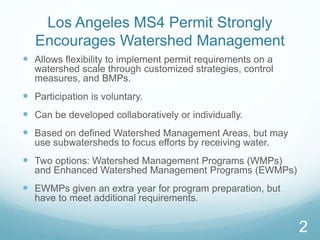
Los Angeles MS4 Permit Strongly 
Encourages Watershed Management 
 Allows flexibility to implement permit requirements on a 
watershed scale through customized strategies, control 
measures, and BMPs. 
 Participation is voluntary. 
 Can be developed collaboratively or individually. 
 Based on defined Watershed Management Areas, but may 
use subwatersheds to focus efforts by receiving water. 
 Two options: Watershed Management Programs (WMPs) 
and Enhanced Watershed Management Programs (EWMPs) 
 EWMPs given an extra year for program preparation, but 
have to meet additional requirements. 
2
3
4
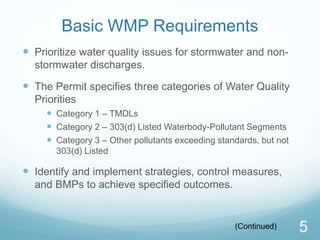
Basic WMP Requirements 
 Prioritize water quality issues for stormwater and non-stormwater 
discharges. 
 The Permit specifies three categories of Water Quality 
Priorities 
 Category 1 – TMDLs 
 Category 2 – 303(d) Listed Waterbody-Pollutant Segments 
 Category 3 – Other pollutants exceeding standards, but not 
303(d) Listed 
 Identify and implement strategies, control measures, 
and BMPs to achieve specified outcomes. 
(Continued) 5
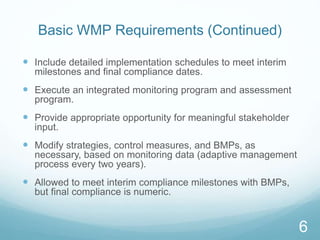
Basic WMP Requirements (Continued) 
 Include detailed implementation schedules to meet interim 
milestones and final compliance dates. 
 Execute an integrated monitoring program and assessment 
program. 
 Provide appropriate opportunity for meaningful stakeholder 
input. 
 Modify strategies, control measures, and BMPs, as 
necessary, based on monitoring data (adaptive management 
process every two years). 
 Allowed to meet interim compliance milestones with BMPs, 
but final compliance is numeric. 
6
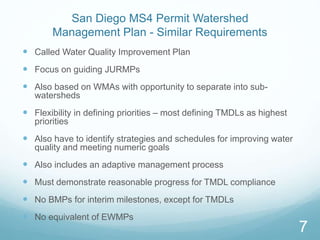
San Diego MS4 Permit Watershed 
Management Plan - Similar Requirements 
 Called Water Quality Improvement Plan 
 Focus on guiding JURMPs 
 Also based on WMAs with opportunity to separate into sub-watersheds 
 Flexibility in defining priorities – most defining TMDLs as highest 
priorities 
 Also have to identify strategies and schedules for improving water 
quality and meeting numeric goals 
 Also includes an adaptive management process 
 Must demonstrate reasonable progress for TMDL compliance 
 No BMPs for interim milestones, except for TMDLs 
 No equivalent of EWMPs 
7
The Los Cerritos Channel 
WMP Example 
8
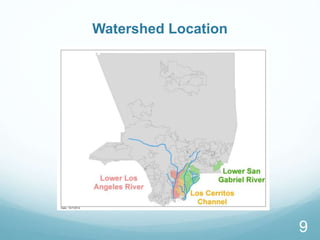
Watershed Location 
9
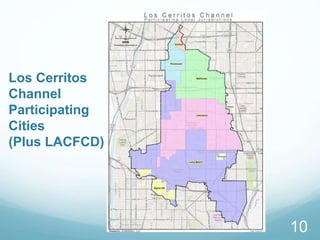
Los Cerritos 
Channel 
Participating 
Cities 
(Plus LACFCD) 
10
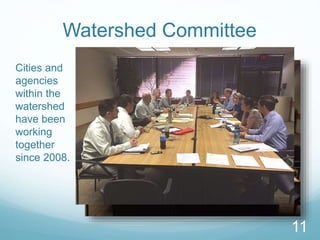
Watershed Committee 
Cities and 
agencies 
within the 
watershed 
have been 
working 
together 
since 2008. 
11
Water Quality Improvement 
Strategy 
 Multi-pronged strategy initially focused on source 
control control, total suspended solids (TSS) reduction, 
and runoff reduction 
 A particular emphasis on true source control for metals 
 SB 346 for copper 
 Future use of Safer Consumer Product Regulations for 
zinc 
 Lead is already under control – no further reduction 
required by TMDL 
12
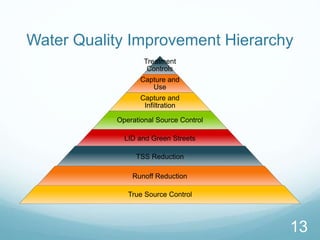
Water Quality Improvement Hierarchy 
Treatment 
Controls 
Capture and 
Use 
Capture and 
Infiltration 
Operational Source Control 
LID and Green Streets 
TSS Reduction 
Runoff Reduction 
True Source Control 
13
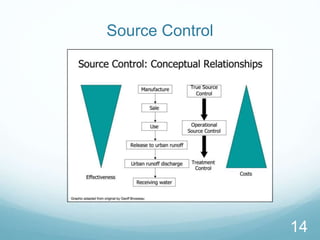
Source Control 
14
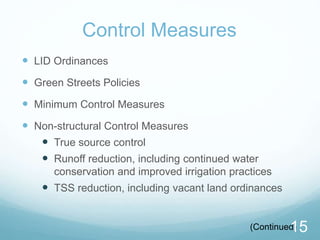
Control Measures 
 LID Ordinances 
 Green Streets Policies 
 Minimum Control Measures 
 Non-structural Control Measures 
 True source control 
 Runoff reduction, including continued water 
conservation and improved irrigation practices 
 TSS reduction, including vacant land ordinances 
(Continued1) 5
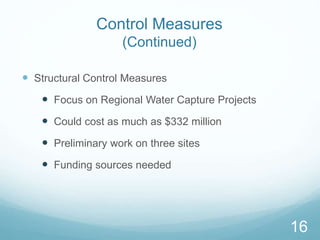
Control Measures 
(Continued) 
 Structural Control Measures 
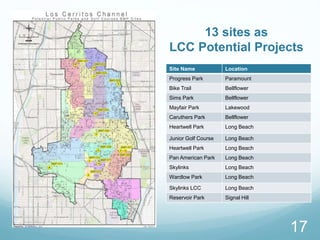
 Focus on Regional Water Capture Projects 
 Could cost as much as $332 million 
 Preliminary work on three sites 
 Funding sources needed 
16
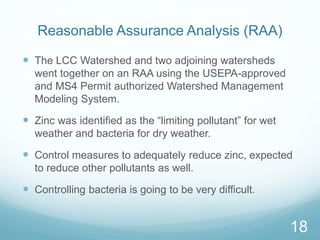
13 sites as 
LCC Potential Projects 
Site Name Location 
Progress Park Paramount 
Bike Trail Bellflower 
Sims Park Bellflower 
Mayfair Park Lakewood 
Caruthers Park Bellflower 
Heartwell Park Long Beach 
Junior Golf Course Long Beach 
Heartwell Park Long Beach 
Pan American Park Long Beach 
Skylinks Long Beach 
Wardlow Park Long Beach 
Skylinks LCC Long Beach 
Reservoir Park Signal Hill 
17
Reasonable Assurance Analysis (RAA) 
 The LCC Watershed and two adjoining watersheds 
went together on an RAA using the USEPA-approved 
and MS4 Permit authorized Watershed Management 
Modeling System. 
 Zinc was identified as the “limiting pollutant” for wet 
weather and bacteria for dry weather. 
 Control measures to adequately reduce zinc, expected 
to reduce other pollutants as well. 
 Controlling bacteria is going to be very difficult. 
18
Reasonable Assurance Analysis 
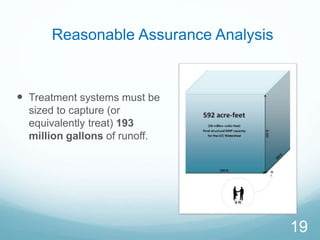
 Treatment systems must be 
sized to capture (or 
equivalently treat) 193 
million gallons of runoff. 
19
Questions? 
Richard Watson 
Richard Watson & Associates, Inc. (RWA) 
949-855-6262 
rwatson@rwaplanning.com 
20

Watson

  • 1.
    Watershed Management Programs Presented by Richard Watson, A.I.C.P. Richard Watson & Associates, Inc. (RWA) Presented to Southern California Water Summit & Fall Conference Coronado, CA November 8, 2014 1
  • 2.
    Los Angeles MS4Permit Strongly Encourages Watershed Management  Allows flexibility to implement permit requirements on a watershed scale through customized strategies, control measures, and BMPs.  Participation is voluntary.  Can be developed collaboratively or individually.  Based on defined Watershed Management Areas, but may use subwatersheds to focus efforts by receiving water.  Two options: Watershed Management Programs (WMPs) and Enhanced Watershed Management Programs (EWMPs)  EWMPs given an extra year for program preparation, but have to meet additional requirements. 2
  • 3.
  • 4.
  • 5.
    Basic WMP Requirements  Prioritize water quality issues for stormwater and non-stormwater discharges.  The Permit specifies three categories of Water Quality Priorities  Category 1 – TMDLs  Category 2 – 303(d) Listed Waterbody-Pollutant Segments  Category 3 – Other pollutants exceeding standards, but not 303(d) Listed  Identify and implement strategies, control measures, and BMPs to achieve specified outcomes. (Continued) 5
  • 6.
    Basic WMP Requirements(Continued)  Include detailed implementation schedules to meet interim milestones and final compliance dates.  Execute an integrated monitoring program and assessment program.  Provide appropriate opportunity for meaningful stakeholder input.  Modify strategies, control measures, and BMPs, as necessary, based on monitoring data (adaptive management process every two years).  Allowed to meet interim compliance milestones with BMPs, but final compliance is numeric. 6
  • 7.
    San Diego MS4Permit Watershed Management Plan - Similar Requirements  Called Water Quality Improvement Plan  Focus on guiding JURMPs  Also based on WMAs with opportunity to separate into sub-watersheds  Flexibility in defining priorities – most defining TMDLs as highest priorities  Also have to identify strategies and schedules for improving water quality and meeting numeric goals  Also includes an adaptive management process  Must demonstrate reasonable progress for TMDL compliance  No BMPs for interim milestones, except for TMDLs  No equivalent of EWMPs 7
  • 8.
    The Los CerritosChannel WMP Example 8
  • 9.
  • 10.
    Los Cerritos Channel Participating Cities (Plus LACFCD) 10
  • 11.
    Watershed Committee Citiesand agencies within the watershed have been working together since 2008. 11
  • 12.
    Water Quality Improvement Strategy  Multi-pronged strategy initially focused on source control control, total suspended solids (TSS) reduction, and runoff reduction  A particular emphasis on true source control for metals  SB 346 for copper  Future use of Safer Consumer Product Regulations for zinc  Lead is already under control – no further reduction required by TMDL 12
  • 13.
    Water Quality ImprovementHierarchy Treatment Controls Capture and Use Capture and Infiltration Operational Source Control LID and Green Streets TSS Reduction Runoff Reduction True Source Control 13
  • 14.
  • 15.
    Control Measures LID Ordinances  Green Streets Policies  Minimum Control Measures  Non-structural Control Measures  True source control  Runoff reduction, including continued water conservation and improved irrigation practices  TSS reduction, including vacant land ordinances (Continued1) 5
  • 16.
    Control Measures (Continued)  Structural Control Measures  Focus on Regional Water Capture Projects  Could cost as much as $332 million  Preliminary work on three sites  Funding sources needed 16
  • 17.
    13 sites as LCC Potential Projects Site Name Location Progress Park Paramount Bike Trail Bellflower Sims Park Bellflower Mayfair Park Lakewood Caruthers Park Bellflower Heartwell Park Long Beach Junior Golf Course Long Beach Heartwell Park Long Beach Pan American Park Long Beach Skylinks Long Beach Wardlow Park Long Beach Skylinks LCC Long Beach Reservoir Park Signal Hill 17
  • 18.
    Reasonable Assurance Analysis(RAA)  The LCC Watershed and two adjoining watersheds went together on an RAA using the USEPA-approved and MS4 Permit authorized Watershed Management Modeling System.  Zinc was identified as the “limiting pollutant” for wet weather and bacteria for dry weather.  Control measures to adequately reduce zinc, expected to reduce other pollutants as well.  Controlling bacteria is going to be very difficult. 18
  • 19.
    Reasonable Assurance Analysis  Treatment systems must be sized to capture (or equivalently treat) 193 million gallons of runoff. 19
  • 20.
    Questions? Richard Watson Richard Watson & Associates, Inc. (RWA) 949-855-6262 rwatson@rwaplanning.com 20

Editor's Notes

  • #18 Add new first column called Site Number