WATER RESOURCES
Water: some facts and figures
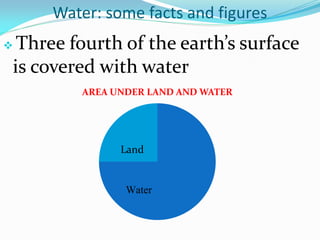
 Three fourth of the earth’s surface
is covered with water
AREA UNDER LAND AND WATER
Water
Land
Water: some facts and figures
 Out of 100% of water 96.5 % of the
total volume of the world’s water is
SALINE
2.5 % is FRESHWATER
70% of freshwater occurs as ice
sheets and glaciers
29% as Groundwater
Water: some facts and figures
 India gets 4% of the global
precipitation
Land area of India is 2.4% of
the world
India hold 17% of the
world’s population
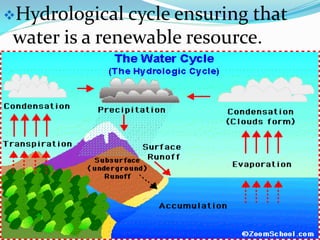
Hydrological cycle ensuring that
water is a renewable resource.
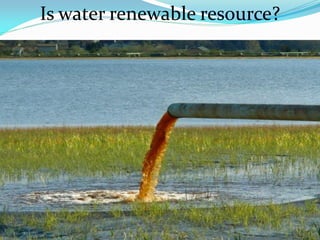
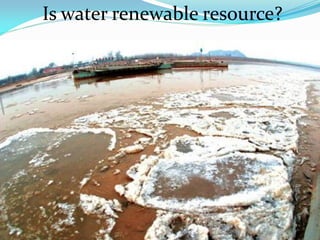
Is water renewable resource?
If the following conditions are
Being continued….
Industrial waste disposal to water
Excessive use of chemical fertilizers
Uses of chemical pesticides
Rapid Urbanization
Over population
Global warming -- Drought
 India – A Monsoon Country
 100 – 120 days experience monsoon
 Still facing water scarcity – Why?
Growing Population
Expanded irrigation
Intensive Industrialisation and
Urbanisation
Hydroelectric Power generation
 India has 10360 small and big rivers
 Mawsinram is the wettest place in the
world
 Water is sufficiently available - but the
quality…. ?
 Chemical pesticides and
fertilizers
Polluted by domestic and industrial
waste
Reasons for the bad quality of water..
 Why water resource is needed to be
conserved?
 To ensure food security
 For the continuation of our livelihoods
To ensure healthy life
To prevent degradation of our
ecosystem
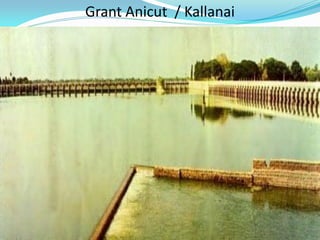
Grant Anicut / Kallanai
GRANT ANICUT or KALLANAI
 By the Cholas king Karikala
around the 2nd Century AD
 It is one of the oldest water
regulator structures in the world,
which is still in use.
It built on the Kaveri river -- TN
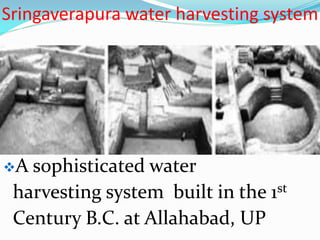
Sringaverapura water harvesting system
A sophisticated water
harvesting system built in the 1st
Century B.C. at Allahabad, UP
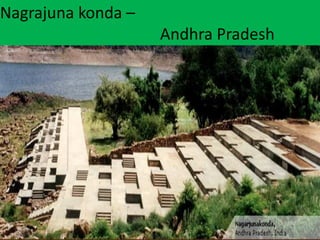
Nagrajuna konda –
Andhra Pradesh
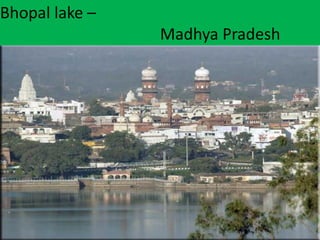
Bhopal lake –
Madhya Pradesh
BHOPAL LAKE – MADHYA PRADESH
 Built between 1005 – 1055 AD
by the Malwa King
It is a source of drinking
water of the city
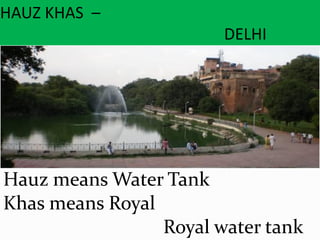
HAUZ KHAS –
DELHI
Hauz means Water Tank
Khas means Royal
Royal water tank
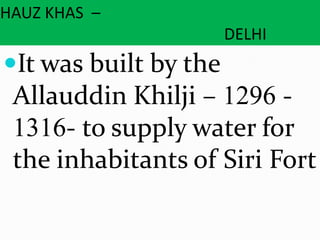
HAUZ KHAS –
DELHI
It was built by the
Allauddin Khilji – 1296 -
1316- to supply water for
the inhabitants of Siri Fort
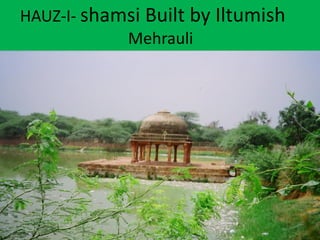
HAUZ-I- shamsi Built by Iltumish
Mehrauli
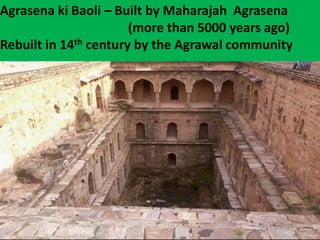
Agrasena ki Baoli – Built by Maharajah Agrasena
(more than 5000 years ago)
Rebuilt in 14th century by the Agrawal community
How do dams help us in conserving and
managing water?
Dams were traditionally built
to impound rivers and
rainwater that could be used
later to irrigate agricultural
areas.
Irrigation
Electricity generation
Domestic and industrial uses
Flood control
Recreation
Inland navigation
Fish breeding
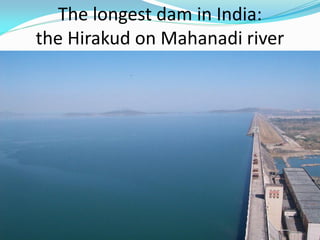
The longest dam in India:
the Hirakud on Mahanadi river
Why multi-purpose projects and large
dams have come under great
controversy?
Regulating and damming of river affect
their natural flow causing poor sediment
flow and excessive sedimentation at the
bottom of the reservoir.
It controls the migration of aquatic fauna
It makes submergence of the existing
vegetation
Why multi-purpose projects and large
dams have come under great
controversy?
It leads large scale displacement of
local communities
It destroys habitat of millions of flora
and fauna
It leads the degradation of soil due to
the continuous irrigation
Who are the beneficiaries of Multi-
purpose projects?
The landowners
Large farmers
Industrialists
Few urban centers
Inter-state water disputes
Kaveri river water dispute
between Karnataka and Tamil
Nadu
Disputes have been started since
1870 between Princely State of
Mysore and Madras Presidency
Inter-state water disputes
Krishna river water dispute
between Karnataka, Andhra
Pradesh and Maharashtra
Maharashtra – 303 KM
Karnataka -- 480 KM
Andhra Pradesh – 517 KM
Inter-state water disputes
Yamuna river water disputes
among UP, Haryana and Delhi
Godavari river water disputes
among Maharashtra, AP,
Karnataka, MP, Odisha and
Chhattisgarh
Inter-national water disputes
Indus river water disputes
between India and Pakistan
Kosi river water disputes
between India and Nepal
Brahmaputra water disputes
between India and China
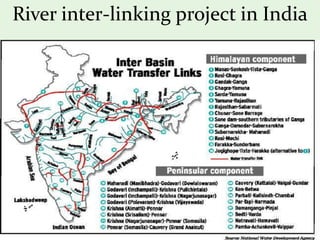
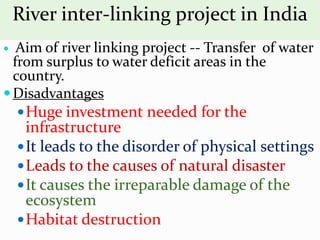
River inter-linking project in India
 Aim of river linking project -- Transfer of water
from surplus to water deficit areas in the
country.
Disadvantages
Huge investment needed for the
infrastructure
It leads to the disorder of physical settings
Leads to the causes of natural disaster
It causes the irreparable damage of the
ecosystem
Habitat destruction
Rainwater harvesting in ancient India
 Hill and Mountainous regions – built diversion
channels like guls and kuls (western Himalayas)
 Rajastan – Rooftop rainwater harvesting was
commonly practised for drinking water
 Bengal – inundation channels were developed to
irrigate the fields
 Arid and semi arid regions –agricultural fields
were converted into rain fed storage structures
Eg. Khadins in Jaisalmer and Johads in other
parts of Rajastan

Water resources class 10

  • 1.
  • 2.
    Water: some factsand figures  Three fourth of the earth’s surface is covered with water AREA UNDER LAND AND WATER Water Land
  • 3.
    Water: some factsand figures  Out of 100% of water 96.5 % of the total volume of the world’s water is SALINE 2.5 % is FRESHWATER 70% of freshwater occurs as ice sheets and glaciers 29% as Groundwater
  • 4.
    Water: some factsand figures  India gets 4% of the global precipitation Land area of India is 2.4% of the world India hold 17% of the world’s population
  • 5.
    Hydrological cycle ensuringthat water is a renewable resource.
  • 6.
  • 7.
  • 8.
    If the followingconditions are Being continued…. Industrial waste disposal to water Excessive use of chemical fertilizers Uses of chemical pesticides Rapid Urbanization Over population Global warming -- Drought
  • 9.
     India –A Monsoon Country  100 – 120 days experience monsoon  Still facing water scarcity – Why? Growing Population Expanded irrigation Intensive Industrialisation and Urbanisation Hydroelectric Power generation
  • 10.
     India has10360 small and big rivers  Mawsinram is the wettest place in the world  Water is sufficiently available - but the quality…. ?  Chemical pesticides and fertilizers Polluted by domestic and industrial waste Reasons for the bad quality of water..
  • 11.
     Why waterresource is needed to be conserved?  To ensure food security  For the continuation of our livelihoods To ensure healthy life To prevent degradation of our ecosystem
  • 12.
  • 13.
    GRANT ANICUT orKALLANAI  By the Cholas king Karikala around the 2nd Century AD  It is one of the oldest water regulator structures in the world, which is still in use. It built on the Kaveri river -- TN
  • 14.
    Sringaverapura water harvestingsystem A sophisticated water harvesting system built in the 1st Century B.C. at Allahabad, UP
  • 15.
  • 16.
  • 17.
    BHOPAL LAKE –MADHYA PRADESH  Built between 1005 – 1055 AD by the Malwa King It is a source of drinking water of the city
  • 18.
    HAUZ KHAS – DELHI Hauzmeans Water Tank Khas means Royal Royal water tank
  • 19.
    HAUZ KHAS – DELHI Itwas built by the Allauddin Khilji – 1296 - 1316- to supply water for the inhabitants of Siri Fort
  • 20.
    HAUZ-I- shamsi Builtby Iltumish Mehrauli
  • 21.
    Agrasena ki Baoli– Built by Maharajah Agrasena (more than 5000 years ago) Rebuilt in 14th century by the Agrawal community
  • 22.
    How do damshelp us in conserving and managing water? Dams were traditionally built to impound rivers and rainwater that could be used later to irrigate agricultural areas.
  • 23.
    Irrigation Electricity generation Domestic andindustrial uses Flood control Recreation Inland navigation Fish breeding
  • 26.
    The longest damin India: the Hirakud on Mahanadi river
  • 27.
    Why multi-purpose projectsand large dams have come under great controversy? Regulating and damming of river affect their natural flow causing poor sediment flow and excessive sedimentation at the bottom of the reservoir. It controls the migration of aquatic fauna It makes submergence of the existing vegetation
  • 28.
    Why multi-purpose projectsand large dams have come under great controversy? It leads large scale displacement of local communities It destroys habitat of millions of flora and fauna It leads the degradation of soil due to the continuous irrigation
  • 29.
    Who are thebeneficiaries of Multi- purpose projects? The landowners Large farmers Industrialists Few urban centers
  • 30.
    Inter-state water disputes Kaveririver water dispute between Karnataka and Tamil Nadu Disputes have been started since 1870 between Princely State of Mysore and Madras Presidency
  • 31.
    Inter-state water disputes Krishnariver water dispute between Karnataka, Andhra Pradesh and Maharashtra Maharashtra – 303 KM Karnataka -- 480 KM Andhra Pradesh – 517 KM
  • 32.
    Inter-state water disputes Yamunariver water disputes among UP, Haryana and Delhi Godavari river water disputes among Maharashtra, AP, Karnataka, MP, Odisha and Chhattisgarh
  • 33.
    Inter-national water disputes Indusriver water disputes between India and Pakistan Kosi river water disputes between India and Nepal Brahmaputra water disputes between India and China
  • 34.
  • 35.
    River inter-linking projectin India  Aim of river linking project -- Transfer of water from surplus to water deficit areas in the country. Disadvantages Huge investment needed for the infrastructure It leads to the disorder of physical settings Leads to the causes of natural disaster It causes the irreparable damage of the ecosystem Habitat destruction
  • 40.
    Rainwater harvesting inancient India  Hill and Mountainous regions – built diversion channels like guls and kuls (western Himalayas)  Rajastan – Rooftop rainwater harvesting was commonly practised for drinking water  Bengal – inundation channels were developed to irrigate the fields  Arid and semi arid regions –agricultural fields were converted into rain fed storage structures Eg. Khadins in Jaisalmer and Johads in other parts of Rajastan