WATER
POLLUTION
Water pollution refersto the presence of harmful
substances in water bodies, including rivers, lakes, and
oceans. These pollutants can originate from various
sources, causing significant harm to both the
environment and human health.
3.
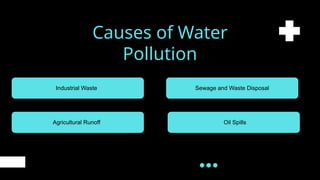
CATEGORIES OF WATERPOLLUTION
Surface Water
Pollution
Groundwater
Pollution
Point Source
Pollution
Non-Point Source
Pollution
4.
Surface Water
Pollution
Surface waterpollution happens in lakes, rivers,
and oceans where water is polluted by chemicals,
waste, or even oil spills. This form of pollution can
have widespread effects on aquatic ecosystems,
as pollutants harm fish and other aquatic life.
Example: The Deepwater Horizon oil spill in 2010
is a well-known case of surface water pollution,
which led to extensive damage to marine life and
ecosystems in the Gulf of Mexico.
5.
Groundwater
Pollution
Groundwater pollution involvesthe contamination
of underground water reserves, which are often
used as sources of drinking water. This pollution
is typically caused by chemicals, agricultural
runoff, and industrial waste. It can be more
difficult to detect and remedy than surface water
pollution, as underground water systems are
often out of sight.
Example: In many rural areas, polluted
groundwater from agricultural runoff or hazardous
waste can contaminate wells, leading to unsafe
drinking water.
6.
Point Source
Pollution
Point sourcepollution refers to contamination that
comes from a single, identifiable source. These
sources are often easier to regulate and treat
because their locations can be pinpointed.
Common examples include industrial factories,
sewage treatment plants, and waste disposal
sites.
Example: Wastewater being discharged into a
river directly from a factory or sewage plant is a
form of point source pollution, where the exact
location of the pollution is known.
7.
Non-Point
Source
Pollution
Non-point source pollutionis diffused and comes
from multiple, widespread sources. This type of
pollution is often the result of runoff from land
surfaces, such as rainwater washing pollutants
from roads, fields, and construction sites into
water bodies.
Example: Excessive use of fertilizers and
pesticides in agriculture often leads to chemicals
being washed into nearby rivers or lakes during
rainfall, a classic example of non-point source
pollution.
8.
Transboundary
Water Pollution
Refers tothe pollution of water
resources that affects more than one
country, often crossing political
borders. This type of pollution occurs
when contaminants from one country
are carried by rivers, lakes, or seas
into neighboring countries, impacting
shared water bodies.
Industrial
Waste
Refers to thecontamination of water
bodies caused by the discharge of
harmful substances from industrial
activities. These pollutants can affect
rivers, lakes, oceans, and
groundwater, leading to serious
environmental, health, and economic
issues. Examples are Chemical
Discharges, Heavy Metals etc...
11.
Agricultural
Runoff
Agricultural Runoff isthe water that flows over
farmland, carrying with it pollutants such as
fertilizers, pesticides, herbicides, and sediment.
When rainwater or irrigation water flows over
agricultural fields, it can pick up these harmful
substances and transport them into nearby rivers,
lakes, and groundwater, contributing to water
pollution. Agricultural runoff is a major source of
non-point source pollution, meaning it comes from
widespread sources rather than a single
identifiable point.
12.
Sewage and
Waste Disposal
Refersto the management and treatment of
wastewater and solid waste generated by
human activities, particularly in urban and
industrial areas. Improper disposal of sewage
and waste can lead to water pollution,
environmental degradation, and serious
public health risks. Effective waste
management systems are essential for
maintaining clean water and a healthy
environment.
13.
Oil Spills
Refer tothe release of petroleum or other oil-
based substances into bodies of water, such
as oceans, rivers, and lakes. These spills can
have catastrophic impacts on marine and
freshwater ecosystems, as well as human
health and economies. Oil spills are often
caused by industrial activities, transportation
accidents, or natural events, and they pose
significant environmental challenges.
Health Issues
Water pollutionposes significant risks to human health.
Contaminants in water, ranging from bacteria and viruses to
chemicals and heavy metals, can cause a wide range of
diseases and health problems. These risks depend on the type
of contamination, the extent of exposure, and the population
affected. Understanding these health issues is crucial to
addressing the public health risks posed by polluted water.
16.
Environmental
Damage
Water pollution leadsto a range of harmful impacts on the
environment, affecting ecosystems, wildlife, and the natural
resources that humans depend on. The contamination of water
bodies such as rivers, lakes, oceans, and groundwater by
pollutants can disrupt the delicate balance of ecosystems, harm
species, and degrade habitats. such as fishes, corals etc...
17.
Economic Impact
Water pollutionnot only affects the environment and human
health but also has significant economic consequences. The
costs associated with polluted water are vast and can impact
various sectors of the economy, including agriculture, fisheries,
tourism, and public health. The economic burdens of water
pollution are felt on local, national, and global scales, affecting
both individuals and governments.
18.
How
Wastewater
Treatment
Works
Wastewater treatment isa crucial process that
removes contaminants from wastewater water
that has been used in homes, industries, and
businesses before it is released back into the
environment or reused. The treatment process
helps ensure that the water is safe for discharge
into natural water bodies or for reuse. It involves
several stages, each designed to remove
specific types of pollutants. The treatment
process generally follows a sequence of
physical, chemical, and biological steps, often
divided into primary, secondary, and tertiary
treatment stages.
19.
1. Preliminary Treatment
Thefirst stage of wastewater treatment is aimed at removing large,
easily identifiable debris from the water, such as sticks, leaves, plastic,
and other large particles.
• Screens: The wastewater flows through large screens that filter
out solid materials. These screens may be manual or mechanical.
• Grit Removal: After screening, water flows into a grit chamber
where heavier particles, such as sand and gravel, settle to the
bottom. This prevents damage to equipment and prepares the
water for further treatment.
Purpose: To remove large debris and prevent clogging of equipment in
later stages.
20.
2. Primary Treatment
Inprimary treatment, the goal is to remove suspended solids and
organic material from wastewater through physical processes.
• Sedimentation: The wastewater flows into large settling tanks called
clarifiers or sedimentation tanks. Here, the flow of water is slowed,
allowing heavier particles (like sludge and organic matter) to settle
to the bottom as primary sludge.
• Skimming: Lighter materials, such as oils, grease, and scum, float
to the surface and are skimmed off.
Purpose: To remove large particles and settleable solids, typically
removing about 60-70% of the suspended solids and organic matter.
21.
3. Secondary Treatment
Secondarytreatment focuses on breaking down organic matter and further removing suspended
solids through biological processes.
• Activated Sludge Process: In this method, air is bubbled through aeration tanks to promote
the growth of bacteria and microorganisms. These microorganisms feed on the dissolved
organic matter (like food waste and sewage) in the water. The bacteria consume the organic
pollutants and convert them into simpler substances, like carbon dioxide and water.
• Trickling Filters: Another method for secondary treatment involves passing wastewater over
a bed of stones or other materials covered with bacteria. The bacteria degrade the organic
matter in the wastewater as it moves through the filter.
• Clarification: After biological treatment, the water is sent to secondary clarifiers, where the
remaining sludge (activated sludge) settles to the bottom. The treated water is then
separated from the sludge.
Purpose: To remove a significant portion of dissolved organic matter, suspended solids, and
pathogens.
22.
4. Tertiary Treatment
Tertiarytreatment further refines the water, typically removing remaining pollutants, including
nutrients (nitrogen and phosphorus), fine solids, and pathogens. This stage is optional and used
when higher water quality is required, such as for water reuse or discharge into sensitive
ecosystems.
• Filtration: Fine filters (e.g., sand or membrane filters) are used to remove remaining
suspended solids.
• Disinfection: The treated water may be disinfected using chlorine, ultraviolet (UV) light, or
ozone. These methods kill harmful pathogens, such as bacteria, viruses, and parasites.
• Nutrient Removal: In some advanced systems, chemicals or additional biological processes
are used to remove excess nutrients like nitrogen and phosphorus, which can cause
eutrophication (excessive algae growth) in receiving water bodies.
Purpose: To remove any remaining contaminants, including fine solids, pathogens, and
nutrients, producing clean water that meets discharge or reuse standards.
23.
5. Sludge Treatmentand Disposal
Throughout the treatment process, solid waste (sludge) accumulates, which must also be
treated and disposed of properly.
• Thickening: Sludge from primary and secondary treatment is thickened to remove excess
water and reduce its volume.
• Digestion: In anaerobic or aerobic digestion tanks, microorganisms break down organic
matter in the sludge. This process reduces the volume of the sludge and stabilizes it, making
it less harmful and more manageable.
• Dehydration: The digested sludge is further dewatered using methods like centrifuges, belt
presses, or drying beds, reducing its water content.
• Disposal or Reuse: The final dewatered sludge can be safely disposed of in landfills,
incinerated, or, in some cases, used as fertilizer or for biogas production.
Purpose: To treat and safely dispose of or reuse the sludge generated during the treatment
process.
24.
6. Final Disposalor Reuse
After completing the treatment stages, the water is either discharged into a
natural water body (such as a river, lake, or ocean) or sent for reuse in various
applications.
• Discharge: In many cases, treated wastewater is released back into natural
bodies of water, where it can be further diluted, treated by natural processes,
and eventually re-enter the water cycle.
• Reuse: In some cases, treated wastewater can be reused for irrigation,
industrial processes, or even potable water (after additional treatment like
reverse osmosis and further disinfection in advanced systems).
Purpose: To ensure that treated water is safe for the environment or human use,
depending on its intended purpose.




![Polymer [ बहुलक ] Chemistry Notes PDF - Irfanullah Mehar - JJ Sir Chemistry.pdf](https://cdn.slidesharecdn.com/ss_thumbnails/polymerchemistrynotespdf-irfanullahmehar-jjsirchemistry-260210172118-3f9b37f7-thumbnail.jpg?width=640&height=640&fit=bounds)

