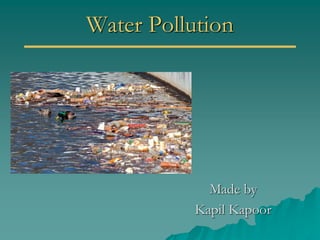
Water Pollution
Made by
Kapil Kapoor
Overview
o Types of Water Pollution
• Sewage
• Disease-causing agents
• Sediment pollution
• Inorganic plant and algal nutrients
• Organic compounds
• Inorganic chemicals
• Thermal pollution
o Water Quality Today
o Improving Water Quality
o Laws related to Water Pollution
Water Pollution
o Water pollution
• Any physical or chemical contamination of water that
adversely affects the health of humans and other
organisms
• Varies in magnitude by location
o It is a major issue globally due to lack of clean &
disease-free water
o Eight categories
• Sewage, disease-causing agents, sediment pollution,
inorganic plant and algal nutrients, organic compounds,
inorganic chemicals, radioactive substances, and thermal
pollution
Sewage
o The release of wastewater from drains or sewers
• Includes human waste, soaps and detergents
o Causes two serious environmental problems:
• Enrichment
• Fertilization of a water body by high levels of plant and algal
nutrients (nitrogen and phosphorus)
• Increase in Biological Oxygen Demand (BOD)
• Amount of oxygen needed by microorganisms to decompose
biological wastes
• As BOD increases Dissolved Oxygen (DO) decreases
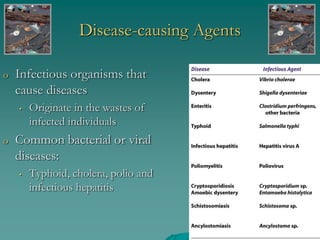
Disease-causing Agents
o Infectious organisms that
cause diseases
• Originate in the wastes of
infected individuals
o Common bacterial or viral
diseases:
• Typhoid, cholera, polio and
infectious hepatitis
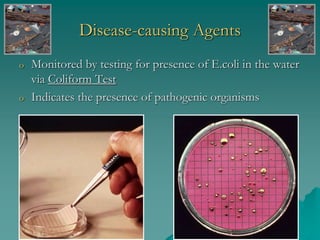
Disease-causing Agents
o Monitored by testing for presence of E.coli in the water
via Coliform Test
o Indicates the presence of pathogenic organisms
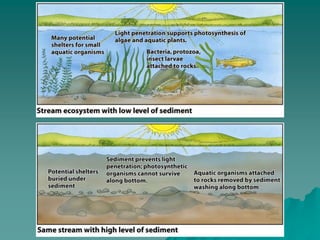
Sediment Pollution
o Excessive amounts of suspended soil particles
• Originates from erosion of agricultural lands, forest soils
exposed by logging, degraded stream banks, overgrazed
rangelands, strip mines and construction
o Problems
• Limits light penetration
• Covers aquatic animals and plants
• Brings insoluble toxins into waterways
Inorganic Plant and Algal
Nutrients
o Chemicals such as nitrogen and phosphorus that
stimulate the growth of plants and algae
• Harmful in large concentrations
o Sources:
• Human and animal wastes, plant residues, atmospheric
deposition and fertilizer runoff
o Causes:
• Enrichment, bad odors and high BOD
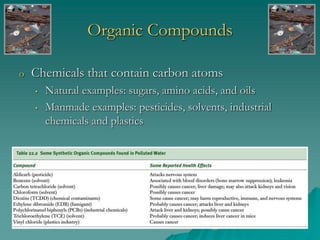
Organic Compounds
o Chemicals that contain carbon atoms
• Natural examples: sugars, amino acids, and oils
• Manmade examples: pesticides, solvents, industrial
chemicals and plastics
Inorganic Chemicals
o Contaminants that contain elements other than
carbon
• Examples: acids, salts and heavy metals
o Do not degrade easily
o Lead
• Found in old paint, industrial pollutants, leaded gasoline
o Mercury
• Mercury bio - accumulates in the muscles of top
predators of the open ocean
Radioactive Substances
o Contain atoms of unstable isotopes that
spontaneously emit radiation
o Sources -
• Mining
• Processing of radioactive materials
• Nuclear power plants
• Natural sources
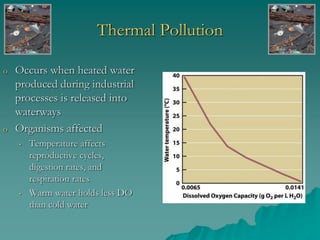
Thermal Pollution
o Occurs when heated water
produced during industrial
processes is released into
waterways
o Organisms affected
• Temperature affects
reproductive cycles,
digestion rates, and
respiration rates
• Warm water holds less DO
than cold water
Quality of Water Today
o Two types of Water Pollution
o Point Source Pollution
• water pollution that can be traced to a specific origin
• Discharge via pipes, sewage and ditches
o Non-Point Source Pollution
• Pollutants that enter bodies of water over large areas
rather than being concentrated at a single point of entry
• Runoff from agricultural fields or parking lots
Industrial Wastes in Water
o Different industries generate different pollutants
• Food Processing Plants - high BOD
• Paper Mills - high BOD as well as toxic compounds
• Textile Industry - Nitrogen , heavy metals and dyestuffs
o Many industries recover toxins before they go into the
waste stream
Water Pollution from
Agriculture
o Agriculture is also a source of water pollution
worldwide
• Animal wastes and plants residues have high BOD
• Chemical pesticides can leach into groundwater
o Almost all streams and rivers are polluted with
agricultural pesticides
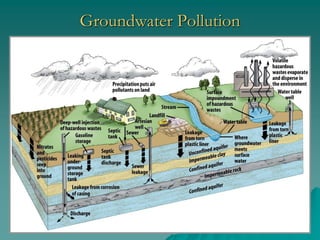
Groundwater Pollution
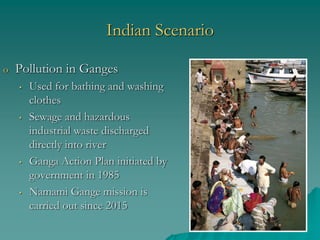
Indian Scenario
o Pollution in Ganges
• Used for bathing and washing
clothes
• Sewage and hazardous
industrial waste discharged
directly into river
• Ganga Action Plan initiated by
government in 1985
• Namami Gange mission is
carried out since 2015
Water Pollution in Other Countries
o Po River, Italy
• Similar to Mississippi River of US
• Pollutants: Sewage, Industrial waste, Sediment
• More than 16 million Italians depend on the river for
drinking water
• Pollution is too high
• Swimming and fishing prohibited
• Cleanup will require a national management plan and
may take decades
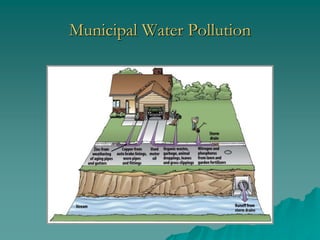
Municipal Water Pollution
Improving Water Quality -
Treatment of Sewage
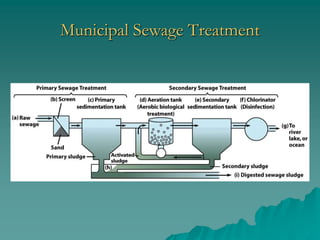
Primary Treatment
• Removing suspended and floating particles by mechanical
processing
Secondary Treatment
• Treating wastewater biologically to decompose suspended organic
matter thereby reducing BOD
• Sewage Sludge is eliminated after these treatments
Tertiary Treatment
• Advanced wastewater treatment methods that aresometimes
employed after above treatments
• Reduces Nitrogen as well as phosphorus from water
Municipal Sewage Treatment
Laws related to Water Pollution
The Water(Prevention and Control of Pollution)Act, 1974
• To provide for prevention control and abatement of water
pollution
• To maintain or restore the wholesomeness of water in country
• To prevent the pollution of water by agricultural industrial and
household sources
• To assess the pollution levels and punish polluters
THANK YOU!

Water pollution

  • 1.
  • 2.
    Overview o Types ofWater Pollution • Sewage • Disease-causing agents • Sediment pollution • Inorganic plant and algal nutrients • Organic compounds • Inorganic chemicals • Thermal pollution o Water Quality Today o Improving Water Quality o Laws related to Water Pollution
  • 3.
    Water Pollution o Waterpollution • Any physical or chemical contamination of water that adversely affects the health of humans and other organisms • Varies in magnitude by location o It is a major issue globally due to lack of clean & disease-free water o Eight categories • Sewage, disease-causing agents, sediment pollution, inorganic plant and algal nutrients, organic compounds, inorganic chemicals, radioactive substances, and thermal pollution
  • 4.
    Sewage o The releaseof wastewater from drains or sewers • Includes human waste, soaps and detergents o Causes two serious environmental problems: • Enrichment • Fertilization of a water body by high levels of plant and algal nutrients (nitrogen and phosphorus) • Increase in Biological Oxygen Demand (BOD) • Amount of oxygen needed by microorganisms to decompose biological wastes • As BOD increases Dissolved Oxygen (DO) decreases
  • 5.
    Disease-causing Agents o Infectiousorganisms that cause diseases • Originate in the wastes of infected individuals o Common bacterial or viral diseases: • Typhoid, cholera, polio and infectious hepatitis
  • 6.
    Disease-causing Agents o Monitoredby testing for presence of E.coli in the water via Coliform Test o Indicates the presence of pathogenic organisms
  • 7.
    Sediment Pollution o Excessiveamounts of suspended soil particles • Originates from erosion of agricultural lands, forest soils exposed by logging, degraded stream banks, overgrazed rangelands, strip mines and construction o Problems • Limits light penetration • Covers aquatic animals and plants • Brings insoluble toxins into waterways
  • 9.
    Inorganic Plant andAlgal Nutrients o Chemicals such as nitrogen and phosphorus that stimulate the growth of plants and algae • Harmful in large concentrations o Sources: • Human and animal wastes, plant residues, atmospheric deposition and fertilizer runoff o Causes: • Enrichment, bad odors and high BOD
  • 10.
    Organic Compounds o Chemicalsthat contain carbon atoms • Natural examples: sugars, amino acids, and oils • Manmade examples: pesticides, solvents, industrial chemicals and plastics
  • 11.
    Inorganic Chemicals o Contaminantsthat contain elements other than carbon • Examples: acids, salts and heavy metals o Do not degrade easily o Lead • Found in old paint, industrial pollutants, leaded gasoline o Mercury • Mercury bio - accumulates in the muscles of top predators of the open ocean
  • 12.
    Radioactive Substances o Containatoms of unstable isotopes that spontaneously emit radiation o Sources - • Mining • Processing of radioactive materials • Nuclear power plants • Natural sources
  • 13.
    Thermal Pollution o Occurswhen heated water produced during industrial processes is released into waterways o Organisms affected • Temperature affects reproductive cycles, digestion rates, and respiration rates • Warm water holds less DO than cold water
  • 14.
    Quality of WaterToday o Two types of Water Pollution o Point Source Pollution • water pollution that can be traced to a specific origin • Discharge via pipes, sewage and ditches o Non-Point Source Pollution • Pollutants that enter bodies of water over large areas rather than being concentrated at a single point of entry • Runoff from agricultural fields or parking lots
  • 15.
    Industrial Wastes inWater o Different industries generate different pollutants • Food Processing Plants - high BOD • Paper Mills - high BOD as well as toxic compounds • Textile Industry - Nitrogen , heavy metals and dyestuffs o Many industries recover toxins before they go into the waste stream
  • 16.
    Water Pollution from Agriculture oAgriculture is also a source of water pollution worldwide • Animal wastes and plants residues have high BOD • Chemical pesticides can leach into groundwater o Almost all streams and rivers are polluted with agricultural pesticides
  • 17.
  • 18.
    Indian Scenario o Pollutionin Ganges • Used for bathing and washing clothes • Sewage and hazardous industrial waste discharged directly into river • Ganga Action Plan initiated by government in 1985 • Namami Gange mission is carried out since 2015
  • 19.
    Water Pollution inOther Countries o Po River, Italy • Similar to Mississippi River of US • Pollutants: Sewage, Industrial waste, Sediment • More than 16 million Italians depend on the river for drinking water • Pollution is too high • Swimming and fishing prohibited • Cleanup will require a national management plan and may take decades
  • 20.
  • 21.
    Improving Water Quality- Treatment of Sewage Primary Treatment • Removing suspended and floating particles by mechanical processing Secondary Treatment • Treating wastewater biologically to decompose suspended organic matter thereby reducing BOD • Sewage Sludge is eliminated after these treatments Tertiary Treatment • Advanced wastewater treatment methods that aresometimes employed after above treatments • Reduces Nitrogen as well as phosphorus from water
  • 22.
  • 23.
    Laws related toWater Pollution The Water(Prevention and Control of Pollution)Act, 1974 • To provide for prevention control and abatement of water pollution • To maintain or restore the wholesomeness of water in country • To prevent the pollution of water by agricultural industrial and household sources • To assess the pollution levels and punish polluters
  • 24.