“Water Crisis and Solutions”

A joint debate-event organized
by RACE & SMART

11 June 2011, Suri, Birbhum
Outline of discussion
• Water Cycle

• Water Problems – Scarcity & Pollution

• Mismanagement of water

• Water Management Principles

• Rainwater Harvesting

• Solutions
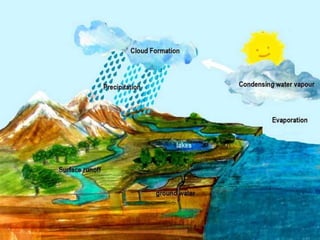
Water Cycle
What is the
problem with
   water?
Water Problems
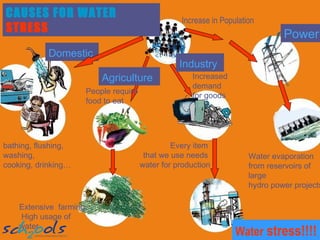
CAUSES FOR WATER                                 Increase in Population
STRESS                                                                        Power
            Domestic
                                                 Industry
                         Agriculture                Increased
                                                    demand
                     People require
                                                    for goods
                     food to eat


bathing, flushing,                             Every item
washing,                               that we use needs             Water evaporation
cooking, drinking…                    water for production           from reservoirs of
                                                                     large
                                                                     hydro power projects

    Extensive farming.
    High usage of
    water
                                                                 Water stress!!!!
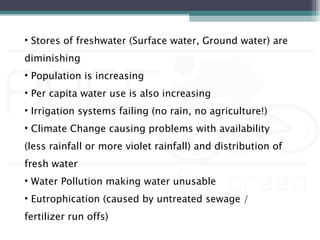
• Stores of freshwater (Surface water, Ground water) are
diminishing
• Population is increasing
• Per capita water use is also increasing
• Irrigation systems failing (no rain, no agriculture!)
• Climate Change causing problems with availability
(less rainfall or more violet rainfall) and distribution of
fresh water
• Water Pollution making water unusable
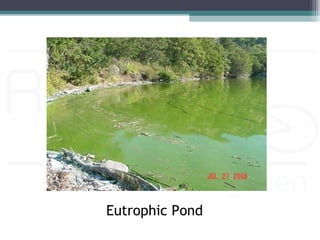
• Eutrophication (caused by untreated sewage /
fertilizer run offs)
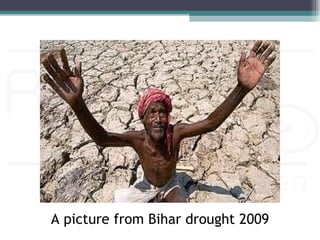
A picture from Bihar drought 2009
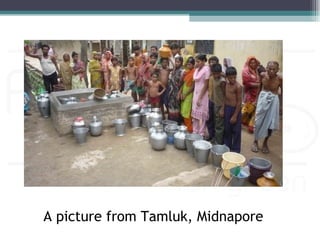
A picture from Tamluk, Midnapore
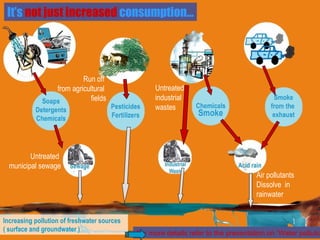
It’s not just increased consumption…


                            Run off
                   from agricultural               Untreated
                              fields               industrial
                                                   wastes


         Untreated
  municipal sewage
                                                                                    Air pollutants
                                                                                    Dissolve in
                                                                                    rainwater


Increasing pollution of freshwater sources
( surface and groundwater )
                                             For more details refer to the presentation on ‘Water pollutio
Eutrophic Pond
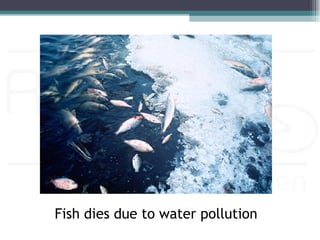
Fish dies due to water pollution
Water can get polluted
naturally


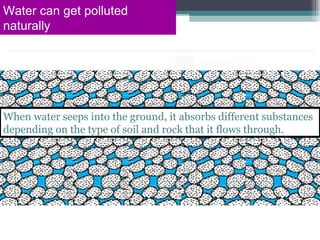
When water seeps into the ground, it absorbs different substances
depending on the type of soil and rock that it flows through.
Water can get polluted
naturally


Some of these substances (arsenic, iron, fluoride etc) can be
harmful to health
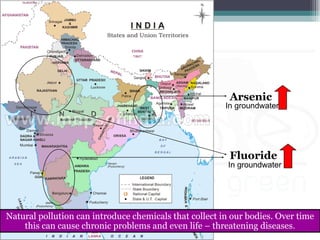
Arsenic
                                                        In groundwater


                                                         Fluoride
                                                        In groundwater


Natural pollution can introduce chemicals that collect in our bodies. Over time
    this can cause chronic problems and even life – threatening diseases.
Problems in Water
  Management
• In India, ‘State’ is the sole provider of water.
• Water is not given any economic value – considered free.
• Community & Households are no longer primary agents of
water provision and management.
• There is still enough water but facility to ‘trap & store’ are
failing badly.
• Large dams causing environmental havoc.
• Expensive maintenance to prevent siltation in reservoirs are
not working in India
• Diversion of water / river linkages are considered as
solution while they are not.
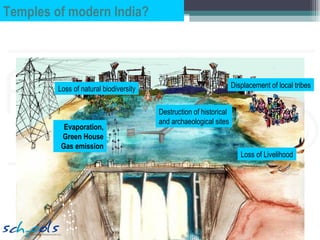
Temples of modern India?


         Loss of natural biodiversity                               Displacement of local tribes


                                        Destruction of historical
                                        and archaeological sites
           Evaporation,
          Green House
          Gas emission
                                                                       Loss of Livelihood
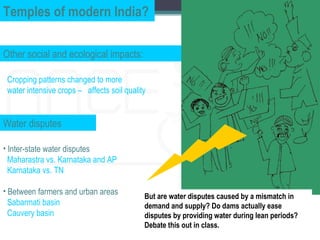
Temples of modern India?

Other social and ecological impacts:

 Cropping patterns changed to more
 water intensive crops – affects soil quality


Water disputes

• Inter-state water disputes
  Maharastra vs. Karnataka and AP
  Karnataka vs. TN

• Between farmers and urban areas
                                            But are water disputes caused by a mismatch in
  Sabarmati basin                           demand and supply? Do dams actually ease
  Cauvery basin                             disputes by providing water during lean periods?
                                            Debate this out in class.
Water Management
   Principles
The Dublin Principles (1992)
1. Fresh water is a finite and vulnerable resource, essential to
    sustain life, development and the environment.
2. Water development and management should be based on a
    participatory approach, involving users, planners and policy-
    makers at all levels
3. Women play a central part in the provision, management and
    safeguarding of water.
4. Water has an economic value in all its competing uses and
    should be recognized as an economic good.
The Right to Water

•   Dublin Principles is the only UN statement which
    emphasizes on ‘economic value’ of water rather than as
    ‘universal right’. This is highly contested by NGOs and
    human rights activists.
•   However different international conventions recognize
    ‘right to water’ as human right.
The Ramsar Convention (1971)
•   Intergovernmental treaty that embodies commitments of
    member countries to maintain the ecological character of their
    Wetlands of International Importance and to plan for the "wise
    use", or sustainable use.
•   India has 25 Ramsar sites – the one in West Bengal is ‘East
    Calcutta Wetlands’ with size of 125 sq.km.
•   The nation with the highest number of sites is the United
    Kingdom at 168.
Rainwater
Harvesting
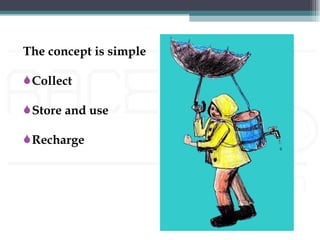
The concept is simple

 Collect

 Store and use

 Recharge
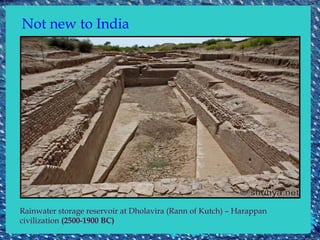
Not new to India


Rainwater storage reservoir at Dholavira (Rann of Kutch) – Harappan
civilization (2500-1900 BC)
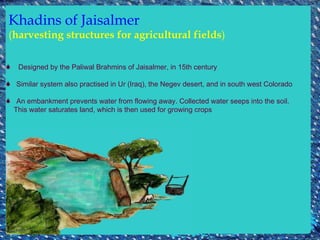
Khadins of Jaisalmer
(harvesting structures for agricultural fields)

   Designed by the Paliwal Brahmins of Jaisalmer, in 15th century

 Similar system also practised in Ur (Iraq), the Negev desert, and in south west Colorado

 An embankment prevents water from flowing away. Collected water seeps into the soil.
  This water saturates land, which is then used for growing crops
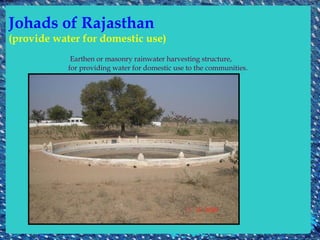
Johads of Rajasthan
(provide water for domestic use)
             Earthen or masonry rainwater harvesting structure,
            for providing water for domestic use to the communities.
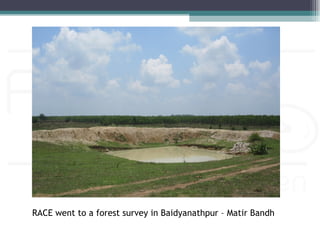
RACE went to a forest survey in Baidyanathpur – Matir Bandh
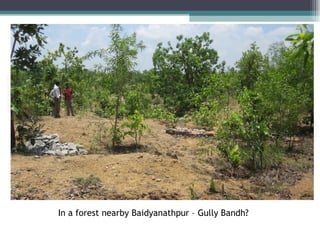
In a forest nearby Baidyanathpur – Gully Bandh?
Solutions
•   Awareness and sensitization.
•   Stop wastage.
•   Assign economic value where feasible.
•   Popularize rainwater harvesting.
•   Create community scale dams, water storages.
•   Reduce ‘global warming’.
•   Discuss and participate.
Thank you!!

Water Crisis & Solutions - RACE presentation

  • 1.
    “Water Crisis andSolutions” A joint debate-event organized by RACE & SMART 11 June 2011, Suri, Birbhum
  • 2.
    Outline of discussion •Water Cycle • Water Problems – Scarcity & Pollution • Mismanagement of water • Water Management Principles • Rainwater Harvesting • Solutions
  • 3.
  • 4.
  • 5.
  • 6.
    CAUSES FOR WATER Increase in Population STRESS Power Domestic Industry Agriculture Increased demand People require for goods food to eat bathing, flushing, Every item washing, that we use needs Water evaporation cooking, drinking… water for production from reservoirs of large hydro power projects Extensive farming. High usage of water Water stress!!!!
  • 7.
    • Stores offreshwater (Surface water, Ground water) are diminishing • Population is increasing • Per capita water use is also increasing • Irrigation systems failing (no rain, no agriculture!) • Climate Change causing problems with availability (less rainfall or more violet rainfall) and distribution of fresh water • Water Pollution making water unusable • Eutrophication (caused by untreated sewage / fertilizer run offs)
  • 8.
    A picture fromBihar drought 2009
  • 9.
    A picture fromTamluk, Midnapore
  • 10.
    It’s not justincreased consumption… Run off from agricultural Untreated fields industrial wastes Untreated municipal sewage Air pollutants Dissolve in rainwater Increasing pollution of freshwater sources ( surface and groundwater ) For more details refer to the presentation on ‘Water pollutio
  • 11.
  • 12.
    Fish dies dueto water pollution
  • 13.
    Water can getpolluted naturally When water seeps into the ground, it absorbs different substances depending on the type of soil and rock that it flows through.
  • 14.
    Water can getpolluted naturally Some of these substances (arsenic, iron, fluoride etc) can be harmful to health
  • 15.
    Arsenic In groundwater Fluoride In groundwater Natural pollution can introduce chemicals that collect in our bodies. Over time this can cause chronic problems and even life – threatening diseases.
  • 16.
  • 17.
    • In India,‘State’ is the sole provider of water. • Water is not given any economic value – considered free. • Community & Households are no longer primary agents of water provision and management. • There is still enough water but facility to ‘trap & store’ are failing badly. • Large dams causing environmental havoc. • Expensive maintenance to prevent siltation in reservoirs are not working in India • Diversion of water / river linkages are considered as solution while they are not.
  • 18.
    Temples of modernIndia? Loss of natural biodiversity Displacement of local tribes Destruction of historical and archaeological sites Evaporation, Green House Gas emission Loss of Livelihood
  • 19.
    Temples of modernIndia? Other social and ecological impacts: Cropping patterns changed to more water intensive crops – affects soil quality Water disputes • Inter-state water disputes Maharastra vs. Karnataka and AP Karnataka vs. TN • Between farmers and urban areas But are water disputes caused by a mismatch in Sabarmati basin demand and supply? Do dams actually ease Cauvery basin disputes by providing water during lean periods? Debate this out in class.
  • 20.
  • 21.
    The Dublin Principles(1992) 1. Fresh water is a finite and vulnerable resource, essential to sustain life, development and the environment. 2. Water development and management should be based on a participatory approach, involving users, planners and policy- makers at all levels 3. Women play a central part in the provision, management and safeguarding of water. 4. Water has an economic value in all its competing uses and should be recognized as an economic good.
  • 22.
    The Right toWater • Dublin Principles is the only UN statement which emphasizes on ‘economic value’ of water rather than as ‘universal right’. This is highly contested by NGOs and human rights activists. • However different international conventions recognize ‘right to water’ as human right.
  • 23.
    The Ramsar Convention(1971) • Intergovernmental treaty that embodies commitments of member countries to maintain the ecological character of their Wetlands of International Importance and to plan for the "wise use", or sustainable use. • India has 25 Ramsar sites – the one in West Bengal is ‘East Calcutta Wetlands’ with size of 125 sq.km. • The nation with the highest number of sites is the United Kingdom at 168.
  • 24.
  • 25.
    The concept issimple  Collect  Store and use  Recharge
  • 26.
    Not new toIndia Rainwater storage reservoir at Dholavira (Rann of Kutch) – Harappan civilization (2500-1900 BC)
  • 27.
    Khadins of Jaisalmer (harvestingstructures for agricultural fields)  Designed by the Paliwal Brahmins of Jaisalmer, in 15th century  Similar system also practised in Ur (Iraq), the Negev desert, and in south west Colorado  An embankment prevents water from flowing away. Collected water seeps into the soil. This water saturates land, which is then used for growing crops
  • 28.
    Johads of Rajasthan (providewater for domestic use) Earthen or masonry rainwater harvesting structure, for providing water for domestic use to the communities.
  • 29.
    RACE went toa forest survey in Baidyanathpur – Matir Bandh
  • 30.
    In a forestnearby Baidyanathpur – Gully Bandh?
  • 31.
  • 32.
    Awareness and sensitization. • Stop wastage. • Assign economic value where feasible. • Popularize rainwater harvesting. • Create community scale dams, water storages. • Reduce ‘global warming’. • Discuss and participate.
  • 33.

Editor's Notes

  • #14 Natural sources of water pollution. The geology of a place can introduce inorganic contaminants into groundwater. As water seeps into the ground, if the rocks and soil are rich in compounds of fluoride, arsenic, iron etc, these compounds dissolve in the groundwater. When groundwater is extracted and used for drinking, these compounds enter our bodies.
  • #15 Compounds of arsenic, fluoride etc. accumulate in our bodies over time due to bio-accumulation. Natural pollution is a non-point source of pollution.
  • #16 Excess fluoride in the groundwater is a problem being faced in most parts of India. Fluoride in small levels is required for healthy teeth and bones. That is why many toothpastes used to contain a small amount of fluoride. But when levels of fluoride are beyond an acceptable limit, they accumulate in our bodies and cause fluorosis. Fluorosis is of two types – dental and skeletal. In the initial stages, teeth started getting discoloured and with increasing concentrations, people get severely crippled. Though defluoridation kits are available, people living in fluoride affected areas are advised on counteracting the affects of fluoride contamination by diet restrictions – eating foods rich in Vitamin C, Calcium and iron and avoiding foods with black salt etc. West Bengal and Bangladesh are affected by high arsenic concentration in groundwater. This causes arsenicosis in humans, which is a life threatening disease. Such contamination is aggravated when there is excessive groundwater extraction. Concentrations of polluting compounds increase in the existing groundwater. People living in areas which have high levels of natural inorganic pollution in groundwater are advised to recharge their groundwater reservoirs with rainwater, so that the concentration of the salts in the groundwater reduces.
  • #19 The damming of a river creates a reservoir upstream from the dam. The reservoir waters spill out into the surrounding environments, flooding the natural habitats that existed before the dam’s construction. To date, over 400,000 square kilometres of the earth have been flooded due to damming. The newly created reservoir has more surface area than the river would have had, and therefore more evaporation occurs than is normal. According to recent studies, reservoirs contribute to greenhouse gas emissions as well. The initial filling of a reservoir floods the existing plant material, leading to the death and decomposition of the carbon-rich plants and trees. The rotting organic matter releases large amounts of carbon into the atmosphere. The decaying plant matter itself settles to the non-oxygenated bottom of the stagnant reservoir, and the decomposition--unmitigated by a flow pattern that would oxygenate the water--produces and eventually releases dissolved methane. Source: Wikipedia
  • #20 Increased irrigation is making farmers move towards commercial crops that are highly water intensive. Since the soil may not be suitable for such crops, the salinity of the soil may be affected. Farmers may also need to use excessive fertilizers to improve crop yields in soils that are not conducive to growing such crops. Fertilizer and pesticide runoff flows back into the river and groundwater, causing water pollution. When a dam is constructed on a free-flowing river in one state, that state can control the outflow of water downstream. Rivers flow across state boundaries and places downstream can be affected by this action. This can lead to inter-state water disputes, which are becoming very common in some parts of our country. The students can be asked to collect data on any one inter-state water dispute and display their findings on a bulletin board. Riots have also broken out when, during the summer months, water has been diverted to important urban centres, depriving farmers in the vicinity of the river with water required for irrigation. An example is rioting and protests by farmers in Mandya district of Karnataka against water being supplied to Bangalore or by farmers in the Sabarmati basin against water supplied to growing urban areas. But according to another school of thought, water disputes result because demand exceeds supply. Dams will in fact solve or at least reduce the intensity of disputes, by making more water available during lean season. What do you think?
  • #27 The Harappan civilisation (2500-1900 BC) comprised a number of urban centres. Dholavira, in the great Rann of Kutch (in present-day Gujarat, western India), is one of them. The city was built in a semi-arid region averaging 260 mm rainfall annually. There were no perennial water sources. Subterranean water was saline, potable water scarce. How did Dholavira manage? Two storm water channels, Manhar (north) and Mansar (south) flanked the city. The city was laid out on a 13 m gradient (higher in the east to lower in the west), ideal for reservoirs. It seems the planners knew this. They made a series of 16 reservoirs between the inner and outer walls of the city to collect the monsoon runoff from the channels, which amounted to 250,000 cu.m. of water. Inside the citadel (inner city), there are large storm drains with apertures. These were not for wastewater, as archaeologists first thought, since they were not connected to housing or bathing platforms. These were for rainwater. The air-apertures ensured easy passage of rainwater. Source: http://www.rainwaterharvesting.org/Solution/History_tour0.htm accessed November 2008 To the casual visitor, the most striking feature of Dholavira is its water management system. One gets the sense that every drop of water had to be saved. About 25 of the city's 250 acres are occupied by 16 rock cut reservoirs of various sizes. Linked by channels and dams, the reservoirs are quite spread out and must have added to the aesthetic appeal of this planned city. Source: http://blog.shunya.net/shunyas_blog/2008/08/dholavira-a-har.html accessed November 2008 In one of the older water harvesting systems found about 130 km from Pune along Naneghat in the Western Ghats, a large number of tanks were cut in the rocks to provide drinking water to tradesmen who used to travel along this ancient trade route.
  • #28 A khadin , also called a dhora , is an ingenious construction designed to harvest surface runoff water for agriculture. Its main feature is a very long (100-300 m) earthen embankment built across the lower hill slopes lying below gravelly uplands. Sluices and spillways allow excess water to drain off. The khadin system is based on the principle of harvesting rainwater on farmland and subsequent use of this water-saturated land for crop production. There are as many as 500 big and small Khadins in Jaisalmer district, which are productive, even with 40 mm rainfall. Rocky-hill-terrain around a valley including the valley slopes, constitute the catchment area of a Khadin. Stony gravels, wasteland with gentle slope in the form of valley can also form the catchment area of such structures.