Outline of  Wastewater Treatment
 
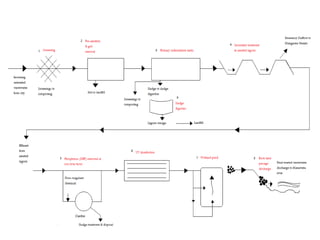
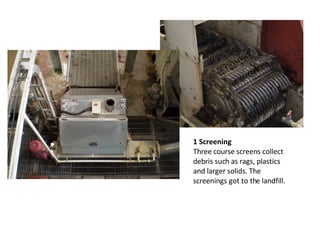
1 Screening Three course screens collect debris such as rags, plastics and larger solids. The screenings got to the landfill.
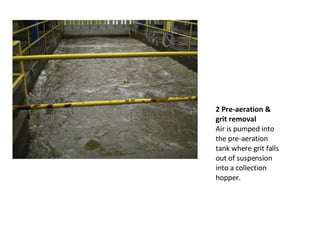
2 Pre-aeration & grit removal  Air is pumped into the pre-aeration tank where grit falls out of suspension into a collection hopper.
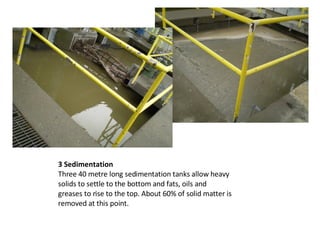
3 Sedimentation Three 40 metre long sedimentation tanks allow heavy solids to settle to the bottom and fats, oils and greases to rise to the top. About 60% of solid matter is removed at this point.
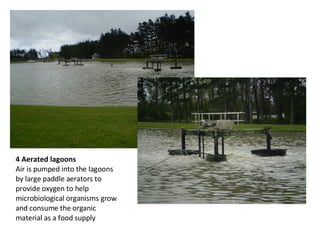
4 Aerated lagoons Air is pumped into the lagoons by large paddle aerators to provide oxygen to help microbiological organisms grow and consume the organic material as a food supply
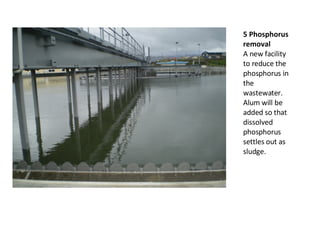
5 Phosphorus removal A new facility to reduce the phosphorus in the wastewater. Alum will be added so that dissolved phosphorus settles out as sludge.
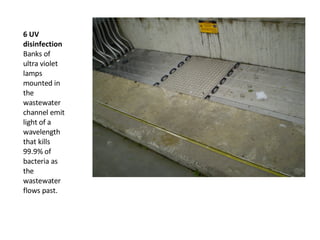
6 UV disinfection Banks of ultra violet lamps mounted in the wastewater channel emit light of a wavelength that kills 99.9% of bacteria as the wastewater flows past.
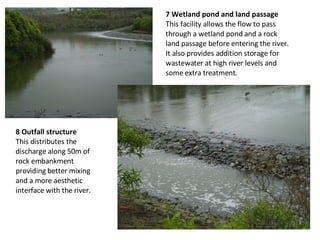
8 Outfall structure  This distributes the discharge along 50m of rock embankment providing better mixing and a more aesthetic interface with the river. 7 Wetland pond and land passage  This facility allows the flow to pass through a wetland pond and a rock land passage before entering the river. It also provides addition storage for wastewater at high river levels and some extra treatment.
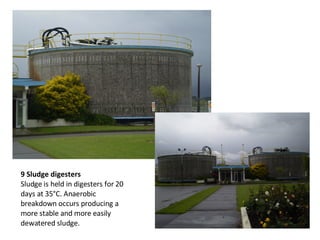
9 Sludge digesters  Sludge is held in digesters for 20 days at 35°C. Anaerobic breakdown occurs producing a more stable and more easily dewatered sludge.

Wastewater Treatment

  • 1.
    Outline of Wastewater Treatment
  • 2.
  • 3.
    1 Screening Threecourse screens collect debris such as rags, plastics and larger solids. The screenings got to the landfill.
  • 4.
    2 Pre-aeration &grit removal Air is pumped into the pre-aeration tank where grit falls out of suspension into a collection hopper.
  • 5.
    3 Sedimentation Three40 metre long sedimentation tanks allow heavy solids to settle to the bottom and fats, oils and greases to rise to the top. About 60% of solid matter is removed at this point.
  • 6.
    4 Aerated lagoonsAir is pumped into the lagoons by large paddle aerators to provide oxygen to help microbiological organisms grow and consume the organic material as a food supply
  • 7.
    5 Phosphorus removalA new facility to reduce the phosphorus in the wastewater. Alum will be added so that dissolved phosphorus settles out as sludge.
  • 8.
    6 UV disinfectionBanks of ultra violet lamps mounted in the wastewater channel emit light of a wavelength that kills 99.9% of bacteria as the wastewater flows past.
  • 9.
    8 Outfall structure This distributes the discharge along 50m of rock embankment providing better mixing and a more aesthetic interface with the river. 7 Wetland pond and land passage This facility allows the flow to pass through a wetland pond and a rock land passage before entering the river. It also provides addition storage for wastewater at high river levels and some extra treatment.
  • 10.
    9 Sludge digesters Sludge is held in digesters for 20 days at 35°C. Anaerobic breakdown occurs producing a more stable and more easily dewatered sludge.