© 2017 WaterProfessionals®
TOP 5 TYPES OF WATER
TREATMENT PROCESSES
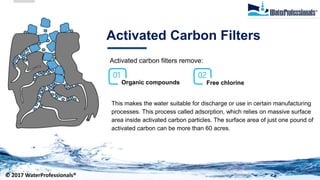
Activated Carbon Filters
01
Organic compounds
02
Free chlorine
This makes the water suitable for discharge or use in certain manufacturing
processes. This process called adsorption, which relies on massive surface
area inside activated carbon particles. The surface area of just one pound of
activated carbon can be more than 60 acres.
Activated carbon filters remove:
© 2017 WaterProfessionals®
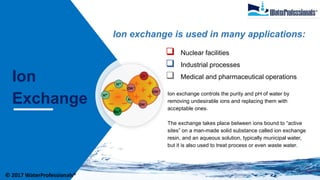
Ion
Exchange
Ion exchange is used in many applications:
 Nuclear facilities
 Industrial processes
 Medical and pharmaceutical operations
Ion exchange controls the purity and pH of water by
removing undesirable ions and replacing them with
acceptable ones.
The exchange takes place between ions bound to “active
sites” on a man-made solid substance called ion exchange
resin, and an aqueous solution, typically municipal water,
but it is also used to treat process or even waste water.
© 2017 WaterProfessionals®
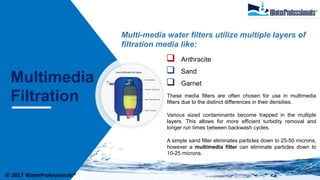
Multimedia
Filtration
Multi-media water filters utilize multiple layers of
filtration media like:
 Anthracite
 Sand
 Garnet
These media filters are often chosen for use in multimedia
filters due to the distinct differences in their densities.
Various sized contaminants become trapped in the multiple
layers. This allows for more efficient turbidity removal and
longer run times between backwash cycles.
A simple sand filter eliminates particles down to 25-50 microns,
however a multimedia filter can eliminate particles down to
10-25 microns.
© 2017 WaterProfessionals®
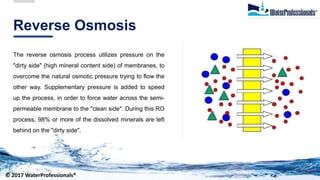
Reverse Osmosis
The reverse osmosis process utilizes pressure on the
"dirty side" (high mineral content side) of membranes, to
overcome the natural osmotic pressure trying to flow the
other way. Supplementary pressure is added to speed
up the process, in order to force water across the semi-
permeable membrane to the "clean side". During this RO
process, 98% or more of the dissolved minerals are left
behind on the "dirty side".
© 2017 WaterProfessionals®
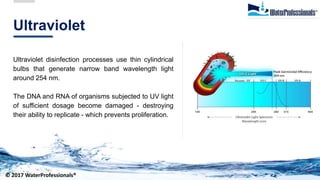
Ultraviolet
Ultraviolet disinfection processes use thin cylindrical
bulbs that generate narrow band wavelength light
around 254 nm.
The DNA and RNA of organisms subjected to UV light
of sufficient dosage become damaged - destroying
their ability to replicate - which prevents proliferation.
© 2017 WaterProfessionals®
WaterProfessionals® can help determine the right water treatment
process and combination of methods right for your application.
For assistance contact us at:
www.WaterProfessionals.com

Top 5 water treatment processes

  • 1.
    © 2017 WaterProfessionals® TOP5 TYPES OF WATER TREATMENT PROCESSES
  • 2.
    Activated Carbon Filters 01 Organiccompounds 02 Free chlorine This makes the water suitable for discharge or use in certain manufacturing processes. This process called adsorption, which relies on massive surface area inside activated carbon particles. The surface area of just one pound of activated carbon can be more than 60 acres. Activated carbon filters remove: © 2017 WaterProfessionals®
  • 3.
    Ion Exchange Ion exchange isused in many applications:  Nuclear facilities  Industrial processes  Medical and pharmaceutical operations Ion exchange controls the purity and pH of water by removing undesirable ions and replacing them with acceptable ones. The exchange takes place between ions bound to “active sites” on a man-made solid substance called ion exchange resin, and an aqueous solution, typically municipal water, but it is also used to treat process or even waste water. © 2017 WaterProfessionals®
  • 4.
    Multimedia Filtration Multi-media water filtersutilize multiple layers of filtration media like:  Anthracite  Sand  Garnet These media filters are often chosen for use in multimedia filters due to the distinct differences in their densities. Various sized contaminants become trapped in the multiple layers. This allows for more efficient turbidity removal and longer run times between backwash cycles. A simple sand filter eliminates particles down to 25-50 microns, however a multimedia filter can eliminate particles down to 10-25 microns. © 2017 WaterProfessionals®
  • 5.
    Reverse Osmosis The reverseosmosis process utilizes pressure on the "dirty side" (high mineral content side) of membranes, to overcome the natural osmotic pressure trying to flow the other way. Supplementary pressure is added to speed up the process, in order to force water across the semi- permeable membrane to the "clean side". During this RO process, 98% or more of the dissolved minerals are left behind on the "dirty side". © 2017 WaterProfessionals®
  • 6.
    Ultraviolet Ultraviolet disinfection processesuse thin cylindrical bulbs that generate narrow band wavelength light around 254 nm. The DNA and RNA of organisms subjected to UV light of sufficient dosage become damaged - destroying their ability to replicate - which prevents proliferation. © 2017 WaterProfessionals®
  • 7.
    WaterProfessionals® can helpdetermine the right water treatment process and combination of methods right for your application. For assistance contact us at: www.WaterProfessionals.com

Editor's Notes

  • #4 A typical transaction would be done in two steps.
  • #5 A typical transaction would be done in two steps.