Name :: Supabana Ghosh
Class :: X == > D
Roll No :: 47
Board Regn Numbr :: B114084140217

Project on
Water
Current water shortages and the cost associated with freshwater
have made water reuse and recycling of major importance. Reused
water is currently used for non-potable purpose , such as
agriculture , landscape , public parks and golf course irrigation
, industrial process water etc. Benefits of reuse includes protection
of ecosystems and reduction and prevention of pollution. This
paper focus on the environmental & health considerations related
to utilization of treated water.
1.Waste water recycling helps you get the most from limited water supplies.
It's a low-cost, environmentally friendly way to create fresh water for
industry and agriculture & offers a wide range of treatment
technologies for reclaiming industrial waste water.
2.Waste Water & Process Technologies is on the forefront with a wide range
of recycling solutions
3.This also benefits You & Reduced stress on drinking water supplies
Flexibility to suit specific applications Affordable cost Low
environmental impact.
* The dilution model; where a wastewater collection system exists but is infiltrated
by groundwater, rain and sand.
* The digester-dyke-pond model for concentrated effluent; to rebuild or
construct a collection system which separates wastewater from rainwater.
* The soil filter model, where large water surfaces are undesirable for social
reasons such as houses located very close to the treatment area.
Advantages
1.
2.
3.
4.

Could stop lots of pollutants to enter the natural process
Could help nature to be cleaner and not plagued by weeds
Could remove Chemicals that could have been harmful for environment
Stops waste water seepage into natural water sources.
Disadvantages

1. Smell .
2. Cuts into natural process where every other person's crap is some
organism's food.
3. Chemicals used could be harmful in long run.
4. Requires large area of land that could be permanently damaged.
5. Air born pollution and germs.
Conclusion
Thus,recycling of waste water has advantages as well as disadvantages but in
most cases it is useful like it could remove harmful chemical from the
environment etc..
Water Resources
What creates an increased water consumption?
* Population growth.
* Economic growth based on agriculture and industry.
* Increased standard of living.

How to improve the situation and create a sustainable
development.
Rainwater harvesting in arid climates (for agriculture).
Wastewater treatment for reuse, particulary in agriculture.
Improve methods for watering.
Processing and venture in drought tolerance crops.
More efficient water use in the industry.
Improve the legal protection of water resources.
Hard Water & Soft
Water
Identifying Hard and Soft Water
* Hard water is water containing a substantial amount of dissolved minerals like
calcium and magnesium.
* Soft water is water where the only ion is sodium.
* Hard water has a negative effect on plumbing and makes some cleaning materials
less effective.
* Soap is ineffective on hard water and reacts with it to form insoluble salt known as
soap scum.
* Soft water may taste salty and not be safe to drink.
Effects of Hard Water
*Homes with hard water use more soap!
*More soap residue.
*Calcium and iron deposits can build up
in appliances and on faucets:
-Washing machine
-Dish washer
-Steam iron
*Shortens their life span and adds to
landfill problem!

Soft Water

* Water with very low concentrations of
minerals.
* Soap lathers easily and is sometimes
difficult to rinse off.
How Can Hard Water Be Made Soft?
*The calcium and magnesium cations need to be removed to soften the water.
* This can be done by adding a solution of soda ash (sodium carbonate) Na2CO3 to
the water to remove the magnesium.
* You can use slaked lime (calcium hydroxide) Ca(OH)2 to remove the calcium.

Reactions
* Ca+2 + Na2 + CO3 + H2O → CaCO3 + Na2 + H2O
* Mg+2 + Ca+2 + 2OH + H2O → Mg(OH)2 + Ca+2 + H2O
* The sodium in the first equation and the calcium in the second equation are
crossed out because they are unaffected by the reaction.

Water Hardness Rating
mg/L as CaCO3

Degree of Hardness

0-60

Soft water

61-120

Moderately hard water

121-180

Hard water

>180

Very hard water
Hydro Power
Hydroelectric Power
Hydroelectric power (often called hydropower) is considered a renewable energy
source. A renewable energy source is one that is not depleted (used up) in the
production of energy. Through hydropower, the energy in falling water is
converted into electricity without “using up” the water. Hydropower energy is
ultimately derived from the sun, which drives the water cycle. In the water
cycle, rivers are recharged in a continuous cycle. Because of the force of
gravity, water flows from high points to low points. There is kinetic energy
embodied in the flow of water.
Sizes of Hydropower Plants
* Large plants : capacity >30 MW
* Small Plants : capacity b/w 100 kW to 30 MW
* Micro Plants : capacity up to 100 kW

Dam Types
* Arch
* Gravity
* Buttress
* Embankment or Earth

Generating Technologies
Types of Hydro Turbines:
Impulse turbines , Pelton Wheel , Cross Flow Turbines , Reaction turbines , Propeller
Turbines , Bulb turbine, Straflo, Tube Turbine, Kaplan Turbine , Francis Turbines , Kinetic
Turbines .
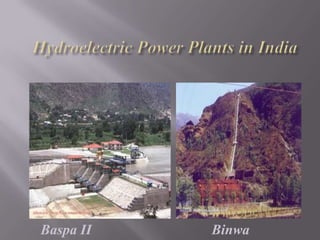
Baspa II

Binwa
Gaj

Nathpa Jakri
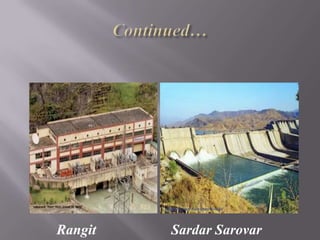
Rangit

Sardar Sarovar
Popular Struggle & Movements
Popular struggle & Movements

Supabana Ghosh
Class X D
Narmada BachaoAndolan Women’s Movement

* Influence politics rather than directly take part in electoral
competition
* They are loose organisations
* Make informal decisions and are flexible
* They depend on spontaneous mass participation
Bolivia…
Fight against Privatization of Water
1) World Bank pressurised Government to give up control of Municipal
Water supply.
2) Sale of rights to a MNC for the City of Cochabamba.
3) Company raised the price of water 4 times.
4) 4 day general strike by Labour and Human Rights and Community
leaders.
5) Government agreed to negotiate.
6) Power of the people forced MNC to flee & made Government to
concede to all demands.
Water supply was restored to municipality at old rates.
Together We Can
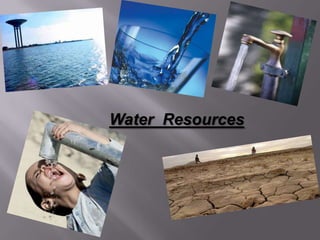
Water Resources

Water resources are sources of water that are useful or potentially
useful. Uses of water include agricultural, industrial , household
, recreational & environmental activities. The majority of human
uses require fresh water .
97 percent of the water on the Earth is salt water. However, only
three percent is fresh water ; slightly over two thirds of this is
frozen in glaciers and polar ice caps.The remaining unfrozen
freshwater is found mainly as groundwater, with only a small
fraction present above ground or in the air.
Harvesting System
Broadly rainwater can be harvested for two purposes
•Storing rainwater for ready use in containers above or below ground
•Charged into the soil for withdrawal later (groundwater recharging)

Source: A Water Harvesting Manual For Urban Areas
Why Rain water be harvested
* To conserve & augment the storage of ground water , reduce water table depletion
, improve the quality of ground water , arrest sea water intrusion in coastal areas &
avoid flood & water stagnation in urban areas .

Rain Water Harvesting (RWH )– Methodologies
• Roof , Land based & Watershed based Rain Water Harvesting
• For Urban & Industrial Environment –
• Roof & Land based RWH
• Public, Private, Office & Industrial buildings
• Pavements, Lawns, Gardens & other open spaces

Rain Water Harvesting– Advantages
1. Provides self-sufficiency to water supply & reduces the cost for pumping of ground water &
Reduces soil erosion & flooding in urban areas.
2. Provides high quality water, soft and low in minerals & improves the quality of ground water
through dilution when recharged.
3. The rooftop rain water harvesting is less expensive & easy to construct, operate and maintain
4. In deserts , RWH is the only relief
8. In saline or coastal areas & Islands, rain water provides good quality water
Supabana project

Supabana project

  • 1.
    Name :: SupabanaGhosh Class :: X == > D Roll No :: 47 Board Regn Numbr :: B114084140217 Project on Water
  • 2.
    Current water shortagesand the cost associated with freshwater have made water reuse and recycling of major importance. Reused water is currently used for non-potable purpose , such as agriculture , landscape , public parks and golf course irrigation , industrial process water etc. Benefits of reuse includes protection of ecosystems and reduction and prevention of pollution. This paper focus on the environmental & health considerations related to utilization of treated water.
  • 3.
    1.Waste water recyclinghelps you get the most from limited water supplies. It's a low-cost, environmentally friendly way to create fresh water for industry and agriculture & offers a wide range of treatment technologies for reclaiming industrial waste water. 2.Waste Water & Process Technologies is on the forefront with a wide range of recycling solutions 3.This also benefits You & Reduced stress on drinking water supplies Flexibility to suit specific applications Affordable cost Low environmental impact.
  • 4.
    * The dilutionmodel; where a wastewater collection system exists but is infiltrated by groundwater, rain and sand. * The digester-dyke-pond model for concentrated effluent; to rebuild or construct a collection system which separates wastewater from rainwater. * The soil filter model, where large water surfaces are undesirable for social reasons such as houses located very close to the treatment area. Advantages 1. 2. 3. 4. Could stop lots of pollutants to enter the natural process Could help nature to be cleaner and not plagued by weeds Could remove Chemicals that could have been harmful for environment Stops waste water seepage into natural water sources. Disadvantages 1. Smell . 2. Cuts into natural process where every other person's crap is some organism's food. 3. Chemicals used could be harmful in long run. 4. Requires large area of land that could be permanently damaged. 5. Air born pollution and germs.
  • 5.
    Conclusion Thus,recycling of wastewater has advantages as well as disadvantages but in most cases it is useful like it could remove harmful chemical from the environment etc..
  • 6.
  • 7.
    What creates anincreased water consumption? * Population growth. * Economic growth based on agriculture and industry. * Increased standard of living. How to improve the situation and create a sustainable development. Rainwater harvesting in arid climates (for agriculture). Wastewater treatment for reuse, particulary in agriculture. Improve methods for watering. Processing and venture in drought tolerance crops. More efficient water use in the industry. Improve the legal protection of water resources.
  • 8.
    Hard Water &Soft Water
  • 9.
    Identifying Hard andSoft Water * Hard water is water containing a substantial amount of dissolved minerals like calcium and magnesium. * Soft water is water where the only ion is sodium. * Hard water has a negative effect on plumbing and makes some cleaning materials less effective. * Soap is ineffective on hard water and reacts with it to form insoluble salt known as soap scum. * Soft water may taste salty and not be safe to drink.
  • 10.
    Effects of HardWater *Homes with hard water use more soap! *More soap residue. *Calcium and iron deposits can build up in appliances and on faucets: -Washing machine -Dish washer -Steam iron *Shortens their life span and adds to landfill problem! Soft Water * Water with very low concentrations of minerals. * Soap lathers easily and is sometimes difficult to rinse off.
  • 11.
    How Can HardWater Be Made Soft? *The calcium and magnesium cations need to be removed to soften the water. * This can be done by adding a solution of soda ash (sodium carbonate) Na2CO3 to the water to remove the magnesium. * You can use slaked lime (calcium hydroxide) Ca(OH)2 to remove the calcium. Reactions * Ca+2 + Na2 + CO3 + H2O → CaCO3 + Na2 + H2O * Mg+2 + Ca+2 + 2OH + H2O → Mg(OH)2 + Ca+2 + H2O * The sodium in the first equation and the calcium in the second equation are crossed out because they are unaffected by the reaction. Water Hardness Rating mg/L as CaCO3 Degree of Hardness 0-60 Soft water 61-120 Moderately hard water 121-180 Hard water >180 Very hard water
  • 12.
  • 13.
    Hydroelectric Power Hydroelectric power(often called hydropower) is considered a renewable energy source. A renewable energy source is one that is not depleted (used up) in the production of energy. Through hydropower, the energy in falling water is converted into electricity without “using up” the water. Hydropower energy is ultimately derived from the sun, which drives the water cycle. In the water cycle, rivers are recharged in a continuous cycle. Because of the force of gravity, water flows from high points to low points. There is kinetic energy embodied in the flow of water. Sizes of Hydropower Plants * Large plants : capacity >30 MW * Small Plants : capacity b/w 100 kW to 30 MW * Micro Plants : capacity up to 100 kW Dam Types * Arch * Gravity * Buttress * Embankment or Earth Generating Technologies Types of Hydro Turbines: Impulse turbines , Pelton Wheel , Cross Flow Turbines , Reaction turbines , Propeller Turbines , Bulb turbine, Straflo, Tube Turbine, Kaplan Turbine , Francis Turbines , Kinetic Turbines .
  • 15.
  • 16.
  • 17.
  • 18.
    Popular Struggle &Movements Popular struggle & Movements Supabana Ghosh Class X D
  • 19.
    Narmada BachaoAndolan Women’sMovement * Influence politics rather than directly take part in electoral competition * They are loose organisations * Make informal decisions and are flexible * They depend on spontaneous mass participation
  • 20.
    Bolivia… Fight against Privatizationof Water 1) World Bank pressurised Government to give up control of Municipal Water supply. 2) Sale of rights to a MNC for the City of Cochabamba. 3) Company raised the price of water 4 times. 4) 4 day general strike by Labour and Human Rights and Community leaders. 5) Government agreed to negotiate. 6) Power of the people forced MNC to flee & made Government to concede to all demands. Water supply was restored to municipality at old rates.
  • 21.
  • 22.
    Water Resources Water resourcesare sources of water that are useful or potentially useful. Uses of water include agricultural, industrial , household , recreational & environmental activities. The majority of human uses require fresh water . 97 percent of the water on the Earth is salt water. However, only three percent is fresh water ; slightly over two thirds of this is frozen in glaciers and polar ice caps.The remaining unfrozen freshwater is found mainly as groundwater, with only a small fraction present above ground or in the air.
  • 24.
    Harvesting System Broadly rainwatercan be harvested for two purposes •Storing rainwater for ready use in containers above or below ground •Charged into the soil for withdrawal later (groundwater recharging) Source: A Water Harvesting Manual For Urban Areas
  • 25.
    Why Rain waterbe harvested * To conserve & augment the storage of ground water , reduce water table depletion , improve the quality of ground water , arrest sea water intrusion in coastal areas & avoid flood & water stagnation in urban areas . Rain Water Harvesting (RWH )– Methodologies • Roof , Land based & Watershed based Rain Water Harvesting • For Urban & Industrial Environment – • Roof & Land based RWH • Public, Private, Office & Industrial buildings • Pavements, Lawns, Gardens & other open spaces Rain Water Harvesting– Advantages 1. Provides self-sufficiency to water supply & reduces the cost for pumping of ground water & Reduces soil erosion & flooding in urban areas. 2. Provides high quality water, soft and low in minerals & improves the quality of ground water through dilution when recharged. 3. The rooftop rain water harvesting is less expensive & easy to construct, operate and maintain 4. In deserts , RWH is the only relief 8. In saline or coastal areas & Islands, rain water provides good quality water