JIMMA UNIVERSTY
FACULTY OF PUBLIC HEALTH
INSTITUTE OF HEALTH SCIENCE
DEPARTMENT OF ENVIRONMENTAL HEALTH
SCIENCE AND TECHNOLOGY
Departmentof EnvironmentalHealth Sciences and Technology
Waste water managementand engineering
Done By ; YINGES BIRHANU
ID.NO RU5691/11
Part: I Answer the following questions accordingly (2 pts each)
1 Which one is not among the possible wastewater contaminants that can harm in the
Ecosystem?
A. Nitrogen and phosphorus
B. bacterium Vibrio Cholera
C. Total solids (TS)
D. None ANSWER;D
2. Which is less likely to occur in industrial wastewater relative to domestic and other
Wastewaters?
A. Poisonous chemicals
B. Minerals
C. Nuclear waste
D. Radioactive wastes
E. Higher dose of pathogens ANSWER;E
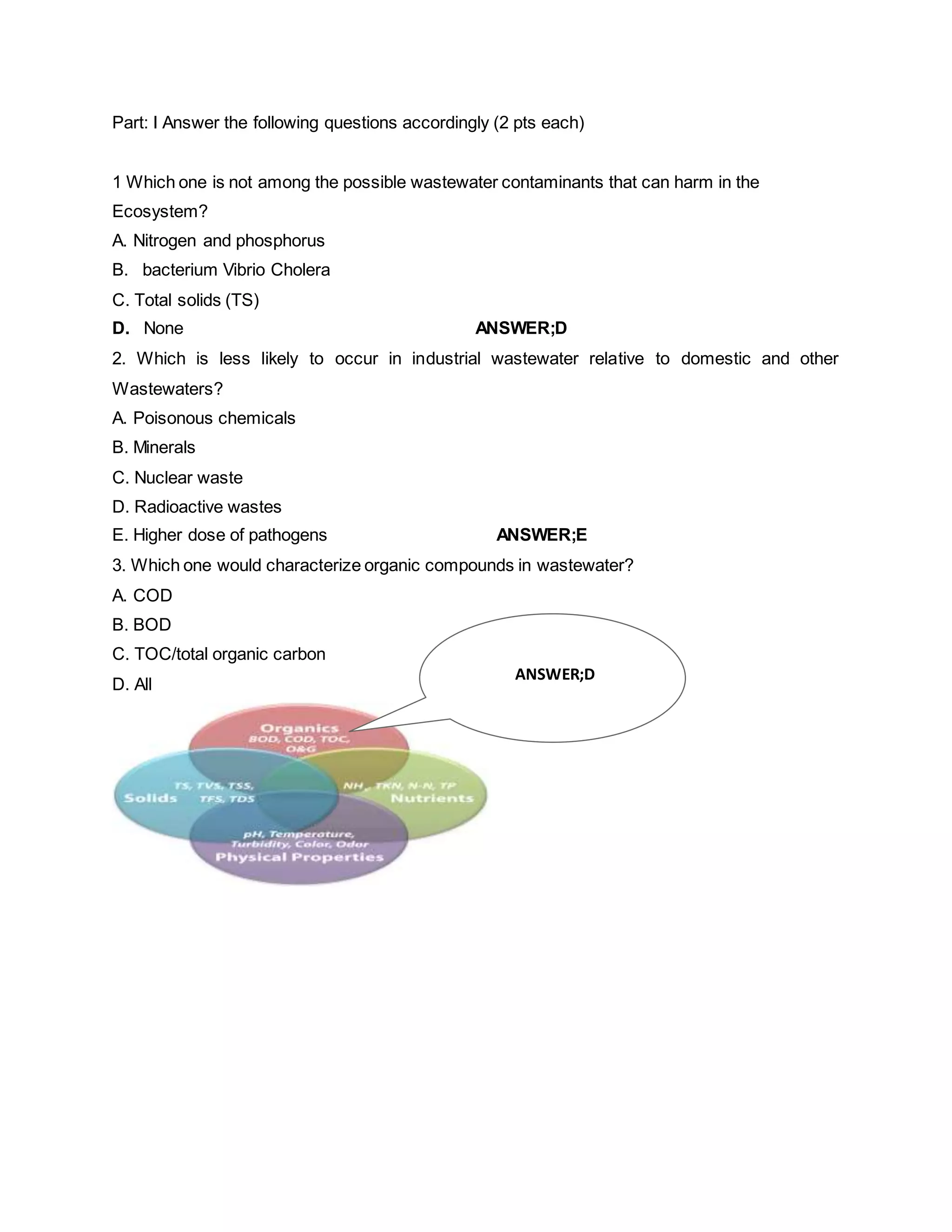
3. Which one would characterize organic compounds in wastewater?
A. COD
B. BOD
C. TOC/total organic carbon
D. All
ANSWER;D
4. State at least two problems associated with Infiltration occurrence in sewer lines?
 Infiltrations reduce the ability of sanitary sewer systems and treatment facilities to transport
and treat domestic and industrial wastewater.
 As a result of infiltration, wastewater treatment processes are disrupted and poorly treated
wastewater is discharged to the environment
 Reduce the capacity of the sewage system leaving less for existing residents and future
growth.
 May cause sewage overflows or overwhelm treatment plants leading to health risks and
property and environmental damage
5. State at least two chemical toxicities/diseases/ that can occur as a result of untreated
wastewater release into surface water
 Skin lesion.can be due to exposure to chemicals like polycyclic hydrocarbons.
 tai-itai disease;is the most severe form of chronic Cd poisoning caused by
prolonged oral Cd ingestion and due to mining.
 Lung cancer; Exposure to certain hazardous chemicals poses a lung cancer risk.
For example Working with materials such as asbestos, uranium, arsenic, cadmium,
chromium, nickel and some petroleum products is especially dangerous
6. Calculate the theoretical COD if the wastewater contains 2.5 g of glutamic acid considering
The following reaction:
C5H9NO4 + 9/2O2 5CO2 + 3H2O + NH3;
Solution;
2.5 g x g
C5H9NO4 + 9/2O2. 5CO2 + 3H2O + NH3
147 g/mol 144g/mol
=2.5g/147gmol-1=xg/144gmol-1
=2.5mol =xmol 144*2.5=147*x
147 144 x=360/147=2.45gram
Thod COD is 2.45gram.
7. Explain the main differences in primary and secondary wastewater treatment technologies?
Wastewater is the used water from toilets, showers, baths, kitchen sinks, laundries and industrial
processes. Around 99% of wastewater is water, and the other 1% is contaminating waste and solids.
o Primary wastewater treatment is the process of removing solid matter from wastewater that
will either float or readily settle out by gravity.
o Secondary wastewater treatment process uses anaerobic microorganisms and retention
time to breakdown and removes the remaining waste and other small particles. Use
microorganisms to biologically remove contaminants from wastewater.
Primary Treatment Secondary Treatment
This process generally utilizes mechanical equipment to
breakup larger particles
Secondary treatment uses biological processes for
extraction
In primary treatment larger particlesare removed With secondary wastewater treatment smaller particles
are removedusing retentiontime
This method requires a shorter time(Slow) requires a longer time because the microbes consume
the waste.(Slower)
The primary wastewater treatment utilizes filtration and
sedimentationprocesses
The secondary treatment uses anaerobic or aerobic
breakdown processes
8. State possible interferences in determination of COD and suggested solutions?
COD is a measure of the oxygen equivalent of the organic matter in a water sample that is
susceptible to oxidation by a strong chemical oxidant.COD widely used as a measure of the
susceptibility to oxidation of the organic and inorganic materials present in water bodies and in the
municipal and industrial wastes
Chemical oxygen demand (COD) relies on chemical oxidation with chromic acid (a strong oxidizer)
If the COD exceeds 1500 mg/L, the sample should be diluted to bring the results in
range.
 Chloride- is the primary interference. Vials with mercuric sulfate can be used to
eliminate chloride interference up to 2000 mg/L Cl. Samples with higher chloride
concentrations should be diluted enough to reduce the chloride concentration below
this limit. If the sample is diluted the values are adjusted based on the dilution
factor.
 Iron- We precipitate iron from the solution by raising pH to about 11, decant the sample
from the precipitate and then neutralize pH before COD analysis
 H2O2- Manganese dioxide (MnO2) can catalyze the residual (unreacted) H2O2 to H2O and
O2 in the sample in order to prevent the interference of H2O2 on COD analysis or oxidized
by dichromate.
9. Explain how BOD estimates the toxicity of wastewater?
Biochemical oxygen demand (BOD) is the amount of dissolved oxygen (DO) needed (i.e.
demanded) by aerobic biological organisms to break down organic material present in a given
water sample at certain temperature over a specific time period. BOD reduction normally
accomplished by that species temporarily ceases until other species reach a suitable population
to utilize that food source, or the original population recovers as biocide concentrations decline
Toxicity Some wastes contain chemicals capable of suppressing microbiological growth or
activity. Potential sources include industrial wastes, antibiotics in pharmaceutical or medical
wastes, sanitizers in food processing or commercial cleaning facilities, chlorination disinfection
used following conventional sewage treatment, and odor-control formulations used in sanitary
waste holding tanks in passenger vehicles or portable toilets. Suppression of the microbial
community oxidizing the waste will lower the test result.
wastewater treatment plant
10. What is activated sludge and how is important in secondary wastewater treatment?
The activated sludge process is a type of wastewater treatment process for treating sewage or
industrial wastewaters using aeration and a biological floc composed of bacteria fungi and
protozoa which are present as loose clumped mass of fine particles that are kept in suspension
by stirring, with the aim of removing organic matter from wastewater.
The general arrangement of an activated sludge process for removing carbonaceous pollution
includes the following items:
An aeration tank where air (or oxygen) is injected in the mixed liquor.
This is followed by a settling tank (usually referred to as "final clarifier" or "secondary settling
tank") to allow the biological flocs (the sludge blanket) to settle, thus separating the biological
sludge from the clear treated water.)
Activated sludge is a biological process that can be used for one or several of the following
purposes: oxidizing carbonaceous biological matter, oxidizing nitrogenous matter: mainly
ammonium and nitrogen in biological matter, removing nutrients (nitrogen and phosphorus).
activated sludge
References
 Wikipedia, the free encyclopedia
 Miklas Scholz, in Wetland Systems to Control Urban Runoff, 2006
 Sciencedirect
 APHA. 2005. Standard methods for the Examination of Water and Wastewater.
21st Edition. American Public Health Association, Washington, D.C
 Rebecca Stott, in Handbook of Water and Wastewater Microbiology, 2003

waste water managment by kina

  • 1.
    JIMMA UNIVERSTY FACULTY OFPUBLIC HEALTH INSTITUTE OF HEALTH SCIENCE DEPARTMENT OF ENVIRONMENTAL HEALTH SCIENCE AND TECHNOLOGY Departmentof EnvironmentalHealth Sciences and Technology Waste water managementand engineering Done By ; YINGES BIRHANU ID.NO RU5691/11
  • 2.
    Part: I Answerthe following questions accordingly (2 pts each) 1 Which one is not among the possible wastewater contaminants that can harm in the Ecosystem? A. Nitrogen and phosphorus B. bacterium Vibrio Cholera C. Total solids (TS) D. None ANSWER;D 2. Which is less likely to occur in industrial wastewater relative to domestic and other Wastewaters? A. Poisonous chemicals B. Minerals C. Nuclear waste D. Radioactive wastes E. Higher dose of pathogens ANSWER;E 3. Which one would characterize organic compounds in wastewater? A. COD B. BOD C. TOC/total organic carbon D. All ANSWER;D
  • 3.
    4. State atleast two problems associated with Infiltration occurrence in sewer lines?  Infiltrations reduce the ability of sanitary sewer systems and treatment facilities to transport and treat domestic and industrial wastewater.  As a result of infiltration, wastewater treatment processes are disrupted and poorly treated wastewater is discharged to the environment  Reduce the capacity of the sewage system leaving less for existing residents and future growth.  May cause sewage overflows or overwhelm treatment plants leading to health risks and property and environmental damage 5. State at least two chemical toxicities/diseases/ that can occur as a result of untreated wastewater release into surface water  Skin lesion.can be due to exposure to chemicals like polycyclic hydrocarbons.  tai-itai disease;is the most severe form of chronic Cd poisoning caused by prolonged oral Cd ingestion and due to mining.  Lung cancer; Exposure to certain hazardous chemicals poses a lung cancer risk. For example Working with materials such as asbestos, uranium, arsenic, cadmium, chromium, nickel and some petroleum products is especially dangerous 6. Calculate the theoretical COD if the wastewater contains 2.5 g of glutamic acid considering The following reaction: C5H9NO4 + 9/2O2 5CO2 + 3H2O + NH3; Solution; 2.5 g x g C5H9NO4 + 9/2O2. 5CO2 + 3H2O + NH3 147 g/mol 144g/mol =2.5g/147gmol-1=xg/144gmol-1 =2.5mol =xmol 144*2.5=147*x 147 144 x=360/147=2.45gram Thod COD is 2.45gram.
  • 4.
    7. Explain themain differences in primary and secondary wastewater treatment technologies? Wastewater is the used water from toilets, showers, baths, kitchen sinks, laundries and industrial processes. Around 99% of wastewater is water, and the other 1% is contaminating waste and solids. o Primary wastewater treatment is the process of removing solid matter from wastewater that will either float or readily settle out by gravity. o Secondary wastewater treatment process uses anaerobic microorganisms and retention time to breakdown and removes the remaining waste and other small particles. Use microorganisms to biologically remove contaminants from wastewater. Primary Treatment Secondary Treatment This process generally utilizes mechanical equipment to breakup larger particles Secondary treatment uses biological processes for extraction In primary treatment larger particlesare removed With secondary wastewater treatment smaller particles are removedusing retentiontime This method requires a shorter time(Slow) requires a longer time because the microbes consume the waste.(Slower) The primary wastewater treatment utilizes filtration and sedimentationprocesses The secondary treatment uses anaerobic or aerobic breakdown processes
  • 5.
    8. State possibleinterferences in determination of COD and suggested solutions? COD is a measure of the oxygen equivalent of the organic matter in a water sample that is susceptible to oxidation by a strong chemical oxidant.COD widely used as a measure of the susceptibility to oxidation of the organic and inorganic materials present in water bodies and in the municipal and industrial wastes Chemical oxygen demand (COD) relies on chemical oxidation with chromic acid (a strong oxidizer) If the COD exceeds 1500 mg/L, the sample should be diluted to bring the results in range.  Chloride- is the primary interference. Vials with mercuric sulfate can be used to eliminate chloride interference up to 2000 mg/L Cl. Samples with higher chloride concentrations should be diluted enough to reduce the chloride concentration below this limit. If the sample is diluted the values are adjusted based on the dilution factor.  Iron- We precipitate iron from the solution by raising pH to about 11, decant the sample from the precipitate and then neutralize pH before COD analysis  H2O2- Manganese dioxide (MnO2) can catalyze the residual (unreacted) H2O2 to H2O and O2 in the sample in order to prevent the interference of H2O2 on COD analysis or oxidized by dichromate. 9. Explain how BOD estimates the toxicity of wastewater? Biochemical oxygen demand (BOD) is the amount of dissolved oxygen (DO) needed (i.e. demanded) by aerobic biological organisms to break down organic material present in a given water sample at certain temperature over a specific time period. BOD reduction normally accomplished by that species temporarily ceases until other species reach a suitable population to utilize that food source, or the original population recovers as biocide concentrations decline Toxicity Some wastes contain chemicals capable of suppressing microbiological growth or activity. Potential sources include industrial wastes, antibiotics in pharmaceutical or medical wastes, sanitizers in food processing or commercial cleaning facilities, chlorination disinfection used following conventional sewage treatment, and odor-control formulations used in sanitary waste holding tanks in passenger vehicles or portable toilets. Suppression of the microbial community oxidizing the waste will lower the test result.
  • 6.
    wastewater treatment plant 10.What is activated sludge and how is important in secondary wastewater treatment? The activated sludge process is a type of wastewater treatment process for treating sewage or industrial wastewaters using aeration and a biological floc composed of bacteria fungi and protozoa which are present as loose clumped mass of fine particles that are kept in suspension by stirring, with the aim of removing organic matter from wastewater. The general arrangement of an activated sludge process for removing carbonaceous pollution includes the following items: An aeration tank where air (or oxygen) is injected in the mixed liquor. This is followed by a settling tank (usually referred to as "final clarifier" or "secondary settling tank") to allow the biological flocs (the sludge blanket) to settle, thus separating the biological sludge from the clear treated water.) Activated sludge is a biological process that can be used for one or several of the following purposes: oxidizing carbonaceous biological matter, oxidizing nitrogenous matter: mainly ammonium and nitrogen in biological matter, removing nutrients (nitrogen and phosphorus). activated sludge
  • 7.
    References  Wikipedia, thefree encyclopedia  Miklas Scholz, in Wetland Systems to Control Urban Runoff, 2006  Sciencedirect  APHA. 2005. Standard methods for the Examination of Water and Wastewater. 21st Edition. American Public Health Association, Washington, D.C  Rebecca Stott, in Handbook of Water and Wastewater Microbiology, 2003