Roles of  The President                             
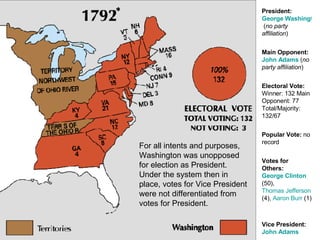
President:  George Washington  ( no party affiliation )  Main Opponent:  John Adams  ( no party affiliation )  Electoral Vote:  Winner: 132 Main Opponent: 77 Total/Majority: 132/67  Popular Vote:  no record  Votes for Others:  George Clinton  (50),  Thomas Jefferson  (4),  Aaron Burr  (1)  Vice President:  John Adams For all intents and purposes, Washington was unopposed for election as President. Under the system then in place, votes for Vice President were not differentiated from votes for President.
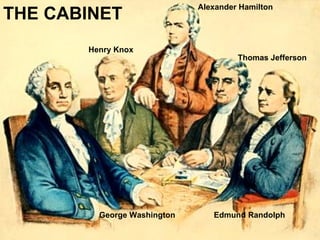
George Washington Henry Knox Edmund Randolph Thomas Jefferson Alexander Hamilton THE CABINET
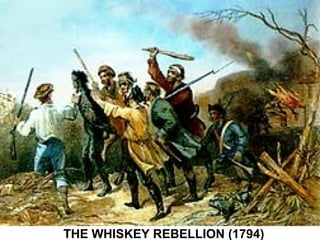
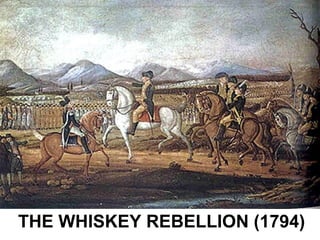
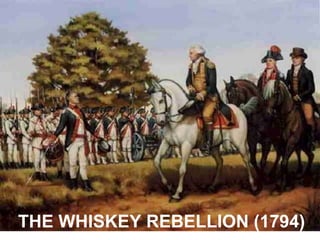
THE WHISKEY REBELLION (1794)
George Washington – 1 st  President (1789 – 1797) Secretary of Treasury: Alexander Hamilton Secretary of State: Thomas Jefferson [Finance] [Diplomacy] Secretary of War: Henry Knox Attorney General: Edmund Randolph [Defense] [Justice] Precedents Cabinet System:  Group of department heads that advise the President Proclamation of Neutrality:  Established U.S. neutrality in European affairs Whiskey Rebellion:   Legitimacy of the power of the President to enforce laws Jay’s Treaty:   Executive privilege was set when Washington refused a request by Congress Farewell Address:  Final advice to the nation to maintain commercial, but not political ties to other nations (no alliances)
Some Famous Things They Didn’t Say! A phrase often incorrectly said to come from  George Washington’s Farewell Address .  Washington warned not against “entangling” alliances but against both “passionate attachments” and “inveterate antipathies” to particular foreign countries.  It was  Thomas Jefferson  who said, in his first Inaugural, “peace, commerce, and honest friendship with all nations,  entangling alliances  with none.” “ Entangling alliances”
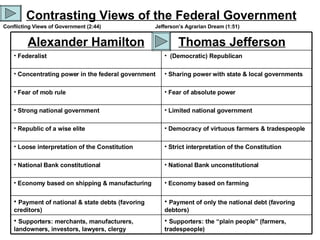
Contrasting Views of the Federal Government Conflicting Views of Government (2:44) Jefferson’s Agrarian Dream (1:51) Supporters: the “plain people” (farmers, tradespeople) Supporters: merchants, manufacturers, landowners, investors, lawyers, clergy Payment of only the national debt (favoring debtors) Payment of national & state debts (favoring creditors) Economy based on farming Economy based on shipping & manufacturing National Bank unconstitutional National Bank constitutional Strict interpretation of the Constitution Loose interpretation of the Constitution Democracy of virtuous farmers & tradespeople Republic of a wise elite Limited national government Strong national government Fear of absolute power Fear of mob rule Sharing power with state & local governments Concentrating power in the federal government (Democratic) Republican Federalist Thomas Jefferson Alexander Hamilton
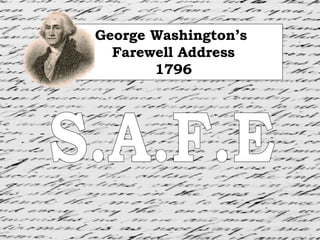
George Washington’s  Farewell Address 1796 S.A.F.E
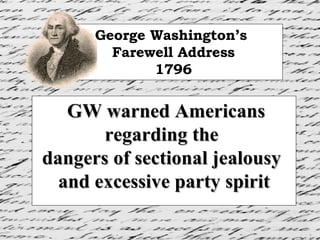
GW warned Americans regarding the  dangers of sectional jealousy  and excessive party spirit George Washington’s  Farewell Address 1796
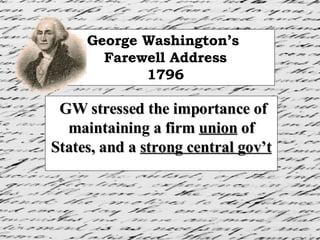
George Washington’s  Farewell Address 1796 GW stressed the importance of maintaining a firm  union  of States, and a  strong central gov’t
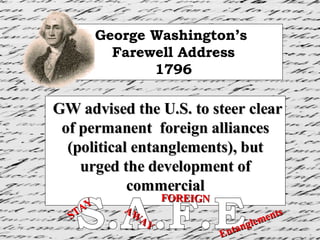
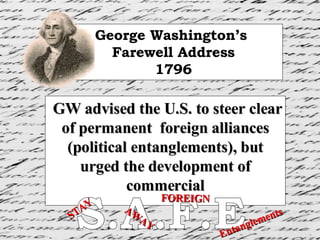
GW advised the U.S. to steer clear of permanent  foreign alliances (political entanglements), but urged the development of commercial George Washington’s  Farewell Address 1796 S.A.F.E STAY AWAY FOREIGN Entanglements
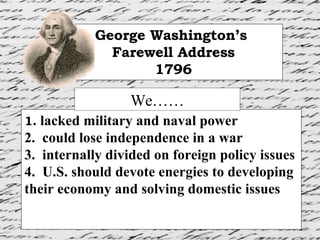
1.  lacked military and naval power 2.  could lose independence in a war 3.  internally divided on foreign policy issues 4.  U.S. should devote energies to developing their economy and solving domestic issues George Washington’s  Farewell Address 1796 We……
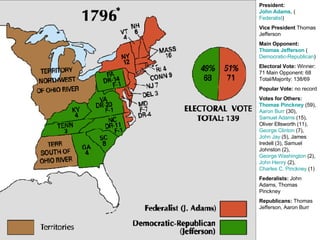
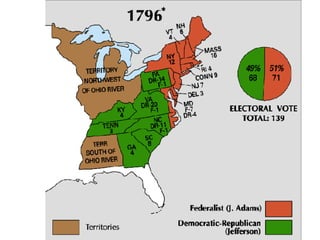
President:  John Adams , ( Federalist )  Vice President  Thomas Jefferson  Main Opponent:  Thomas Jefferson  ( Democratic-Republican ) Electoral Vote:  Winner: 71 Main Opponent: 68 Total/Majority: 138/69  Popular Vote:  no record  Votes for Others:  Thomas Pinckney  (59),  Aaron Burr  (30),  Samuel Adams  (15), Oliver Ellsworth (11),  George Clinton  (7),  John Jay  (5), James Iredell (3), Samuel Johnston (2),  George Washington  (2),  John Henry  (2),  Charles C. Pinckney  (1)  Federalists:  John Adams, Thomas Pinckney  Republicans:  Thomas Jefferson, Aaron Burr
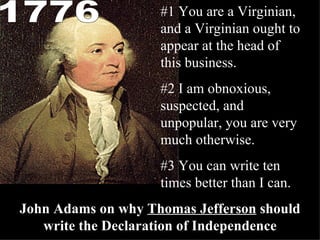
#1 You are a Virginian, and a Virginian ought to appear at the head of this business. #2 I am obnoxious, suspected, and unpopular, you are very much otherwise. #3 You can write ten times better than I can. John Adams on why  Thomas Jefferson  should write the Declaration of Independence 1776
ELECTION of 1796                              The Constitution in 1796 required presidential electors to place the names of  two  individuals on their ballots; the candidate with the highest vote count, if a majority, became the president and the runner up the vice president. The results were not anticipated by anyone.  Adams won with 71 electoral votes, but was followed by Thomas Jefferson with 68 votes; Thomas Pinckney trailed the leaders with 59. The president was a Federalist, but the vice president was the leader of the Democratic Republicans opposition – an untidy situation.
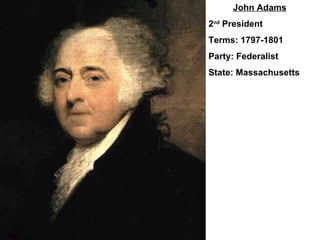
John Adams 2 nd  President Terms: 1797-1801 Party: Federalist State: Massachusetts
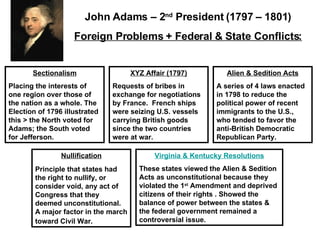
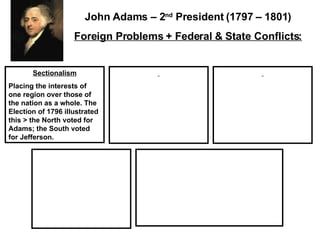
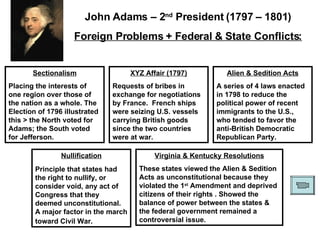
Sectionalism Placing the interests of one region over those of the nation as a whole. The Election of 1796 illustrated this > the North voted for Adams; the South voted for Jefferson. XYZ Affair (1797) Requests of bribes in exchange for negotiations by France.  French ships were seizing U.S. vessels carrying British goods since the two countries were at war.  Alien & Sedition Acts A series of 4 laws enacted in 1798 to reduce the political power of recent immigrants to the U.S., who tended to favor the anti-British Democratic Republican Party.  Nullification Principle that states had the right to nullify, or consider void, any act of Congress that they deemed unconstitutional. A major factor in the march toward Civil War.  Virginia & Kentucky Resolutions These states viewed the Alien & Sedition Acts as unconstitutional because they violated the 1 st  Amendment and deprived citizens of their rights . Showed the balance of power between the states & the federal government remained a controversial issue.  John Adams – 2 nd  President (1797 – 1801) Foreign Problems + Federal & State Conflicts:
Sectionalism Placing the interests of one region over those of the nation as a whole. The Election of 1796 illustrated this > the North voted for Adams; the South voted for Jefferson. John Adams – 2 nd  President (1797 – 1801) Foreign Problems + Federal & State Conflicts:
 
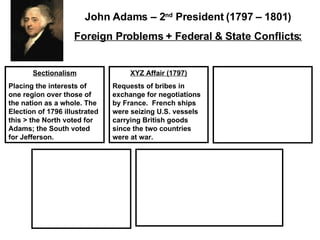
Sectionalism Placing the interests of one region over those of the nation as a whole. The Election of 1796 illustrated this > the North voted for Adams; the South voted for Jefferson. XYZ Affair (1797) Requests of bribes in exchange for negotiations by France.  French ships were seizing U.S. vessels carrying British goods since the two countries were at war.  John Adams – 2 nd  President (1797 – 1801) Foreign Problems + Federal & State Conflicts:
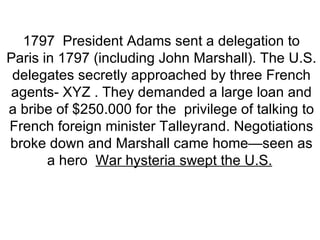
1797  President Adams sent a delegation to Paris in 1797 (including John Marshall). The U.S. delegates secretly approached by three French agents- XYZ . They demanded a large loan and a bribe of $250.000 for the  privilege of talking to French foreign minister Talleyrand. Negotiations broke down and Marshall came home—seen as a hero   War hysteria swept the U.S.
Some Famous Things They Didn’t Say! Charles Pinckney  was supposed to have said this in 1797 when he and two other American diplomats who were trying to negotiate a treaty with the French were asked for a bribe by agents of the foreign minister  Talleyrand  (The XYZ Affair.)  What Pinckney did say was,  “No! No! Not a sixpence, sir!” The famous words, however, were spoken a year later by Congressman  Robert Goodloe Harper  of South Carolina at a banquet for another of these diplomats,  John Marshall  (the future Chief Justice of the Supreme Court.) “ Millions for defense,  but not one cent for tribute”
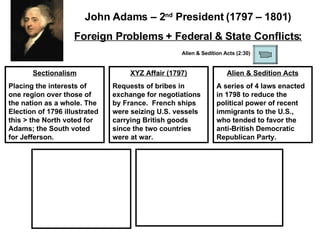
Sectionalism Placing the interests of one region over those of the nation as a whole. The Election of 1796 illustrated this > the North voted for Adams; the South voted for Jefferson. XYZ Affair (1797) Requests of bribes in exchange for negotiations by France.  French ships were seizing U.S. vessels carrying British goods since the two countries were at war.  Alien & Sedition Acts A series of 4 laws enacted in 1798 to reduce the political power of recent immigrants to the U.S., who tended to favor the anti-British Democratic Republican Party.  John Adams – 2 nd  President (1797 – 1801) Foreign Problems + Federal & State Conflicts: Alien & Sedition Acts (2:30)
 
The USA Patriot Act -- the nation's main anti-terrorism tool -- was enacted by Congress and signed into law by President Bush in October 2001.  In July 2005, the House voted 257-171 to extend the act's key provisions, making permanent 14 of the 16 provisions that were to expire at the end of the year. Two other provisions -- on business records and "roving wiretaps" -- were renewed for 10 years.  Here is an overview of the law.
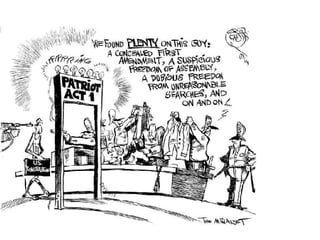
Information sharing The Patriot Act allows information from criminal probes to be shared with intelligence agencies and other parts of the government.  The act authorizes U.S. law enforcement and intelligence officers to share information about suspected terrorists with a broad range of federal agencies and governmental departments.
Roving wiretap Section 206 of the act authorizes "multi-point," also known as "roving," wiretaps to intercept wire, oral and electronic communications without separate court approvals for each instance. It allows law enforcement officials to get court orders to wiretap a suspect's phone conversations, seize electronic and voice messages, and intercept Internet traffic without limiting it to a specific phone or identifying the suspect.
Detention and jail The federal government is allowed to detain non-U.S. citizens suspected of terrorism for up to seven days without specific charges. The administration originally wanted to hold them indefinitely.  One of the amendments sets a 20-year jail term for an attack against a rail or mass-transit vehicle; a 30-year sentence if the vehicle carries nuclear material; and life imprisonment -- with the possibility of the death penalty -- if anyone is killed in such an attack.
Records access Section 215 allows officials to demand access to business, medical, library and tax records without judicial approval  In July 2005, the Senate Intelligence Committee approved giving the FBI expanded powers to subpoena records without the approval of a judge or grand jury, but the amendment requires the FBI director to approve any request for library or bookstore records.
"Sneak & Peek" Section 213 authorizes officials to search a home or business on a "delayed notice," meaning they don't have to notify the suspect immediately.
Money laundering Title III of the act expands measures against money laundering by requiring additional record keeping and reports for certain transactions and requiring identification of account holders.
Statute of limitations The Patriot Act eliminates the statute of limitations for prosecuting the most egregious terrorist acts, but maintains the statute of limitation on most crimes at five to eight years.
 
Sectionalism Placing the interests of one region over those of the nation as a whole. The Election of 1796 illustrated this > the North voted for Adams; the South voted for Jefferson. XYZ Affair (1797) Requests of bribes in exchange for negotiations by France.  French ships were seizing U.S. vessels carrying British goods since the two countries were at war.  Alien & Sedition Acts A series of 4 laws enacted in 1798 to reduce the political power of recent immigrants to the U.S., who tended to favor the anti-British Democratic Republican Party.  Nullification Principle that states had the right to nullify, or consider void, any act of Congress that they deemed unconstitutional. A major factor in the march toward Civil War.  Virginia & Kentucky Resolutions These states viewed the Alien & Sedition Acts as unconstitutional because they violated the 1 st  Amendment and deprived citizens of their rights . Showed the balance of power between the states & the federal government remained a controversial issue.  John Adams – 2 nd  President (1797 – 1801) Foreign Problems + Federal & State Conflicts:

Washington To Adams

  • 1.
  • 2.
    Roles of The President                             
  • 3.
    President: GeorgeWashington ( no party affiliation ) Main Opponent: John Adams ( no party affiliation ) Electoral Vote: Winner: 132 Main Opponent: 77 Total/Majority: 132/67 Popular Vote: no record Votes for Others: George Clinton (50), Thomas Jefferson (4), Aaron Burr (1) Vice President: John Adams For all intents and purposes, Washington was unopposed for election as President. Under the system then in place, votes for Vice President were not differentiated from votes for President.
  • 4.
    George Washington HenryKnox Edmund Randolph Thomas Jefferson Alexander Hamilton THE CABINET
  • 5.
  • 6.
  • 7.
  • 8.
    George Washington –1 st President (1789 – 1797) Secretary of Treasury: Alexander Hamilton Secretary of State: Thomas Jefferson [Finance] [Diplomacy] Secretary of War: Henry Knox Attorney General: Edmund Randolph [Defense] [Justice] Precedents Cabinet System: Group of department heads that advise the President Proclamation of Neutrality: Established U.S. neutrality in European affairs Whiskey Rebellion: Legitimacy of the power of the President to enforce laws Jay’s Treaty: Executive privilege was set when Washington refused a request by Congress Farewell Address: Final advice to the nation to maintain commercial, but not political ties to other nations (no alliances)
  • 9.
    Some Famous ThingsThey Didn’t Say! A phrase often incorrectly said to come from George Washington’s Farewell Address . Washington warned not against “entangling” alliances but against both “passionate attachments” and “inveterate antipathies” to particular foreign countries. It was Thomas Jefferson who said, in his first Inaugural, “peace, commerce, and honest friendship with all nations, entangling alliances with none.” “ Entangling alliances”
  • 10.
    Contrasting Views ofthe Federal Government Conflicting Views of Government (2:44) Jefferson’s Agrarian Dream (1:51) Supporters: the “plain people” (farmers, tradespeople) Supporters: merchants, manufacturers, landowners, investors, lawyers, clergy Payment of only the national debt (favoring debtors) Payment of national & state debts (favoring creditors) Economy based on farming Economy based on shipping & manufacturing National Bank unconstitutional National Bank constitutional Strict interpretation of the Constitution Loose interpretation of the Constitution Democracy of virtuous farmers & tradespeople Republic of a wise elite Limited national government Strong national government Fear of absolute power Fear of mob rule Sharing power with state & local governments Concentrating power in the federal government (Democratic) Republican Federalist Thomas Jefferson Alexander Hamilton
  • 11.
    George Washington’s Farewell Address 1796 S.A.F.E
  • 12.
    GW warned Americansregarding the dangers of sectional jealousy and excessive party spirit George Washington’s Farewell Address 1796
  • 13.
    George Washington’s Farewell Address 1796 GW stressed the importance of maintaining a firm union of States, and a strong central gov’t
  • 14.
    GW advised theU.S. to steer clear of permanent foreign alliances (political entanglements), but urged the development of commercial George Washington’s Farewell Address 1796 S.A.F.E STAY AWAY FOREIGN Entanglements
  • 15.
    GW advised theU.S. to steer clear of permanent foreign alliances (political entanglements), but urged the development of commercial George Washington’s Farewell Address 1796 S.A.F.E STAY AWAY FOREIGN Entanglements
  • 16.
    1. lackedmilitary and naval power 2. could lose independence in a war 3. internally divided on foreign policy issues 4. U.S. should devote energies to developing their economy and solving domestic issues George Washington’s Farewell Address 1796 We……
  • 17.
    President: JohnAdams , ( Federalist ) Vice President Thomas Jefferson Main Opponent: Thomas Jefferson ( Democratic-Republican ) Electoral Vote: Winner: 71 Main Opponent: 68 Total/Majority: 138/69 Popular Vote: no record Votes for Others: Thomas Pinckney (59), Aaron Burr (30), Samuel Adams (15), Oliver Ellsworth (11), George Clinton (7), John Jay (5), James Iredell (3), Samuel Johnston (2), George Washington (2), John Henry (2), Charles C. Pinckney (1) Federalists: John Adams, Thomas Pinckney Republicans: Thomas Jefferson, Aaron Burr
  • 18.
    #1 You area Virginian, and a Virginian ought to appear at the head of this business. #2 I am obnoxious, suspected, and unpopular, you are very much otherwise. #3 You can write ten times better than I can. John Adams on why Thomas Jefferson should write the Declaration of Independence 1776
  • 19.
    ELECTION of 1796                             The Constitution in 1796 required presidential electors to place the names of two individuals on their ballots; the candidate with the highest vote count, if a majority, became the president and the runner up the vice president. The results were not anticipated by anyone. Adams won with 71 electoral votes, but was followed by Thomas Jefferson with 68 votes; Thomas Pinckney trailed the leaders with 59. The president was a Federalist, but the vice president was the leader of the Democratic Republicans opposition – an untidy situation.
  • 20.
    John Adams 2nd President Terms: 1797-1801 Party: Federalist State: Massachusetts
  • 21.
    Sectionalism Placing theinterests of one region over those of the nation as a whole. The Election of 1796 illustrated this > the North voted for Adams; the South voted for Jefferson. XYZ Affair (1797) Requests of bribes in exchange for negotiations by France. French ships were seizing U.S. vessels carrying British goods since the two countries were at war. Alien & Sedition Acts A series of 4 laws enacted in 1798 to reduce the political power of recent immigrants to the U.S., who tended to favor the anti-British Democratic Republican Party. Nullification Principle that states had the right to nullify, or consider void, any act of Congress that they deemed unconstitutional. A major factor in the march toward Civil War. Virginia & Kentucky Resolutions These states viewed the Alien & Sedition Acts as unconstitutional because they violated the 1 st Amendment and deprived citizens of their rights . Showed the balance of power between the states & the federal government remained a controversial issue. John Adams – 2 nd President (1797 – 1801) Foreign Problems + Federal & State Conflicts:
  • 22.
    Sectionalism Placing theinterests of one region over those of the nation as a whole. The Election of 1796 illustrated this > the North voted for Adams; the South voted for Jefferson. John Adams – 2 nd President (1797 – 1801) Foreign Problems + Federal & State Conflicts:
  • 23.
  • 24.
    Sectionalism Placing theinterests of one region over those of the nation as a whole. The Election of 1796 illustrated this > the North voted for Adams; the South voted for Jefferson. XYZ Affair (1797) Requests of bribes in exchange for negotiations by France. French ships were seizing U.S. vessels carrying British goods since the two countries were at war. John Adams – 2 nd President (1797 – 1801) Foreign Problems + Federal & State Conflicts:
  • 25.
    1797  President Adamssent a delegation to Paris in 1797 (including John Marshall). The U.S. delegates secretly approached by three French agents- XYZ . They demanded a large loan and a bribe of $250.000 for the  privilege of talking to French foreign minister Talleyrand. Negotiations broke down and Marshall came home—seen as a hero  War hysteria swept the U.S.
  • 26.
    Some Famous ThingsThey Didn’t Say! Charles Pinckney was supposed to have said this in 1797 when he and two other American diplomats who were trying to negotiate a treaty with the French were asked for a bribe by agents of the foreign minister Talleyrand (The XYZ Affair.) What Pinckney did say was, “No! No! Not a sixpence, sir!” The famous words, however, were spoken a year later by Congressman Robert Goodloe Harper of South Carolina at a banquet for another of these diplomats, John Marshall (the future Chief Justice of the Supreme Court.) “ Millions for defense, but not one cent for tribute”
  • 27.
    Sectionalism Placing theinterests of one region over those of the nation as a whole. The Election of 1796 illustrated this > the North voted for Adams; the South voted for Jefferson. XYZ Affair (1797) Requests of bribes in exchange for negotiations by France. French ships were seizing U.S. vessels carrying British goods since the two countries were at war. Alien & Sedition Acts A series of 4 laws enacted in 1798 to reduce the political power of recent immigrants to the U.S., who tended to favor the anti-British Democratic Republican Party. John Adams – 2 nd President (1797 – 1801) Foreign Problems + Federal & State Conflicts: Alien & Sedition Acts (2:30)
  • 28.
  • 29.
    The USA PatriotAct -- the nation's main anti-terrorism tool -- was enacted by Congress and signed into law by President Bush in October 2001. In July 2005, the House voted 257-171 to extend the act's key provisions, making permanent 14 of the 16 provisions that were to expire at the end of the year. Two other provisions -- on business records and "roving wiretaps" -- were renewed for 10 years. Here is an overview of the law.
  • 30.
    Information sharing ThePatriot Act allows information from criminal probes to be shared with intelligence agencies and other parts of the government. The act authorizes U.S. law enforcement and intelligence officers to share information about suspected terrorists with a broad range of federal agencies and governmental departments.
  • 31.
    Roving wiretap Section206 of the act authorizes "multi-point," also known as "roving," wiretaps to intercept wire, oral and electronic communications without separate court approvals for each instance. It allows law enforcement officials to get court orders to wiretap a suspect's phone conversations, seize electronic and voice messages, and intercept Internet traffic without limiting it to a specific phone or identifying the suspect.
  • 32.
    Detention and jailThe federal government is allowed to detain non-U.S. citizens suspected of terrorism for up to seven days without specific charges. The administration originally wanted to hold them indefinitely. One of the amendments sets a 20-year jail term for an attack against a rail or mass-transit vehicle; a 30-year sentence if the vehicle carries nuclear material; and life imprisonment -- with the possibility of the death penalty -- if anyone is killed in such an attack.
  • 33.
    Records access Section215 allows officials to demand access to business, medical, library and tax records without judicial approval In July 2005, the Senate Intelligence Committee approved giving the FBI expanded powers to subpoena records without the approval of a judge or grand jury, but the amendment requires the FBI director to approve any request for library or bookstore records.
  • 34.
    "Sneak & Peek"Section 213 authorizes officials to search a home or business on a "delayed notice," meaning they don't have to notify the suspect immediately.
  • 35.
    Money laundering TitleIII of the act expands measures against money laundering by requiring additional record keeping and reports for certain transactions and requiring identification of account holders.
  • 36.
    Statute of limitationsThe Patriot Act eliminates the statute of limitations for prosecuting the most egregious terrorist acts, but maintains the statute of limitation on most crimes at five to eight years.
  • 37.
  • 38.
    Sectionalism Placing theinterests of one region over those of the nation as a whole. The Election of 1796 illustrated this > the North voted for Adams; the South voted for Jefferson. XYZ Affair (1797) Requests of bribes in exchange for negotiations by France. French ships were seizing U.S. vessels carrying British goods since the two countries were at war. Alien & Sedition Acts A series of 4 laws enacted in 1798 to reduce the political power of recent immigrants to the U.S., who tended to favor the anti-British Democratic Republican Party. Nullification Principle that states had the right to nullify, or consider void, any act of Congress that they deemed unconstitutional. A major factor in the march toward Civil War. Virginia & Kentucky Resolutions These states viewed the Alien & Sedition Acts as unconstitutional because they violated the 1 st Amendment and deprived citizens of their rights . Showed the balance of power between the states & the federal government remained a controversial issue. John Adams – 2 nd President (1797 – 1801) Foreign Problems + Federal & State Conflicts: