“  The consequences of . . . [an] inefficient government are too obvious to be dwelt upon. Thirteen sovereignties pulling against each other, and all tugging at the federal head will soon bring ruin on the whole. . . .  Let us have [government] by which our lives, liberty, and property will be secured or let us know the worst at once. ” ~George Washington
Case #1: Settling the National Debt 1)  Revolutionary War Gov’t owed France > 10 million dollars Gov’t owed U.S. citizens > 34 million dollars Struggled to raise revenue 2)  Congress could not tax  (states had that power) Congress had to rely on borrowing Could not pass amendment to change the law because they needed 13 out of 13 vote to amend laws – not every state voted yes 3)  Not successful  Failed to develop a workable plan Bad credit rating
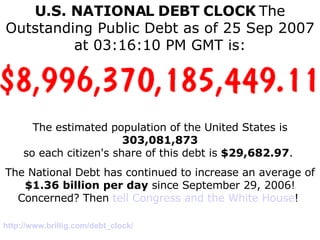
U.S. NATIONAL   DEBT   CLOCK   The Outstanding Public Debt as of 25 Sep 2007 at 03:16:10 PM GMT is: The estimated population of the United States is  303,081,873 so each citizen's share of this debt is  $29,682.97 .  The National Debt has continued to increase an average of $1.36 billion per day  since September 29, 2006! Concerned? Then  tell Congress and the White House !  http://www. brillig .com/debt_clock/
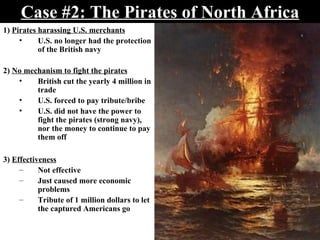
Case #2: The Pirates of North Africa 1)  Pirates harassing U.S. merchants U.S. no longer had the protection of the British navy 2)  No mechanism to fight the pirates British cut the yearly 4 million in trade U.S. forced to pay tribute/bribe U.S. did not have the power to fight the pirates (strong navy), nor the money to continue to pay them off 3)  Effectiveness Not effective Just caused more economic problems Tribute of 1 million dollars to let the captured Americans go
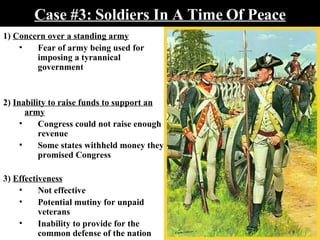
Case #3: Soldiers In A Time Of Peace 1)  Concern over a standing army Fear of army being used for imposing a tyrannical government 2)  Inability to raise funds to support an army Congress could not raise enough revenue Some states withheld money they promised Congress 3)  Effectiveness Not effective   Potential mutiny for unpaid veterans Inability to provide for the common defense of the nation
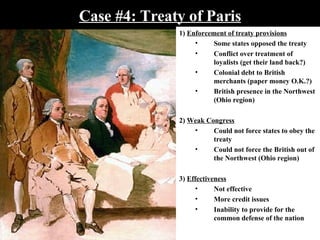
Case #4: Treaty of Paris 1)  Enforcement of treaty provisions Some states opposed the treaty Conflict over treatment of loyalists (get their land back?) Colonial debt to British merchants (paper money O.K.?) British presence in the Northwest (Ohio region) 2)  Weak Congress   Could not force states to obey the treaty Could not force the British out of the Northwest (Ohio region)  3)  Effectiveness Not effective More credit issues Inability to provide for the common defense of the nation
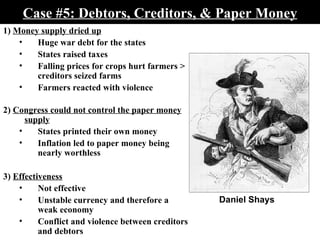
Case #5: Debtors, Creditors, & Paper Money 1)  Money supply dried up Huge war debt for the states States raised taxes Falling prices for crops hurt farmers > creditors seized farms Farmers reacted with violence 2)  Congress could not control the paper money supply States printed their own money Inflation led to paper money being nearly worthless  3)  Effectiveness Not effective Unstable currency and therefore a weak economy Conflict and violence between creditors and debtors Daniel Shays
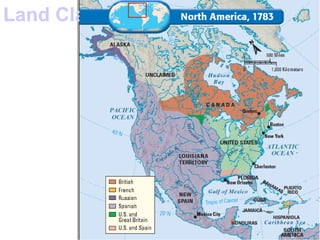
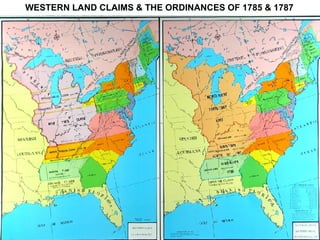
Land Claims of the States After The Treaty of Paris 1783
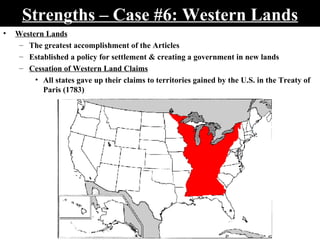
Strengths – Case #6: Western Lands Western Lands The greatest accomplishment of the Articles Established a policy for settlement & creating a government in new lands Cessation of Western Land Claims All states gave up their claims to territories gained by the U.S. in the Treaty of Paris (1783)
WESTERN LAND CLAIMS & THE ORDINANCES OF 1785 & 1787
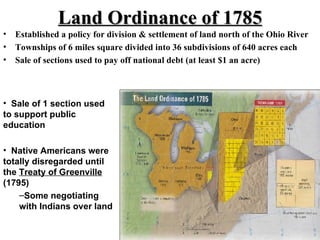
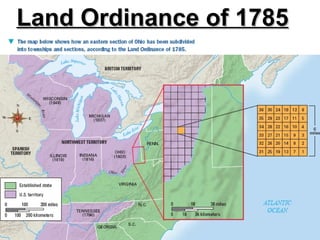
Land Ordinance of 1785 Established a policy for division & settlement of land north of the Ohio River Townships of 6 miles square divided into 36 subdivisions of 640 acres each Sale of sections used to pay off national debt (at least $1 an acre) Sale of 1 section used to support public education  Native Americans were totally disregarded until the  Treaty of Greenville  (1795) Some negotiating with Indians over land
Land Ordinance of 1785
Northwest Ordinance of 1787 2-Stage plan for territories becoming states: When an area had a population of more than 5,000 adult males > it could establish a government [governor, legislature, judges] At 60,000 people > write a constitution & apply for statehood Statehood  When Congress approved their constitution Northwest Territory became Ohio, Indiana, Illinois, Michigan, & Wisconsin

Weakness Of Articles

  • 1.
    “ Theconsequences of . . . [an] inefficient government are too obvious to be dwelt upon. Thirteen sovereignties pulling against each other, and all tugging at the federal head will soon bring ruin on the whole. . . . Let us have [government] by which our lives, liberty, and property will be secured or let us know the worst at once. ” ~George Washington
  • 2.
    Case #1: Settlingthe National Debt 1) Revolutionary War Gov’t owed France > 10 million dollars Gov’t owed U.S. citizens > 34 million dollars Struggled to raise revenue 2) Congress could not tax (states had that power) Congress had to rely on borrowing Could not pass amendment to change the law because they needed 13 out of 13 vote to amend laws – not every state voted yes 3) Not successful Failed to develop a workable plan Bad credit rating
  • 3.
    U.S. NATIONAL DEBT CLOCK The Outstanding Public Debt as of 25 Sep 2007 at 03:16:10 PM GMT is: The estimated population of the United States is 303,081,873 so each citizen's share of this debt is $29,682.97 . The National Debt has continued to increase an average of $1.36 billion per day since September 29, 2006! Concerned? Then tell Congress and the White House ! http://www. brillig .com/debt_clock/
  • 4.
    Case #2: ThePirates of North Africa 1) Pirates harassing U.S. merchants U.S. no longer had the protection of the British navy 2) No mechanism to fight the pirates British cut the yearly 4 million in trade U.S. forced to pay tribute/bribe U.S. did not have the power to fight the pirates (strong navy), nor the money to continue to pay them off 3) Effectiveness Not effective Just caused more economic problems Tribute of 1 million dollars to let the captured Americans go
  • 5.
    Case #3: SoldiersIn A Time Of Peace 1) Concern over a standing army Fear of army being used for imposing a tyrannical government 2) Inability to raise funds to support an army Congress could not raise enough revenue Some states withheld money they promised Congress 3) Effectiveness Not effective Potential mutiny for unpaid veterans Inability to provide for the common defense of the nation
  • 6.
    Case #4: Treatyof Paris 1) Enforcement of treaty provisions Some states opposed the treaty Conflict over treatment of loyalists (get their land back?) Colonial debt to British merchants (paper money O.K.?) British presence in the Northwest (Ohio region) 2) Weak Congress Could not force states to obey the treaty Could not force the British out of the Northwest (Ohio region) 3) Effectiveness Not effective More credit issues Inability to provide for the common defense of the nation
  • 7.
    Case #5: Debtors,Creditors, & Paper Money 1) Money supply dried up Huge war debt for the states States raised taxes Falling prices for crops hurt farmers > creditors seized farms Farmers reacted with violence 2) Congress could not control the paper money supply States printed their own money Inflation led to paper money being nearly worthless 3) Effectiveness Not effective Unstable currency and therefore a weak economy Conflict and violence between creditors and debtors Daniel Shays
  • 8.
    Land Claims ofthe States After The Treaty of Paris 1783
  • 9.
    Strengths – Case#6: Western Lands Western Lands The greatest accomplishment of the Articles Established a policy for settlement & creating a government in new lands Cessation of Western Land Claims All states gave up their claims to territories gained by the U.S. in the Treaty of Paris (1783)
  • 10.
    WESTERN LAND CLAIMS& THE ORDINANCES OF 1785 & 1787
  • 11.
    Land Ordinance of1785 Established a policy for division & settlement of land north of the Ohio River Townships of 6 miles square divided into 36 subdivisions of 640 acres each Sale of sections used to pay off national debt (at least $1 an acre) Sale of 1 section used to support public education Native Americans were totally disregarded until the Treaty of Greenville (1795) Some negotiating with Indians over land
  • 12.
  • 13.
    Northwest Ordinance of1787 2-Stage plan for territories becoming states: When an area had a population of more than 5,000 adult males > it could establish a government [governor, legislature, judges] At 60,000 people > write a constitution & apply for statehood Statehood When Congress approved their constitution Northwest Territory became Ohio, Indiana, Illinois, Michigan, & Wisconsin